
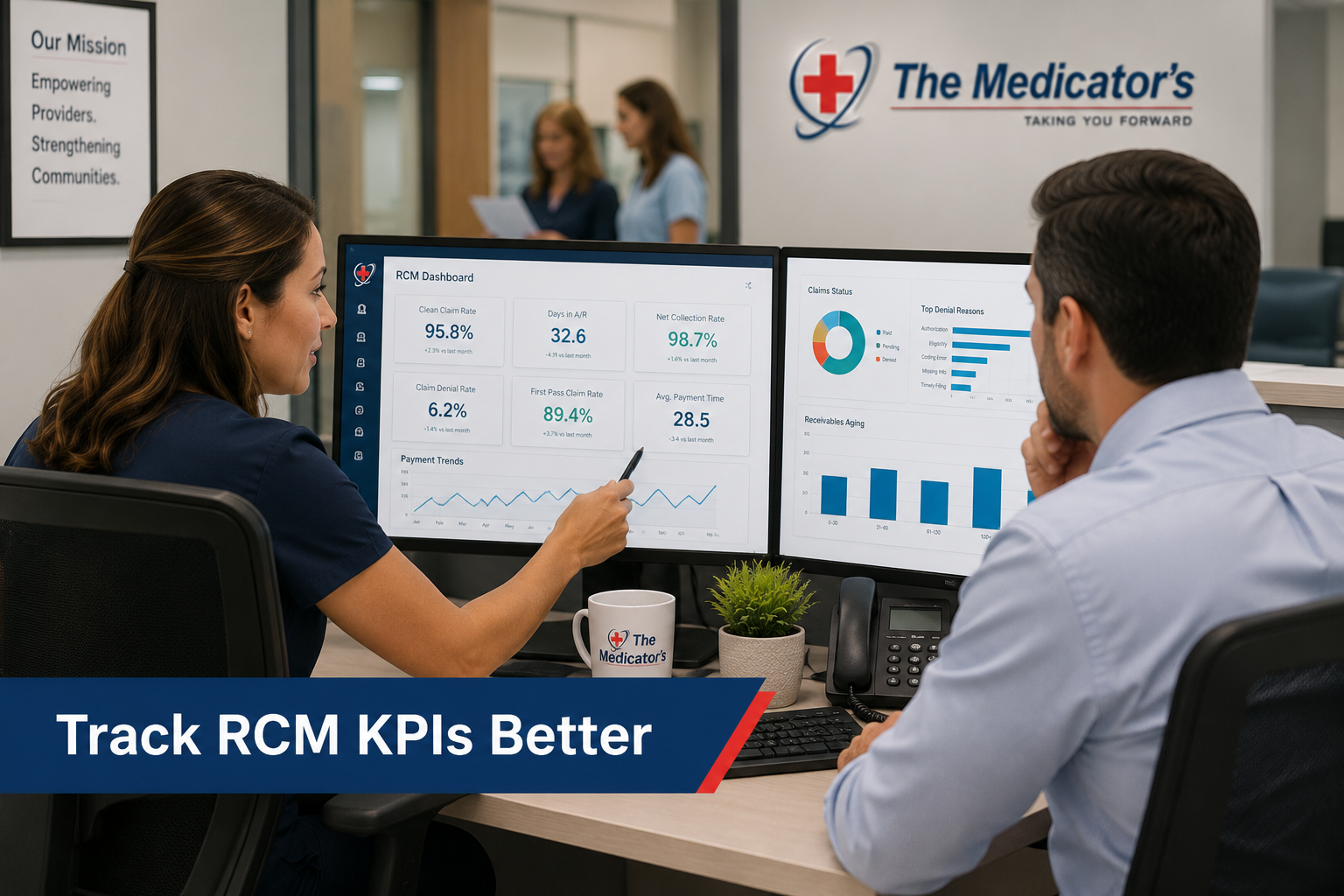
Healthcare providers should monitor key revenue cycle management (RCM) KPIs to understand how effectively their practice converts patient services into payments. The most important metrics include clean claim rate, denial rate, days in accounts receivable (A/R), aged A/R percentage, net collection rate, charge lag, and authorization approval rate. Tracking these indicators helps practices identify revenue leakage, improve billing workflows, and make informed financial decisions.
7 Essential RCM KPIs Every Medical Practice Should Track
| RCM KPI | What It Measures | Why It Matters |
|---|---|---|
| Clean Claim Rate | Claims accepted without initial errors | Identifies claim preparation and submission problems |
| Initial Denial Rate | Claims denied during initial processing | Highlights coding, eligibility, authorization, and documentation issues |
| Days in A/R | Average time required to collect outstanding payments | Shows how quickly revenue is being recovered |
| Aged A/R Percentage | Outstanding balances within aging categories | Identifies claims requiring immediate follow-up |
| Net Collection Rate | Percentage of collectible revenue actually collected | Evaluates overall collection performance |
| Charge Lag | Time between service delivery and claim submission | Helps identify delays in billing workflows |
| Authorization Approval Rate | Percentage of authorization requests approved | Measures the effectiveness of authorization processes |
Practices should use consistent metric definitions and compare results over time. Targets can vary by specialty, payer mix, practice size, and billing arrangements.
How Can RCM KPIs Help Identify Revenue Cycle Problems?
KPIs become valuable when practices use them to investigate the reasons behind changing financial results.
For example, a pain management practice may notice an increase in authorization-related denials alongside growing A/R. Reviewing denial categories, payer responses, and authorization records can reveal whether the problem originates in eligibility verification, authorization workflows, coding, or claim submission.
A structured revenue cycle management process connects these activities instead of treating each billing problem separately.
Practices can also review medical billing company performance and medical practice reporting and decision-making to understand how financial data should guide operational improvements.
Which Billing Activities Should Practices Review Alongside Their KPIs?
A KPI dashboard shows where problems may exist. Reviewing the underlying workflows helps explain why they occur.
- Claim accuracy: Review coding, charge capture, and claim submission processes through professional medical billing services.
- Denial trends: Identify recurring rejection and denial reasons, then address their root causes through structured denial management.
- Outstanding payments: Monitor unpaid claims, aging balances, and payer follow-ups with dedicated A/R management services.
- Front-end accuracy: Evaluate insurance coverage and patient information through eligibility verification services.
- Coding and documentation: Review claim accuracy and potential revenue leakage through medical billing audit services.
- Provider enrollment: Check whether credentialing and payer enrollment issues are affecting claim reimbursement with medical credentialing services.
These activities should be reviewed together because a problem at the beginning of the revenue cycle can affect payment outcomes later.
How Often Should Healthcare Providers Review RCM KPIs?
A practical reporting schedule includes:
- Weekly: Review new denials, rejected claims, authorization issues, and high-priority unpaid accounts.
- Monthly: Evaluate collection trends, days in A/R, aged balances, charge lag, and payer performance.
- Quarterly: Assess recurring billing problems, workflow efficiency, and opportunities for process improvement.
Practices experiencing persistent billing issues can also consider a structured medical billing audit to establish a clearer picture of their current performance.
Improve Your Revenue Cycle Performance With Better KPI Monitoring
Tracking RCM KPIs is only the first step. Healthcare providers need accurate reporting, consistent claim follow-up, effective denial management, and reliable billing workflows to turn performance data into measurable operational improvements.
The Medicator’s supports medical practices with medical billing, revenue cycle management, eligibility verification, credentialing, denial management, A/R follow-up, and billing audits.
If your practice is experiencing rising denials, delayed reimbursements, or unresolved A/R, request a practice analysis to identify potential revenue cycle gaps and areas that may need improvement.
You can also contact The Medicator’s to discuss your practice’s billing and RCM requirements.
