
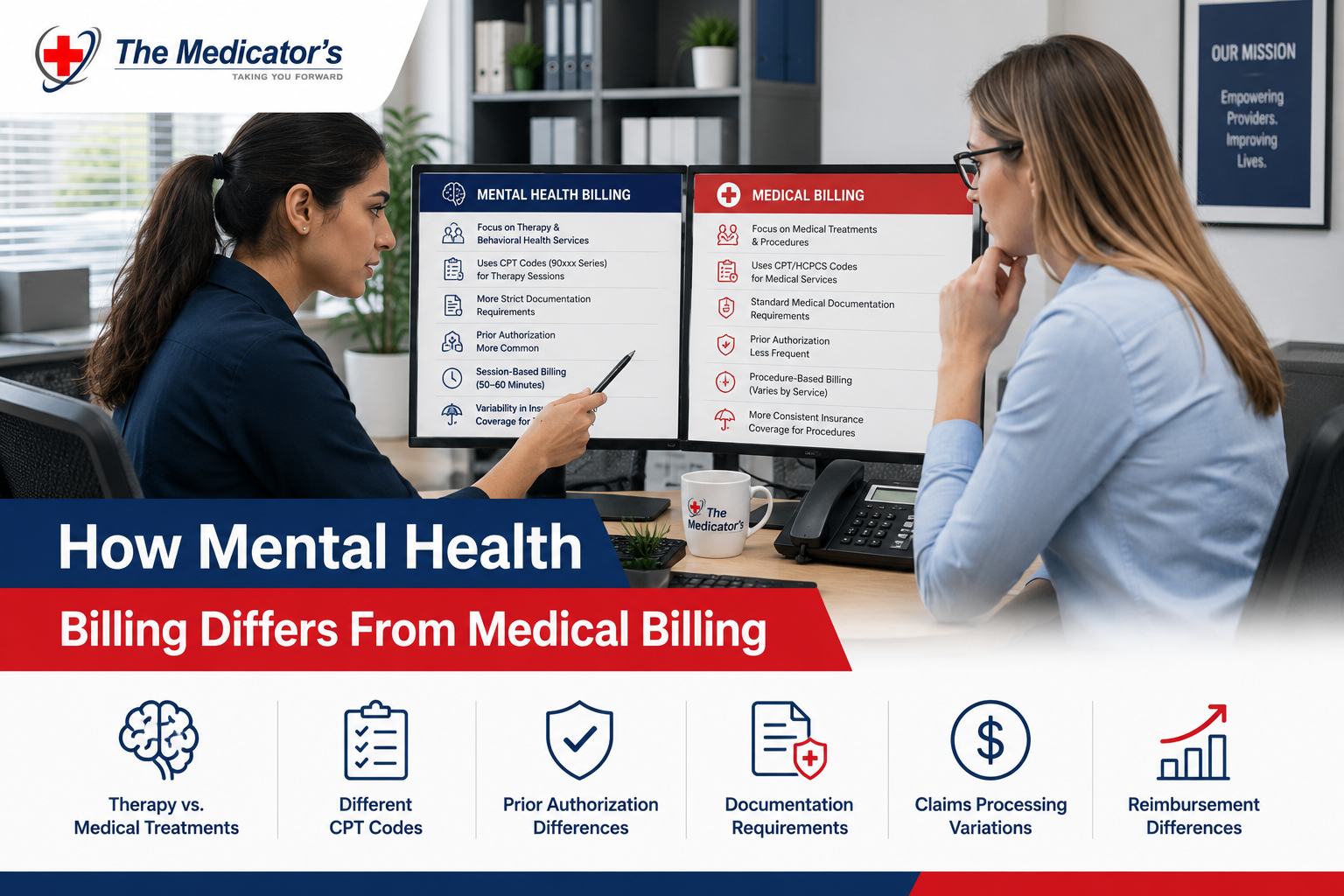
Key Differences Between Mental Health and Medical Billing
Although both processes involve insurance claims, mental health billing has unique challenges that require specialized Revenue Cycle Management (RCM) expertise.
1. Time-Based CPT Coding Requirements
Many behavioral health services use time-based CPT codes where reimbursement depends on the documented length of the session. For example, psychotherapy codes require accurate recording of session duration and service details. Incorrect time documentation can result in denied or reduced payments.
2. More Detailed Clinical Documentation
Mental health claims often require clear documentation of medical necessity, treatment goals, patient progress, and therapeutic services provided. Missing details in clinical notes can create compliance concerns and reimbursement delays.
3. Higher Authorization and Payer Complexity
Many insurance companies require Prior Authorization or periodic reviews for behavioral health services. Failure to confirm requirements before treatment can lead to unpaid claims.
Real Example: Behavioral Health Billing Challenge
A psychiatry practice provides medication management and therapy services for patients with different insurance plans. One payer requires authorization updates after a specific number of visits, while another requires different documentation standards. Without proper Eligibility Verification, authorization tracking, and payer follow-up, claims may be delayed or denied.
An experienced behavioral health billing specialist understands that successful reimbursement depends on combining accurate CPT coding, ICD-10 diagnosis coding, claim scrubbing, documentation review, and denial management.
Common Mistakes Mental Health Practices Should Avoid
- Using incorrect therapy or evaluation codes
- Missing session duration requirements
- Ignoring payer authorization changes
- Submitting claims without documentation review
- Treating behavioral health billing like standard medical billing
The Medicator’s provides specialized Mental Health Billing Services that support psychiatry and behavioral health practices with coding accuracy, denial prevention, AR management, and complete RCM solutions.
If your mental health practice is experiencing claim delays, frequent denials, or billing complexity, The Medicator’s can help optimize your workflow and improve reimbursement accuracy.
