
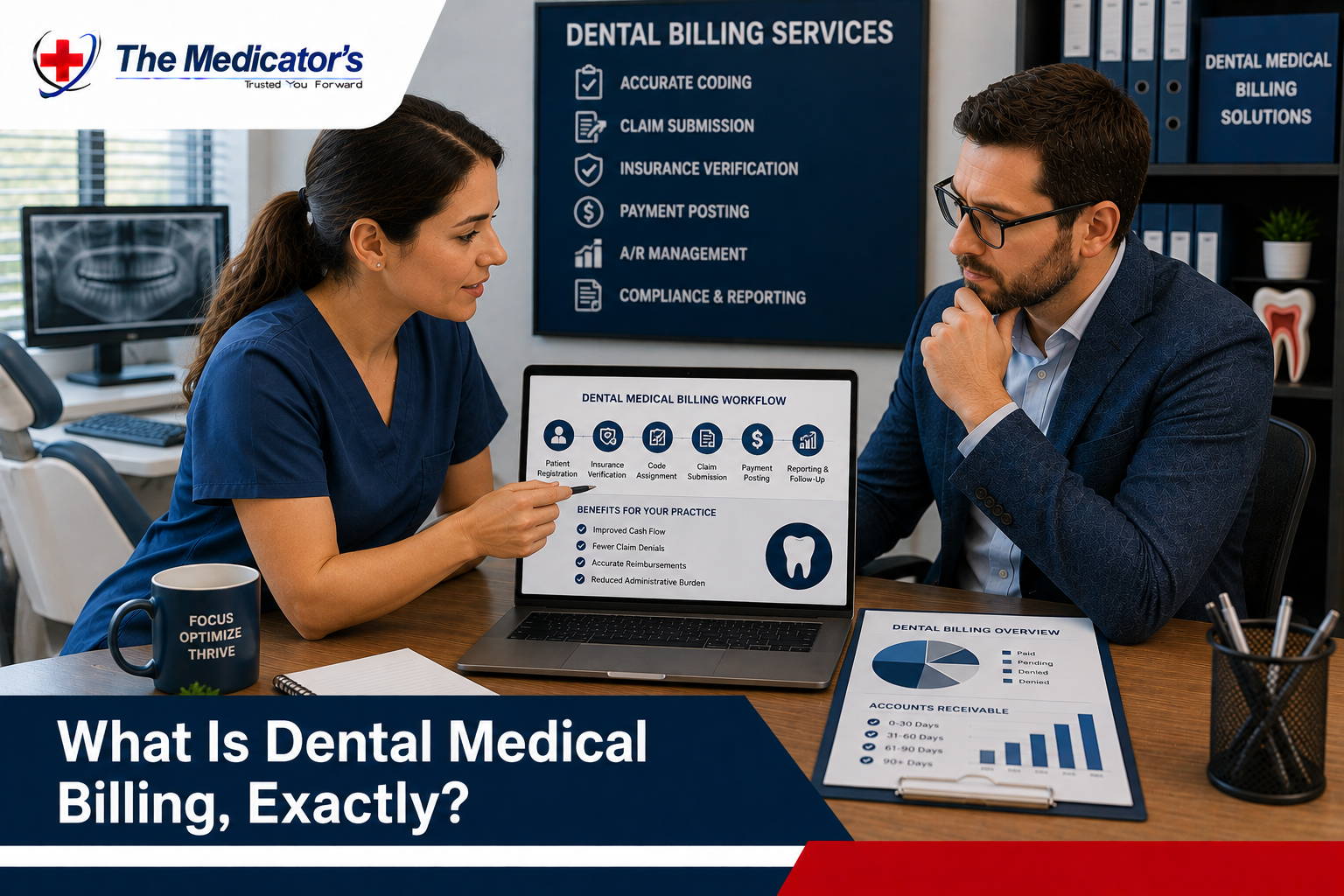
Dental medical billing is the process of submitting and managing claims to medical insurance plans for dental-related services that qualify for medical coverage. Unlike traditional dental billing, which generally involves dental insurance and CDT codes, dental medical billing focuses on procedures that are medically necessary because they diagnose or treat an underlying medical condition.
For example, certain oral and maxillofacial procedures, medically necessary extractions, trauma-related treatment, sleep apnea services, and procedures associated with systemic conditions may qualify for medical insurance depending on the patient’s coverage and payer requirements.
A specialized dental medical billing company can help dental and oral healthcare providers determine appropriate billing workflows, prepare claims, manage denials, and follow up with medical payers.
How Is Dental Medical Billing Different From Dental Billing?
Traditional dental billing primarily involves dental insurance, while dental medical billing involves submitting qualifying services to a patient’s medical insurance.
The distinction matters because the two systems can use different:
- Coding systems
- Claim forms
- Medical necessity requirements
- Payer policies
- Documentation standards
- Benefit structures
- Authorization requirements
Dental practices that provide services with a medical component may therefore need staff who understand both dental and medical reimbursement processes.
What Codes Are Used in Dental Medical Billing?
Dental medical billing may involve CPT, HCPCS, and ICD-10-CM codes, depending on the service and payer. Dental billing traditionally relies heavily on CDT codes.
The diagnosis must support the medical necessity of the service, while the procedure code should accurately describe what was performed. Incorrect coding, missing documentation, or an unsupported diagnosis-to-procedure relationship can result in claim denials.
What Dental Services Can Be Billed to Medical Insurance?
Not every dental service qualifies for medical insurance. Coverage depends on the patient’s plan, the nature of the procedure, medical necessity, and the payer’s policies.
Potentially medical-billable services may include:
- Treatment related to facial or oral trauma
- Certain oral and maxillofacial surgeries
- Procedures associated with medically diagnosed conditions
- Treatment connected to congenital abnormalities
- Certain sleep-related healthcare services
- Oral procedures required because of an underlying medical condition
The practice should verify benefits and payer requirements before assuming that a particular dental procedure will be reimbursed through medical insurance.
Why Is Documentation Important in Dental Medical Billing?
Medical payers may require documentation demonstrating why the service was medically necessary. The patient’s clinical record may need to support the diagnosis, symptoms, treatment plan, procedure performed, and relationship between the medical condition and the service.
Depending on the procedure, supporting documentation may include:
- Clinical notes
- Diagnostic findings
- Treatment plans
- Imaging
- Referral documentation
- Prior authorization
- Operative reports
- Relevant medical history
Strong documentation gives the billing team evidence to support the claim and can make denial follow-up more effective.
Common Dental Medical Billing Problems
Dental practices can encounter several problems when submitting medical claims, including:
- Incorrect medical codes
- Missing diagnosis codes
- Incomplete clinical documentation
- Incorrect patient or insurance information
- Failure to obtain required authorization
- Medical necessity denials
- Coordination-of-benefits issues
- Incorrect claim submission
- Delayed denial follow-up
These problems can delay reimbursement even when the underlying service is covered by the patient’s medical plan.
How The Medicator’s Supports Dental Medical Billing
The Medicator’s medical billing services help healthcare providers manage key revenue cycle processes, including coding, claim submission, denial management, payment posting, and accounts receivable follow-up.
If you’re unsure whether billing problems are affecting your practice’s revenue, you can request a free practice analysis to identify potential gaps in your billing workflow. You can also contact The Medicator’s to discuss your practice’s specific requirements.
Improve Your Dental Medical Billing Process
Dental medical billing connects qualifying dental and oral healthcare services with the medical insurance reimbursement system. Because medical claims can involve different coding, documentation, authorization, and medical necessity requirements, practices need a billing process designed around the specific service being provided.
If your practice is struggling with medical claim submissions, denials, or unpaid balances, The Medicator’s medical billing services can help manage the revenue cycle. You can also request a free practice analysis to identify opportunities to improve billing performance.
