
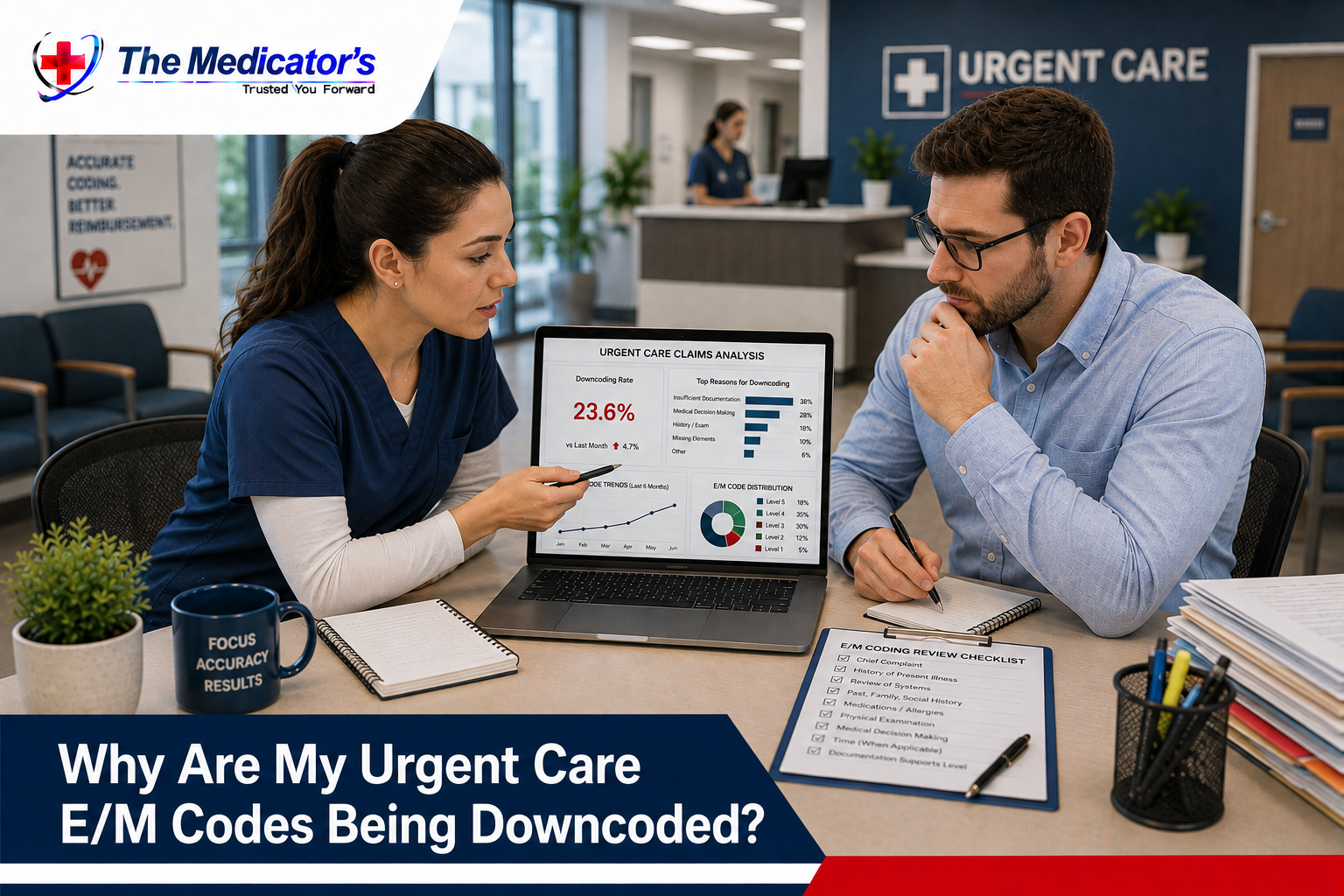
Urgent care Evaluation and Management (E/M) codes are frequently downcoded due to aggressive payer software algorithms, incomplete documentation of Medical Decision Making (MDM) complexity, or unbundled modifier issues when procedures (such as X-rays, splints, or rapid lab testing) are performed during the same visit. Because payers closely monitor high-level walk-in encounter billing (such as CPT 99204, 99205, 99214, and 99215), documentation gaps trigger immediate automated downcoding edits or post-payment clawbacks.
At The Medicator’s, our specialized team delivers comprehensive urgent care revenue cycle management alongside tailored urgent care billing in Texas and nationwide. We perform detailed clinical chart audits, train providers on current AMA/CMS MDM standards, and enforce pre-submission clearinghouse rules to maintain clean claim acceptance rates above 97%.
Primary Causes of Urgent Care E/M Downcoding
Understanding why commercial health plans and Medicare Advantage programs adjust E/M codes down helps walk-in clinics establish proactive safeguards:
1. Automated Payer Downcoding Policies & Peer Benchmarks
Major commercial insurers—such as Cigna (under its E/M Coding Accuracy Policy R49) and Aetna (via its Claim and Code Review Program)—utilize automated algorithms to screen Level 4 and Level 5 visits (CPT 99204/99205 and 99214/99215). Rather than reviewing clinical notes upfront, these payer algorithms automatically downgrade submitted codes to a lower tier if billing patterns exceed regional peer averages or if diagnosis codes are deemed routine.
2. Incomplete Medical Decision Making (MDM) Documentation
Under Current Procedural Terminology (CPT) guidelines, outpatient E/M levels are determined primarily by Medical Decision Making (MDM) or total provider time on the date of service. E/M claims are routinely downcoded when provider notes fail to document:
Problem Complexity: Listing acute illness without describing systemic symptoms, exacerbation risks, or severe diagnostic uncertainty.
Data Reviewed: Failing to explicitly record independent reviews of diagnostic X-rays, orders for external lab panels, or discussions with outside specialists.
Management Risk: Omitting documentation regarding prescription drug management, parenteral medication decisions, or emergency treatment considerations.
Similar documentation standards are required across other medical specialties, including revenue cycle management for internal medicine, revenue cycle management for pediatrics, and revenue cycle management for pain management.
3. Unbundled Same-Day Procedures & Missing Modifier 25
When an urgent care provider performs an E/M evaluation alongside a minor procedure (such as a laceration repair, foreign body removal, splint application, or joint injection), payers bundle the visit into the procedure unless Modifier 25 is attached to the E/M line. Submitting Modifier 25 without documenting a distinct, separately identifiable E/M service causes automated downcoding or claim line rejection.
4. Vague Diagnosis Coding & POS Mismatches
Using non-specific ICD-10 codes fails to support the clinical necessity of higher-level care. Additionally, reporting incorrect location credentials on claims—such as failing to align facility billing with proper POS codes in medical billing (e.g., POS 20 for Urgent Care vs. POS 11 for Office)—triggers processing edits.
E/M Leveling & Downcoding Impact at a Glance
The following outline details common urgent care E/M code levels, downcoding targets, and key documentation requirements:
CPT 99214 (Established Level 4 – Moderate MDM): Common Downcode Target: Reduced to CPT 99213. Documentation Requirement: Must meet 2 of 3 MDM elements: 1 acute illness with systemic symptoms OR 1 chronic illness with mild exacerbation; ordering/reviewing 3+ tests; or active prescription drug management.
CPT 99215 (Established Level 5 – High MDM): Common Downcode Target: Reduced to CPT 99214 or 99213. Documentation Requirement: Must meet 2 of 3 MDM elements: acute illness/injury posing threat to life or bodily function; high data review complexity; or high-risk treatment decision (e.g., parenteral controlled substances or emergency surgery evaluation).
CPT 99204 (New Patient Level 4 – Moderate MDM): Common Downcode Target: Reduced to CPT 99203. Documentation Requirement: Comprehensive evaluation of acute complicated injury/illness requiring moderate MDM or 45+ minutes of provider time on date of service.
CPT 99205 (New Patient Level 5 – High MDM): Common Downcode Target: Reduced to CPT 99204. Documentation Requirement: Complex presentation requiring high-complexity MDM or 60+ minutes of provider time on date of service.
Actionable Steps to Prevent and Appeal E/M Downcoding
Standardize EHR Documentation Templates: Configure EHR charting to require explicit entries for prescription drug management, differential diagnoses, and diagnostic image reviews.
Audit Provider E/M Bell-Curves: Track your clinic’s billing distribution monthly to ensure Level 4 and Level 5 code usage aligns with clinical severity and national benchmarks.
Differentiate Rejections from Denials: Isolating whether claim adjustments stem from front-office errors or clinical downcoding is easier when you evaluate your clinic’s overall denial rate vs. rejection rate.
Monitor Outstanding Accounts Receivable: Review unpaid E/M balances on your practice’s A/R aging report to catch downcoded claims early and submit full clinical chart appeals within payer deadlines.
The E/M Protection & Appeal Workflow: What to Expect
Protecting practice reimbursement from payer downcoding policies requires a structured, four-phase revenue cycle process:
Clinical Charting & MDM Capture: Documenting complete treatment rationales, diagnostic reviews, and risk factors at the time of care.
Certified Coding Audit & Modifier Scrubbing: Verifying selected E/M levels against clinical notes and applying Modifier 25 for same-day procedures.
Pre-Submission Clearinghouse Scrubbing: Running claims through dynamic NCCI and payer-specific edits prior to submission.
Adjudication Monitoring & Reconsideration Appeals: Identifying downcoded line items on Explanation of Benefits (EOB) statements and submitting supporting chart notes for full reimbursement.
Maximize Practice Reimbursement with The Medicator’s
Automated payer downcoding, missing CPT modifiers, and strict MDM documentation rules can significantly reduce practice cash flow.
At The Medicator’s, our certified medical billing specialists provide end-to-end revenue cycle management across multiple healthcare disciplines. Beyond our focus on urgent care revenue cycle management and urgent care billing in Texas, we deliver specialized billing solutions for medical billing for internal medicine, revenue cycle management for pediatrics, revenue cycle management for cardiology, revenue cycle management for orthopedic, revenue cycle management for pain management, and specialized medical billing for psychiatry (also supported via revenue cycle management for psychiatry).
Partnering with our billing team ensures:
First-Pass Clean Claim Acceptance Above 97%: Catching MDM documentation gaps, missing modifiers, and coding errors before submission.
Days in A/R Kept Under 30 Days: Accelerating reimbursement and preventing unpaid balances from accumulating.
Full Financial Recovery for Rendered Care: Fighting unfair downcoding edits to recover full value for every documented encounter.
Is automated downcoding or E/M reimbursement loss impacting your clinic’s profits? Capture every dollar you earn. Request a free, custom urgent care practice analysis with The Medicator’s team today!
