
What is the most common reason for claim rejection?

Yes, the most common reason for claim rejection is missing or inaccurate patient information, such as incorrect demographics, misspelled names, or invalid insurance ID numbers. Because rejections occur before a claim is processed, even simple clerical errors, like a transposed digit in a member ID or an outdated CPT code—can trigger an immediate “kick-back” from […]
What Are the Top 5 Denials in Medical Billing?
Yes, understanding the most common denial codes is essential for any practice looking to improve its cash flow. While the specific list can fluctuate slightly depending on the specialty, the five most frequent denials in medical billing consistently center on administrative and clerical oversight. However, seeing a denial is often just a symptom of a […]
Which health insurance denies the least claims?
There is no single “best” insurance provider that guarantees the lowest denial rate nationwide, as denial rates fluctuate significantly based on your state, your specific health plan type (e.g., HMO vs. PPO), and the accuracy of the medical coding submitted by your healthcare provider. While integrated delivery systems, such as Kaiser Permanente, often report lower […]
Which Medical Insurance Companies Deny the Most Claims?
Yes, certain insurance carriers consistently report higher claim denial rates, particularly within the Affordable Care Act (ACA) marketplace and for certain Medicare Advantage plans. Data from 2023–2025 frequently highlights carriers such as Molina Healthcare, UnitedHealthcare, Oscar Health, and Ambetter as having denial rates that can reach 30% or higher for in-network claims. Other major payers, […]
Why Do My Claims Keep Getting Denied?
Yes, recurring medical claim denials are a common operational challenge for many practices, usually stemming from systemic front-end registration errors or failure to align documentation with evolving payer requirements. If your claims are consistently denied, it often points to a break in your submission workflow rather than just a series of isolated typos. However, denials […]
What is the 80/20 Rule in Healthcare?
Yes, the 80/20 rule, also known as the Pareto Principle, is a foundational concept in healthcare management that states roughly 80% of outcomes are driven by 20% of the causes. In clinical and administrative settings, this principle is widely used to identify that a small segment of patients (approximately 20%) often accounts for the vast […]
Why Are So Many Health Insurance Claims Denied?

Health insurance claims are frequently denied due to a combination of administrative oversight, evolving payer requirements, and strict automated adjudication processes. While administrative errors (such as missing patient data or coding mistakes) account for roughly 24% of denials, a significant portion stems from utilization management issues, including lack of prior authorization and services deemed not […]
Where Do Medical Billers Make the Most Money?
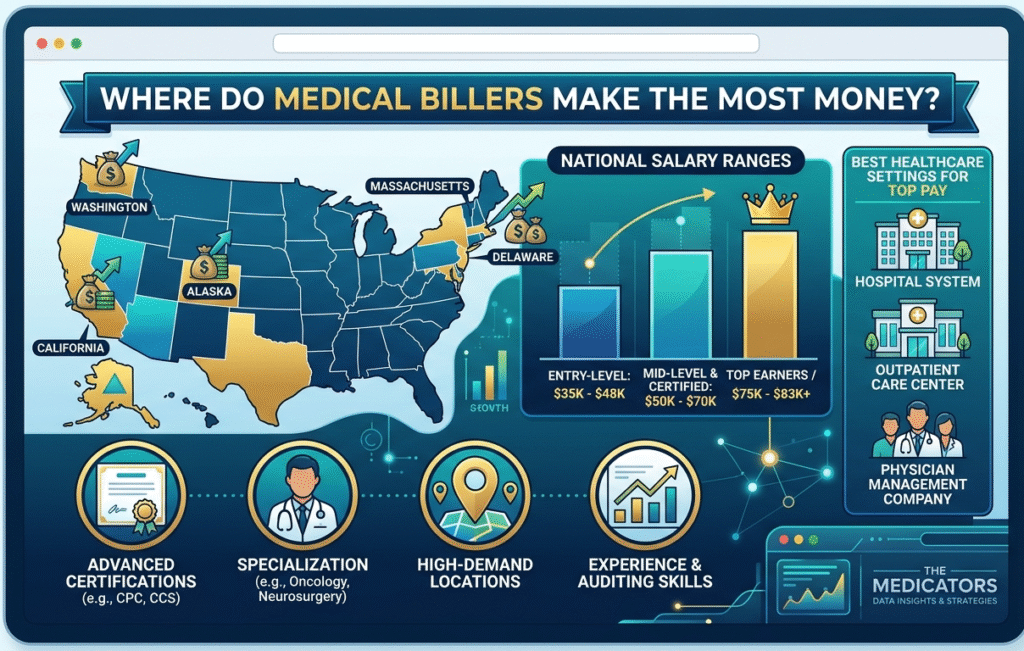
Medical billers and coders earn the highest salaries in states with a high demand for specialized healthcare services, with top-tier, certified professionals often exceeding $75,000 to $83,000 annually. While the national average remains competitive, compensation peaks for those in specialized roles, such as surgical coding or revenue cycle management, particularly in states like Delaware, Alaska, […]
What are the best CPT codes to use for Psychiatry telehealth in 2026?

Yes, for psychiatric telehealth in 2026, the best CPT codes remain the standard evaluation, management, and psychotherapy codes, but maximizing reimbursement requires pairing them with the correct, mandatory telehealth modifiers (such as -95 for synchronous video) and precise time documentation. This is because, unlike some medical specialties that faced reimbursement “cliffs,” audio-video telehealth delivery for […]
Is medical billing and coding worth it in 2026?

Yes, medical billing and coding remains a highly valuable and stable career path in 2026. As the healthcare industry continues to expand and transition toward complex value-based care models, the demand for professionals who can accurately translate medical services into standardized codes is at an all-time high. For healthcare providers, partnering with a professional medical […]
