
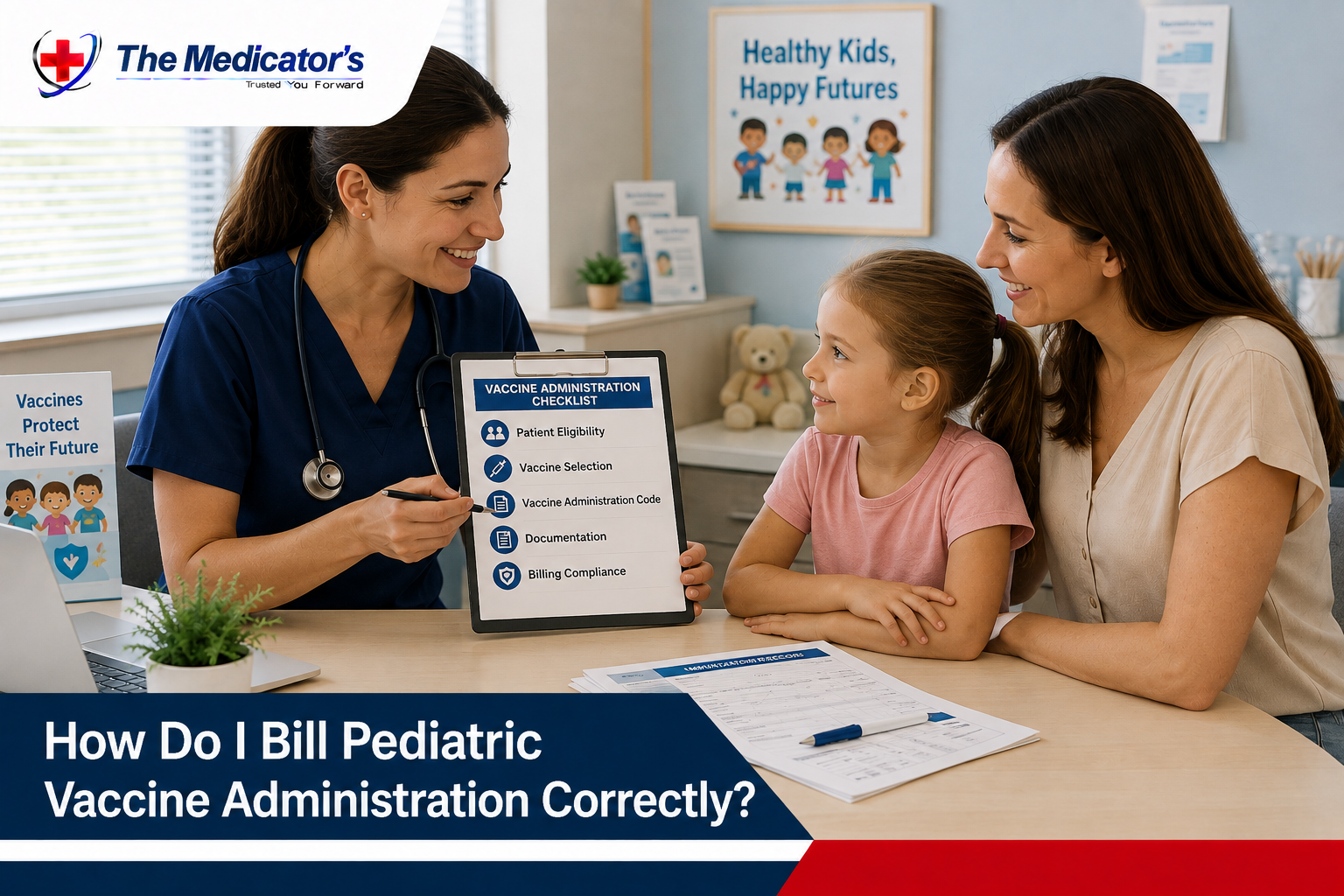
Billing pediatric vaccine administration correctly requires accurate reporting of the vaccine product code and the corresponding immunization administration code. The appropriate administration code depends on factors such as the patient’s age, vaccine route, documented face-to-face counseling, and applicable CPT and payer requirements. Errors in vaccine coding, component calculations, National Drug Code (NDC) reporting, or Vaccines for Children (VFC) billing can result in claim rejections, denials, delayed reimbursement, and additional administrative work.
At The Medicator’s, we help pediatric practices manage complex immunization claims through specialized coding review, claim submission, denial follow-up, and revenue cycle support. Our pediatric billing services in Texas and nationwide billing support can help practices identify preventable billing errors, strengthen documentation workflows, and improve visibility into outstanding claims. For practices experiencing recurring payment delays, our medical billing services can support a more consistent approach to claim management and reimbursement follow-up.
Core Pediatric Vaccine Administration CPT Codes (Ages 18 and Under)
Pediatric immunization administration code selection depends on the service performed, the vaccine route, and whether the required face-to-face counseling was provided by a physician or other qualified healthcare professional. Practices should verify current CPT guidance and payer-specific policies before submitting claims.
Administration With Counseling (CPT 90460 and 90461)
- CPT 90460 (First or Only Component): Generally used for immunization administration for patients through age 18 when the required face-to-face counseling is provided by a physician or other qualified healthcare professional to the patient or caregiver. It represents the first or only component of each vaccine or toxoid administered.
- CPT 90461 (Each Additional Component): An add-on code for each additional vaccine component when the requirements for 90460 and 90461 are met.
Example: For an MMR vaccine containing measles, mumps, and rubella components, when the requirements for counseling-based administration coding are met, the administration may be reported as 90460 once and 90461 twice. Confirm the applicable product and component guidance before billing.
Administration Without the Required Counseling (CPT 90471–90474)
- CPT 90471 and 90472 (Injectable Vaccines): CPT 90471 generally represents administration of the first injectable vaccine, while CPT 90472 represents each additional injectable vaccine administered during the encounter, subject to applicable coding rules.
- CPT 90473 and 90474 (Oral or Intranasal Vaccines): CPT 90473 generally represents administration of the first oral or intranasal vaccine, while CPT 90474 represents each additional oral or intranasal vaccine.
For patients through age 18, these codes may be appropriate when the counseling requirements for 90460 and 90461 are not met. Code selection must reflect the actual service, route, patient circumstances, and payer rules. Do not select an administration code based only on the number of injections or doses.
Linking E/M Services, Place of Service, and Modifiers
Pediatric immunizations are frequently administered during preventive visits or acute office encounters. Accurate billing requires the practice to distinguish the vaccine product, administration service, and any separately identifiable evaluation and management (E/M) service.
- Well-Child Visits: New-patient preventive medicine codes generally range from 99381–99385, while established-patient preventive medicine codes range from 99391–99395. Select the appropriate code based on the patient’s age, patient status, and service performed.
- Modifier 25: Append modifier 25 to the appropriate E/M code only when the provider performs a significant, separately identifiable E/M service on the same day as another service and the documentation supports it. A routine preventive visit or vaccine administration does not automatically justify modifier 25 on an additional E/M claim line.
- Correct Place of Service: Report the place of service that accurately reflects where the service was provided. Review applicable place of service codes in medical billing and confirm payer-specific requirements.
- ICD-10 Diagnosis Coding: Z23 is commonly used for encounters for immunization when appropriate. Link diagnoses and services according to the actual encounter, documentation, and payer instructions.
Practices that also bill preventive and problem-oriented visits on the same date should review the rules for billing a sick visit with a well-child visit on the same day. A consistent coding review process can help identify unsupported services before claims are submitted.
Pediatric Vaccine Coding Guidelines Comparison
The following table provides a general reference for common vaccine administration scenarios. Final code selection depends on the documented service and applicable CPT and payer guidance.
| Vaccine type | Components | With required counseling | Without required counseling |
|---|---|---|---|
| Hepatitis B or varicella | Confirm product-specific component guidance | Generally 90460 for the first or only component, when requirements are met | Generally 90471 for the first injectable vaccine, when requirements are met |
| MMR | 3 components | Generally 90460 × 1 and 90461 × 2, when requirements are met | Generally 90471 for the first injectable vaccine, when requirements are met |
| DTaP-IPV-HepB (Pediarix) | 5 components | Generally 90460 × 1 and 90461 × 4, when requirements are met | Generally 90471 for the first injectable vaccine, when requirements are met |
| Oral rotavirus vaccine | Confirm product-specific component guidance | Generally 90460 for the first or only component, when requirements are met | Generally 90473 for the first oral vaccine, when requirements are met |
Coding reminder: The table is a simplified reference, not a substitute for current CPT guidance. Counseling-based administration codes use vaccine component counting, while other administration codes follow their own reporting rules. Additional vaccines administered during the same encounter may require additional administration codes when the applicable criteria are satisfied.
Essential Chart Documentation and Claim Submission Requirements
Complete documentation supports accurate reimbursement and helps pediatric practices respond to payer reviews. Requirements vary by payer, state program, vaccine product, and claim type, so billing teams should use a documented pre-submission checklist.
- Complete Chart Elements: Record the vaccine administered, date of service, dose, route, administration site, and other clinical details required by applicable standards and payer policies. Document manufacturer, lot number, expiration date, and Vaccine Information Statement (VIS) information as required by clinical and program rules.
- Provider Counseling Verification: When reporting CPT 90460 or 90461, document the required face-to-face counseling provided by the physician or other qualified healthcare professional. The record should support the service billed.
- NDC and Product Reporting: When required by the payer, include the correct National Drug Code, unit of measure, quantity, and other required product details in the specified claim format. Requirements are not identical across all payers.
- VFC and State Program Compliance: For vaccines supplied through the Vaccines for Children program, follow the applicable state and payer instructions for vaccine product reporting, administration fees, eligibility documentation, and inventory reconciliation. Do not automatically apply a $0.00 charge or an SL modifier without confirming the applicable billing instructions.
- Diagnosis and Code Validation: Verify that vaccine product codes, administration codes, diagnoses, units, and place of service accurately reflect the services performed.
- Accounts Receivable Follow-Up: Track unpaid and rejected immunization claims, document payer responses, and take corrective action within applicable filing and appeal deadlines. A structured A/R aging report can help staff prioritize outstanding claims and identify recurring payment delays.
Why Pediatric Vaccine Claims Get Rejected
Vaccine claim problems can arise from incomplete documentation, incorrect administration codes, inaccurate component counts, missing NDC information, or discrepancies between the claim and payer requirements.
- Missing counseling documentation: CPT 90460 and 90461 may be unsupported if the required counseling is not documented.
- Incorrect component calculations: Combination vaccines require appropriate component counting under current coding guidance.
- NDC reporting errors: Missing or incorrectly formatted NDC information can trigger payer edits when the information is required.
- Eligibility and coverage issues: Coverage limitations, inaccurate patient information, or unverified benefits can delay processing.
- VFC billing errors: Incorrect handling of publicly supplied vaccines or administration fees can create compliance and reimbursement problems.
- Code and diagnosis mismatches: Incorrect product codes, administration units, diagnosis links, or place of service can cause claim edits or denials.
A structured denial management process should identify the underlying cause, correct supported errors, submit appropriate corrections or appeals, and monitor repeated patterns. Practices can also use this guide to denial rates versus rejection rates to distinguish front-end claim rejections from payer denials and determine where workflow improvements are needed.
Vaccines for Children (VFC) Billing: Quick Reference
The Vaccines for Children program provides eligible children with vaccines at no cost for the vaccine product. Participating providers must follow program rules covering eligibility, inventory, administration fees, and documentation.
- Confirm eligibility: Document VFC eligibility according to applicable program requirements.
- Separate vaccine product and administration: Follow state Medicaid, managed care, and program instructions for reporting publicly supplied vaccines and billing allowable administration fees.
- Maintain inventory records: Reconcile publicly supplied vaccines with administration records and claims.
- Verify fee rules: Administration fees, fee limits, and waiver requirements depend on the applicable program and payer. Do not bill families for the cost of VFC-supplied vaccines.
- Follow claim instructions: Product codes, modifiers, zero-charge reporting, and other claim requirements may vary by state and payer. Confirm the specific instructions before submission.
For official guidance, review the CDC’s Vaccines for Children information for providers.
Pediatric Billing Services That Protect Your Vaccine Revenue
Managing pediatric immunization claims requires more than entering CPT codes. Practices must coordinate clinical documentation, vaccine inventory, eligibility verification, payer-specific billing rules, claim correction, and accounts receivable follow-up. When these tasks are handled inconsistently, staff can spend valuable time resolving preventable errors instead of supporting patients and practice operations.
The Medicator’s provides medical billing and revenue cycle support to help pediatric practices manage their billing workflows. Depending on the practice’s needs, our services can include:
- Pediatric claim review: Check vaccine product and administration codes against available documentation and applicable billing requirements.
- Eligibility verification: Help identify coverage and benefit issues before claim submission.
- Immunization billing support: Review counseling documentation, component counts, and required product information.
- Denial management: Investigate rejected or denied claims and coordinate appropriate corrections, resubmissions, or appeals.
- Accounts receivable management: Track unpaid claims and prioritize follow-up based on outstanding balances and filing deadlines.
- Billing workflow analysis: Identify recurring claim issues and opportunities to improve documentation and submission processes.
Pediatric practices considering a pediatric medical billing company should evaluate the provider’s experience with immunization administration coding, preventive E/M services, payer requirements, and VFC workflows. The right level of support depends on the practice’s payer mix, claim volume, staffing, and existing billing systems.
Through pediatric billing services in Texas and nationwide support, The Medicator’s can help practices assess recurring claim issues and build a more consistent billing process. Practices that need a broader review can also explore our practice analysis services.
Are vaccine administration rejections, documentation gaps, or unresolved claims creating additional work for your team? Request a personalized practice analysis with The Medicator’s to discuss your pediatric billing workflow, denial trends, and revenue cycle priorities. Call 888-277-1460 or visit The Medicator’s to learn more about available billing support.
