
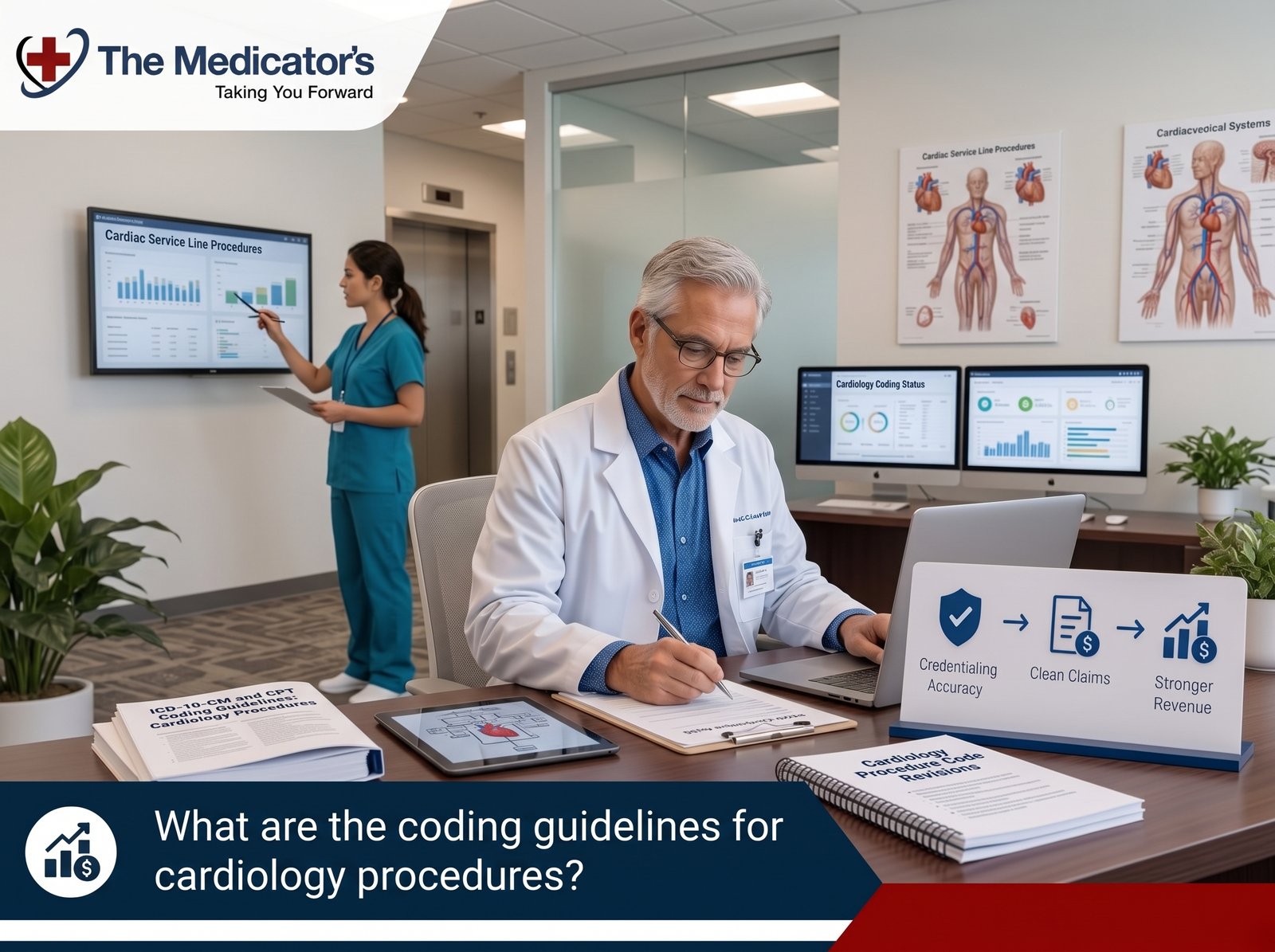
Cardiology coding guidelines help healthcare practices report cardiovascular procedures and services accurately, support medical necessity, and submit compliant insurance claims. Correct cardiology coding requires appropriate CPT and ICD-10-CM code selection, complete clinical documentation, accurate modifier use, and compliance with applicable payer policies.
For cardiology practices experiencing recurring claim denials, coding inconsistencies, or growing accounts receivable, reviewing the coding process can reveal opportunities to improve billing accuracy. Practices can evaluate professional medical billing services when they need additional support with coding review, claims processing, denial management, and reimbursement workflows.
What Are the Main Cardiology Coding Guidelines?
Cardiology coding guidelines depend on the service performed, the provider’s documentation, the claim setting, and the payer’s requirements. A cardiology coder should review the applicable CPT instructions, ICD-10-CM guidelines, National Correct Coding Initiative (NCCI) edits, and relevant Medicare or commercial payer policies.
Key requirements include:
- Selecting CPT codes that accurately describe the documented service or procedure.
- Assigning ICD-10-CM diagnosis codes supported by the medical record.
- Checking whether modifiers are appropriate and supported by the circumstances.
- Reviewing code combinations for bundling restrictions and other applicable edits.
- Confirming medical necessity and payer-specific coverage requirements.
- Reporting only services that are documented, performed, and separately reportable under applicable rules.
For Medicare claims, review the CMS Medicare NCCI Policy Manual and relevant coding and coverage guidance. Requirements can differ between professional and facility claims, Medicare and commercial insurance, and individual payer policies.
How to Choose the Correct CPT Codes for Cardiology Procedures
Accurate CPT coding for cardiology procedures begins with identifying the service actually performed. The coder should review the procedure report, physician documentation, applicable code descriptors, and relevant coding instructions rather than selecting a code based on the procedure’s general name alone.
Common cardiology coding areas include:
- Cardiac catheterization and coronary angiography: Review the documented procedure, applicable code requirements, diagnosis support, and payer coverage policies.
- Percutaneous coronary interventions: Confirm the services performed, applicable code-selection rules, and bundling edits.
- Echocardiography and cardiovascular imaging: Verify the type of study, required documentation, and applicable technical or professional billing requirements.
- Electrocardiography and rhythm monitoring: Confirm the service performed, reporting requirements, and applicable payer rules.
- Electrophysiology procedures: Review the procedure details and applicable coding instructions before assigning codes.
- Evaluation and management services: Determine whether the documented visit supports a separately reportable E/M service under the applicable rules.
For example, cardiac catheterization and coronary angiography claims may be subject to NCCI edits and other payer requirements. CMS guidance also addresses diagnosis coding and documentation needed to support these services. Review the applicable CMS cardiac catheterization and coronary angiography billing and coding guidance.
Because CPT code descriptions and coding instructions change, verify code selection against the current code set and applicable payer guidance before submitting claims.
ICD-10-CM Diagnosis Coding for Cardiology Billing
ICD-10-CM diagnosis coding establishes the documented condition or reason supporting the service. An appropriate diagnosis code should reflect the provider’s documentation and satisfy applicable reporting and medical necessity requirements.
Cardiology practices should pay particular attention to:
- Specificity: Use the level of detail supported by the documentation.
- Clinical support: Ensure the diagnosis is documented by an appropriate provider and meets applicable coding rules.
- Procedure linkage: Report the diagnosis or diagnoses that support the service under the relevant payer requirements.
- Incomplete documentation: Request clarification when necessary rather than guessing or assigning an unsupported diagnosis.
- Code validity: Confirm that the code is valid for the applicable date of service and current code-set year.
Incorrect or insufficient diagnosis coding can contribute to claim rejections, medical necessity denials, and requests for additional documentation. Practices can strengthen their review process through medical billing audit services that examine coding accuracy, documentation gaps, and recurring claim issues.
Cardiology Modifier Guidelines and Common Coding Errors
Modifiers communicate additional information about a service when the applicable coding rules permit or require their use. They should never be added simply to bypass a denial or edit.
Common cardiology billing errors include:
- Applying a modifier without sufficient documentation.
- Reporting services separately when the applicable rules bundle them.
- Selecting codes that do not match the procedure report.
- Using an unsupported diagnosis to establish medical necessity.
- Overlooking payer-specific authorization or coverage requirements.
- Submitting duplicate or inconsistent claim lines.
- Failing to correct recurring errors after denials are identified.
Modifier requirements depend on the code combination, service setting, payer policy, and circumstances of the encounter. Review the relevant CPT instructions, current NCCI edits, and payer guidance before billing. CMS also publishes resources explaining correct coding and modifier use through its National Correct Coding Initiative.
When the same errors appear repeatedly, a structured coding review can help determine whether the cause is documentation, code selection, staff training, software configuration, or payer-specific billing rules.
How to Prevent Cardiology Coding Denials
Preventing cardiology claim denials requires a consistent process that checks coding accuracy before submission and analyzes denials after payer adjudication.
A practical cardiology claim review should include:
- Verify patient and insurance information. Confirm eligibility, coverage details, and applicable authorization requirements before the service when required.
- Review procedure documentation. Match the reported service to the documented procedure and current coding instructions.
- Validate CPT and ICD-10-CM codes. Check code accuracy, specificity, and supporting documentation.
- Check modifiers and code edits. Review applicable bundling rules, NCCI edits, and payer-specific requirements.
- Confirm medical necessity. Verify that documentation and diagnosis coding support the service under the applicable coverage policy.
- Review claims before submission. Identify missing information, inconsistent codes, and preventable errors.
- Track denials and appeals. Categorize denial reasons, correct errors, follow applicable deadlines, and identify recurring patterns.
For a deeper look at claim issues, read Denial Rate vs. Rejection Rate: The Difference Every Practice Should Know. Practices can also explore revenue cycle management services when they need support coordinating claims, payment posting, denial follow-up, and performance monitoring.
When Should a Cardiology Practice Outsource Medical Billing and Coding?
Outsourcing cardiology medical billing may be worth evaluating when an in-house team struggles to keep up with coding updates, payer requirements, denied claims, unpaid balances, or reporting responsibilities.
A cardiology billing company should be able to explain its approach to:
- Cardiology CPT and ICD-10-CM coding review.
- Claim submission and rejection correction.
- Denial management and appeal tracking.
- Insurance eligibility and authorization workflows.
- Payment posting and reconciliation.
- Insurance accounts receivable follow-up.
- Billing performance reports and recurring-error analysis.
- Data protection and appropriate access to patient information.
Before choosing an outsourced medical billing company, ask about its experience with cardiology procedures, the services included in its contract, its reporting schedule, and how it handles existing accounts receivable.
Practices should compare vendors based on service scope, specialty expertise, communication, security procedures, and transparent performance reporting rather than relying on promised collection rates alone.
How Cardiology Billing Audits Can Identify Revenue Cycle Problems
A cardiology billing audit can help identify patterns such as unsupported codes, inconsistent modifiers, missing documentation, preventable denials, underpayments, or unresolved claims. The scope should be defined according to the practice’s needs and the records available for review.
An audit may examine:
- CPT and ICD-10-CM coding accuracy.
- Documentation support and medical necessity.
- Claim edits and modifier use.
- Denial trends by payer, code, and reason.
- Payment posting and reimbursement discrepancies.
- Aging accounts receivable and follow-up practices.
The goal is to identify errors and workflow weaknesses, not to maximize code levels or report unsupported services. Findings should lead to corrective actions, staff education, and monitoring of subsequent claim performance.
Explore A/R management services if unresolved insurance balances are a major concern, and review how to read an A/R aging report to understand how outstanding claims can be organized for follow-up.
Why Consider The Medicator’s for Cardiology Billing Support?
The Medicator’s provides medical billing and revenue cycle support for practices seeking help with claim workflows, billing accuracy, denials, and accounts receivable. Practices evaluating outsourced billing can review the available medical billing services and revenue cycle management services to determine whether the service scope aligns with their operational needs.
If your cardiology practice is facing recurring coding errors, denied claims, incomplete reporting, or growing A/R, request a free practice analysis to discuss your existing billing workflow and identify areas that may require closer review.
Improve Cardiology Coding Accuracy and Billing Performance
Following cardiology coding guidelines requires accurate documentation, appropriate CPT and ICD-10-CM code selection, careful modifier use, and regular review of applicable payer rules. Consistent coding checks and denial analysis can help practices identify preventable billing issues and improve revenue cycle oversight.
If your team needs additional support, explore medical billing audits, outsourced medical billing services, and A/R management options. Contact The Medicator’s to discuss your billing challenges and request a free practice analysis.
