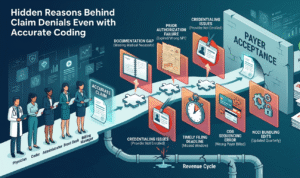
A flawed medical billing process does not signal its existence with alarms; it silently drains the resources of your practice by way of denied claims, late payments, expiration of deadlines, and insufficient documentation. Industry statistics show that 80% of medical bills contain at least one error, and U.S. healthcare providers lose approximately $125 billion annually due to denied claims, billing errors, and coding errors. To make matters worse, 65% of denied claims are never resubmitted, which means that money is lost forever.
The Medicator has worked with hundreds of physicians’ offices to establish a clear pattern of revenue loss caused by internal process failures rather than payer contracts, which often go undetected for many months, and, in some instances, years.
The following are some signs that your medical billing process could be negatively impacting your revenue and steps you can take to correct it before it costs you more.
High Denial Rates With No Structured Recovery Process
Consistent denial rates above 5-10% for your practice are a systemic problem, not just a rough patch. Denial rates above 10% indicate that errors are built into your front end workflow and are not being identified before submitting claims. The lack of structure, or a tracking system to appeal, and recover denied claims compounds the damage caused by a denial.
Key warning signs include:
- No system to track the denials; no identification of root causes or re-occurring issues.
- Denied claims that go without follow-up action for longer than 48-72 from when the claim was initially submitted.
- Re-occurrence of the same denial reason codes (CO-11, CO-4, CO-97) month after month.
- Submission of appeals inconsistently or none at all.
The financial reality is stark. According to industry data, 90% of denied claims are preventable. However, many practices only recover a small fraction of their money due to poor follow-up workflows and not analyzing denial trends.
Medicator uses a detailed approach to trace every denial to its root cause (registration error, coding mismatch, documentation lapse), leading them to construct specific protocols for correcting the mistake and eliminating the potential for another occurrence.
Front-Desk & Charge Capture Failures That Start the Problem Early
The front desk of your business is where revenue cycle challenges happen, not in the billing department. Often, these challenges don’t show themselves until weeks later when a claim has been denied.
Examples of some of the most expensive front end failures include:
- No eligibility verification before the visit: Failing to verify insurance coverage and benefits before seeing a patient is a leading reason for all claims being denied completely. Performing a real time eligibility check on the day of the appointment will eliminate this problem completely.
- Uncollected co-pays and deductibles at time of service: Each dollar that is not collected during the visit increases your exposure to having that amount going uncollected. Patient collections get exponentially more difficult after they leave your office without having paid for their visit.
- Delayed charge entry: When charges are entered into the system days or weeks after the patient was seen, there is a greater risk of missing filing deadlines, delayed cash flow, and increased error rates due to having to rely on memory rather than on real-time documentation.
These inefficiencies are not small, rather they are revenue loss points that get worse every day. For example, if you had a missed co-pay policy applied to a high volume practice, then you would lose tens of thousands of dollars per year in bad debt.
Frequent Coding and Documentation Errors Triggering Unnecessary Denials
Mistakes in coding are one of the largest and most underestimated lost revenues. Billing departments often make errors, especially if they are under pressure, using older codes, or lack coding knowledge in their specialty.
The most damaging coding errors we see at The Medicator’s include:
- Upcoding or downcoding: When billed for coding, a provider may understate or overstate a service’s complexity, known as upcoding and downcoding. Upcoding puts you at risk of being audited and having to return funds, downcoding means money goes unclaimed!
- Unbundling services: Separately billing multiple CPT codes instead of using one bundled code will result in payers quickly finding out that you have billed two codes for one service. Payers will deny the claims, or worse yet, will recoup the overpayment!
- Incorrect or missing modifiers: Certain modifiers exist to explain the nature of services that are billed. If you apply the wrong modifier, or don’t apply any modifiers at all, the chances of getting paid will be drastically reduced based off the denial of claims and underpayments and/or may result in your provider being flagged for potential violations of compliance.
- Poor clinical documentation: If your provider has not provided sufficient documentation to support your claim with the corresponding CPT and ICD-10 codes, payers will undercode or deny the claim. “Abdominal pain” is not interchangeable with “acute appendicitis”.
- Using outdated code sets:The coding for CPT, ICD-10, and HCPCS codes is updated every January. Therefore, if you do not conduct an annual review and update your codes, you will have denials on a recurring basis, resulting in many avoidable claims being denied.
Accurate coding is not just a compliance matter but also an important way to protect revenues. Missing a modifier or using an incorrect diagnostic code can result in your practice losing at least $150 for each claim, and many claims per month multiply that loss significantly by the total amount lost to the practice.
Declining Financial Performance Metrics You’re Not Tracking
You can’t fix what you don’t measure. Many practices that come to The Medicator’s have one thing in common: they are not actively tracking their financial KPIs, which indicate the health of their billing workflow.
Critical metrics that signal a failing billing workflow:
- Rising Days in A/R: If your average days in accounts receivable are continuing to increase, then you are not recovering payment as quickly as you should be. The industry standard is typically 35-40 days or less. If your A/R paycheck days are more than 35-40 days, then you should take immediate action to address this.
- High 90+ Day A/R: An extremely high percentage of 90+ day accounts receivable indicates a major risk for your practice. Research indicates that practices with a large percentage of aged receivables can lose up to 30% of their total annual revenue due to not working these aged accounts.
- Declining Net Collection Rate: Your net collection rate measures how much you have collected compared to how much you were supposed to collect. If your net collection rate is below 95%, then you have money leaking from your business. You need to look to see where that leakage is occurring.
- Low Clean Claim Rate: An insufficient clean claim rate (less than 90 – 95%) suggests that the volume of claims being submitted with issues has caused a significant increase in the potential for denials or delays.
Without dashboards, denial trend reports, and real-time accounts receivable visibility for billing errors, your billing risk is at an all-time high and will likely continue to grow until it becomes too large to ignore.
Operational Inefficiencies and Over-Reliance on Manual Processes
Even highly skilled billing teams experience a performance ceiling due to the absence of a consolidated system. The fastest way to lose a claim, miss deadlines, and burn out staff is through the use of manual billing workflows such as spreadsheets, paper-based billing items, and siloed communication between departments.
Operational red flags that signal your workflow needs restructuring:
- No active payer management or credentialing oversight: The lack of continuous credentialing data for your staff creates out-of-network denials for claims related to services your practice performs each month.
- Manual claim scrubbing: Errors that can be detected instantly through an automated claim validation application will reach payers without being fixed resulting in days of follow-up work required from lost claims.
- Staff overload with no escalation process:When your billing staff fall behind on follow-up for denials, they cannot meet their revenue goals due to excessive work and overburdened staff.
- No automated filing deadline tracking: Each payer has its own submission deadlines for payment. If you miss any deadline, you will NEVER collect that claim.
What These Warning Signs Are Really Costing Your Practice
A staggering amount of financial losses could be attributed to the simultaneous failures of these five workflows: denied claims, aging receivables, undercharging for procedures, front-end mistakes, and operational deficiencies. These failures not only affect cash flow but also take up employee time resources as well as expose the organization to compliance issues and create a lack of trust from patients.
How The Medicator’s Protects and Maximizes Your Practice Revenue
The Medicator does not merely identify the fault in the workflow but will provide systematic and long-term fixes through their complete suite of revenue cycle management services designed to eliminate all traces of a failing billing process.
- Verify eligibility for patients in real-time when scheduling appointments
- Submit clean claims using automated validation processes specific to each payer
- Code all procedures using annual updates from our certified coding expert(s), so the codes are accurate, specialty/condition-specific, and you have a documented process for each procedure for audits
- Manage & track claims denials with root cause analysis & rapid appeal processing
- Monitor Accounts Receivable (A/R) with advanced real-time tracking metrics on dashboards and key performance indicators (KPI’s)
- Ensure all plans/insurance providers are credentialed and enrolled with your practice in order to prevent out-of-network denials at the point-of-service.
The Medicator’s can provide your practice with the billing solutions necessary for your success. If your practice is experiencing high rates of denial, has a high percentage of coding errors or you simply do not know where your revenue is going, we can use our knowledge and resources to help your practice streamline processes.
Don’t let a poor-performing medical billing workflow cost your practice another penny.
Contact The Medicator’s to receive a free revenue cycle assessment designed specifically for your practice.
Frequently Asked Questions
1. What is considered a high claim denial rate for a medical practice?
A denial rate above 5–10% is a warning sign that your billing workflow may have systemic issues. Frequent denials often point to coding errors, eligibility problems, or poor documentation.
2. How can billing errors impact a practice’s revenue?
Billing errors can delay reimbursements, increase denied claims, and lead to lost revenue that is never recovered. Even small recurring mistakes can cost practices thousands annually.
3. Why is insurance eligibility verification so important?
Verifying eligibility before appointments helps prevent claim denials related to inactive coverage or missing benefits. It also improves patient payment collection at the time of service.
4. What are the most common coding mistakes in medical billing?
Common coding errors include incorrect modifiers, outdated CPT or ICD-10 codes, unbundling services, and insufficient documentation. These mistakes often trigger denials or underpayments.
5. What financial KPIs should medical practices monitor regularly?
Practices should track Days in A/R, Net Collection Rate, Clean Claim Rate, and 90+ Day A/R balances. Monitoring these metrics helps identify revenue leakage early.
6. Can outdated medical billing workflows affect patient satisfaction?
Yes. Delayed billing, incorrect charges, and repeated payment issues can frustrate patients and reduce trust in your practice’s operations and professionalism.
7. How can The Medicator’s improve a struggling medical billing workflow?
The Medicator provides end-to-end revenue cycle management, including eligibility checks, accurate coding, denial management, A/R monitoring, and automated clean claim submission to maximize collections.