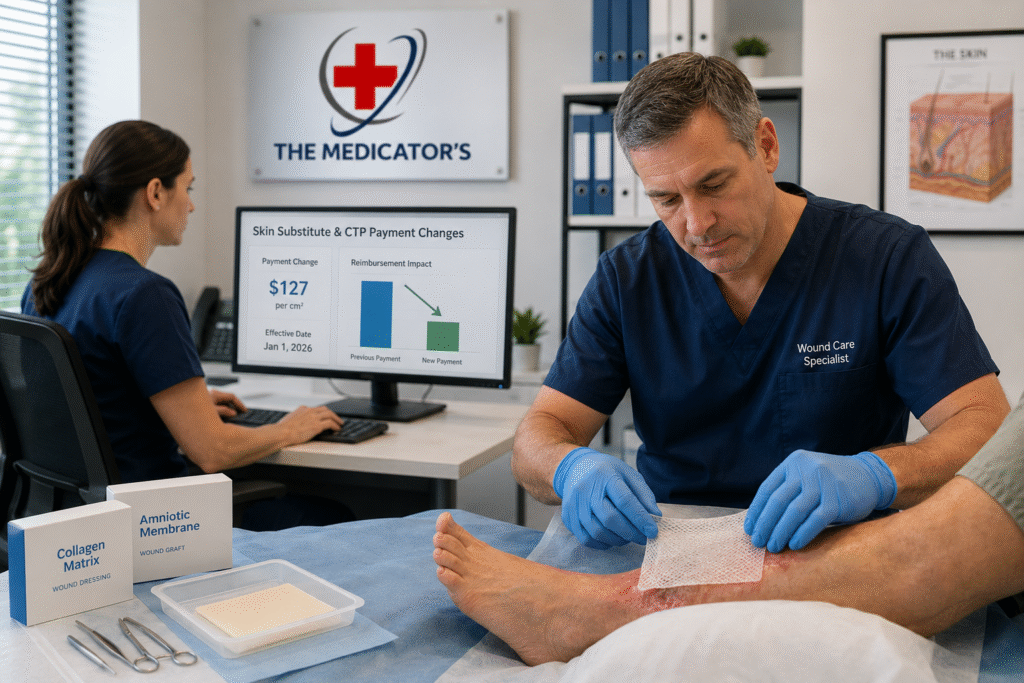
If your wound care practice bills for skin substitute grafts, 2026 has already reshaped how those claims get paid. The Centers for Medicare & Medicaid Services finalized sweeping payment changes for Cellular and Tissue Based Products, and providers who haven’t adjusted their coding and documentation workflows are already seeing the financial impact.
These changes matter because skin substitute grafts and CTPs have become a central part of advanced wound care, used every day to treat diabetic foot ulcers, venous leg ulcers, and other chronic wounds that don’t respond to standard treatment. As their use has grown, so has Medicare’s scrutiny of how they’re billed.
The updated payment policy affects reimbursement rates, coding requirements, documentation expectations, and ultimately practice profitability. Some providers will see a modest adjustment. Others, particularly those relying heavily on higher cost products, are facing a significant shift in what Medicare actually pays.
Wound care centers, hospital outpatient departments, ambulatory surgery centers, podiatrists, plastic and vascular surgeons, and the billing teams that support them all need to understand exactly what changed and why.
This guide walks through the full picture: what skin substitute grafts and CTPs actually are, why CMS overhauled the payment methodology, what the new rules require, the coding and documentation standards that now matter more than ever, and how practices can adapt without losing revenue or falling out of compliance.
What Are Skin Substitute Grafts and Cellular and Tissue Based Products (CTPs)?
Definition of Skin Substitute Grafts
Skin substitute grafts are biological or synthetic materials applied directly to a wound to support and accelerate the body’s natural healing process. Instead of simply covering a wound the way a traditional dressing does, these grafts actively encourage tissue regeneration.
They’re used primarily in wound management for chronic, slow healing wounds where standard care alone hasn’t produced adequate progress. Common applications include ulcers, surgical wounds, and wounds that have stalled despite weeks of conservative treatment.
What Are Cellular and Tissue Based Products (CTPs)?
CTPs is the broader clinical and regulatory term CMS uses for this entire product category, sometimes also referred to as skin substitutes or CAMPs in industry literature.
Unlike traditional wound dressings, which primarily protect a wound and manage moisture, CTPs are designed to interact biologically with the wound bed. Products in this category range from biological materials derived from human or animal tissue to fully synthetic constructs engineered to mimic the structure of skin.
This distinction matters clinically and financially. Regenerative medicine applications like these carry a different coding pathway, a different documentation standard, and, as of 2026, a dramatically different payment structure than a standard dressing change.
Common Conditions Treated with Skin Substitute Grafts
Skin substitute grafts and CTPs are most commonly used for:
- Diabetic foot ulcers (DFUs)
- Venous leg ulcers (VLUs)
- Pressure injuries
- Surgical wounds that fail to close normally
- Traumatic wounds
- Burns
- Chronic non healing wounds of other origins
Because these conditions often involve vulnerable, medically complex patients, advanced wound care requires documentation and reimbursement processes that reflect both the clinical seriousness and the cost of the products involved.
Why CMS Updated Skin Substitute and CTP Payment Policies
CMS didn’t make these changes in isolation. Medicare spending on skin substitute grafts grew dramatically over just a few years, and that growth, combined with real fraud concerns, pushed the agency toward a fundamentally different payment approach.
The reform reflects several converging priorities:
- Rising utilization that far outpaced expected clinical need
- Cost management, since some products were billing at rates exceeding two thousand dollars per square centimeter under the previous methodology
- Evidence based reimbursement, tying payment more closely to demonstrated clinical effectiveness
- Clinical effectiveness standards that hadn’t kept pace with the number of products entering the market
- Standardization of payment methodology across physician offices, hospital outpatient departments, and ambulatory surgery centers
- Program integrity and fraud prevention, following federal investigations that uncovered widespread improper billing in this category
To put the scale of the problem in perspective, Medicare spending on these products rose from roughly 256 million dollars in 2019 to more than 10 billion dollars by 2024, an increase CMS attributes largely to high launch prices and limited supporting clinical data across many products entering the market.
Overview of the Latest CMS Payment Changes
At a high level, CMS finalized a new, standardized payment methodology for skin substitutes and CTPs as part of the Calendar Year 2026 Medicare Physician Fee Schedule and Hospital Outpatient Prospective Payment System final rules, released October 31, 2025.
The core change replaces the previous Average Sales Price based pricing model, which allowed reimbursement for some products to exceed two thousand dollars per square centimeter, with a flat, site neutral rate of approximately 127 dollars per square centimeter. This rate applies consistently across physician offices, hospital outpatient departments, and mobile clinics, effective January 1, 2026.
CMS estimates this single change could reduce Medicare spending on skin substitutes by close to 90 percent, which gives a sense of just how significant the previous pricing gap had become. You can review the complete details directly through the CMS CY2026 Physician Fee Schedule final rule fact sheet.
Separately, CMS had also finalized new Local Coverage Determinations that would have sharply limited which specific products were covered for diabetic foot ulcer and venous leg ulcer treatment. In a notable late development, CMS announced on December 24, 2025, that its Medicare Administrative Contractors would withdraw those finalized LCDs just before their scheduled effective date, a decision covered in detail by the Association for Advancing Tissue and Biologics. The payment methodology changes in the physician fee schedule were not affected by this withdrawal and remain in effect. Providers should understand that this is a fluid regulatory area, and coverage policy specifically for DFU and VLU indications may still change again as MACs revisit the issue.
Who Is Affected by These CMS Changes?
The updated payment structure touches nearly every setting where wound care is delivered, including:
- Wound care centers
- Hospitals
- Hospital Outpatient Departments (HOPDs)
- Ambulatory Surgery Centers (ASCs)
- Physician offices
- Podiatrists
- Plastic surgeons
- General surgeons
- Vascular surgeons
- Internal medicine physicians involved in wound care
- Medical billing companies supporting any of the above
If your practice bills for CTP application in any of these settings, the new rate and its documentation requirements now apply directly to your reimbursement.
Key CMS Payment Changes Providers Should Understand
Updated Payment Methodology
Under the previous model, skin substitutes were reimbursed based on Average Sales Price plus a percentage add on, a structure that allowed significant variation between products and created strong financial incentives to select higher priced options regardless of comparative clinical benefit.
The new methodology treats most CTPs as an incident to supply, reimbursed at a standardized rate of approximately 127 dollars per square centimeter rather than through product specific ASP calculations. For practices that had been using premium priced products, this represents a substantial reduction in per unit reimbursement, which makes accurate coding and full utilization tracking more financially important than ever.
Product Classification Updates
Products are now evaluated and grouped based on clinical evidence and regulatory category rather than simply by brand or manufacturer pricing tier. This classification directly affects how a product is coded and how confidently a practice can defend its selection during a payer review or audit.
Changes to Separate Payment Eligibility
Whether a product qualifies for separate payment, versus being bundled into a broader procedure payment, now depends more heavily on site of service and current CMS packaging rules. Practices need to confirm eligibility for each product they use rather than assuming coverage carries over from prior years.
HCPCS Code Updates
As with most major CMS payment overhauls, this update comes with a wave of HCPCS Level II coding changes, including new codes for products that meet updated evidence standards, retirement of codes tied to products no longer separately reimbursed, and revised descriptors that change how existing codes should be applied. Coding accuracy at this level directly determines whether a claim is paid correctly the first time.
Hospital Outpatient Payment Changes
Under the Outpatient Prospective Payment System, CTP application now follows updated packaging rules and Ambulatory Payment Classification assignments that reflect the new flat rate methodology. Hospital billing teams need to confirm their charge description masters and coding software reflect these updates directly.
Ambulatory Surgery Center (ASC) Payment Updates
ASC reimbursement for CTP procedures has been aligned closer to the site neutral model, though specific packaging and payment rules still differ in some respects from HOPD billing. Practices operating across both settings should not assume identical workflows apply.
Billing Implications for Providers
The payment overhaul creates several practical billing implications that go beyond the headline rate change:
- Accurate HCPCS reporting reflecting the correct, currently valid product code
- CPT coding accuracy for the associated application procedure
- Units billed that precisely match the wound size and product quantity actually used
- Product wastage reporting, where applicable, documented clearly to support billed units
- Modifier usage applied correctly for repeat applications, multiple procedures, or specific payer requirements
- Place of Service (POS) coding that matches where the procedure was actually performed
- Documentation requirements that support every element of the claim from medical necessity through product selection
Getting any one of these wrong under the new payment structure carries a higher financial cost than it did under the old model, simply because there’s less margin for error built into the flat rate.
Medical Coding Considerations
CPT Procedure Coding
The CPT code for the application procedure itself is separate from the HCPCS code for the product, and both need to align with the documented wound characteristics and the actual technique used. Debridement performed at the same encounter carries its own coding relationship to the graft application, and multiple procedure considerations can affect reimbursement for secondary services performed the same day.
HCPCS Product Coding
Correct product identification is essential, since CMS reimburses based on the specific code tied to the product actually applied. Quantity reporting has to reflect precise square centimeter measurements of the wound and the graft used, since inaccurate quantity reporting is one of the fastest ways to trigger a denial or an audit flag under the new methodology.
ICD-10 Diagnosis Coding
Ulcer diagnosis coding needs to reflect wound specificity, including laterality, severity, and anatomical location where applicable. Vague or incomplete ICD-10-CM coding weakens the medical necessity case for the entire claim, even when the clinical care itself was appropriate.
Documentation Requirements
Documentation may be the single most important factor in whether a skin substitute claim survives payer review, and CMS scrutiny in this area has only intensified. Strong documentation should include:
- Medical necessity clearly articulated in clinical terms
- Wound measurements recorded consistently at each encounter
- Wound progression showing response, or lack of response, to prior treatment
- Previous treatments attempted before moving to graft application
- Product selection rationale, explaining why this specific CTP was chosen
- Procedure notes detailing the application technique and any debridement performed
- Photographic documentation, where applicable, to support wound status objectively
- Follow-up care demonstrating ongoing monitoring of healing progress
Thorough documentation doesn’t just support reimbursement. It’s your primary defense if a claim is selected for post payment review, which is increasingly common in this product category. Our medical necessity documentation guide walks through exactly how to structure notes that hold up under review.
Medical Necessity Requirements
CMS expects clear evidence of appropriate patient selection before a skin substitute graft is applied. That generally includes documentation of a chronic wound meeting an established duration threshold, evidence of conservative treatment failure over a reasonable period, and clinical indications that specifically support graft application over continued standard care.
Providers should treat medical necessity as an ongoing documentation requirement rather than a one time checkbox, since CMS expectations in this category continue to evolve alongside the payment methodology itself.
Common Billing Mistakes After CMS Payment Changes
Practices adjusting to the new rules commonly run into these errors:
- Incorrect HCPCS codes, often carried over from a prior year’s code set
- Incorrect CPT codes for the application procedure
- Missing documentation supporting medical necessity or wound progression
- Billing for unsupported products no longer eligible for separate payment
- Incorrect product units that don’t match documented wound measurements
- Failure to update coding software with the latest HCPCS revisions
- Incorrect modifiers applied to repeat or multiple procedures
- Duplicate billing for the same application across overlapping claims
- Incomplete operative notes lacking key procedural detail
- Missing medical necessity documentation entirely
Any one of these can trigger a denial. Several of them together are exactly the pattern that draws payer audits. Our guide on how to reduce medical claim denials covers the broader denial prevention framework, while a structured claim scrubbing process catches most of these errors before the claim ever reaches the payer.
Compliance Considerations
Compliance in this category spans several layers, including current CMS regulations and general Medicare billing requirements, Local Coverage Determinations and National Coverage Determinations that apply in your specific jurisdiction, documentation compliance standards, medical record retention requirements, and regular internal audits to catch problems proactively.
Given the regulatory volatility this category has seen, including the December 2025 LCD withdrawal detailed in this Applied Policy analysis of Medicare’s evolving response, practices should treat compliance monitoring as an ongoing process rather than a one time setup. You can review CMS’s own explanation of how local coverage determinations are developed and revised through its local coverage determination process and timeline resource.
Financial Impact of the CMS Changes
For many practices, the financial impact extends well beyond the headline reimbursement rate:
- Reimbursement changes that reduce per unit revenue substantially for previously premium priced products
- Revenue implications across the entire wound care service line, not just individual claims
- Product selection decisions that now carry more direct financial consequence
- Practice profitability that may require reassessment of which products and procedures remain viable
- Cost management pressure as acquisition costs for existing inventory may no longer align with new reimbursement
- Inventory planning challenges, particularly for practices holding higher cost product stock purchased before the rate change took effect
Practices that acted early to review their product mix and billing accuracy are generally weathering this transition far better than those still operating on last year’s assumptions.
How Providers Can Prepare for the New Payment Rules
- Review updated CMS guidance directly rather than relying solely on secondhand summaries
- Audit current billing workflows against the new payment methodology
- Update HCPCS code libraries in your billing and EHR systems immediately
- Train providers and billing staff on both the coding changes and the documentation expectations behind them
- Improve documentation templates to consistently capture medical necessity and wound progression
- Monitor payer communications, since commercial payers often follow CMS’s lead with some lag
- Perform internal billing audits on a recurring basis, not just once after implementation
- Review contracts with product suppliers in light of the new reimbursement reality
Best Practices for Billing Skin Substitute Grafts and CTPs
Ongoing best practices that protect both compliance and revenue include verifying payer coverage before every application, confirming and documenting medical necessity clearly, tracking wound progression consistently across visits, selecting the correct HCPCS code for the specific product used, validating CPT coding against the actual procedure performed, working from current coding references rather than outdated code books, monitoring CMS updates on an ongoing basis, and tracking reimbursement trends across your own claims to catch problems early.
Technology That Helps Maintain Compliance
Modern billing operations lean heavily on technology to keep pace with a policy area that changes this quickly. That includes medical billing software with built in code validation, dedicated coding software reflecting current HCPCS and CPT updates, full Revenue Cycle Management platforms, structured documentation tools built for wound care specifically, Electronic Health Records systems that integrate cleanly with billing workflows, and audit software that flags potential issues before claims go out the door.
Key Performance Indicators (KPIs) to Monitor
Tracking the right metrics gives you an early warning system for problems tied to this policy shift.
| KPI | Why It Matters |
|---|---|
| Clean Claim Rate | Measures billing accuracy on first submission |
| First-Pass Acceptance Rate | Indicates overall claim quality |
| Denial Rate | Identifies emerging reimbursement issues |
| Average Reimbursement Time | Measures payment efficiency |
| Days in Accounts Receivable | Evaluates cash flow health |
| Documentation Error Rate | Measures compliance quality |
A sudden shift in any of these numbers immediately after a coding or payment policy change is usually the first sign that your billing workflow needs adjustment before the problem compounds.
How Professional Medical Billing Services Help Providers Adapt
This is exactly the kind of regulatory shift where specialized billing support earns its value quickly. A dedicated billing partner brings ongoing CMS policy monitoring so your team isn’t caught off guard by the next update, HCPCS coding expertise specific to CTPs and skin substitutes, CPT coding validation against actual procedure notes, thorough documentation reviews before claims go out, proactive claim scrubbing, denial prevention, structured appeals management when claims are denied, revenue optimization across your entire wound care service line, regular compliance audits, and ongoing billing education as CMS continues to refine this policy area.
If your team is still catching up on the January 2026 changes, our Revenue Cycle Management services are built to absorb exactly this kind of regulatory transition without disrupting your cash flow.
Signs Your Practice Needs Billing Support After CMS Changes
Watch for these indicators that your current process isn’t keeping pace with the new rules:
- Increasing claim denials tied to skin substitute or CTP billing
- Coding uncertainty among staff about which HCPCS codes now apply
- Documentation deficiencies flagged during internal or payer review
- Delayed reimbursements compared to your pre-2026 baseline
- Frequent payer requests for additional records
- Staff unfamiliar with the new payment methodology or LCD status
- Declining reimbursement despite stable or growing procedure volume
If several of these sound familiar, a full medical billing audit is the fastest way to find out exactly where revenue is at risk.
Why Choose The Medicator’s for Medical Billing Services
Navigating a policy shift this significant requires a billing partner who actually specializes in the regulatory detail, not just general medical billing.
The Medicator’s brings direct expertise in CMS billing regulations, including the specific coding and payment changes affecting skin substitute grafts and CTPs in 2026. Our certified coding specialists stay current on HCPCS and CPT updates as they’re finalized, not months after the fact, and our team maintains ongoing monitoring of regulatory updates so your practice isn’t caught off guard by the next CMS revision.
Every claim goes through documentation support and structured claim scrubbing before submission, backed by dedicated denial management when issues do arise. Our compliance focused approach to billing keeps your practice protected through the kind of regulatory volatility this category has shown over the past year, all supported by transparent reporting and full Revenue Cycle Management expertise.
If your practice bills for CTPs or skin substitute grafts and you’re not fully confident your current coding and documentation hold up under the new rules, now is the time to check. Talk to The Medicator’s today for a review of your current wound care billing workflow.
Conclusion
CMS payment changes for skin substitute grafts and Cellular and Tissue Based Products require providers to stay informed and adapt their billing workflows quickly, particularly given how much this policy area has shifted in just the past several months.
Success under the new rules depends on accurate coding, thorough documentation, ongoing compliance with current CMS requirements, and continuous monitoring of a reimbursement landscape that is still evolving. Practices that proactively review their processes now, rather than waiting for a denial pattern to force the issue, are the ones protecting their revenue most effectively.
Partnering with experienced medical billing professionals who specialize in this exact regulatory area can help your practice minimize denials, maintain compliance, and protect the revenue this shift has put at risk. Contact The Medicator’s to make sure your wound care billing is fully aligned with the 2026 CMS payment rules.
Frequently Asked Questions
What are Cellular and Tissue-Based Products (CTPs)?
CTPs, also called skin substitutes, are biological or synthetic materials applied to a wound to actively support tissue regeneration, rather than simply protecting the wound the way a traditional dressing does.
What are skin substitute grafts?
Skin substitute grafts are a category of CTP applied directly to chronic or non healing wounds, such as diabetic foot ulcers and venous leg ulcers, to accelerate the body’s natural healing response.
What changed in the latest CMS payment policy?
Effective January 1, 2026, CMS replaced the previous Average Sales Price based reimbursement model with a standardized, site neutral flat rate of approximately 127 dollars per square centimeter for most CTPs across physician offices, hospital outpatient departments, and mobile clinics.
Which providers are affected?
Wound care centers, hospitals, hospital outpatient departments, ambulatory surgery centers, podiatrists, plastic surgeons, general and vascular surgeons, and internal medicine physicians involved in wound care are all affected, along with the billing companies supporting them.
Do HCPCS codes change?
Yes. The 2026 update includes new HCPCS codes for qualifying products, retirement of codes tied to products no longer separately reimbursed, and revised descriptors that affect how remaining codes should be applied.
How do these updates affect reimbursement?
Reimbursement for most CTPs dropped substantially compared to the prior ASP based model, since some products previously billed at rates exceeding two thousand dollars per square centimeter now fall under the standardized flat rate.
What documentation is required?
Claims need clear documentation of medical necessity, wound measurements, wound progression, prior treatments attempted, product selection rationale, detailed procedure notes, and evidence of follow-up care.
How can providers avoid claim denials?
Accurate HCPCS and CPT coding, correct unit reporting matched to actual wound size, thorough documentation, and proactive claim scrubbing before submission are the most effective ways to reduce denials in this category.
Are hospitals and ASCs affected differently?
Yes, to a degree. While the underlying payment methodology is designed to be site neutral, hospital outpatient departments and ambulatory surgery centers follow somewhat different packaging and payment rules under OPPS versus ASC payment systems.
How often does CMS update payment policies?
CMS typically updates physician fee schedule and outpatient payment policies annually, though this particular product category has seen unusually frequent revisions, including a rate correction and an LCD withdrawal within just a few months of the original 2026 effective date.
Should practices perform billing audits after payment changes?
Yes. A billing audit immediately following any major CMS payment change is one of the most effective ways to catch coding errors, documentation gaps, and compliance risks before they accumulate into denied claims or a payer audit.