
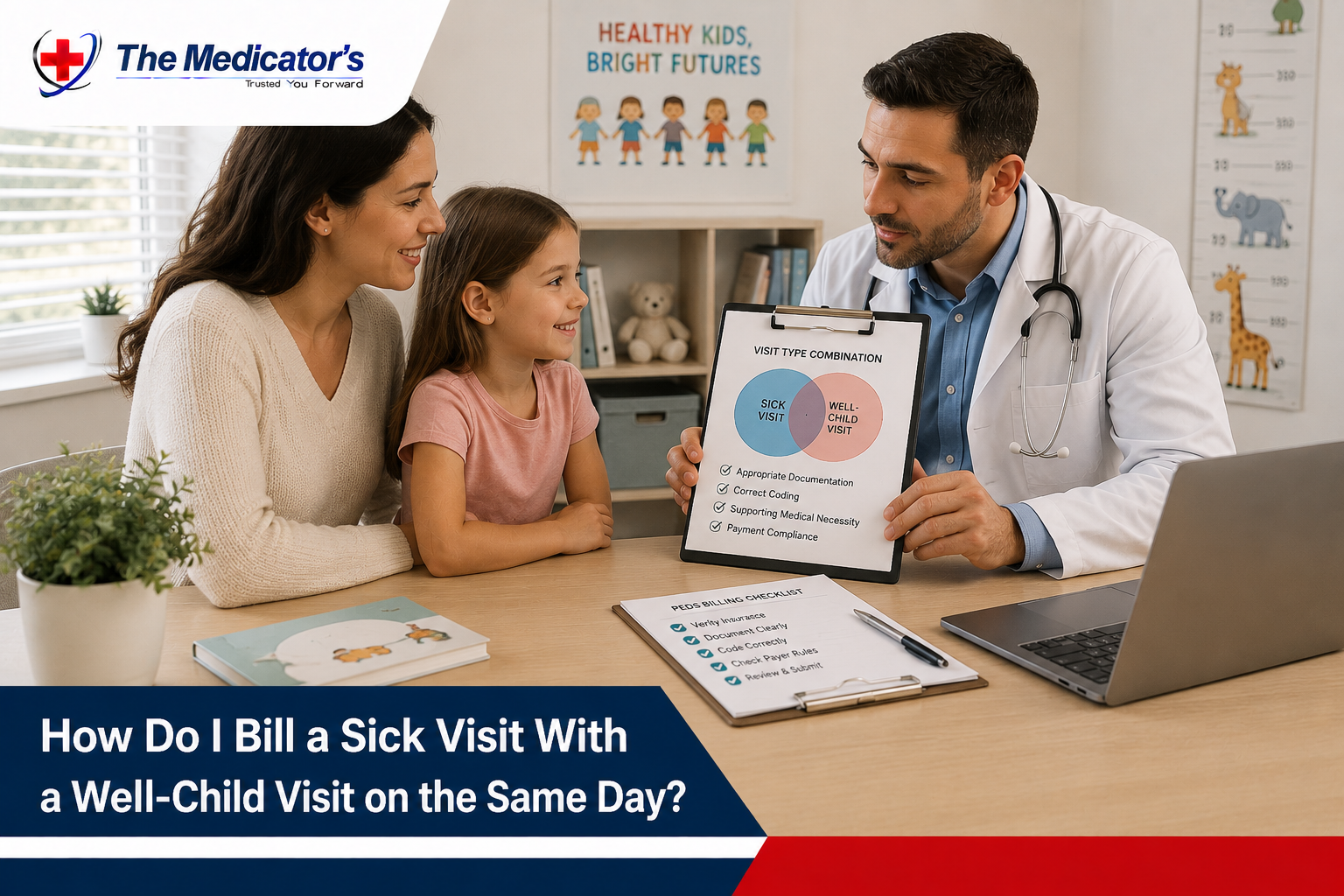
Billing a sick visit and a well-child visit on the same day may be appropriate under CPT coding guidelines when both services are medically necessary and the sick visit involves significant, separately identifiable evaluation and management work beyond the preventive examination. To report both services, use the age-appropriate preventive medicine code alongside the appropriate problem-oriented Evaluation and Management (E/M) code. Modifier 25 is generally appended to the sick visit E/M code when the documentation supports a separately identifiable service. Always verify applicable payer policies before submitting the claim.
At The Medicator’s, our coding and revenue cycle management specialists help pediatric practices identify billable services, improve claim accuracy, and follow applicable coding requirements. Through specialized pediatric billing in Texas and nationwide support, we help practices streamline complex claims workflows, address denial rate vs. rejection rate challenges, and manage revenue more effectively.
Core Coding & Claim Submission Steps
When submitting a claim for a combined preventive and acute visit, follow these coding steps to support accurate claim processing by commercial payers and Medicaid managed care organizations (MCOs):
- Report the Preventive Medicine Code: Select the age-appropriate well-child CPT code based on the patient’s age and new or established status:
- New Patient Preventive Visits: CPT 99381 for patients younger than 1 year, 99382 for ages 1–4, 99383 for ages 5–11, 99384 for ages 12–17, 99385 for ages 18–39, 99386 for ages 40–64, or 99387 for ages 65 and older.
- Established Patient Preventive Visits: CPT 99391 for patients younger than 1 year, 99392 for ages 1–4, 99393 for ages 5–11, 99394 for ages 12–17, 99395 for ages 18–39, 99396 for ages 40–64, or 99397 for ages 65 and older.
- Report the Problem-Oriented Sick Visit Code: Select the appropriate office or outpatient E/M code based on the patient’s status and the documented medical decision-making or qualifying time. The applicable code range is CPT 99202–99205 for new patients and 99212–99215 for established patients.
- Append Modifier 25 When Appropriate: Append Modifier 25 to the problem-oriented E/M code, such as
99213-25, when the sick visit represents a significant, separately identifiable service on the same day as the preventive examination. Confirm the payer’s modifier and claim-submission requirements before filing. - Link the Appropriate Diagnosis Codes:
- Link the preventive medicine code to the appropriate routine health examination diagnosis, such as Z00.129 for a routine child health examination without abnormal findings or Z00.121 for a routine child health examination with abnormal findings, as supported by the documentation.
- Link the sick visit E/M code to the specific acute or chronic condition evaluated, such as acute otitis media, pharyngitis, or an asthma exacerbation. Use the most specific supported ICD-10-CM code and avoid unspecified ICD-10 codes when the clinical documentation supports a more precise diagnosis.
Strict Medical Documentation Requirements
Modifier 25 claims may receive additional review. The medical record should demonstrate that the acute or problem-oriented evaluation involved work beyond the usual components of the preventive examination.
| Documentation Rule | Clinical & Operational Guidelines |
|---|---|
| Separately Identifiable Notes | Clearly document the preventive examination and the problem-oriented evaluation. Distinct note sections can help identify the chief complaint, history of present illness (HPI), problem-focused examination, assessment, and treatment plan. |
| Justify Additional Clinical Work | Document the medical decision-making or qualifying time associated with the acute problem. The record must support a separately identifiable E/M service beyond routine screening, anticipatory guidance, and preventive care. |
| Evaluate Whether a Separate Service Is Supported | Do not report a separate sick visit solely because a minor condition or incidental finding is mentioned. The documentation must support the additional E/M service under applicable coding guidelines. |
| Avoid Overlapping Documentation | Do not rely solely on routine preventive examination elements to justify the problem-oriented E/M service. Clearly identify the additional evaluation, clinical decisions, and treatment related to the patient’s problem. |
Same-Day Sick & Well Billing Breakdown
A clear claim layout helps distinguish the preventive service from the problem-oriented visit. The following example illustrates the general approach for an established patient; actual codes and diagnosis links must reflect the services documented and the payer’s requirements.
- Line Item 1 (Preventive Visit): Report the appropriate established-patient preventive medicine code, such as CPT 99393 for a child aged 5–11, linked to the supported preventive examination diagnosis.
- Line Item 2 (Sick Visit): Report the appropriate problem-oriented E/M code, such as CPT
99213-25when Modifier 25 is justified, linked to the specific condition evaluated and treated.
The presence of two services does not automatically justify two separately payable codes. Medical necessity, documentation, coding rules, and payer policies determine whether both services can be reported and reimbursed.
How to Handle Common Modifier 25 Denials
Even when a practice believes both services are supported, a payer may deny or bundle a same-day claim. Review the reason code and applicable policy before correcting or appealing the claim.
- Verify Modifier Placement: Confirm that Modifier 25 is attached to the problem-oriented E/M code when supported, rather than to the preventive medicine code. Check the payer’s claim-editing requirements.
- Review Payer-Specific Policies: Check the applicable commercial plan or Medicaid program’s rules for same-day preventive and problem-oriented visits. Additional modifiers or program-specific requirements may apply in certain circumstances.
- Submit Supporting Documentation on Appeal: When appropriate, submit the relevant clinical records and a clear explanation showing how the problem-oriented service was distinct from the preventive examination. Follow the payer’s appeal requirements and protect patient information.
- Monitor A/R Aging Buckets: Track unpaid and denied claims using your A/R aging report so your team can prioritize follow-up and submit appeals before applicable deadlines.
Maximize Practice Reimbursement with The Medicator’s
Billing a well-child examination and a sick visit during one encounter can improve patient convenience while allowing a practice to report separately supported services. However, accurate reimbursement depends on documentation, appropriate code selection, modifier use, and payer-specific billing requirements.
At The Medicator’s, our pediatric billing specialists help practices review coding and documentation, identify claim errors, manage denials, and follow up on outstanding accounts receivable. With our pediatric billing services in Texas, your practice can benefit from:
- More Accurate Claim Submission: Review code selection, diagnosis links, modifier use, and documentation before claims are submitted.
- Denial Follow-Up and Appeals: Investigate payer denials, correct supported errors, and appeal eligible claims with appropriate documentation.
- More Organized Revenue Cycle Management: Monitor unpaid claims, prioritize A/R follow-up, and identify recurring billing issues that may affect collections.
Are Modifier 25 denials or payer bundling edits affecting your practice’s revenue? Request a personalized pediatric practice analysis from The Medicator’s team to identify opportunities to improve billing workflows and claim management.
