
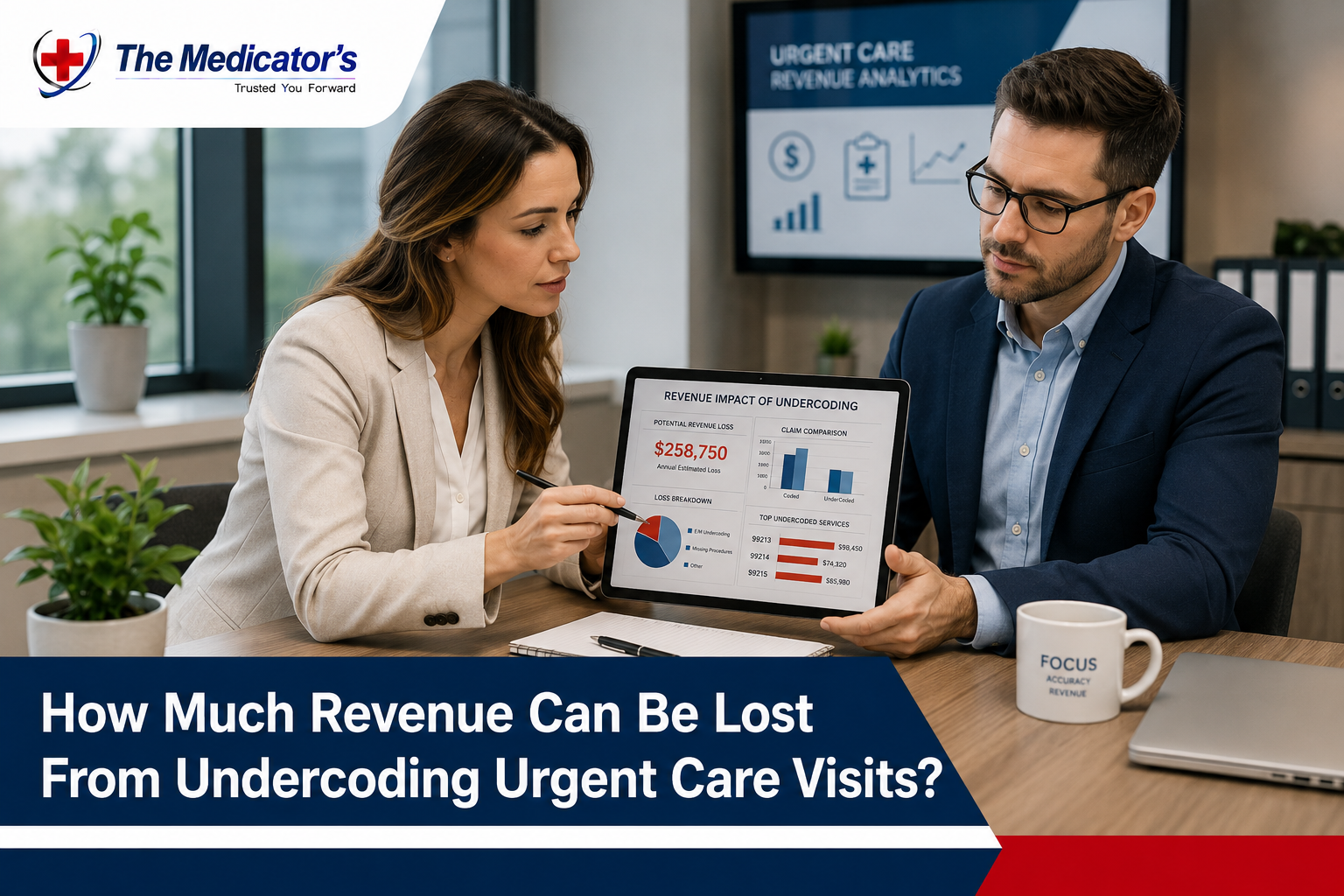
Undercoding urgent care visits can cost an individual healthcare provider between $35,000 and $70,000 per year, while causing a full-scale urgent care clinic to lose $150,000 to $300,000 or more in annual revenue. Undercoding occurs when clinicians or billers submit lower-level evaluation and management (E/M) codes, such as billing CPT 99213 instead of CPT 99214, even when the patient’s medical decision-making (MDM) or total encounter time fully supports the higher level of care.
At The Medicator’s, our certified medical billing and coding specialists help walk-in clinics and fast-track centers stop revenue leakage caused by defensive coding habits. By delivering comprehensive urgent care revenue cycle management in Texas and nationwide, we audit clinical documentation, optimize E/M level selection, and maintain clean claim acceptance rates above 97%.
Why Undercoding Happens in High-Volume Urgent Care
Undercoding is rarely intentional; rather, it is a byproduct of high patient volume, fast-paced workflows, and fear of payer scrutiny:
Audit Scrutiny and Compliance Fears: Many clinicians habitually downcode complex visits to Level 3 (CPT 99203/99213) out of fear that billing Level 4 (CPT 99204/99214) will trigger insurance audits or clawbacks.
Rushed Documentation Workflows: Urgent care providers often manage 30 to 50 walk-in patients per shift. Limited charting time leads to abbreviated clinical notes that fail to capture the full scope of medical decision-making.
Uncaptured Prescription and Diagnostic Complexity: Providers frequently omit key details from clinical notes, such as ordering prescription drug management, reviewing external diagnostic tests, or evaluating acute exacerbations, which automatically qualify visits for moderate-complexity E/M billing.
Lack of Time-Based Billing Tracking: Under AMA guidelines, established patient visits lasting 30 minutes or more can be billed as CPT 99214 based on total time spent on the date of service. Without automated EHR time trackers, this billable time goes unrecorded.
The Financial Scale of E/M Undercoding
Because urgent care centers rely on high encounter volumes, even a minor 10% to 20% downcoding rate results in compounding financial losses over a 12-month period:
| E/M Visit Code Pair | Level 3 Reimbursement | Level 4 Reimbursement | Average Revenue Gap Per Encounter |
| Established Patient (99213 vs 99214) | ~$95 to $100 | ~$135 to $150 | $36 to $50 Lost |
| New Patient (99203 vs 99204) | ~$115 to $125 | ~$170 to $190 | $55 to $65 Lost |
The Volume Multiplier Effect
Per Provider Impact: A clinician who downcodes just 4 visits per day loses approximately $160 daily. Over 220 working days, that single provider leaves $35,200 to $44,000 on the table.
Per Clinic Impact: In a multi-provider urgent care clinic seeing 80 patients per day, a 15% undercoding rate across walk-in encounters creates an annual loss exceeding $180,000.
Ancillary and Procedure Losses: When E/M visits are downcoded, associated procedures (such as nebulizer treatments, IV hydration, rapid labs, or splinting) are often mistakenly left unbilled or unlinked to appropriate POS codes in medical billing, worsening overall practice revenue loss.
How to Eliminate Undercoding and Recover Lost Revenue
Urgent care practices can capture every dollar earned without increasing audit risk by implementing structured coding practices:
Train Providers on MDM Guidelines: Educate clinical staff on the three core elements of Medical Decision Making: problems addressed, data reviewed, and risk of complications. Highlighting that prescription drug management satisfies moderate risk helps clinicians confidently bill Level 4 codes when supported.
Utilize EHR Documentation Templates: Implement smart EHR templates that automatically capture review of systems, order histories, and total time spent reviewing chart notes.
Conduct Routine Internal Chart Audits: Audit a random sample of 10 to 20 charts per provider quarterly to compare rendered care against billed CPT codes. Differentiating your clinic’s overall denial rate vs. rejection rate reveals whether revenue gaps stem from coding habits or clearinghouse formatting errors.
Partner with Certified Urgent Care Coders: Professional RCM specialists review clinical charts prior to claim submission to ensure every documented complexity factor is accurately reflected on the claim.
The Revenue Optimization Process: What to Expect
Transitioning your urgent care center to an accurate, compliant billing model follows a four-step framework:
Baseline Coding Audit: Analyzing historical E/M code distribution curves (99212 through 99215) to identify undercoding trends and quantify financial loss.
Provider Education & Template Alignment: Updating EHR charting shortcuts and training clinicians on compliant documentation for high-acuity walk-in encounters.
Pre-Submission Claim Scrubbing: Verifying that E/M levels, modifiers, diagnostic codes, and lab charges are correctly aligned before clearinghouse transmission.
A/R Tracking & Financial Growth: Monitoring aging accounts receivables on a monthly A/R aging report to keep average days in A/R under 30 days.
Why Choose The Medicator’s for Your Urgent Care Center?
Defensive coding and documentation shortcuts take a heavy toll on urgent care margins, forcing practices to work harder for less reimbursement.
At The Medicator’s, our certified coding experts eliminate undercoding, resolve documentation bottlenecks, and maximize first-pass claim acceptance. By partnering with our team for urgent care billing in Texas and nationwide, your clinic achieves:
Clean Claim Rates Above 97%: Capturing full E/M complexity, valid CPT modifiers, and ancillary charges prior to billing.
Complete Financial Recovery: Eliminating $35,000+ per provider in hidden undercoding losses while maintaining 100% audit compliance.
Days in A/R Kept Under 30 Days: Accelerating cash flow and protecting practice revenue.
Are defensive coding or undercoded visits draining your urgent care revenue? Stop leaving earned reimbursement behind. Request a free, custom urgent care practice analysis with The Medicator’s team today!
