
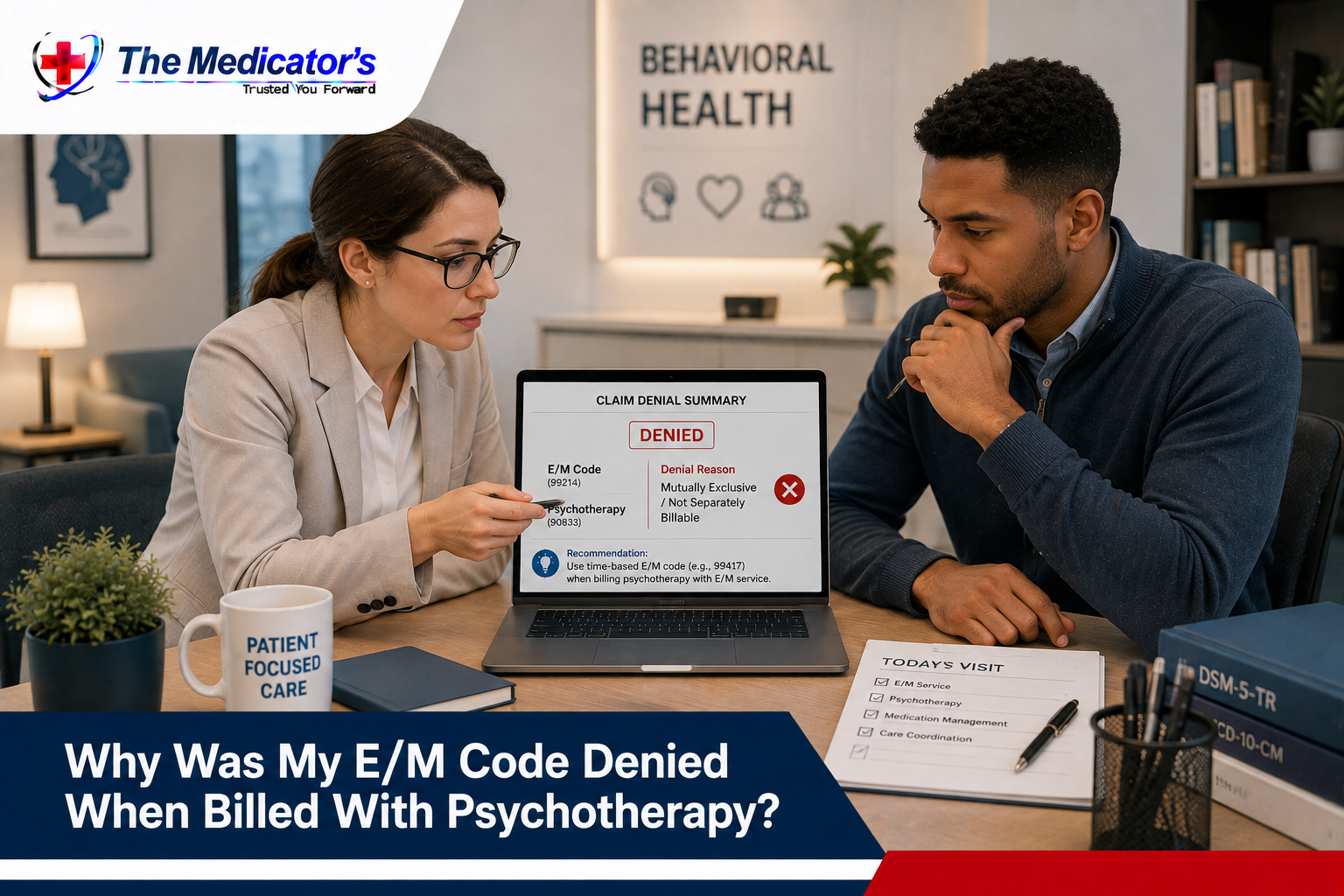
An Evaluation and Management (E/M) code billed on the same day as psychotherapy is typically denied due to a missing Modifier 25, improper selection of standalone psychotherapy codes instead of add-on codes (+90833, +90836, +90838), overlapping time documentation in clinical notes, or a failure to establish separate medical necessity for both services. Insurers utilize automated claims-scrubbing edits to bundle these dual-service visits unless strict coding and documentation guidelines are met.
At The Medicator’s, our specialized behavioral health team provides comprehensive psychiatric billing services, including tailored psychiatry medical billing in Florida and nationwide. We perform clinical documentation reviews, enforce payer-specific modifier logic, and eliminate bundling edits to help practices maintain clean claim acceptance rates above 97%.
Primary Reasons E/M Codes Are Denied Alongside Psychotherapy
Understanding why payers deny same-day E/M and psychotherapy claims helps providers implement effective clinical documentation and billing workflows:
1. Missing or Incorrect Modifier 25
When an E/M service (CPT 99202–99215) and a psychotherapy service are performed on the same date by the same provider, commercial payers and Medicare contractors often require Modifier 25 appended to the primary E/M code. This modifier signals to the payer’s adjudication system that the evaluation and medication management was a significant, separately identifiable medical service from the psychotherapy session. Omitting Modifier 25 triggers automated bundling rejections.
2. Billing Standalone Therapy Codes Instead of Psychotherapy Add-Ons
When a single clinician provides both medication management and psychotherapy during the same visit, CPT guidelines prohibit reporting standalone therapy codes (such as 90832, 90834, or 90837). Instead, you must report the primary E/M code paired with the appropriate psychotherapy add-on code:
CPT +90833: 30-minute psychotherapy add-on (16–37 minutes face-to-face).
CPT +90836: 45-minute psychotherapy add-on (38–52 minutes face-to-face).
CPT +90838: 60-minute psychotherapy add-on (53+ minutes face-to-face).
Submitting standalone codes alongside E/M services leads to immediate claim line denials under National Correct Coding Initiative (NCCI) edits.
3. Overlapping Time Documentation & Missing Start/Stop Times
Payer compliance rules require that time spent on E/M decision-making (or history and exam) must be completely separate from face-to-face psychotherapy time. If clinical notes list total visit duration without explicitly splitting time (e.g., listing “45 minutes total” without documenting 15 minutes for medication management and 30 minutes for psychotherapy), payers downcode or deny the psychotherapy add-on during post-payment audits.
4. Insufficient Medical Necessity for Dual Services
Clinical notes must justify why both medical evaluation (such as adjusting psychiatric medications, monitoring side effects, or reviewing lab results) and active psychotherapy were medically necessary during the same encounter. Vague progress notes that fail to outline distinct therapeutic interventions result in medical necessity denials.
Same-Day E/M and Psychotherapy Denial Causes at a Glance
The following outline details common bundling errors, denial drivers, and operational fixes:
Missing Modifier 25: Root Cause: E/M billed alongside add-on therapy without Modifier 25. Fix: Append Modifier 25 to the E/M code line and resubmit claim.
Standalone Code Error: Root Cause: Billed 90834/90837 instead of add-on codes (+90833/+90836/+90838). Fix: Void claim and rebill primary E/M with correct psychotherapy add-on code.
Overlapping Time Notes: Root Cause: Chart fails to state separate time spent on E/M vs. psychotherapy. Fix: Update documentation templates to capture distinct durations for each service.
Non-Specific Diagnosis / POS Mismatch: Root Cause: Mismatched location codes or non-specific ICD-10 coding. Fix: Ensure correct POS codes in medical billing (e.g., POS 11 for Office or POS 02/10 for Telehealth) are applied.
Actionable Steps to Prevent and Overturn Denial Claims
Audit EOB Claim Adjustment Codes: Review Explanation of Benefits (EOB) statements to identify specific Claim Adjustment Reason Codes (CARCs), such as CO-59 (Distinct procedural service) or CO-97 (Bundled service).
Standardize Behavioral Health EHR Templates: Configure EHR progress notes to enforce separate sections for medical decision-making/medication management and psychotherapy interventions, including mandatory separate time logs.
Differentiate Rejections from Denials: Isolating whether claim errors stem from clearinghouse front-end edits or payer back-end adjudication is easier when analyzing your practice’s overall denial rate vs. rejection rate.
Monitor Outstanding A/R Buckets: Audit unpaid behavioral health claims on your practice’s A/R aging report to catch unpaid psychotherapy add-ons before timely filing limits expire.
The E/M & Psychotherapy Claim Recovery Workflow: What to Expect
Resolving same-day behavioral health denials requires a structured, four-phase revenue cycle workflow:
Denial Identification & Code Review: Analyzing remittance advice to determine if the denial resulted from missing modifiers, incorrect code pairings, or time documentation gaps.
Chart Audit & Documentation Verification: Verifying that provider progress notes record distinct medical management details and separate face-to-face psychotherapy minutes.
Claim Correction & Clearinghouse Scrubbing: Applying Modifier 25 to the E/M code, correcting CPT add-on pairings, and running claims through pre-submission edits.
Formal Reconsideration & Appeal Submission: Attaching clinical notes and time logs when submitting formal appeals for claims denied due to medical necessity or bundling.
Maximize Behavioral Health Reimbursement with The Medicator’s
Navigating complex same-day coding rules, time-point requirements, and Modifier 25 mandates can cause significant revenue leakage for psychiatric practices and mental health clinics.
At The Medicator’s, our certified medical billing specialists provide comprehensive revenue cycle solutions across multiple specialties. In addition to our dedicated focus on psychiatry medical billing in Florida and nationwide behavioral health coding, we deliver specialized billing support for internal medicine RCM services in USA and primary care clinics.
Partnering with our billing team ensures:
First-Pass Clean Claim Acceptance Above 97%: Eliminating missing modifiers, standalone code errors, and time overlaps prior to claim submission.
Days in A/R Kept Under 30 Days: Accelerating reimbursement and preventing aged accounts from turning into write-offs.
Full Financial Recovery for Dual Services: Protecting practice revenue so clinicians receive full payment for both medical evaluation and psychotherapy services.
Are E/M bundling denials or missing add-on payments impacting your clinic’s cash flow? Capture every dollar you earn. Request a free, custom practice analysis with The Medicator’s team today!
