
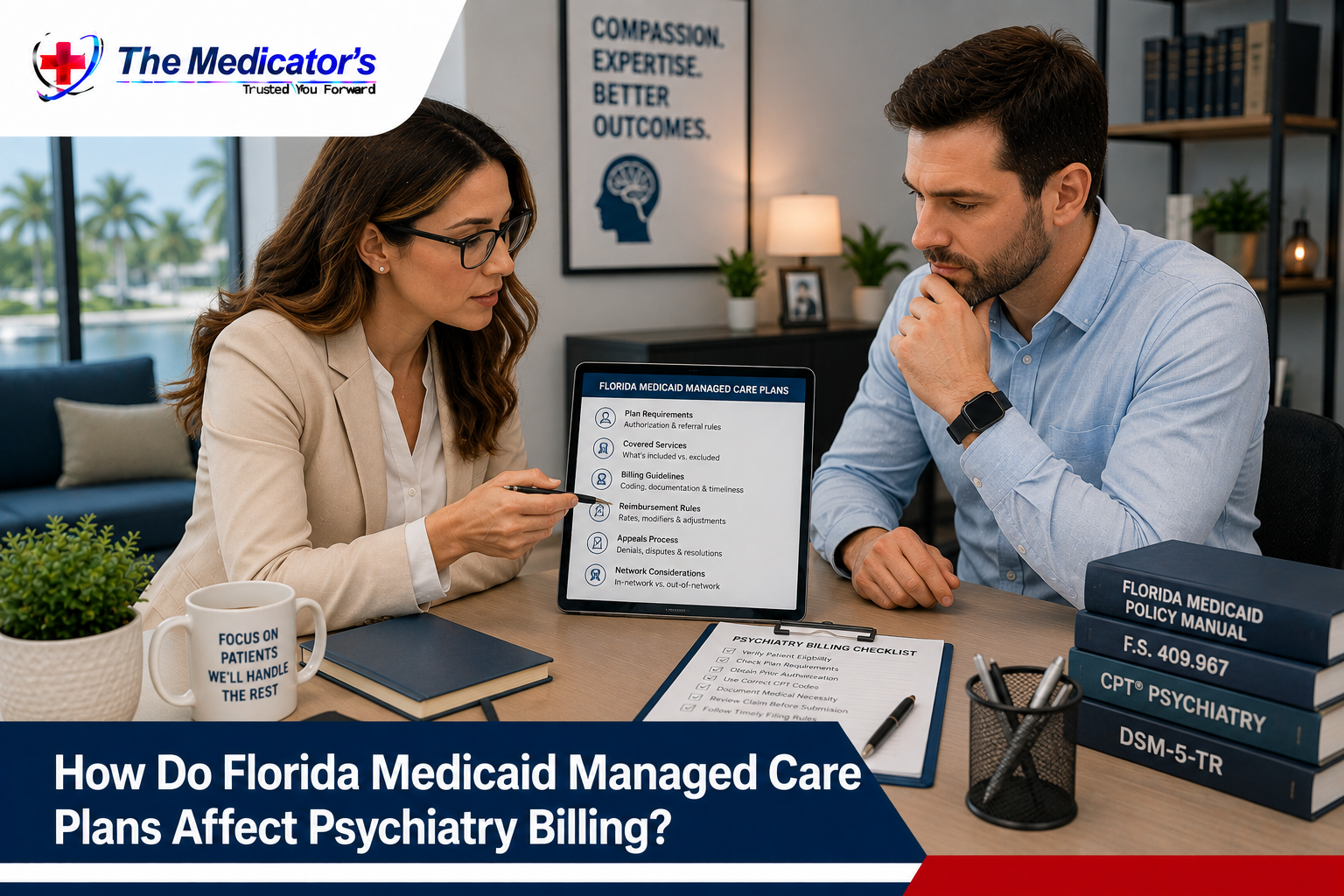
Florida Medicaid managed care affects psychiatry billing by requiring behavioral health practices to follow the applicable health plan’s provider participation rules, covered benefits, authorization requirements, claim submission procedures, and reimbursement policies. Under Florida’s Statewide Medicaid Managed Care (SMMC) program, providers must identify the member’s current plan and follow the requirements that apply to the specific service and date of care.
For psychiatric practices, these responsibilities can create administrative challenges when billing diagnostic evaluations, medication management, psychotherapy, psychological testing, and telepsychiatry services. An incorrect payer selection, inactive provider enrollment, missing authorization, unsupported code, or invalid telehealth billing detail can delay payment or result in a rejected or denied claim.
Practices that bill multiple Florida Medicaid managed care plans need a consistent process for eligibility verification, credentialing, authorization tracking, coding, electronic claim submission, denial follow-up, and accounts receivable management.
At The Medicator’s, we help healthcare practices evaluate their billing workflows and identify opportunities to improve claim management. Our psychiatry medical billing services in Florida are relevant for psychiatric clinics, mental health providers, outpatient behavioral health practices, and prescribers seeking specialized billing support.
If your team is experiencing repeated Medicaid denials, delayed reimbursement, or administrative backlogs, professional Florida Medicaid billing services can help organize these workflows and identify recurring problems.
Why Florida Medicaid Psychiatry Billing Requires Plan-Specific Management
Florida Medicaid managed care plans may use different provider networks, authorization procedures, claim requirements, and payment policies. Providers should not assume that a billing rule accepted by one plan automatically applies to another.
The following areas deserve particular attention.
1. Provider Credentialing and Medicaid Network Enrollment
Psychiatrists, psychiatric nurse practitioners, psychologists, therapists, and other behavioral health professionals must meet the applicable enrollment, credentialing, and network participation requirements for the services they provide.
Florida Medicaid enrollment and participation with an individual managed care plan are related but distinct administrative considerations. Practices should verify the provider’s status with the appropriate program and plan before billing services under that provider.
Common problems include:
- A rendering provider is not correctly linked to the billing entity.
- The provider’s enrollment or network status is inactive or incomplete.
- The claim identifies the wrong billing or rendering NPI.
- The service is submitted under a provider or location that is not authorized for the applicable arrangement.
- A change in practice location or provider information has not been reflected in the relevant records.
These problems can create claim rejections, denials, or payment delays. Regular credentialing reviews and accurate provider records help reduce avoidable administrative errors.
Practices that need help coordinating credentialing with billing operations can explore psychiatry medical billing in Florida and discuss whether additional provider enrollment support is appropriate.
2. Prior Authorization and Behavioral Health Medical Necessity
Prior authorization requirements depend on the member’s plan, benefit, service, and applicable policy. Some psychiatric services may be subject to authorization, service limits, or additional documentation requirements, while other services may not require advance approval under the relevant arrangement.
Before providing a service, verify whether authorization is required and whether the request covers the intended service, provider, and date or period of care.
For psychiatric diagnostic evaluations, psychological testing, intensive outpatient services, and other behavioral health procedures, the billing team should confirm the applicable policy rather than assume that every service requires the same approval.
An effective authorization workflow includes:
- Checking the current plan’s requirements before the service.
- Recording the authorization reference number when applicable.
- Confirming the approved service and applicable dates or limits.
- Tracking requests for additional clinical documentation.
- Communicating authorization changes to scheduling and clinical staff.
- Checking whether the completed service matches the approval before submitting the claim.
Medication step therapy and prescription coverage are also distinct from professional medical claim authorization. When a medication requires approval, staff should follow the applicable pharmacy benefit or medical benefit process rather than assume that one approval automatically covers every related service.
If your practice experiences repeated authorization-related denials, review your denial rate versus rejection rate to distinguish submission problems from claims denied during payer adjudication.
3. Florida Telepsychiatry Billing: POS Codes and Modifiers
Telepsychiatry billing requires accurate reporting of how and where the service was delivered. Place of Service (POS) codes and modifiers should follow the applicable Florida Medicaid policy and the specific managed care plan’s instructions.
Two commonly used telehealth place of service codes are:
- POS 02: Telehealth provided in a location other than the patient’s home.
- POS 10: Telehealth provided in the patient’s home.
Modifier requirements can vary according to the payer, claim type, service, and applicable billing instructions. Florida Medicaid’s fee-for-service telemedicine rule includes requirements for modifier GT, but providers should not assume that every managed care plan uses an identical claim format. For example, Sunshine Health has published plan-specific guidance that differs from a universal GT-modifier approach. Check the current instructions for the member’s plan and the date of service. https://ahca.myflorida.com/medicaid/statewide-medicaid-managed-care/medicaid-telehealth.html https://www.sunshinehealth.com/newsroom/telehealth-billing-update.html
Before submitting a telepsychiatry claim, verify:
- Whether the service is covered when delivered through telehealth.
- Whether the provider and service meet the applicable requirements.
- Whether POS 02 or POS 10 is appropriate.
- Whether a modifier is required and which modifier the plan accepts.
- Whether the claim includes the correct provider, diagnosis, and service details.
- Whether documentation supports the service delivered.
Incorrect assumptions about modifiers can create preventable claim edits. For more guidance, see POS Codes in Medical Billing.
4. Payer Portals, Clearinghouses, and Electronic Claim Submission
Behavioral health billing teams may need to work across multiple payer portals, authorization platforms, and clearinghouse workflows. Each claim must be routed to the appropriate payer using the required electronic transaction format and current billing information.
A reliable submission process should include:
- Confirming the patient’s active Medicaid managed care plan.
- Verifying the billing and rendering provider information.
- Checking authorization requirements and applicable reference numbers.
- Reviewing CPT or HCPCS codes, diagnosis codes, modifiers, and POS details.
- Correcting front-end errors before resubmitting rejected claims.
- Monitoring payer acknowledgments, remittance advice, and claim status.
- Documenting follow-up actions for claims that remain unresolved.
A clearinghouse acceptance message does not necessarily mean that a claim has been approved for payment. The payer may still review eligibility, coverage, medical necessity, coding, authorization, and other requirements.
Practices that need help managing this process can consider medical billing services or broader revenue cycle management services.
Florida Medicaid Psychiatry Billing Rules at a Glance
The following table summarizes important billing checkpoints. These are general workflow considerations, not universal coverage or authorization rules for every Florida Medicaid managed care plan.
| Billing Area | Example | What the Practice Should Verify |
|---|---|---|
| Psychiatric diagnostic evaluation | CPT 90791 and 90792 | Code accuracy, applicable service limits, coverage, and authorization requirements |
| E/M with psychotherapy add-on | CPT 90833 with an appropriate E/M code | Documentation, code pairing, time and service requirements, and applicable modifier rules |
| Telepsychiatry | POS 02 or POS 10 where appropriate | Patient location, covered modality, and payer-specific POS and modifier instructions |
| Provider participation | Billing and rendering provider information | Active enrollment, network participation, and correct NPI relationships |
| Claim submission | Electronic professional claim | Correct payer routing, coding, authorization information, and required claim fields |
| Timely filing | Original claims and corrected claims | The applicable plan’s filing deadline and any specific correction or appeal rules |
| Denial follow-up | Rejected or denied claim | Remittance reason, correction requirements, appeal rights, and submission deadlines |
Important: Do not assume that CPT 90791 or 90792 always requires authorization, that modifier 25 applies to every E/M and psychotherapy combination, or that all plans use the same timely filing period. Confirm the rules for the specific plan and service.
For official Florida Medicaid resources and current fee schedules, consult the Florida Agency for Health Care Administration (AHCA). Managed care plan provider manuals and current provider notices should also be checked before billing.
How to Reduce Florida Medicaid Psychiatry Claim Denials
Recurring denials can indicate problems with eligibility, credentialing, coding, authorization, documentation, claim routing, or payer follow-up. Identifying the underlying cause is more useful than repeatedly resubmitting claims without correcting the issue.
1. Verify Medicaid Eligibility and the Current Managed Care Plan
Check eligibility and plan assignment before the service using the applicable eligibility system or payer workflow. Record the coverage information relevant to the date of service and verify that the claim will be sent to the correct plan.
Do not rely only on an earlier eligibility check when coverage or plan assignment may have changed.
2. Check Provider Enrollment and Network Status
Confirm that the billing and rendering providers meet the applicable enrollment and network requirements. Review NPI details, practice locations, and provider-to-group relationships before transmitting claims.
If the provider is not properly linked or the network information is outdated, resolve the issue through the appropriate enrollment or plan process.
3. Validate CPT Codes, Modifiers, and Diagnosis Coding
Ensure that the submitted codes match the documented service and that the diagnosis supports the claim. For E/M services paired with psychotherapy, confirm the applicable code combination, documentation, time requirements, and modifier rules.
For telepsychiatry, verify the correct POS and modifier instructions rather than applying a single format to every plan.
Review Why Unspecified ICD-10 Codes Get Claims Denied and How to Fix It for additional guidance on diagnosis specificity.
4. Identify Whether the Problem Is a Rejection or a Denial
A rejection usually indicates that a claim did not pass an initial submission or validation step. A denial occurs when the payer adjudicates the claim and declines payment, in whole or in part.
The correction process differs. A rejected claim may need a formatting or data correction, while a denied claim may require corrected coding, additional documentation, an appeal, or another payer-directed action.
Review the explanation or remittance details, document the actual reason, and follow the appropriate process. Learn more in our guide to the difference between denial rate and rejection rate.
5. Track Outstanding Claims and A/R Aging
Unresolved claims can become harder to manage as filing and appeal deadlines approach. Maintain a work queue for outstanding claims, record the last action taken, and assign a next step and responsible staff member.
Review your A/R aging report to prioritize older balances, identify recurring payer issues, and determine whether authorization or credentialing problems are contributing to delays.
How Outsourced Florida Psychiatry Billing Services Can Help
Managing multiple Florida Medicaid plans requires consistent administrative processes and accurate billing information. When internal staff must handle eligibility checks, credentialing, authorization requests, claim corrections, appeals, and payment posting simultaneously, unresolved tasks can accumulate.
Outsourced psychiatry billing services may help practices that need additional capacity, specialized behavioral health billing support, or more consistent claim follow-up.
Depending on the scope of the agreement, a billing partner may assist with:
- Eligibility and benefits verification.
- Provider enrollment and credentialing coordination.
- Authorization tracking and documentation follow-up.
- Psychiatric CPT and diagnosis coding review.
- Telehealth POS and modifier checks.
- Electronic claim submission and rejection correction.
- Denial management and payer follow-up.
- Payment posting and remittance review.
- Accounts receivable monitoring and reporting.
- Recurring billing issue analysis.
When comparing a behavioral health billing company with an in-house billing team, evaluate its experience with psychiatric services, familiarity with Medicaid managed care, quality control procedures, reporting capabilities, communication standards, and approach to handling unresolved claims.
Ask potential vendors which functions are included, which remain your staff’s responsibility, how performance is reported, and how patient information is protected.
The Medicator’s offers psychiatry medical billing in Florida and broader revenue cycle management services for practices evaluating their billing operations.
Why Choose The Medicator’s for Florida Medicaid Psychiatry Billing?
Florida psychiatric practices may need support with multiple plan requirements, recurring claim errors, provider enrollment issues, telehealth billing questions, and outstanding accounts receivable.
The Medicator’s works with healthcare practices to evaluate billing workflows and identify opportunities to improve claim processing, denial follow-up, and revenue cycle visibility. Support can be tailored to the practice’s needs and the services included in the engagement.
Our medical billing support can help your team focus on the following operational priorities:
- More consistent claim submission: Review coding, provider information, and required claim details before submission.
- Structured denial follow-up: Categorize denials, identify corrective actions, and monitor unresolved claims.
- Better accounts receivable visibility: Track outstanding balances and prioritize follow-up based on age, payer, and denial reason.
- Improved workflow coordination: Connect eligibility, authorization, coding, billing, and payment follow-up processes.
- Practice-specific performance review: Identify recurring problems using available billing and claim data instead of relying on unsupported performance promises.
If your psychiatric practice needs broader operational support, explore our internal medicine revenue cycle management services or request a practice analysis to discuss potential billing workflow improvements.
Get Help With Florida Medicaid Psychiatry Billing
Managing Florida Medicaid managed care claims can become complicated when each plan has different operational requirements and your team is responsible for credentialing, eligibility, authorizations, coding, claim submission, and follow-up.
If your practice is dealing with repeated Medicaid claim denials, telepsychiatry billing errors, authorization delays, or growing A/R balances, professional billing support may help you identify the causes and establish a more consistent process.
Looking for Florida Medicaid psychiatry billing services? Contact The Medicator’s to discuss your practice’s billing challenges, current workflow, and potential revenue cycle support options.
- Explore our psychiatry medical billing services in Florida.
- Review our medical billing services.
- Request a practice analysis to discuss opportunities for improvement.
Call (888) 277-1460 or email info@themedicators.com to get started.
