
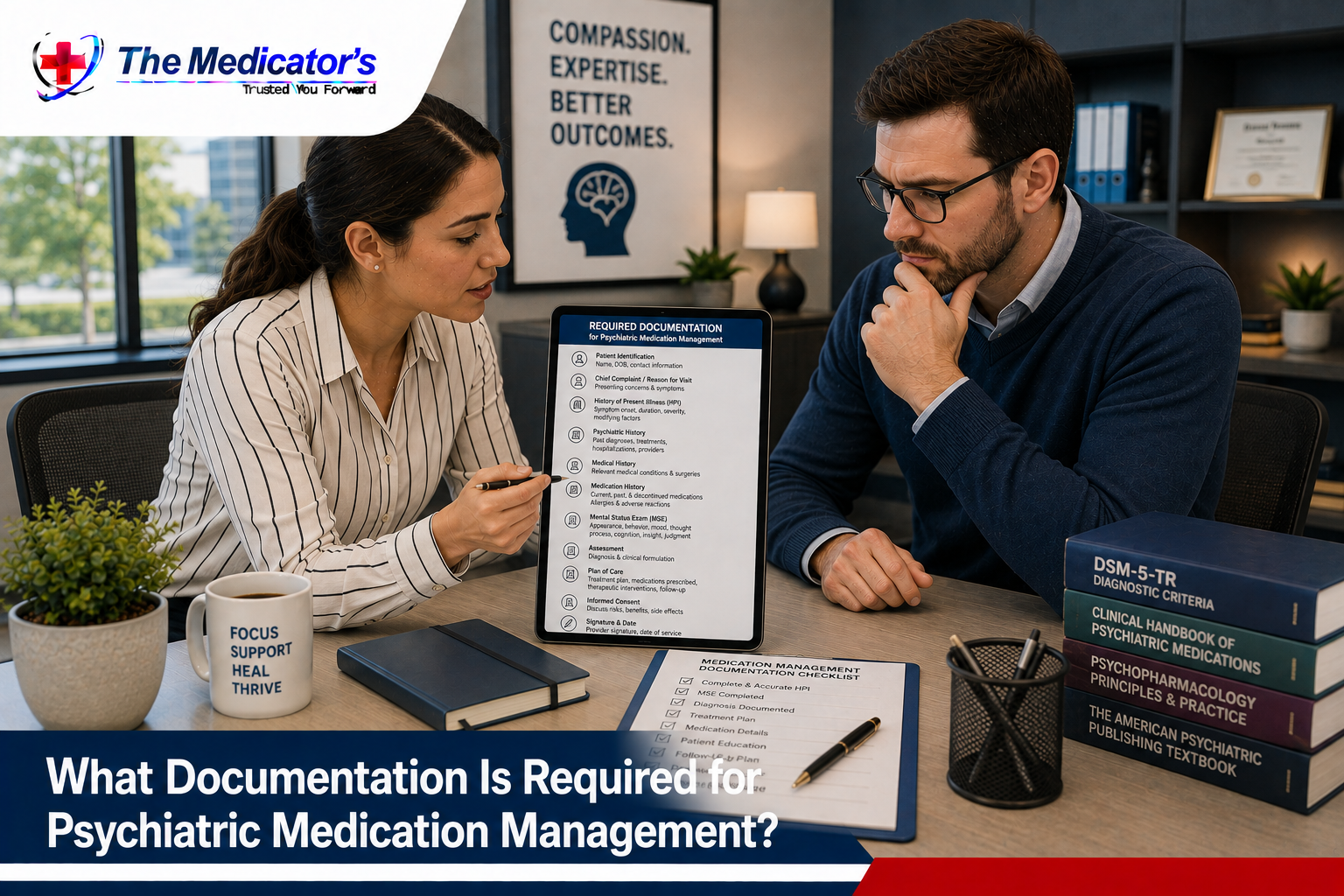
Psychiatric medication management documentation requires recording the patient’s current medications, dosages, clinical rationale for any changes, side effect evaluations, mental status exams, and safety assessments for risks like self-harm. Records must also document patient education, informed consent, and mandatory state Prescription Drug Monitoring Program (PDMP) checks for controlled substances. Comprehensive documentation protects patient safety and provides the clinical necessity required to defend Evaluation and Management (E/M) code levels during payer audits.
At The Medicator’s, our certified behavioral health coding team delivers specialized medical billing and revenue cycle solutions, including dedicated psychiatry medical billing in Florida and nationwide. We perform clinical chart audits, enforce documentation compliance, and eliminate coding errors to help psychiatric practices maintain clean claim acceptance rates above 97%.
Core Clinical Components for Medication Management Progress Notes
To satisfy Medicare, Medicaid, and commercial payer audit standards, psychiatric medication management progress notes must include specific clinical and risk elements:
1. Essential Encounter Metadata & Chief Complaint
Every encounter note must establish foundational visit details, including the date of service, total face-to-face duration, location, and the patient’s chief complaint detailing active psychiatric symptoms. For virtual visits, progress notes must comply with telehealth mandates, including origin verification as outlined in our guide to POS codes in medical billing (e.g., POS 10 for patient home or POS 02 for facility).
2. Comprehensive Medication Profile & Clinical Rationale
The progress note must clearly document active psychiatric and medical prescriptions, including drug name, strength, dosage, route, and administration frequency. Any decision to adjust, titrate, discontinue, or initiate a medication must be supported by an explicit clinical rationale that justifies medical necessity.
3. Efficacy, Side Effect Profile & Adherence Tracking
Payers require documented evidence that the clinician evaluated both therapeutic response and potential adverse effects. Notes should detail:
Treatment Response: Symptom reduction or clinical stability.
Adverse Effects: Screening for sedation, weight changes, metabolic issues, or extrapyramidal symptoms.
Medication Compliance: Patient self-reported adherence or pharmacy refill consistency.
4. Mental Status Examination (MSE) & Safety Risk Assessment
A structured Mental Status Exam must evaluate appearance, speech, thought content, thought process, mood, affect, insight, and judgment. Additionally, every medication management note must include a documented safety risk assessment covering suicidal or homicidal ideation, self-harm risks, and protective factors.
5. Compliance, Informed Consent & PDMP Audits
When prescribing controlled substances (such as stimulants or benzodiazepines), clinicians must document patient education regarding potential risks, benefits, and alternative therapies. Notes must also record mandatory queries of the state Prescription Drug Monitoring Program (PDMP) database and log urine drug screen (UDS) results when applicable.
Documentation Checklist for Audit Protection
The following outline details essential progress note sections, clinical requirements, and compliance checks:
Medication Inventory: Requirement: Complete list of current drugs, dosages, and compliance. Audit Value: Proves active prescription monitoring.
Clinical Rationale: Requirement: Justification for all dosage adjustments, additions, or stops. Audit Value: Establishes medical decision-making complexity.
Side Effect Screening: Requirement: Assessment of adverse drug reactions or metabolic monitoring. Audit Value: Validates ongoing clinical oversight.
Risk & Safety Assessment: Requirement: Evaluation of suicide/violence risk and safety planning. Audit Value: Fulfills clinical risk management standards.
Actionable Steps to Improve Documentation and Prevent Denials
Standardize EHR Medication Management Templates: Configure clinical EHR templates to include mandatory fields for side effect checks, risk assessments, and PDMP verifications.
Differentiate Time Spent on Dual Services: When performing medication management alongside same-day psychotherapy, maintain separate duration statements for E/M decision-making and face-to-face therapy time to prevent bundling edits.
Differentiate Rejections from Denials: Recognizing whether claims fail due to front-end clearinghouse typos or back-end medical necessity audits is simplified by monitoring your practice’s overall denial rate vs. rejection rate.
Monitor Aging Accounts Receivable: Regularly review unpaid medication management lines on your practice’s A/R aging report to catch documentation-related denials early.
The Documentation Audit & Recovery Workflow: What to Expect
Maintaining audit-ready documentation and recovering denied claims involves a structured four-phase process:
EHR Template Alignment: Standardizing progress notes to capture all required clinical elements, time tracking, and risk assessments.
Clinical Chart Auditing: Reviewing clinical records against billed E/M code levels to ensure alignment with medical decision-making complexity.
Claim Scrubbing & Modifier Validation: Appending required modifiers (e.g., Modifier 25 for dual services) and verifying diagnosis coding.
Appeals & Chart Submission: Responding to payer medical necessity audits with organized clinical progress notes and PDMP compliance records.
Optimize Your Behavioral Health Revenue with The Medicator’s
Navigating complex documentation standards, medical decision-making rules, and payer audit guidelines can create severe administrative friction for psychiatric practices.
At The Medicator’s, our certified coding and billing specialists deliver comprehensive revenue cycle management across medical specialties. Beyond our dedicated focus on psychiatry medical billing in Florida and behavioral health billing, we provide specialized RCM support for primary care and internal medicine practices through our internal medicine RCM services in USA.
Partnering with our billing team ensures:
First-Pass Clean Claim Acceptance Above 97%: Stopping coding mismatches, modifier omissions, and documentation gaps before claims are submitted.
Days in A/R Kept Under 30 Days: Accelerating reimbursement and preventing aged accounts from stalling practice cash flow.
Full Audit Protection & Financial Recovery: Ensuring clinical progress notes defend every billed code level during payer audits.
Are documentation requirements or medication management denials impacting your clinic’s cash flow? Capture every dollar you earn. Request a free, custom practice analysis with The Medicator’s team today!
