
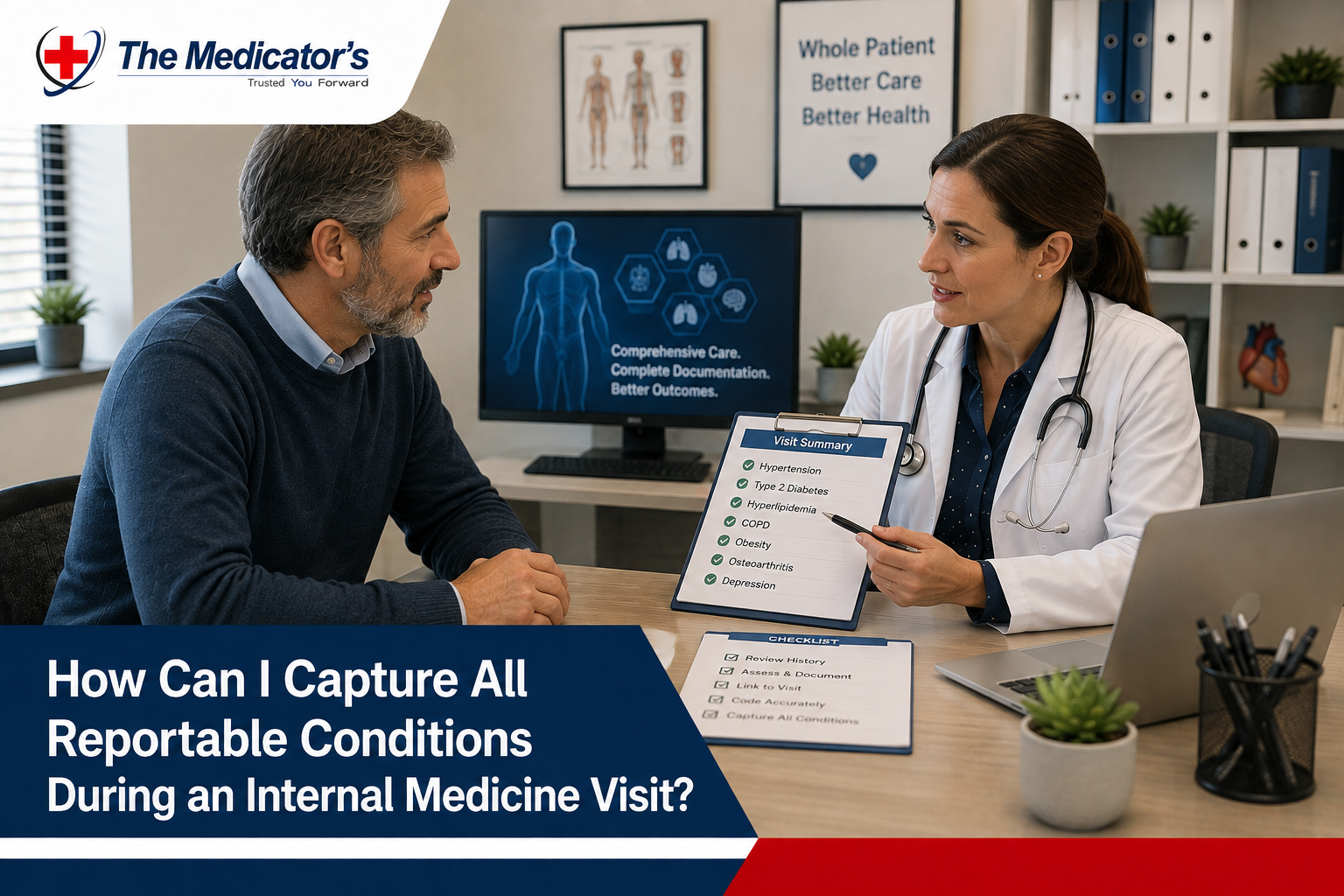
To capture all reportable conditions during an internal medicine visit, you must implement a structured, multi-step documentation workflow that combines pre-visit chart reviews, targeted clinical inquiries during the encounter, and explicit clinical linkage in your progress notes. Capturing every active acute, chronic, and co-morbid condition ensures complete diagnostic coding, drives accurate risk adjustment (such as HCC scores), and establishes the high Medical Decision Making (MDM) complexity needed to support appropriate Evaluation and Management (E/M) code levels.
At The Medicator’s, our certified coding and revenue cycle team provides specialized billing solutions, including dedicated internal medicine billing solutions in Florida and nationwide. We help internal medicine practices refine clinical documentation workflows, eliminate code selection gaps, and maintain clean claim acceptance rates above 97%.
3-Phase Workflow to Capture All Reportable Conditions
Systematically documenting every reportable condition requires structured protocols before, during, and after the patient encounter:
1. Pre-Visit Chart Auditing & Problem List Reconciliation
Before stepping into the exam room, review the patient’s historical health records, active problem list, prescription refill history, and recent specialist consult notes. Identify historical chronic conditions—such as compensated heart failure, chronic kidney disease, or diabetic neuropathy—that require annual re-evaluation or continuous medication management, even if the patient is not presenting with acute symptoms.
2. Comprehensive Encounter Assessment & Scribe Protocols
During the physical exam and review of systems (ROS), actively evaluate how secondary or co-existing conditions impact the primary chief complaint:
Assess Status: Explicitly state whether each documented condition is stable, improving, deteriorating, or uncontrolled.
Document Management: Record all clinical actions taken for every condition, including continuing current prescription dosages, ordering surveillance lab panels, or providing dietary counseling. Under ICD-10 coding guidelines, conditions that are evaluated, monitored, or managed during an encounter are reportable.
3. Maximum ICD-10 Specificity & Clinical Linkage
Avoid submitting generic diagnostic descriptors on claim forms. Using unspecified diagnosis codes fails to capture true patient complexity and frequently leads to claim rejections, as highlighted in our guide explaining why unspecified ICD-10 codes get claims denied. Ensure every secondary diagnosis is coded to its highest level of specificity (4th and 5th-digit ICD-10 codes) and linked directly to its corresponding treatment plan.
Condition Capture & Coding Requirements at a Glance
The following matrix outlines condition categories, required documentation elements, and clinical coding impact:
Primary Acute Complaint: Required Documentation: Onset, severity, exam findings, and definitive diagnostic impression. Coding Impact: Establishes primary diagnosis on CMS-1500 claim form.
Stable Chronic Conditions: Required Documentation: Current stability status, medication continuity, or routine lab monitoring. Coding Impact: Supports Level 4/5 E/M decision-making complexity (CPT 99214/99215).
Secondary Co-Morbidities: Required Documentation: Impact on primary treatment choices (e.g., renal dosing adjustments). Coding Impact: Drives Risk Adjustment/HCC scoring and medical necessity proof.
Social Determinants of Health (SDOH): Required Documentation: Z-codes (Z55–Z65) noting economic, housing, or transportation barriers. Coding Impact: Fulfills Quality Payment Program (QPP) measures and elevates MDM risk factors.
Actionable Steps to Improve Documentation and Prevent Denials
Leverage EHR Clinical Decision Support (CDS) Prompts: Configure your Electronic Health Record system to display smart alerts for unconfirmed chronic conditions, missing annual re-evaluations, or incomplete ICD-10 codes.
Audit A/R Buckets for Uncaptured Complexity: Analyze unpaid internal medicine claim lines on your practice’s A/R aging report to identify claims denied due to lack of medical necessity or missing secondary diagnosis codes.
Differentiate Rejections from Denials: Understanding whether claim shortfalls stem from clearinghouse code format errors or post-adjudication medical necessity edits is simplified by tracking your practice’s overall denial rate vs. rejection rate.
Link Every Billed Code to a Specific Diagnosis: Ensure that ancillary procedures or diagnostic labs ordered during the visit are mapped directly to their corresponding ICD-10 codes to prevent unbundling edits.
The Diagnostic Documentation & Billing Workflow: What to Expect
Capturing all reportable conditions and converting them into clean claims involves a structured four-phase revenue cycle process:
Pre-Encounter Preparation: Reviewing patient history, outstanding care gaps, and chronic disease registries prior to the visit.
Clinical Encounter & Linkage: Evaluating active conditions, documenting “status + plan” for each, and recording precise time/MDM parameters.
Coding & Pre-Submission Scrubbing: Mapping clinical notes to high-specificity ICD-10 codes, attaching required modifiers, and executing clearinghouse rule checks.
Remittance Audit & Quality Review: Reviewing Explanation of Benefits (EOB) statements to confirm full contractual reimbursement without downcoding edits.
Optimize Your Internal Medicine Revenue with The Medicator’s
Missed chronic diagnoses, incomplete condition documentation, and unspecified ICD-10 coding can lead to severe downcoding edits, reduced risk-adjustment scores, and lost revenue for internal medicine practices.
At The Medicator’s, our certified coding and billing specialists deliver end-to-end revenue cycle management across medical specialties. Beyond our dedicated focus on internal medicine billing solutions in Florida, we provide comprehensive nationwide billing support through our internal medicine RCM services in USA.
Partnering with our billing team ensures:
First-Pass Clean Claim Acceptance Above 97%: Eliminating diagnosis mismatches, modifier omissions, and unspecified code edits before claims are submitted.
Days in A/R Kept Under 30 Days: Accelerating reimbursement and preventing aged evaluation claims from stalling cash flow.
Full Financial Recovery for Patient Complexity: Ensuring your practice is fully reimbursed for every documented acute and chronic condition managed during the encounter.
Are missed diagnoses, downcoding edits, or documentation gaps impacting your clinic’s cash flow? Capture every dollar you earn. Request a free, custom practice analysis with The Medicator’s team today!
