
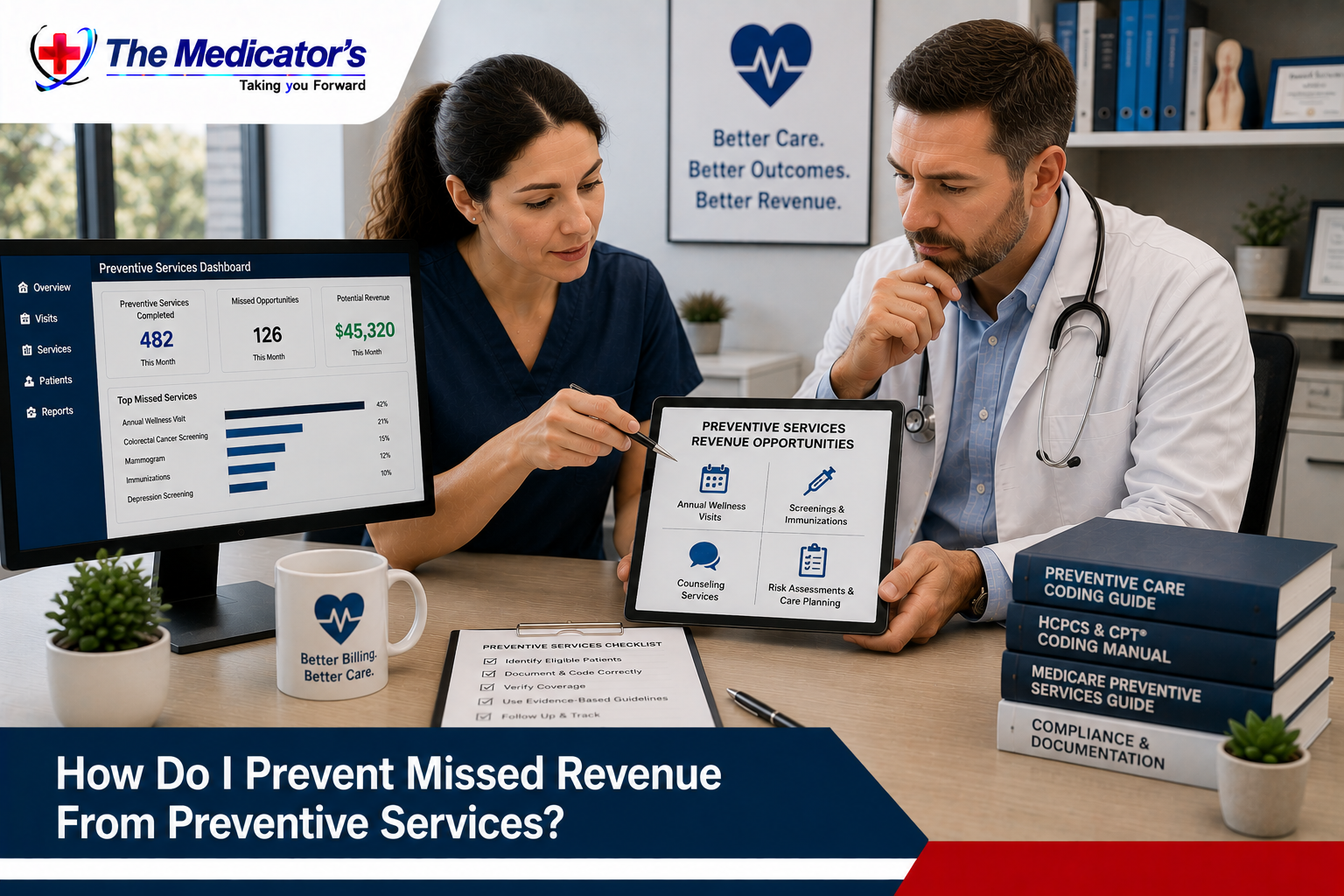
Preventing missed revenue from preventive services requires bridging operational gaps across front-desk verification, EHR clinical charting, and claims scrubbing. Primary care and specialty practices routinely lose revenue due to unverified payer frequency limits, unbilled preventive add-on services, unapplied Modifier 25 edits, and failing to analyze systemic denial patterns.
At The Medicator’s, our certified coding and revenue cycle experts deliver specialized billing solutions, including dedicated internal medicine billing solutions in Florida and nationwide. We help practices eliminate preventive billing revenue leaks, enforce compliant modifier logic, and maintain clean claim acceptance rates above 97%.
Strategic Areas to Stop Preventive Service Revenue Leakage
Maximizing reimbursement for preventive care involves implementing rigorous safeguards across every phase of the revenue cycle:
1. Real-Time Front-End Eligibility and Frequency Checks
Submitting preventive claims (such as Medicare Annual Wellness Visits or commercial preventive exams) before verifying eligibility is a leading cause of administrative denials.
Frequency Limit Verification: Check real-time eligibility (RTE) portals to confirm exact last-service dates. Medicare allows subsequent AWVs (CPT/HCPCS G0439) once every 11 full calendar months; submitting a claim even one day early results in an immediate rejection.
Commercial Preventive Coverage Rules: Verify whether the patient’s commercial plan covers routine physicals (CPT 99381–99397) annually by calendar year or rolling 365 days.
2. Capture Unbilled Preventive Add-On Services
Practices frequently miss billable add-on services performed alongside routine preventive exams. Certified coders should audit progress notes for secondary preventive opportunities, including:
Advance Care Planning (CPT 99497): Billed when discussing end-of-life care or advance directives during a Medicare AWV ($0 copay for the patient when combined with an AWV).
Depression Screening (HCPCS G0444 / CPT 96127): Billable annually for standardized depression risk evaluations (e.g., PHQ-9).
Alcohol Misuse Screening (HCPCS G0442): Covered for annual behavioral counseling and screening interventions.
Cardiovascular Disease Screening (HCPCS G0446): Covered for annual intensive behavioral therapy for cardiovascular disease.
3. Enforce Compliant Modifier 25 Rules for Same-Day Visits
When a patient presents for a preventive exam but requires evaluation and treatment for a significant, separate acute symptom or active chronic condition, practices must bill both services:
Separate Encounter Progress Notes: Ensure clinical notes clearly partition preventive HRA findings from problem-oriented Medical Decision Making (MDM).
Append Modifier 25: Attach Modifier 25 to the problem-oriented office visit code (CPT 99202–99215) to prevent automated payer bundling edits.
High-Specificity ICD-10 Diagnosis Linking: Link the preventive CPT code to Z00.00 or Z00.01 and link the E/M code to specific diagnostic codes. Non-specific diagnostic coding routinely causes clearinghouse holds, as detailed in our guide explaining why unspecified ICD-10 codes get claims denied.
4. Optimize Pre-Submission Scrubbing and Root-Cause Tracking
Relying on manual post-denial follow-up wastes administrative resources. Implement automated EHR charge-capture rules that catch missing screening codes, invalid modifier combinations, or timing mismatches prior to claim submission. Group recurring preventive claim denials by root cause on your remittance reports to address underlying documentation or front-desk workflow gaps.
Key Preventive Services & Add-On Billing Matrix
The following matrix highlights core preventive codes, frequency limits, and billable add-on opportunities:
| Service / Code | Clinical Description | Payer Frequency Rules | Billable Add-On Options |
| HCPCS G0438 | Initial Medicare Annual Wellness Visit | Once in a lifetime (After 12 mos Part B) | CPT 99497 (Advance Care), G0444 (Depression) |
| HCPCS G0439 | Subsequent Medicare Annual Wellness Visit | Once every 11 full calendar months | CPT 99497, HCPCS G0442 (Alcohol Screening) |
| CPT 99381–99397 | Commercial Preventive Physical Exam | Age/Plan specific (12 mos or calendar year) | CPT 96127 (Behavioral/Emotional Assessment) |
| CPT 99202–99215 | Office Visit (billed with AWV/Physical) | As clinically required (Requires Modifier 25) | CPT 99417 / HCPCS G2212 (Prolonged Service) |
Actionable Steps to Prevent Preventive Service Revenue Losses
Conduct Pre-Visit Intake & Patient Disclosure: Inform patients before rooming that preventive checkups cover routine screening only, and addressing new symptoms or chronic illness adjustments will require a separate E/M service charge.
Differentiate Rejections from Denials: Pinpointing whether preventive claim errors stem from front-end clearinghouse timing edits or back-end non-covered benefit rules is simplified by monitoring your practice’s overall denial rate vs. rejection rate.
Monitor Outstanding A/R Aging Buckets: Audit unpaid preventive claim lines on your practice’s A/R aging report to catch claims stalled in secondary insurance reviews.
Schedule Monthly Provider Documentation Reviews: Review sample progress notes with clinical teams to ensure all preventive screening questionnaires (HRAs, PHQ-9s) are fully attested and supported in the electronic chart.
The Preventive Care Revenue Optimization Workflow: What to Expect
Establishing a leak-proof preventive billing workflow follows a structured four-phase process:
Real-Time Eligibility & Verification: Verifying patient coverage, last-service dates, and secondary benefits prior to appointment confirmation.
Clinical Intake & Segregated Charting: Administering Health Risk Assessments, capturing mandatory screening templates, and documenting any separate acute/chronic care.
Coding Validation & Pre-Submission Scrubbing: Assigning appropriate preventive CPT/G-codes, appending Modifier 25 to dual-service visits, and capturing allowable add-on codes.
Remittance Audit & Denial Trend Analysis: Monitoring ERA responses, resolving front-end rejections rapidly, and updating EHR billing rules to eliminate recurring errors.
Optimize Your Internal Medicine Revenue with The Medicator’s
Managing complex Medicare AWV frequency checks, commercial physical guidelines, Modifier 25 compliance, and preventive screening add-on codes can create severe administrative strain and missed revenue for primary care and internal medicine practices.
At The Medicator’s, our certified coding and billing specialists deliver complete revenue cycle management across medical specialties. Beyond our dedicated internal medicine billing solutions in Florida, we provide comprehensive nationwide billing support through our internal medicine RCM services in USA.
Partnering with our billing team ensures:
First-Pass Clean Claim Acceptance Above 97%: Eliminating frequency timing rejections, unapplied modifier bundling edits, and missing screening codes before claims drop.
Days in A/R Kept Under 30 Days: Accelerating reimbursement and keeping aged preventive claims off your practice ledgers.
Full Financial Recovery for Preventive Care: Capturing every allowable screening add-on code and protecting your revenue for both wellness planning and complex care management.
Are preventive claim rejections, missed screening codes, or modifier denials affecting your clinic’s cash flow? Capture every dollar you earn. Request a free, custom practice analysis with The Medicator’s team today!
