
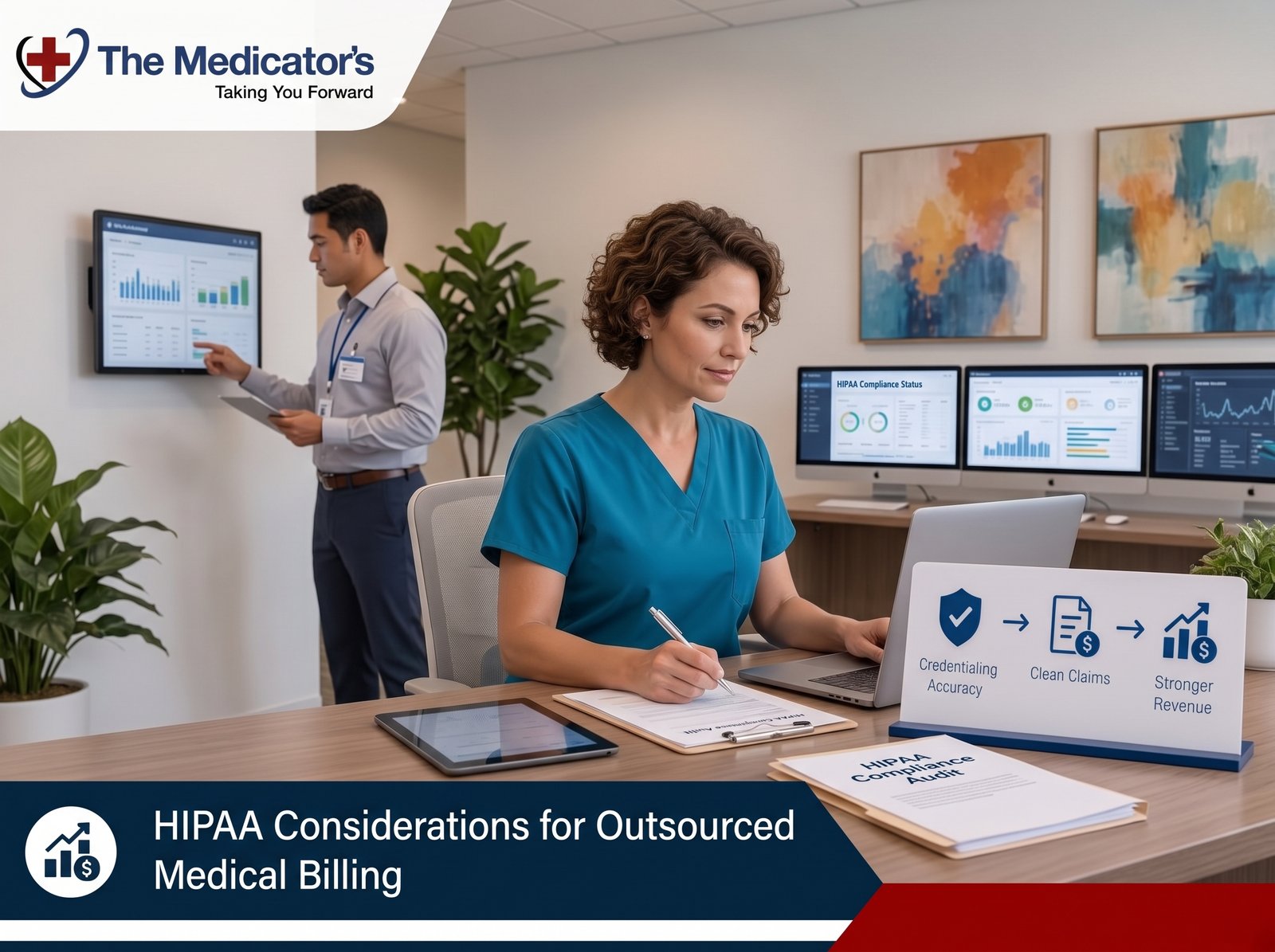
Outsourced medical billing HIPAA compliance requires healthcare practices to evaluate how their billing partners access, use, store, and protect protected health information (PHI). Before hiring a medical billing company, practices should review the applicable Business Associate Agreement (BAA), security safeguards, access controls, incident-reporting procedures, and subcontractor responsibilities. Choosing a billing partner with appropriate contractual and operational safeguards helps practices assess privacy risks while managing claims, denials, and accounts receivable.
If your practice is comparing outsourced medical billing companies, do not evaluate vendors on price alone. Review their billing expertise, data protection practices, service scope, reporting, and contract terms before sharing patient information. The Medicator’s medical billing services can be evaluated alongside your practice’s operational and billing requirements.
Is Outsourcing Medical Billing HIPAA Compliant?
Yes. Outsourcing medical billing is permitted under HIPAA when the parties meet applicable privacy, security, and contractual requirements. A medical billing company that creates, receives, maintains, or transmits PHI on behalf of a covered entity will generally qualify as a business associate.
In many cases, the practice and billing vendor must enter into a written BAA that defines permitted uses and disclosures of PHI, safeguards, breach reporting responsibilities, and relevant subcontractor obligations.
However, signing a BAA alone does not establish that the entire arrangement is compliant. Practices must also assess the vendor’s actual security practices and determine whether its procedures are appropriate for the services provided.
For official guidance, review the U.S. Department of Health and Human Services (HHS) resource on HIPAA business associates.
What Should a HIPAA-Compliant Medical Billing Company Provide?
When comparing HIPAA-compliant medical billing companies, assess the following areas before granting access to patient records.
1. Business Associate Agreement Requirements
A BAA should clearly establish the vendor’s responsibilities for handling PHI. Before signing an outsourced medical billing contract, review whether the agreement addresses:
- Permitted uses and disclosures of patient information.
- Applicable safeguards for electronic PHI.
- Reporting of security incidents and breaches as required.
- Restrictions and obligations involving subcontractors.
- Data return or destruction when the relationship ends, where feasible and applicable.
- Responsibilities and procedures for addressing contractual violations.
A standard confidentiality agreement should not automatically be treated as a substitute for a BAA. The agreement should reflect the actual services, information access, and responsibilities involved.
Practices can consult the official HHS sample business associate agreement provisions when preparing for vendor discussions.
2. PHI Access Controls and Workforce Security
Medical billing teams may need access to patient demographics, insurance information, diagnosis codes, procedure details, claims, and remittance records. Access should be appropriate to each person’s assigned duties.
Ask prospective vendors how they:
- Assign and review user permissions.
- Protect accounts with suitable authentication controls.
- Train staff on privacy and security responsibilities.
- Remove access when employees change roles or leave.
- Monitor access to sensitive information.
- Investigate inappropriate access or disclosures.
A billing partner should be able to explain how these procedures are applied to the services it performs for your practice.
3. Electronic PHI Security Safeguards
Electronic protected health information requires appropriate safeguards under the HIPAA Security Rule. During a vendor security assessment, ask how the company manages:
- Secure transmission of patient and billing information.
- User authentication and account security.
- Audit logs and access monitoring.
- Backup and recovery procedures.
- Security risk analysis and risk management.
- Incident response and business continuity.
- Workforce security policies and training.
The appropriate safeguards depend on the environment and risks involved. Review the HHS HIPAA Security Rule guidance when assessing a prospective billing vendor.
4. Subcontractor and Third-Party Security
Some medical billing companies use third-party platforms, technology providers, or subcontractors. If a subcontractor handles PHI on behalf of a business associate, applicable business associate requirements may also apply to that relationship.
Before hiring a medical billing outsourcing company, ask which third parties may handle patient information, how their responsibilities are documented, and how security incidents are escalated.
5. Incident Reporting and Data Retention
Your contract should clarify how security incidents are handled, who investigates them, and how notifications are made in accordance with applicable requirements.
Also confirm how PHI will be retained, returned, or securely destroyed when the agreement ends, where feasible and applicable. The vendor transition plan should address access removal, records management, and the handling of outstanding claims.
What Are the Risks of Outsourcing Medical Billing Without Proper HIPAA Safeguards?
Choosing a vendor without reviewing its contractual and security practices can create privacy, compliance, and operational risks.
Common weaknesses include:
- Sharing PHI before required contractual arrangements are in place.
- Giving billing staff broader access than their duties require.
- Failing to review subcontractor access to patient information.
- Assuming a signed BAA guarantees that all safeguards are in place.
- Using insecure methods to exchange patient records or billing files.
- Failing to establish incident-reporting procedures.
- Leaving former vendor accounts active after a contract ends.
- Overlooking data-return and transition requirements.
Outsourcing does not automatically transfer every HIPAA responsibility to the vendor. Covered entities and business associates have their own applicable obligations based on their roles and activities.
Practices that also need to review claim accuracy and billing processes can consider medical billing audit services to assess coding, claims, and workflow issues within the agreed audit scope.
How to Choose an Outsourced Medical Billing Company
When searching for outsourced medical billing services, compare each vendor’s security practices, billing expertise, service scope, reporting, and contract terms.
Use this checklist during vendor selection:
| Evaluation area | What to verify |
|---|---|
| BAA and contract | Will the vendor sign an appropriate BAA before PHI is shared? |
| Security safeguards | What processes protect the patient information it handles? |
| Staff access | How are user permissions assigned, reviewed, and removed? |
| Subcontractors | Which third parties may access PHI, and how are their responsibilities governed? |
| Incident response | How are incidents investigated and reported? |
| Billing expertise | Does the vendor understand your specialty, payer mix, and billing workflows? |
| Reporting | Will you receive reports on claims, denials, payments, and outstanding balances? |
| Contract exit | How will data, system access, and open claims be managed when services end? |
Ask vendors to explain their safeguards and provide relevant documentation where appropriate. Avoid relying solely on broad marketing claims about being “HIPAA certified” or “fully compliant.” Evaluate the actual contractual obligations and security processes relevant to your arrangement.
For broader billing support, compare revenue cycle management services alongside the vendor’s security and operational capabilities.
Is Outsourcing Insurance Eligibility Verification HIPAA Compliant?
Outsourcing insurance eligibility verification can be permissible under HIPAA when applicable requirements for PHI access, business associate relationships, and safeguards are met.
Eligibility verification may involve patient identifiers, insurance details, coverage information, and other data needed to confirm benefits. Before outsourcing this function, review the vendor’s access permissions, contractual responsibilities, data exchange methods, and procedures for protecting the information it handles.
Ask whether eligibility verification is included in the billing agreement, whether a subcontractor performs the service, and how verification results are shared with your team.
Explore eligibility verification services if your practice needs support with insurance verification workflows.
Can You Outsource A/R Management and Denial Management While Protecting PHI?
Yes. Accounts receivable management and denial management can be outsourced when the arrangement meets applicable HIPAA requirements and appropriate safeguards are in place.
These services may involve claim details, payer correspondence, patient information, remittance records, and supporting documentation. The vendor should have appropriate access permissions and documented processes for handling these records.
Before hiring an outsourced A/R and denial management company, ask how it prioritizes unpaid claims, tracks appeal deadlines, documents follow-up, and protects patient information throughout the process.
Review A/R management services and how to read an A/R aging report to understand how outstanding balances can be organized and monitored.
You can also read Denial Rate vs. Rejection Rate: The Difference Every Practice Should Know to understand why claim rejections and payer denials should be tracked separately.
How Much Does HIPAA-Compliant Medical Billing Outsourcing Cost?
The cost of outsourced medical billing depends on claim volume, specialty complexity, service scope, payer mix, technology requirements, and the vendor’s pricing model. Common arrangements include percentage-based fees, fixed monthly pricing, per-claim charges, and hybrid structures.
When requesting a medical billing services quote, clarify:
- Whether coding, claims submission, denial management, and A/R follow-up are included.
- Whether eligibility verification or authorization support costs extra.
- Whether onboarding, software, or transition fees apply.
- How existing accounts receivable and previously denied claims will be handled.
- What security documentation and contractual assurances are available.
- How termination and data-return provisions are addressed.
Compare the total service scope and documented safeguards rather than choosing solely on the lowest price. A clear contract should explain what the vendor will do, what your practice must do, and how both parties will handle patient information.
Why Consider The Medicator’s for Outsourced Medical Billing?
The Medicator’s provides medical billing and revenue cycle support for practices evaluating external assistance with claims, denials, billing workflows, and accounts receivable.
If your practice is considering outsourced medical billing, identify the services you need, the information the vendor will access, and the contractual and security requirements that must be addressed before onboarding.
Review The Medicator’s medical billing services and revenue cycle management services to explore available support.
If you are experiencing recurring denials, incomplete billing reports, or growing A/R, request a free practice analysis to discuss your billing workflow and identify areas that may need closer review.
Final Checklist Before Outsourcing Medical Billing
Before signing an outsourced medical billing agreement, make sure you have:
- Reviewed the vendor’s services and access to PHI.
- Addressed applicable BAA and contractual requirements.
- Evaluated relevant security controls and risk-management procedures.
- Clarified incident reporting and subcontractor responsibilities.
- Defined data retention, return, and transition procedures.
- Compared billing expertise, service scope, reporting, and pricing.
- Documented responsibilities for each stage of the billing workflow.
Outsourcing medical billing can be a practical option for healthcare practices, but vendor selection should include privacy and security considerations as well as operational needs. A careful review of contracts, access controls, safeguards, and service responsibilities can help your practice make a more informed decision.
Need help evaluating your billing workflow? Contact The Medicator’s to discuss your medical billing requirements and request a free practice analysis.
