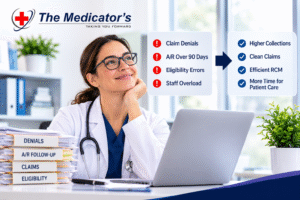
A practice can fill its schedule every day and still wait months for payment when eligibility errors, coding gaps, and unworked denials stack up behind the front desk. Choosing among full-service RCM companies is one of the most consequential financial decisions a practice owner makes, because the partner you select touches every dollar from scheduling to final payment.
This 2026 comparison explains the main types of full-service RCM companies, what each one covers, and where The Medicator’s fits for independent practices, group practices, and hospital-based teams.
Best Full-Service RCM Companies for Healthcare Practices
Here is the list of the best full-service rcm companies for medical practices 2026:
1. The Medicator’s: Specialty-Focused Full-Service RCM
Best for: Independent practices, group practices, and hospital-based teams that want a medical billing company to manage the revenue cycle end to end.
The Medicator’s has provided billing and revenue cycle support since 2003 and works with 30+ specialties, including cardiology, orthopedics, pediatrics, psychiatry, pain management, and internal medicine. Its medical billing services cover ICD-10, CPT, and HCPCS coding support, claim preparation, submission, and follow-up. Its revenue cycle management services extend that scope to scheduling support, charge entry, payment posting, denial appeals, and patient statements.
The service list goes further than claims. The Medicator’s also offers prior authorization management, payer contract review, clinical documentation support, and medical virtual assistant services. Its team works inside your existing EHR or practice management system, and it lists eClinicalWorks, NextGen, Allscripts, Greenway, Practice Fusion, and athenahealth among the platforms it supports. Before onboarding, the team reviews your current workflow and system compatibility.
What stands out for practice owners:
- Specialty-aware account management: Each client is assigned a dedicated account manager who understands the practice’s specialty.
- Certified coding: CPC-certified coders handle coding and claim review, and the company reports a 99% clean claim rate.
- Round-the-clock support: The company states that its billing support team is available 24/7.
- Compliance-focused workflows: Processes are HIPAA-compliant and follow CMS guidelines, payer-specific rules, and ICD-10/CPT standards.
The Medicator’s also reports that practices can increase collections by up to 20% and reduce overhead by up to 40% compared with managing billing in-house. These are company-reported figures, not guarantees, and the real impact depends on your starting A/R, payer mix, and denial patterns. A free practice analysis is the fastest way to see what is realistic for your practice.
2. Enterprise Outsourcers for Hospitals and Health Systems
Large outsourcers staff patient access, coding, billing, and collections for hospital networks. Their strengths are scale, enterprise technology, and the ability to absorb very high claim volumes.
The trade-off is fit. Contract structures, onboarding timelines, and minimum volumes are usually designed for systems, so a ten-provider specialty group may receive less attention than it needs.
3. Software-Led Platforms With Optional Services
Billing and clearinghouse platforms give your team tools for claim submission, eligibility checks, and reporting. Some add a services layer on top.
These platforms work well when you already have capable in-house billers. The catch is that the software does not follow up on unpaid claims by itself, so your staff still owns the work.
4. How the Main Types of Full-Service RCM Companies Compare
| Model | Best Fit | Main Trade-Off |
| Specialty-focused partner | Independent and group practices | Confirm specialty expertise |
| Enterprise outsourcer | Hospitals and health systems | Less flexibility |
| Software-led platform | Practices with strong billing staff | Staff still handles the work |
| In-house billing team | Practices wanting direct control | Hiring and training costs |
What Full-Service RCM Companies Should Include
Use this checklist when you review proposals from full-service RCM companies. If a proposal leaves out a step, ask who handles it.
- Insurance eligibility verification: Coverage is confirmed before the visit, which prevents avoidable rejections and surprise patient balances.
- Medical billing and coding services: Accurate ICD-10, CPT, and HCPCS coding, charge entry, and documentation review so every billable service is captured.
- Claim scrubbing and submission: Claims are checked against payer rules before they go out.
- Payment posting: ERAs and EOBs are posted promptly, and underpayments are flagged.
- Denial management: Denials are tracked by payer and reason, corrected, and appealed, with root causes fed back to the front end.
- A/R management services: Aging buckets at 30, 60, and 90+ days are worked on a schedule, not only when someone has time.
- Credentialing and payer enrollment: A provider who is not properly enrolled with a payer cannot be paid by that payer, so this step protects revenue before the first claim.
- Billing audits: Periodic reviews that catch coding inconsistencies, missed charges, and revenue leakage.
- Reporting: Clear visibility into clean claim rate, days in A/R, denial rate, and collections.
Full-Service RCM Companies vs. Billing Software
Billing software gives your team a tool. It does not post payments, chase a denied claim at day 60, or call a payer about an underpayment. Someone on your staff still has to do that work, and that is where many practices lose revenue. Full-service RCM companies take on the work itself, supported by certified coders and structured follow-up.
Software can still be the right choice for practices with experienced billers and stable staffing. For a closer look at the decision, read our comparison of medical billing companies vs. billing software.
How to Compare Full-Service RCM Companies
A side-by-side evaluation works better than a demo-by-demo impression. Score each vendor on the same criteria:
- Scope of services: Confirm eligibility, coding, claims, denials, A/R, and credentialing are all included, not sold as add-ons.
- Specialty depth: Payer rules, modifiers, and authorization requirements differ by specialty. Ask for experience in yours, and browse the specialties The Medicator’s supports.
- EHR compatibility: The vendor should work inside your current system rather than force a migration.
- Reporting transparency: The strongest full-service RCM companies will show clean claim rate, denial rate, days in A/R, and net collection rate, and will define how each is calculated.
- Pricing structure: Outsourced billing is commonly priced as a percentage of collections, a flat monthly fee, or a per-claim rate. Ask what is excluded. Our guide to medical billing services cost explains the common models.
- Fit for your size: A solo practice and a 40-provider group need different workflows. Larger organizations can start with our guide to medical billing companies for large physician groups.
- Contract terms: Check notice periods, data ownership, and what happens to your records if you leave.
Questions to Ask Before You Outsource Medical Billing
Put these questions to each of the full-service RCM companies on your shortlist before you sign:
- Who will be my day-to-day contact, and what is their specialty experience?
- Are your coders certified, and how are claims reviewed before submission?
- How do you handle denials, appeals, and underpayments?
- Which EHR and practice management systems do you work in?
- How often will I receive reports, and which metrics will they include?
- Will you sign a business associate agreement? Under HIPAA, covered entities generally need a written contract with vendors that handle protected health information, and HHS publishes sample business associate agreement provisions that show what such a contract should address.
- What does the first 90 days look like?
Signs Your Practice Is Ready for Medical Billing Outsourcing
Most practices do not decide to outsource medical billing after one bad month. They decide after a pattern becomes impossible to ignore:
- Denials keep returning for the same reasons, and nobody has time to fix the root cause.
- Accounts receivable older than 90 days keeps growing.
- Billing staff turnover forces you to retrain people repeatedly.
- New providers wait weeks or months for payer enrollment, and their claims stall.
- Your team spends more time on hold with payers than supporting patients.
Each of these problems has a direct cost: slower cash flow, lower net collections, and more overtime for staff. Medical billing outsourcing to a partner with specialty experience replaces a fragile in-house process with a team whose only job is protecting reimbursement.
Conclusion
The best full-service RCM companies do more than submit claims. They verify coverage up front, code accurately, work every denial, follow up on aging A/R, and keep provider enrollment current, with reporting you can understand.
If you want that level of coverage from a team that knows your specialty, The Medicator’s is built to deliver it. Request a free practice analysis to review your denials, A/R, and revenue goals, or contact The Medicator’s to discuss your billing challenges with an RCM specialist. You can also call (888) 277-1460 or email info@themedicators.com.
Frequently Asked Questions
What Are Full-Service RCM Companies?
Full-service RCM companies manage the financial process of a patient encounter from start to finish. That includes eligibility verification, coding, claim submission, payment posting, denial management, A/R follow-up, and often credentialing.
How Much Do Full-Service RCM Companies Charge?
Pricing varies by practice size, specialty, claim volume, and services included. Common structures include a percentage of collections, a flat monthly fee, or a per-claim rate. The Medicator’s provides quotes based on your practice, so request a free practice analysis for a tailored estimate.
Is It Better to Outsource Medical Billing or Keep It In-House?
Outsourcing tends to suit practices that struggle with denials, aging A/R, or staff turnover, or that want predictable costs. In-house billing suits practices with experienced staff and the budget to train and retain them. Many practices compare both before deciding.
Can The Medicator’s Work With My Existing EHR?
The Medicator’s states that it works with major EHR and practice management systems, including eClinicalWorks, NextGen, Allscripts, Greenway, Practice Fusion, and athenahealth. Its team reviews your workflow and system compatibility before onboarding.