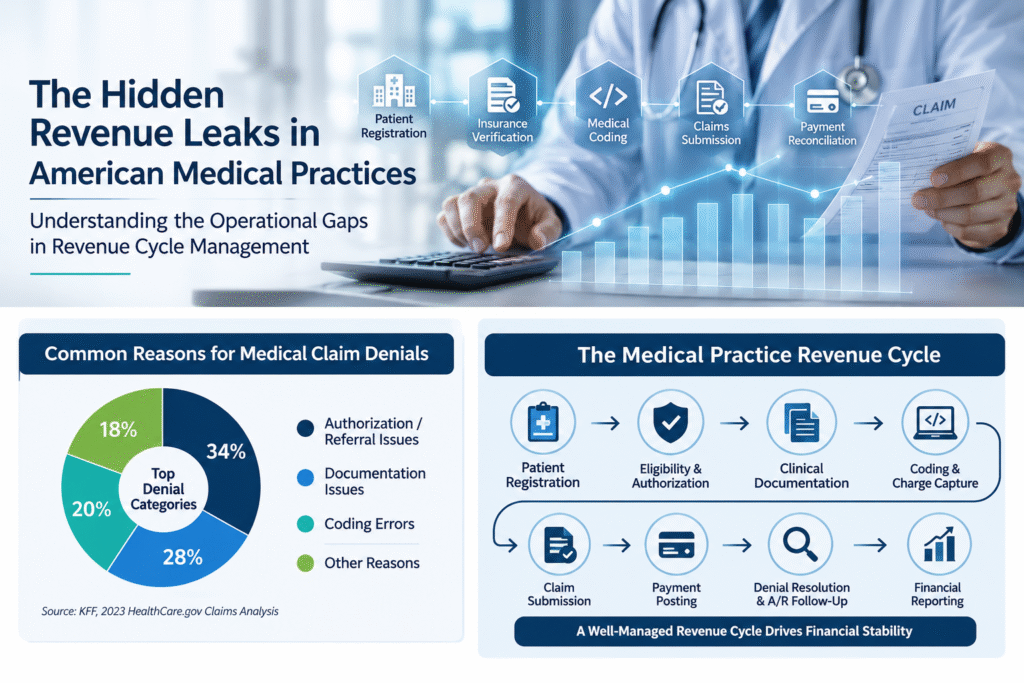
Understanding the Operational Gaps in Provider Revenue Cycle Management
An Industry Research & Insights Report | The Medicator’s | 2026
1. Executive Summary
Medical practices operate within a complex administrative and financial environment in which clinical services must be translated into accurate documentation, insurance claims, reimbursement decisions and financial records. Although patient care remains the primary purpose of healthcare delivery, the administrative processes behind medical billing play an essential role in the financial sustainability of medical organizations.
Revenue cycle management (RCM) encompasses the activities that connect patient registration, insurance eligibility verification, clinical documentation, medical coding, claim submission, payment processing and accounts receivable management. These activities are interconnected. An issue originating during patient registration or prior authorization may not become financially visible until a claim is submitted, denied or left unpaid.
The administrative complexity of this system is substantial.
According to the 2025 CAQH Index, US healthcare avoided an estimated $258 billion in administrative costs in 2024 through electronic transactions, yet the industry still spent about $82 billion on the administrative tasks the Index tracks and could save a further $21 billion through fuller automation of manual and partially manual transactions.
Claim processing and reimbursement also present challenges for healthcare providers.
A January 2025 KFF analysis of 2023 HealthCare.gov marketplace data found that insurers denied approximately 19% of in-network claims. Separately, the Centers for Medicare & Medicaid Services (CMS) estimated a 7.66% improper payment rate for Medicare Fee-for-Service in fiscal year 2024.
These figures measure different aspects of healthcare administration and payment integrity; they are not direct measurements of revenue lost by individual medical practices.
This report examines the operational gaps that can contribute to revenue leakage in American medical practices. It investigates weaknesses across front-end, mid-cycle and back-end revenue cycle activities, with particular attention to eligibility verification, prior authorization, clinical documentation, medical coding, claim processing, denial management and accounts receivable oversight.
The report also considers how fragmented workflows, limited reporting visibility and insufficient root-cause analysis can allow recurring claim denials and other administrative problems to continue.
Rather than treating revenue leakage as a single billing error, the analysis approaches it as a potential outcome of interconnected process weaknesses. It concludes by examining practical approaches to improving revenue cycle oversight, strengthening administrative controls, evaluating medical billing services and outsourced medical billing models, and identifying areas requiring further research.
2. Introduction: The Financial Infrastructure Behind Medical Practices
Healthcare delivery depends on more than clinical expertise and access to medical facilities. Every patient encounter also generates administrative responsibilities involving insurance coverage, patient information, medical documentation, medical coding, billing and financial reconciliation.
These responsibilities form the financial infrastructure of medical practices.
A medical service may be clinically completed, but its financial outcome remains dependent on several administrative steps. The provider must document the service, establish the appropriate coding, prepare the claim, submit the information to the correct payer and monitor the resulting payment or denial.
The process is not always linear. Claims may require additional documentation, corrections, resubmission, appeals or payer follow-up. Payments may also differ from expected amounts because of contractual adjustments, benefit limitations, processing errors or other reimbursement considerations.
This creates a distinction between providing healthcare services and successfully completing the administrative process required for reimbursement.
2.1 Why Revenue Cycle Management Matters
Revenue cycle management provides the organizational framework through which medical practices manage the financial activities associated with patient care.
An effective revenue cycle requires coordination among clinical personnel, administrative staff, coding professionals, medical billing teams, insurance companies and technology systems.
When these activities operate independently, information gaps can develop. For example, inaccurate insurance information may affect claim submission, while incomplete documentation may create difficulties during medical necessity reviews.

The 2025 CAQH Index illustrates the broader administrative challenge. Its findings show that healthcare organizations still carry substantial costs for administrative transactions, including eligibility verification, prior authorization, claim submission and claim status inquiries, even as electronic adoption grows.
These findings demonstrate why administrative efficiency should be considered an important part of healthcare financial management. Practices evaluating their overall workflows can also review revenue cycle management services to understand how these activities are coordinated.
2.2 Research Objectives
This report has five primary objectives:
- Examine administrative and operational weaknesses across the medical practice revenue cycle.
- Investigate how front-end, mid-cycle and back-end processes influence reimbursement activities.
- Identify factors associated with recurring claim denials, delayed payments and unresolved accounts receivable.
- Evaluate the role of administrative oversight, medical billing audits and technology in identifying process weaknesses.
- Present practical considerations for improving revenue cycle management within medical practices.
2.3 Scope of the Research
The analysis focuses on US medical practices and provider-side revenue cycle operations.
It considers administrative activities involving commercial insurance, Medicare and Medicaid where relevant. However, payer policies, reimbursement requirements and claim processing procedures differ across programs, insurers, specialties and contractual arrangements.
Consequently, the report does not assume that every operational problem applies equally to all healthcare providers.
3. Understanding the Modern Medical Billing Ecosystem
Medical billing is part of a broader administrative network connecting healthcare providers, patients, insurance companies and technology intermediaries.
Each participant contributes information necessary to establish coverage, document services, process claims and determine payment responsibilities.
3.1 Healthcare Providers and Clinical Documentation
Providers generate the clinical information that supports medical billing.
Documentation establishes the services performed, clinical circumstances, diagnoses and other information necessary to support the claim.
Incomplete or inconsistent documentation can create difficulties during medical coding, medical necessity reviews and payer processing.
Clinical documentation is therefore not simply a record of patient care. It also provides the supporting information required for appropriate reimbursement and payment integrity.
3.2 Insurance Companies and Reimbursement Processes
Insurance companies evaluate submitted claims according to coverage provisions, contractual arrangements, coding requirements and applicable payment policies.
Claims may be paid, adjusted, rejected or denied depending on the information submitted and the applicable rules.
Differences in payer policies and administrative requirements can create additional complexity for practices that work with multiple insurance organizations.
3.3 Clearinghouses and Practice Management Systems
Electronic clearinghouses and practice management systems support the exchange and processing of administrative information.
They can identify certain formatting and data errors before claims reach insurers. However, passing electronic validation does not establish that a claim satisfies every coverage, documentation or medical necessity requirement.
Technology therefore supports the medical billing process but does not eliminate the need for appropriate review and oversight. For an overview of these responsibilities, see what a medical billing service does.
3.4 The Interconnected Nature of Revenue Cycle Operations
The revenue cycle should be viewed as a connected system rather than a collection of independent administrative tasks.
Its major stages include:
- Patient registration and demographic information.
- Insurance eligibility and benefits verification.
- Authorization and referral review.
- Clinical documentation.
- Medical coding and charge capture.
- Claim preparation and submission.
- Payer adjudication and payment posting.
- Denial resolution, A/R follow-up and reconciliation.
A weakness in one stage may create additional administrative work in another. Understanding these relationships is essential to identifying the underlying causes of revenue cycle inefficiencies.
4. Front-End Revenue Cycle Problems: Eligibility Verification, Benefits and Prior Authorization
The front end establishes the administrative information needed before healthcare services are delivered.
This stage includes patient registration, insurance verification, benefits review, financial responsibility assessment and prior authorization when required.
Errors during this stage can affect subsequent medical billing activities.
4.1 Insurance Eligibility and Coverage Verification
Insurance eligibility verification establishes whether a patient’s coverage is active for a particular date of service.
However, eligibility confirmation does not necessarily establish that a specific service is covered, medically necessary or payable.
Practices must also consider benefit limitations, network status, deductibles, copayments, coinsurance and other applicable coverage provisions.
Incorrect patient information or outdated insurance details can create claim processing complications.
For example, a patient may present an insurance card that contains outdated information, while the practice management system continues to use previously recorded coverage details.
If these discrepancies are not identified before claim submission, the resulting administrative correction may require additional staff time and payer communication.
4.2 Prior Authorization and Referral Requirements
Some services require prior authorization or referrals before treatment.
The process may involve submitting clinical documentation, identifying the requested service and communicating with the appropriate payer.
The American Medical Association’s May 2026 publication of its 2025 physician survey reported that only 33% of the 1,000 surveyed physicians believed the latest insurer pledge on prior authorization would make a meaningful difference. The survey also found that practices complete an average of 40 prior authorization requests per physician each week, spending about 13 hours of physician and staff time on them.
The finding illustrates continuing physician concerns regarding authorization-related administrative processes. It does not establish that every authorization delay results in a claim denial.
The HHS Office of Inspector General has also examined Medicare Advantage prior authorization and payment denials.
Its 2022 report reviewed a sample of 250 prior authorization denials and 250 payment denials from 15 large Medicare Advantage organizations, identifying instances in which requests or payments meeting applicable Medicare coverage or billing rules were denied.
Together, these findings demonstrate the importance of examining authorization requirements, payer decisions and the administrative processes supporting them.
4.3 Administrative Consequences of Front-End Weaknesses
Potential consequences include:
- Incorrect insurance information.
- Unverified benefit limitations.
- Missing prior authorization documentation.
- Referral-related processing issues.
- Inaccurate patient financial estimates.
- Additional claim corrections and follow-up.
These issues should be examined as part of the broader revenue cycle rather than treated as isolated registration mistakes.
5. Mid-Cycle Revenue Cycle Problems: Clinical Documentation, Medical Coding and Charge Capture
The mid-cycle connects clinical services with the administrative information used for reimbursement.
This stage is particularly important because medical coding and billing depend on accurate clinical documentation.
5.1 Clinical Documentation Completeness
Medical records provide evidence supporting the services performed.
Documentation should accurately describe the patient’s condition, relevant clinical findings, treatment and services delivered.
Missing or inconsistent information can complicate coding decisions and payer reviews.
CMS reported an estimated $31.70 billion in Medicare Fee-for-Service improper payments for FY 2024, representing an estimated improper payment rate of 7.66%.
CMS also identified missing or insufficient documentation as a major contributor to improper payment findings.
These figures require careful interpretation. Improper payments include overpayments, underpayments and payments that cannot be determined to be correct because of insufficient information. They are not estimates of fraud or direct financial losses experienced by individual medical practices.
Nevertheless, the findings demonstrate the importance of documentation completeness and compliance with applicable payment requirements.
5.2 Medical Coding Accuracy
Medical coding translates clinical information into standardized classifications and billing codes.
Common coding systems include:
- ICD-10-CM for diagnoses.
- CPT for medical procedures and services.
- HCPCS for healthcare procedures, supplies and services.
Coding decisions must reflect the documentation and applicable coding guidelines.
Potential weaknesses include incorrect code selection, missing modifiers, inconsistent units, incorrect diagnosis associations and incomplete supporting documentation.
These problems may create claim processing complications, additional reviews or reimbursement discrepancies. Practices can examine these risks through structured medical billing audit services.
5.3 Charge Capture and Billing Discrepancies
Charge capture connects documented services to the charges entered into the billing system.
When services are not accurately recorded or transferred, discrepancies can develop between clinical records and billing information.
For example, a service documented in the medical record may not be accurately represented in the charge record. Similarly, an incorrect service code may create inconsistencies between documentation and the submitted claim.
Effective controls should compare documented services, charge records and submitted claims to identify inconsistencies.
6. Back-End Revenue Cycle Problems: Claim Denials, Denial Management and Payment Reconciliation
The back end involves the administrative activities that occur after claims are prepared and submitted.
These activities include payer processing, denial management, payment posting, reconciliation and follow-up.
Understanding these activities requires examining both the broader healthcare claims environment and the operational processes that influence how individual practices manage submitted claims.
6.1 Claim Submission and Processing
Electronic claim submission reduces some manual administrative tasks, but it does not eliminate the possibility of errors.
Claims may encounter:
- Missing or incorrect information.
- Invalid coding combinations.
- Payer-specific submission requirements.
- Incorrect provider identifiers.
- Authorization discrepancies.
- Timely filing issues.
A claim that passes an initial clearinghouse edit can still encounter payer-level adjudication problems.
From an operational perspective, claim submission should be evaluated as part of a larger process that includes pre-submission review, electronic acceptance monitoring, payer status tracking and timely correction of identified errors.
6.2 Understanding Claim Denials
A claim denial is not necessarily evidence that a service was inappropriate or that a payer made an error.
Denials may result from administrative requirements, coverage limitations, documentation issues, coding discrepancies or other payer-specific conditions.
A January 2025 KFF analysis of 2023 HealthCare.gov marketplace data found that insurers denied approximately 19% of in-network claims. The analysis examined approximately 425 million claims submitted to 175 insurers.
The most frequently reported denial category in the analysis was a general “other” category, followed by administrative reasons, excluded services, prior authorization or referral issues, and medical necessity considerations.
These findings provide an important view of the marketplace claims environment, but they do not represent the denial rate for every US healthcare payer, Medicare claim, Medicaid claim or individual medical practice.
The research implication is that claim denial patterns should be examined according to payer, claim type, service category and stated reason rather than treated as one uniform problem. For a practical discussion of denial review and appeals, see CPT denial and appeal management services.
6.3 Operational Factors Contributing to Claim Denials
Several operational factors may influence claim outcomes.
These include incomplete patient or insurance information, coding and documentation discrepancies, authorization requirements and inconsistencies between submitted information and payer records.
The relationship between these factors is important.
For example, an authorization-related issue may originate before a patient receives a service, but its financial implications may become visible only when the claim reaches payer adjudication.
Similarly, an inaccurate provider identifier or enrollment record may create a processing problem even when the clinical documentation is otherwise complete.
From a revenue cycle operations perspective, these situations demonstrate why denial management requires more than simply reviewing the payer’s denial message. The underlying information and administrative workflow must also be examined.
6.4 Denial Categorization and Root-Cause Analysis
Monitoring only the total number of denied claims provides limited information about the reasons behind reimbursement problems.
Practices can obtain a more detailed understanding by categorizing denials according to:
- Denial reason and adjustment code.
- Insurance payer.
- Service and specialty.
- Claim submission date.
- Original claim amount.
- Outstanding balance.
- Correction or appeal status.
- Final resolution outcome.
This approach allows administrators to distinguish isolated claim issues from recurring operational patterns.
For example, repeated authorization-related denials may indicate a need to examine scheduling and pre-service verification procedures. Repeated coding-related denials may justify additional documentation and coding review.
These are illustrative examples of how denial management can be organized.
The broader conclusion is that denial categorization and root-cause analysis can help practices identify areas requiring further investigation and evaluate the effectiveness of corrective procedures.
6.5 Payment Posting and Reconciliation
Payment posting records the financial outcome of processed claims.
Reconciliation compares expected payments with actual remittances and identifies discrepancies requiring further examination.
Potential issues include:
- Incorrect payment allocation.
- Unidentified adjustments.
- Contractual payment discrepancies.
- Duplicate posting.
- Unresolved patient balances.
- Possible underpayments.
A reliable reconciliation process helps maintain accurate financial records and improves visibility into outstanding balances.
It also allows administrators to investigate whether discrepancies result from contractual adjustments, processing issues, incomplete information or other payment-related circumstances.
7. The Growing Challenge of Aging Accounts Receivable (A/R) in Medical Practices
Accounts receivable represents amounts outstanding for services already provided but not yet fully collected or resolved.
A/R management is therefore an important component of revenue cycle oversight. Practices seeking more structured oversight of unresolved balances can review medical A/R management services.
7.1 Why Claims Remain Outstanding
Unresolved balances may result from:
- Pending payer adjudication.
- Missing documentation.
- Incorrect claim information.
- Denials requiring correction or appeal.
- Coordination-of-benefits issues.
- Contractual or payment discrepancies.
- Delayed follow-up.
Not every outstanding balance represents collectible revenue. Some may involve contractual adjustments, patient responsibility or legitimate nonpayment under applicable coverage provisions.
7.2 Understanding A/R Aging
Aging reports organize outstanding receivables according to the length of time balances remain unresolved.
Common reporting categories include:
| Aging category | Administrative significance |
| 0–30 days | Recently submitted or outstanding balances |
| 31–60 days | Claims requiring status monitoring |
| 61–90 days | Increased need for follow-up review |
| 91–120 days | Potential resolution and filing concerns |
| Over 120 days | Older balances requiring detailed assessment |
These are commonly used analytical categories, not universal payer deadlines.
7.3 Why A/R Visibility Matters
A single total A/R figure does not explain why money remains outstanding.
Administrators need information about payer distribution, denial categories, claim status, balance age and the actions required for resolution.
Without this information, practices may have difficulty distinguishing normal processing delays from recurring operational problems.
Effective accounts receivable management therefore requires structured follow-up, accurate claim status information and consistent monitoring of unresolved balances. Related considerations are discussed in A/R management services.
8. Why Traditional Medical Billing Workflows May Fail to Identify Revenue Leakage
One of the central questions in revenue cycle management is not simply whether errors occur, but whether organizations can recognize and address recurring problems.
8.1 Fragmented Administrative Responsibilities
Different employees may handle registration, coding, claim submission, payment posting and denial follow-up.
Although specialization can improve task management, fragmented responsibilities can make it difficult to understand how one error affects the entire revenue cycle.
For example, a registration error may affect eligibility verification, which can subsequently create claim processing complications.
Without appropriate communication between departments, the original issue may remain unidentified.
8.2 Delayed Reporting
Reports that only show historical totals may not provide sufficient information about the current status of unresolved claims.
Administrators need both retrospective performance information and timely operational indicators.
A monthly collection report, for example, may demonstrate overall financial activity but provide insufficient detail about individual claims that require immediate action.
8.3 Limited Root-Cause Analysis
Repeatedly correcting individual claims may not resolve the process weakness that caused the errors.
For example, recurring authorization-related denials may require an examination of scheduling, verification and authorization procedures rather than simply resubmitting individual claims.
The distinction between correcting an individual claim and correcting the underlying workflow is central to effective revenue cycle management.
8.4 Incomplete Performance Monitoring
Useful monitoring should examine multiple indicators, including:
- Initial claim acceptance.
- Denial categories and trends.
- Days in accounts receivable.
- Outstanding balances by aging category.
- Payment posting accuracy.
- Appeal outcomes.
- Underpayment identification.
- Claim resolution timelines.
These measures should be interpreted together, with appropriate definitions and consistent reporting periods.
9. The Role of Medical Billing Audits in Identifying Operational Gaps
A medical billing audit is a structured examination of selected administrative, coding and financial processes.
Its purpose is to identify discrepancies, evaluate controls and determine whether procedures are functioning as intended.
9.1 Pre-Billing and Post-Billing Reviews
Pre-billing reviews examine information before claims are submitted.
Post-billing reviews examine processed claims, payment records, adjustments and unresolved balances.
Both approaches can identify different types of administrative weaknesses.
A pre-billing review may identify incomplete information or coding inconsistencies before submission, while a post-billing review may identify payment discrepancies or recurring denial patterns.
9.2 Documentation and Coding Reviews
Reviews can examine whether submitted codes correspond to supporting documentation and applicable coding requirements.
The purpose is to identify inconsistencies, not automatically assume that every discrepancy represents an overpayment or underpayment.
A structured medical billing audit checklist can help organize the examination of patient information, documentation, coding, modifiers, charges and claim outcomes.
9.3 Denial and A/R Analysis
A structured medical billing audit can categorize denials, identify recurring issues and examine whether follow-up activities are appropriately documented.
It can also examine outstanding receivables to determine whether balances require further action, adjustment or resolution.
For a related explanation, see how a billing audit can identify lost revenue.
9.4 Corrective Actions
An audit becomes useful when its findings lead to practical improvements.
These may include revised procedures, additional staff education, improved documentation controls, better reporting and more consistent monitoring.
The effectiveness of a medical billing audit should therefore be assessed not only by the discrepancies identified but also by the corrective measures implemented afterward.
10. Technology, AI-Assisted Medical Billing and Human Expertise in Modern RCM
Technology is changing how healthcare administrative transactions are conducted.
Automation can reduce repetitive tasks and improve the exchange of standardized information. However, it does not remove the need for accurate source data, human oversight and appropriate controls.
10.1 Electronic Administrative Transactions and Billing Automation
Electronic eligibility verification, claim submission and claim status inquiries can reduce manual administrative work.
The 2025 CAQH Index identified an estimated $21 billion in remaining annual savings opportunity through full automation of manual and partially manual transactions, after an estimated $258 billion in administrative costs was already avoided in 2024.
The Index also highlights the continuing need for providers and health plans to improve electronic transaction adoption.
These findings demonstrate that medical billing automation is not simply a technology investment. It is also an operational improvement opportunity.
10.2 AI-Assisted Billing and Analytics
Potential applications include:
- Identifying unusual claim patterns.
- Supporting coding reviews.
- Categorizing denial information.
- Prioritizing outstanding accounts.
- Detecting data inconsistencies.
- Supporting operational reporting.
These applications should be evaluated based on accuracy, transparency, data protection and their ability to support established workflows.
AI-assisted medical billing should not be treated as a substitute for professional medical coding judgment, clinical documentation review or compliance oversight.
10.3 The Importance of Human Oversight
Automated systems may not fully interpret complex clinical documentation, payer policies or unusual reimbursement situations.
Qualified personnel remain important for reviewing exceptions, evaluating documentation, resolving complex denials and making decisions requiring professional judgment.

Technology should support sound administrative processes rather than replace accountability.
11. Strategies for Improving Revenue Cycle Performance in Medical Practices
Improving revenue cycle performance requires coordinated attention to the entire administrative process.
11.1 Standardize Front-End Procedures
Establish consistent registration, eligibility verification and prior authorization procedures.
Information should be verified at appropriate points in the patient workflow, with exceptions documented for follow-up.
11.2 Strengthen Documentation and Coding Controls
Maintain clear documentation standards and establish appropriate review procedures.
Medical coding discrepancies should be analyzed to identify whether they originate from documentation, code selection, system configuration or other workflow issues.
11.3 Establish Structured Denial Monitoring
Denials should be categorized according to their reasons and monitored over time.
Recurring categories should trigger a review of the underlying processes, not just individual claim corrections.
11.4 Improve A/R Follow-Up
Outstanding balances should be prioritized using factors such as aging, payer requirements, claim status, balance value and applicable deadlines.
Follow-up activity should be documented so administrators can assess progress and identify unresolved cases.
11.5 Strengthen Financial Reconciliation
Payment information should be compared with expected reimbursement and applicable contractual adjustments.
Discrepancies should be investigated and documented.
11.6 Develop Meaningful Performance Reporting
Reporting should provide more than total charges and collections.
It should help administrators understand what happened, where problems occurred, which accounts remain unresolved and what actions are necessary.
An effective revenue cycle management strategy requires both financial performance measurement and operational accountability.
12. The Role of Outsourced Medical Billing and RCM Partners in the Healthcare Ecosystem
Medical practices use different operating models to manage their administrative and financial responsibilities.
Some maintain internal billing departments, others use external administrative support, and some combine internal personnel with specialized third-party assistance.
Each approach involves different considerations.
12.1 Internal Revenue Cycle Operations
Internal teams may offer direct access to practice workflows and clinical personnel.
However, their effectiveness depends on staffing, training, management, technology and workload distribution.
12.2 External Administrative Support and Outsourced Medical Billing Services
External RCM arrangements may provide additional operational capacity and specialized expertise.
Outsourced medical billing services and external revenue cycle management companies may support activities such as eligibility verification, medical coding, claim submission, denial management, payment posting and A/R monitoring.
However, outsourcing does not automatically resolve revenue cycle problems.
The arrangement requires appropriate communication, access controls, clear responsibilities, performance reporting and oversight.
12.3 Accountability and Compliance
Healthcare organizations must consider privacy, security and contractual obligations when sharing protected health information.
Business associate agreements and appropriate HIPAA safeguards are important when external parties perform functions involving protected health information.
12.4 Evaluating Operational Support Models and Medical Billing Companies
An objective evaluation of a medical billing company or internal team should consider:
- Scope of responsibilities.
- Reporting transparency.
- Communication procedures.
- Coding and billing expertise.
- Denial follow-up processes.
- Data security controls.
- Performance measurement.
- Contractual accountability.
The appropriate model depends on the operational requirements and circumstances of the individual practice.
The decision to maintain internal operations, use outsourced revenue cycle management or adopt a hybrid model should be based on documented needs rather than assumptions about the superiority of one arrangement. Practices comparing providers can also review what to look for when choosing a medical billing partner.
13. Conclusion and Industry Recommendations for Medical Billing and Revenue Cycle Management
The financial administration of medical practices involves a series of connected activities extending from patient registration through final payment reconciliation.
Revenue cycle inefficiencies may emerge at multiple stages, including insurance verification, prior authorization, clinical documentation, medical coding, claim submission, denial resolution and accounts receivable management.
The evidence examined in this report demonstrates the scale of healthcare administrative activity and the importance of documentation, transaction accuracy and operational oversight. However, industry-level figures should not be interpreted as direct measurements of financial losses experienced by individual practices.
An important conclusion is that revenue leakage should not be approached exclusively as a claim submission problem.
It requires examination of the broader administrative system, including how information is collected, transferred, reviewed and monitored.
For healthcare administrators, several priorities emerge:
- Strengthen the accuracy of patient and insurance information.
- Establish consistent prior authorization and documentation procedures.
- Monitor medical coding and claim submission quality.
- Categorize denials and investigate recurring causes.
- Improve visibility into outstanding accounts receivable.
- Maintain accurate payment posting and reconciliation.
- Evaluate automation while preserving appropriate human oversight.
- Establish meaningful financial and operational reporting.
- Conduct periodic medical billing audits to evaluate administrative controls.
- Assess internal and outsourced medical billing and RCM arrangements according to measurable operational requirements.
Further research is needed to understand how these operational factors differ by specialty, practice size, payer mix and organizational structure.
Future studies could examine the relationship between administrative workflow maturity, denial resolution, A/R aging and reimbursement performance across different categories of medical practices.
Ultimately, effective revenue cycle oversight depends on the ability to identify administrative weaknesses, understand their underlying causes and establish procedures that support accurate and timely financial operations. Practices seeking an independent view of their own revenue cycle can discuss a medical billing audit or outsourced medical billing support with The Medicator’s. Practices seeking an independent view of their own revenue cycle can discuss a medical billing audit or outsourced medical billing support with The Medicator’s.
14. References and Research Methodology
14.1 Research Methodology
This report uses a secondary research and descriptive analytical approach.
It examines publicly available healthcare industry reports, government publications, policy research and administrative workflow information to understand operational challenges affecting medical practice revenue cycle management.
The analysis organizes the subject into front-end, mid-cycle and back-end processes and examines how weaknesses in these areas may contribute to administrative inefficiencies.
The report does not present original survey findings or claim to represent a statistically representative sample of American medical practices. Operational examples and recommendations are analytical illustrations unless attributed to a cited external study.
14.2 Research Limitations
The report has several limitations:
- Industry statistics may represent specific insurance markets or government programs rather than all healthcare claims.
- Claim denial definitions and reporting methodologies may differ among payers.
- Improper payment estimates should not be interpreted as direct measures of provider revenue leakage.
- Administrative challenges vary by specialty, practice size and payer mix.
- The report does not establish causal relationships between individual administrative weaknesses and financial outcomes.
Further primary research would be necessary to establish practice-level prevalence and quantify the financial effects of specific operational problems.
14.3 References
- CAQH. 2025 CAQH Index: U.S. Healthcare Avoided $258 Billion and Accelerated Automation, Interoperability and AI Adoption. https://www.caqh.org/blog/2025-caqh-index-shows-u.s.-healthcare-avoided-258-billion-and-accelerated-automation-interoperability-and-ai-adoption
- KFF. (2025, January 27). HealthCare.gov Insurers Denied Nearly 1 in 5 In-Network Claims in 2023, but Information About Reasons is Limited in Public Data. https://www.kff.org/private-insurance/healthcare-gov-insurers-denied-nearly-1-in-5-in-network-claims-in-2023-but-information-about-reasons-is-limited-in-public-data/
- Centers for Medicare & Medicaid Services. (2024, November 15). Fiscal Year 2024 Improper Payments Fact Sheet. https://www.cms.gov/newsroom/fact-sheets/fiscal-year-2024-improper-payments-fact-sheet
- American Medical Association. (2026, May 13). AMA Prior Authorization Physician Survey. https://www.ama-assn.org/practice-management/prior-authorization/ama-prior-authorization-physician-survey
- HHS Office of Inspector General. (2022). Some Medicare Advantage Organization Denials of Prior Authorization Requests Raise Concerns About Beneficiary Access to Medically Necessary Care. https://oig.hhs.gov/reports/all/2022/some-medicare-advantage-organization-denials-of-prior-authorization-requests-raise-concerns-about-beneficiary-access-to-medically-necessary-care/