
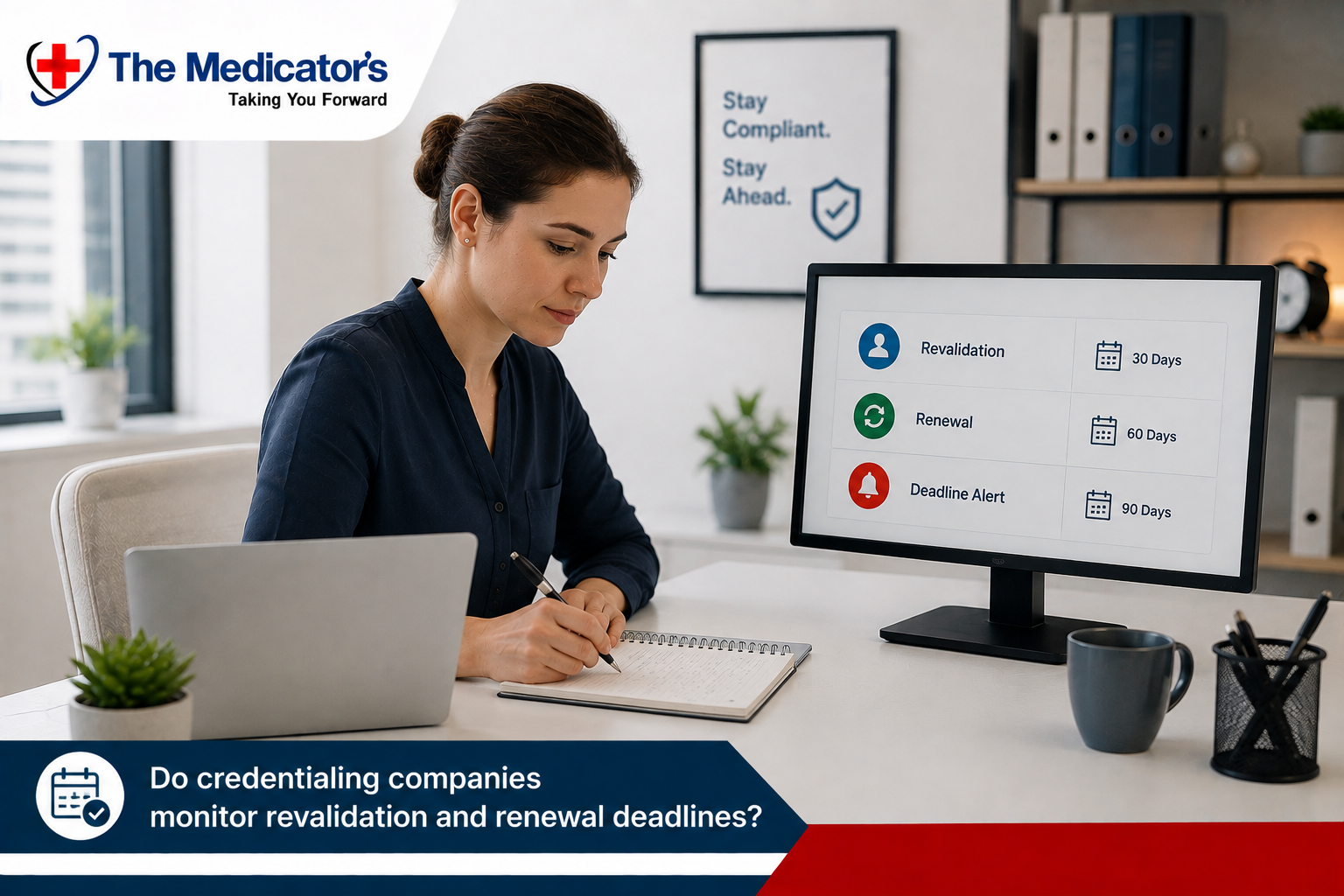
Yes, professional credentialing companies actively monitor revalidation, renewal, and document expiration deadlines as a fundamental component of ongoing provider enrollment maintenance. Professional partners construct master tracking schedules and automated 90-to-120-day alert workflows to prevent lapses in state medical licenses, DEA certificates, CAQH attestations, commercial payer re-credentialing, and Medicare or Medicaid revalidations.
At The Medicator’s, our certified credentialing and RCM team delivers continuous provider tracking, including dedicated medical credentialing in Chicago, Illinois and nationwide. We help medical practices, specialty groups, and multi-location clinics eliminate expired license penalties, maintain clean payer rosters, and sustain clean claim acceptance rates above 97%.
Core Credentials and Revalidations Tracked by Professional Companies
Outsourcing provider enrollment maintenance ensures proactive monitoring across four distinct compliance categories:
1. Medicare and Medicaid Periodic Revalidation
CMS mandates Medicare revalidation every five years for physicians and non-physician practitioners (and every three years for durable medical equipment suppliers). State Medicaid programs enforce similar periodic re-enrollment cycles. Credentialing specialists manage the Provider Enrollment, Chain, and Ownership System (PECOS) updates and state Medicaid portal filings well before strict submission deadlines expire.
2. Commercial Payer Re-Credentialing Cycles
Most commercial insurance panels require re-credentialing every two to three years. Credentialing partners maintain updated provider profiles, submit updated CAQH data, and process network re-enrollment applications to ensure uninterrupted in-network status.
3. Expirable Licenses, Certifications, and Insurance
Professional credentialing firms manage ongoing primary source verification and document updates for:
State Medical Licenses: Tracking state-specific renewal dates and continuing medical education (CME) credit requirements.
Controlled Substance Permits: Managing federal DEA registrations and state-level controlled substance certificates.
Malpractice Policy Declarations: Updating annual certificate of insurance (COI) documents across all active payer portals.
Board Certifications: Tracking maintenance of certification (MOC) deadlines.
4. Quarterly CAQH ProView Re-Attestations
Commercial payers drop providers from active online directories if Council for Affordable Quality Healthcare (CAQH) profiles are not re-attested every 120 days. Professional partners automate quarterly CAQH profile reviews, preventing accidental network terminations.
How Professional Tracking Systems Prevent Revenue Loss
Missing a revalidation deadline directly threatens practice cash flow. When Medicare or a commercial payer deactivates a provider’s billing privileges due to a missed revalidation:
Immediate Billing Holds: Claims submitted for services rendered during the gap are rejected automatically as non-covered.
Compound RCM Delays: Unpaid claims collect on aging reports, increasing administrative overhead. To understand how credentialing gaps impact front-end claim workflows, evaluate your practice’s overall denial rate vs. rejection rate.
Retroactive Billing Restrictions: Payers rarely allow retroactive billing for periods where enrollment lapsed, forcing practices to absorb permanent contractual write-offs.
Provider Renewal & Revalidation Monitoring Overview
| Credential / Event | Standard Renewal Cycle | Typical Lead Time Initiated | Financial Risk of Missed Deadline |
| CAQH ProView Attestation | Every 90–120 Days | 30 Days Prior | Immediate removal from commercial payer online directories |
| Commercial Re-Credentialing | Every 2–3 Years | 120 Days Prior | Out-of-network downcoding or complete claim rejections |
| Medicare PECOS Revalidation | Every 5 Years (3 for DME) | 90–120 Days Prior | Deactivation of Medicare billing privileges and billing holds |
| State Medical License & DEA | Every 1–3 Years (State Varies) | 90 Days Prior | Illegal practice risks, loss of prescriptive authority, and claim denials |
Real-World Scenario: Catching a PECOS Revalidation Notice
A five-physician cardiology group received a Medicare PECOS revalidation notice sent to an outdated administrative email address. Because the practice engaged a professional credentialing company:
Automated System Detection: The vendor’s PECOS monitoring tool flagged the pending 90-day revalidation window independently of the physical letter.
Rapid Form Submission: Updated ownership structures, re-attested CMS-855A forms, and verified EFT details were submitted 60 days before the deadline.
Zero Interruption to Cash Flow: Medicare enrollment remained active, avoiding billing holds and preventing unpaid claims on the practice’s A/R aging report. When combined with precise clinical documentation, practices eliminate compound billing errors. Read our guide on why unspecified ICD-10 codes get claims denied.
Expert Credentialing Insight
“Payers do not issue second chances for missed revalidation deadlines. If a physician misses a Medicare revalidation window, CMS deactivates their NPI enrollment, and restoring billing privileges can take up to 120 days. Professional monitoring is not just administrative help; it is financial insurance against unbillable clinical hours.”
Protect Your Practice Revenue with The Medicator’s
Tracking state licensing boards, PECOS revalidation cycles, CAQH attestations, and commercial payer rosters across multiple providers can overwhelm practice managers.
At The Medicator’s, our certified credentialing and revenue cycle experts handle complete provider enrollment maintenance across all 50 states. Beyond our specialized medical credentialing in Chicago, Illinois, we provide nationwide cardiology billing in Florida and comprehensive internal medicine RCM services in USA.
Partnering with our credentialing team ensures:
100% Proactive Expiration Tracking: Automated 90-to-120-day alerts for state licenses, DEA certificates, and payer revalidations.
Flawless CAQH & Roster Maintenance: Continuous profile updates to prevent directory drops and network exclusions.
Seamless Revenue Flow: Keeping Days in A/R under 30 days by eliminating enrollment-related claim holds.
Are revalidation notices, missing attestations, or credentialing tracking challenges risking your practice’s billing privileges? Secure your payer enrollments today. Request a free, custom practice analysis with The Medicator’s team!
