
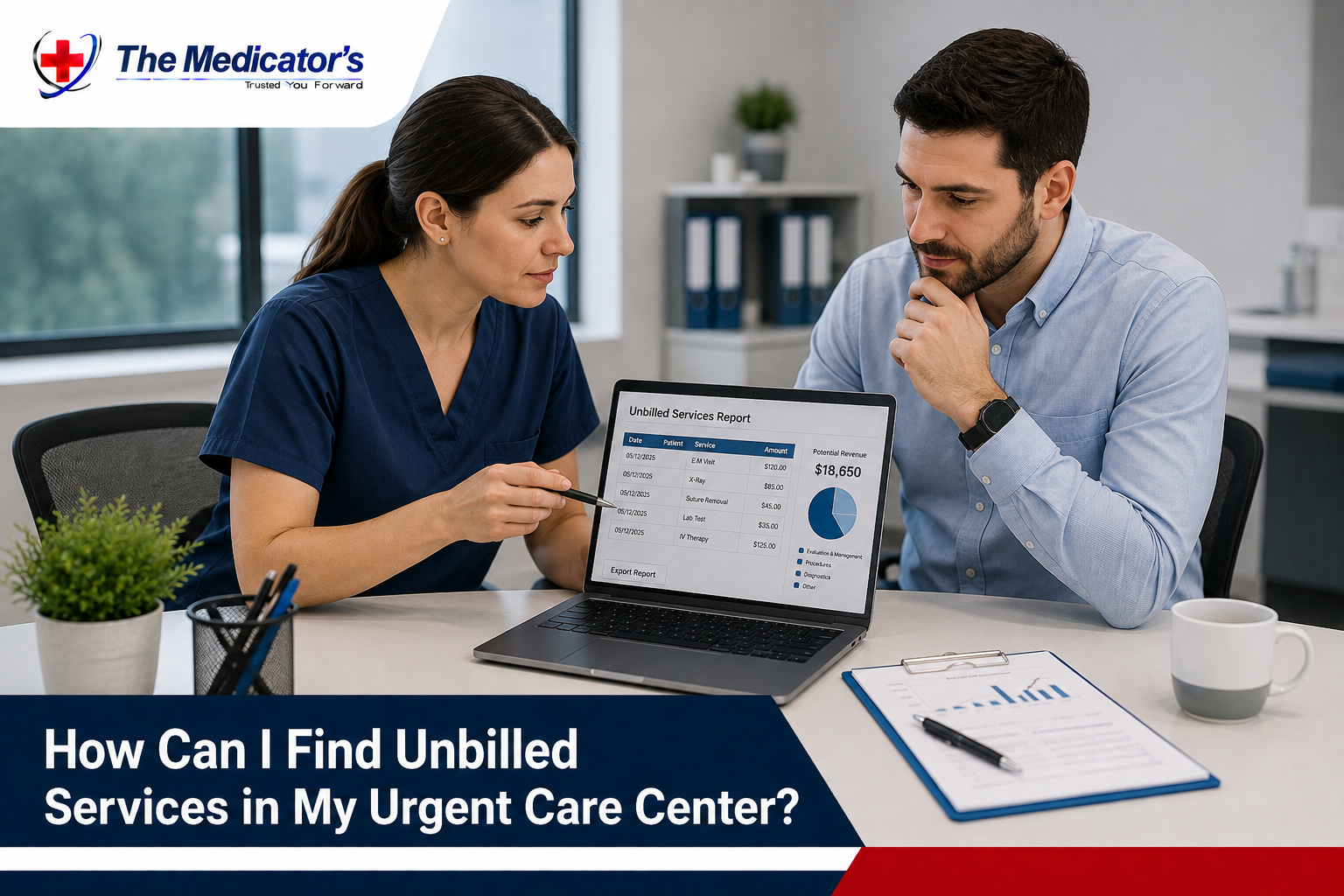
Finding unbilled services in an urgent care center requires running daily “Unbilled Claims” or “Unposted Charges” reports in your practice management system, auditing clinical logs against EHR schedules, and reconciling ancillary service tracking sheets. Because urgent care clinics handle high patient volumes, walk-ins, rapid diagnostic testing, and same-day procedures, unclosed charts and missing charge capture can cause significant revenue leakage if not caught before billing cycles close.
At The Medicator’s, our revenue cycle specialists help urgent care providers identify unbilled encounters, resolve coding bottlenecks, and streamline charge capture. By partnering with our team for specialized urgent care revenue cycle management in Texas and nationwide, clinics keep first-pass clean claim acceptance rates above 97% and recover lost clinical revenue.
Key Steps to Identify Unbilled Urgent Care Services
To capture every billable service and prevent unbilled encounters from slipping past timely filing deadlines, urgent care operations should implement these structured auditing steps:
Audit Daily Sign-In and Clinical Logs
Cross-referencing physical and digital patient logs against billed claims ensures no encounter goes untracked:
Compare EHR Schedules to Sign-In Sheets: Reconcile patient sign-in logs or digital kiosk check-ins with completed provider charts to verify that every walk-in or triage visit was converted into a billable claim.
Identify Unclosed Provider Charts: Check provider shift logs daily for open or unfinalized clinical documentation. Providers must sign off on clinical charts before claims can be scrubbed and submitted.
Review Triage and Fast-Track Records: Ensure patients who left after triage or received rapid nurse visits (such as suture removals or simple dressing changes) have appropriate charge capture entries.
Run Practice Management Software Reports
Leverage automated billing software tools to flag encounters stuck in billing queues:
Generate “Unbilled Claims” Reports: Run daily and weekly “Charges Not Posted” or “Unbilled Encounters” reports to locate completed visits that lack corresponding claim files.
Inspect “Held” and “Error” Queues: Search billing clearinghouses for encounters flagged with missing insurance details, invalid demographic data, or incomplete POS codes in medical billing.
Check Unspecified Coding Flags: Identify claims stalled due to vague diagnostic codes, as resolving unspecified ICD-10 code denials before submission speeds up reimbursement cycles.
Reconcile Ancillary and In-House Procedure Logs
Ancillary services represent the most common source of unbilled revenue in fast-paced urgent care environments:
In-House Laboratory Logs: Audit point-of-care lab test logs (rapid flu, COVID-19, strep, urinalysis, point-of-care blood panels) against billed line items.
Imaging & X-Ray Tracking: Match radiologist logbooks and PACS imaging records directly against billed CPT technical and professional components.
Injections, Supplies, and Suture Kits: Verify that administered medications, nebulizer treatments, IV fluids, splints, and surgical supply kits are routinely attached to primary Evaluation and Management (E/M) claims.
Actionable Strategies to Fix Unbilled Charge Root Causes
Eliminating recurring unbilled services requires updating front-desk workflows, clinical chart closing rules, and billing software configurations:
Enforce Same-Day Chart Closure: Require providers to finalize clinical documentation and select billable CPT codes before the end of their shift.
Standardize Front-Desk Data Capture: Train intake staff to verify patient demographic information, primary insurance coverage, and guarantor details at check-in.
Automate Clearinghouse Edit Rules: Configure billing software filters to scrub claims daily for missing modifier 25 entries, unlinked lab codes, or invalid NDCs.
Conduct Weekly Revenue Audits: Periodically cross-reference total weekly patient volume against billed claims to track collection performance. Measuring your clinic’s overall denial rate vs. rejection rate helps determine whether revenue delays stem from incomplete documentation or clearinghouse edits.
The Urgent Care Charge Capture Workflow: What to Expect
Establishing a reliable charge reconciliation process involves four clear operational phases:
Patient Intake & Log Reconciliation: Verifying registration details and cross-checking daily sign-in sheets against EHR visit lists.
Clinical Documentation & Charge Scrubbing: Ensuring providers sign charts prompt and verifying that all ancillary lab and imaging services are coded.
Clearinghouse Review & Error Scrubbing: Clearing error queues, correcting demographic typos, and linking appropriate diagnosis codes prior to transmission.
A/R Follow-Up & Revenue Recovery: Tracking unpaid claims through a structured A/R aging report to catch lingering unposted charges before timely filing limits expire.
Why Choose The Medicator’s for Your Urgent Care Center?
Unbilled charges, unclosed provider charts, and administrative bottlenecks disrupt cash flow and create severe financial loss for high-volume urgent care centers.
At The Medicator’s, our certified medical billing and revenue cycle experts specialize in full-service charge capture audits, clearinghouse error scrubbing, and urgent care reimbursement optimization. By partnering with our team for urgent care billing in Texas and across the United States, your clinic benefits from:
First-Pass Clean Claim Acceptance Above 97%: Stopping unbilled ancillary services, modifier omissions, and chart errors before claims leave your facility.
Days in A/R Kept Under 30 Days: Accelerating cash flow and preventing aged accounts from turning into uncollectible write-offs.
Complete Financial Transparency: Real-time visibility into unbilled encounters, provider chart closing metrics, and monthly collection performance.
Are unposted charges, unclosed provider charts, or clearinghouse hold-ups impacting your clinic’s revenue? Capture every dollar you earn. Request a free, custom urgent care practice analysis with The Medicator’s team today!
