
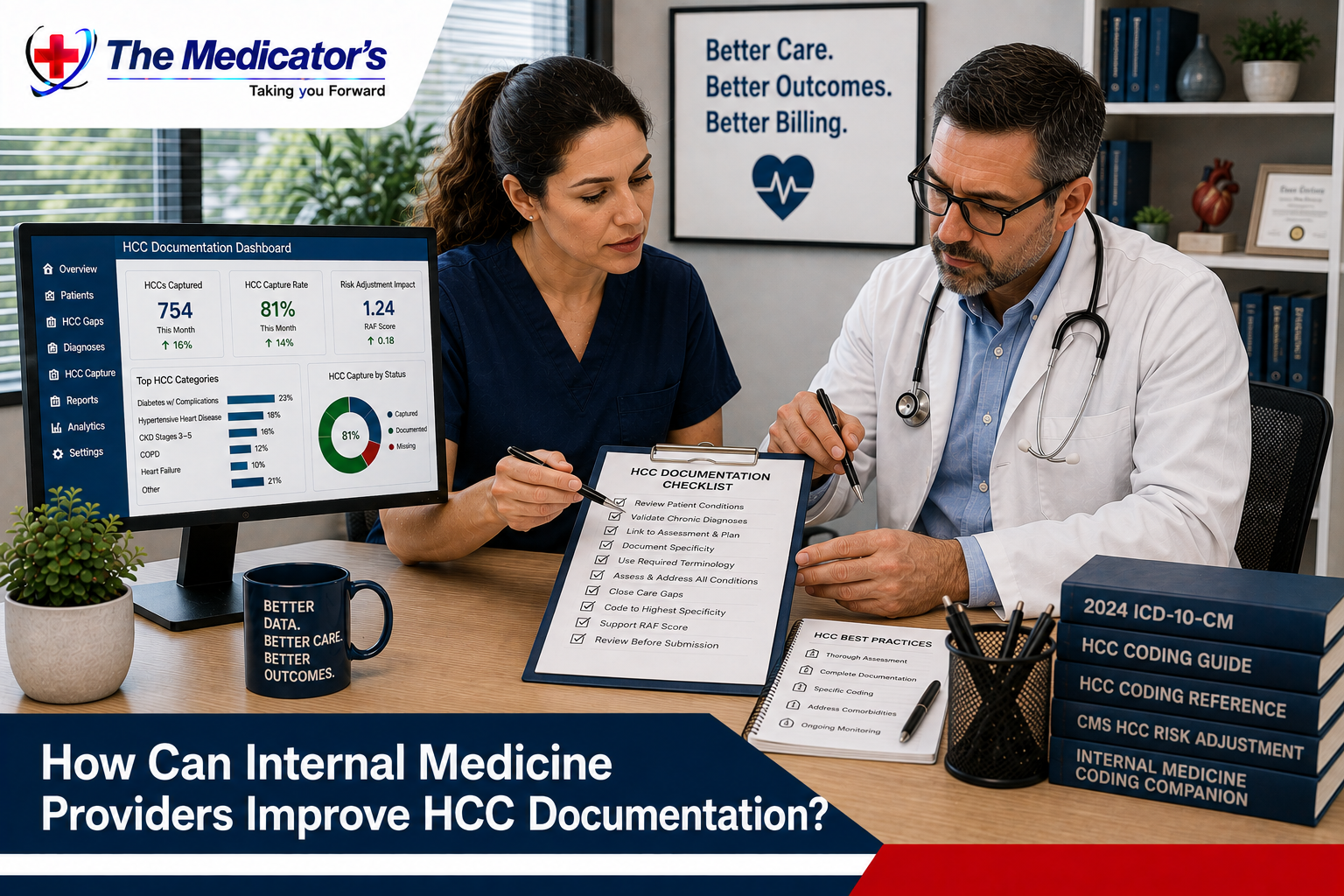
Internal medicine providers can improve Hierarchical Condition Category (HCC) documentation by strictly applying the MEAT criteria (Monitoring, Evaluating, Assessing, Treating) during every patient encounter, capturing all active chronic conditions annually, utilizing high-specificity ICD-10 codes, and optimizing Electronic Health Record (EHR) decision support tools. Accurate risk-adjustment documentation ensures that Medicare Advantage and value-based care reimbursement accurately reflects the true clinical complexity and burden of care of your patient panel.
At The Medicator’s, our certified coding and revenue cycle experts deliver specialized billing solutions, including dedicated internal medicine billing solutions in Florida and nationwide. We help internal medicine groups refine clinical documentation workflows, eliminate HCC recapture gaps, and maintain clean claim acceptance rates above 97%.
Key Strategies to Optimize HCC Documentation in Internal Medicine
Systematically capturing risk-adjusted diagnoses requires structured clinical, operational, and EHR-driven documentation workflows:
1. Consistently Apply the MEAT Criteria
Under Medicare Risk Adjustment guidelines, simply listing a chronic condition in the patient’s historical problem list is insufficient. Each reported HCC diagnosis must be supported in the encounter progress note using at least one element of the MEAT framework:
Monitor: Tracking vital signs, lab trends, disease progression, or diagnostic test results (e.g., “A1c stable at 7.1%”).
Evaluate: Reviewing diagnostic findings, symptom severity, or response to therapy (e.g., “CKD Stage 3a eGFR 52, stable”).
Assess: Charting clinical impressions, disease status, or prognosis (e.g., “Hypertension controlled on current regimen”).
Treat: Ordering medications, adjusting dosages, prescribing therapies, or referring to specialists (e.g., “Increase lisinopril to 20mg daily”).
2. Recapture All Chronic Conditions Annually
Risk adjustment factor (RAF) scores reset on January 1st of every calendar year. Internists must evaluate and document every active chronic condition—including stable conditions, historical amputations, organ transplants, and long-term Ostomies—at least once per calendar year. Utilizing Medicare Annual Wellness Visits (AWVs) is an ideal opportunity to perform comprehensive annual HCC recapture.
3. Document to the Highest Level of ICD-10 Specificity
Unspecified ICD-10 codes dilute patient risk scores and frequently trigger payer documentation audits. Avoid generic descriptors by specifying disease acuity, etiology, manifestation, and underlying complications. For example, instead of reporting unspecified Type 2 Diabetes (E11.9), document Type 2 diabetes mellitus with diabetic chronic kidney disease (E11.22) alongside Chronic kidney disease, stage 3a (N18.31).
To prevent clearinghouse rejections caused by non-specific coding, review our detailed guide on why unspecified ICD-10 codes get claims denied.
4. Optimize EHR Decision Support & Point-of-Care Alerts
Configure your EHR with risk-adjustment clinical decision support tools. Automated prompts can highlight unrecaptured chronic diagnoses from the prior calendar year, suggest higher-specificity ICD-10 codes based on clinical lab values (e.g., suggesting CKD staging based on eGFR trends), and prompt providers for Social Determinants of Health (SDOH) Z-codes (Z55–Z65).
HCC Documentation Best Practices at a Glance
The following matrix summarizes core HCC documentation strategies, clinical requirements, and risk-adjustment impacts:
| Documentation Strategy | Clinical Requirement | Risk Adjustment & Billing Impact |
| MEAT Criteria Compliance | Document explicit Monitoring, Evaluation, Assessment, or Treatment for every reported diagnosis. | Validates medical necessity and protects against risk-adjustment audit clawbacks. |
| Annual Recapture | Re-evaluate and document all active chronic conditions every calendar year. | Ensures accurate RAF scoring and prevents loss of risk-adjusted capitation revenue. |
| High ICD-10 Specificity | Report underlying manifestations, complications, and disease staging (e.g., CKD stage). | Accurately reflects true patient illness severity and drives appropriate risk scores. |
| Annual Wellness Visit Integration | Conduct a full health risk assessment and chronic condition review during the AWV. | Maximizes single-encounter HCC recapture without increasing routine visit stress. |
Actionable Steps to Prevent Audit Clawbacks and Revenue Leakage
Conduct Pre-Submission Chart Audits: Perform regular peer reviews and clinical documentation improvement (CDI) audits to catch missing MEAT criteria before claims are finalized.
Track Accounts Receivable Aging Buckets: Monitor unpaid internal medicine claim lines on your practice’s A/R aging report to catch claims delayed due to diagnostic code mismatches or medical necessity edits.
Differentiate Rejections from Denials: Identifying whether claim errors stem from clearinghouse code format typos or back-end risk-adjustment edits is simplified by tracking your practice’s overall denial rate vs. rejection rate.
Clean Up Historical EHR Problem Lists: Eliminate outdated, resolved, or duplicate diagnoses from EHR problem lists to prevent incorrect historical coding and “history of” documentation traps.
The HCC Documentation & Billing Workflow: What to Expect
Establishing a compliant HCC documentation and coding workflow follows a structured four-phase process:
Pre-Visit Risk Identification: Reviewing historical claims data, care gap reports, and unrecaptured prior-year HCCs during pre-visit planning.
Clinical Encounter & MEAT Charting: Evaluating chronic conditions during the visit and explicitly charting status and treatment plans in progress notes.
Coding Validation & Pre-Submission Scrubbing: Mapping clinical notes to high-specificity ICD-10 codes and validating MEAT documentation prior to claim submission.
Remittance Monitoring & Performance Analytics: Analyzing Explanation of Benefits (EOB) statements and payer RAF reconciliation reports to ensure complete reimbursement.
Optimize Your Internal Medicine Revenue with The Medicator’s
Incomplete MEAT documentation, unrecaptured chronic conditions, and unspecified ICD-10 coding can result in artificially low RAF scores, audit clawbacks, and significant revenue leakage for internal medicine practices.
At The Medicator’s, our certified coding and billing specialists deliver complete revenue cycle management across medical specialties. Beyond our dedicated focus on internal medicine billing solutions in Florida, we provide comprehensive nationwide billing support through our internal medicine RCM services in USA.
Partnering with our billing team ensures:
First-Pass Clean Claim Acceptance Above 97%: Eliminating diagnosis code mismatches, unspecified code edits, and documentation gaps before claims are submitted.
Days in A/R Kept Under 30 Days: Accelerating reimbursement and keeping aged evaluation claims off your practice ledgers.
Full Financial Recovery for Patient Complexity: Ensuring your clinic receives accurate risk adjustment scoring and complete reimbursement for managing complex, multi-system chronic conditions.
Are unrecaptured HCC diagnoses, documentation gaps, or risk-adjustment audits affecting your practice revenue? Capture every dollar you earn. Request a free, custom practice analysis with The Medicator’s team today!
