
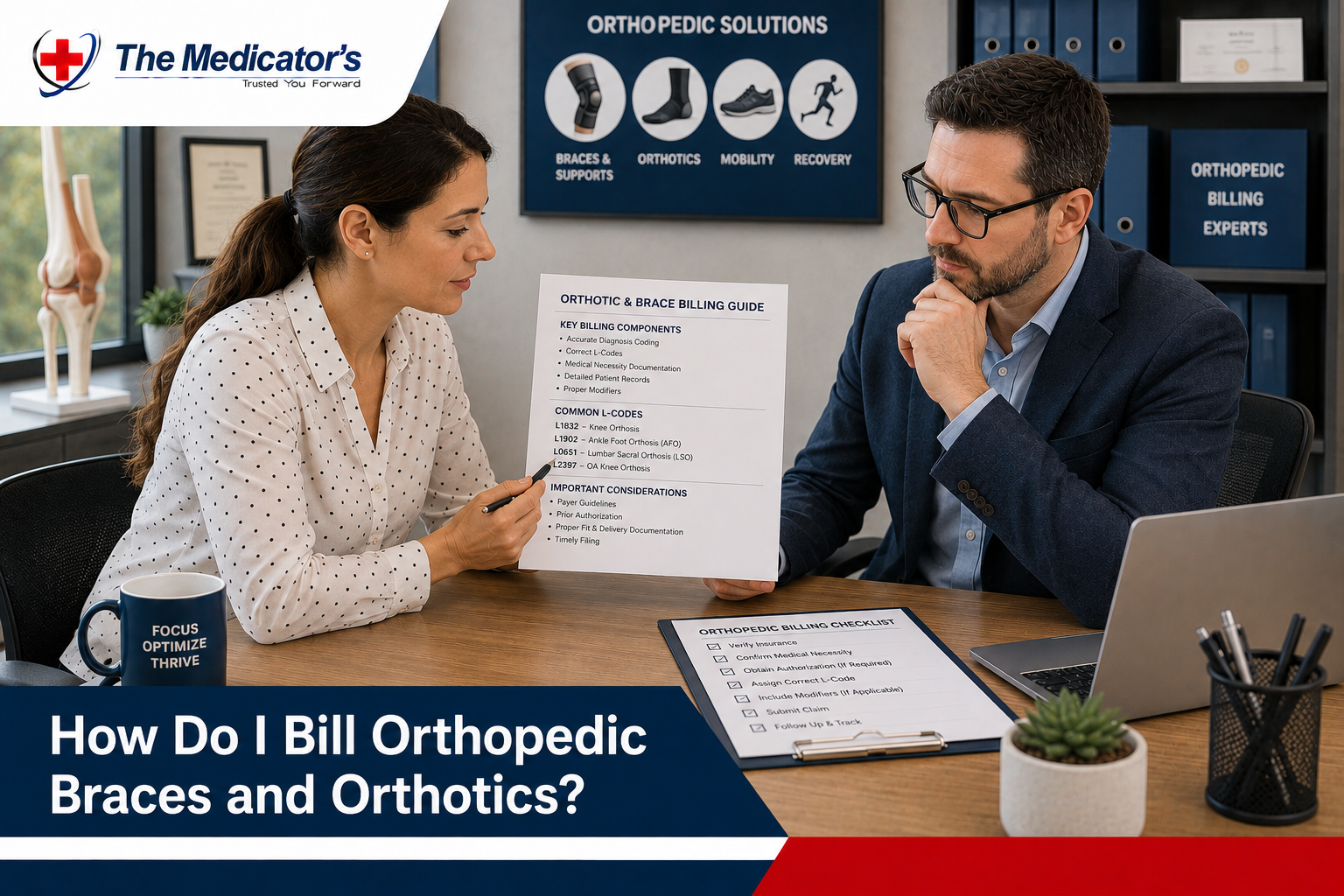
Billing orthopedic braces and orthotics requires using precise Healthcare Common Procedure Coding System (HCPCS) Level II L-codes, applying the correct off-the-shelf (OTS) versus custom-fit descriptors, securing an active Durable Medical Equipment, Prosthetics, Orthotics, and Supplies (DMEPOS) supplier status, and verifying prior authorization guidelines before dispensing items to patients.
At The Medicator’s, our certified revenue cycle management experts specialize in medical billing for surgical groups, DMEPOS compliance, and custom orthotic reimbursement. By delivering specialized orthopedic billing and DMEPOS services in Texas and nationwide, we help practices maintain first-pass clean claim acceptance rates above 97%, avoid administrative write-offs, and ensure complete regulatory compliance.
1. Select the Proper HCPCS Level II L-Codes
Orthotic devices and bracing are billed using HCPCS L-codes ranging from L0000 to L3999:
- Spinal Orthoses (L0100 – L0999): Covers cervical collars, lumbo-sacral orthoses (LSO), and thoracic-lumbo-sacral orthoses (TLSO).
- Lower Extremity Orthoses (L1900 – L2999): Encompasses ankle-foot orthoses (AFO), knee orthoses (KO), and knee-ankle-foot orthoses (KAFO).
- Upper Limb Orthoses (L3650 – L3999): Includes shoulder, elbow, wrist-hand-finger orthoses (WHFO), and dynamic upper extremity braces.
- Foot Orthotics and Shoe Additions (L3000 – L3599): Encompasses custom-molded inserts, arch supports, and therapeutic shoe modifications.
Codes must strictly mirror the item’s fabrication and delivery method (prefabricated vs. custom-fabricated) to prevent immediate payer rejections.
2. Distinguishing Off-the-Shelf (OTS) vs. Custom-Fit Braces
The Centers for Medicare & Medicaid Services (CMS) and private payers enforce strict coding distinctions between Off-the-Shelf and Custom-Fit prefabricated orthotics:
| Category | Description & Fitting Requirements | Practitioner Expertise Required |
| Off-the-Shelf (OTS) | Prefabricated items requiring minimal self-adjustment (e.g., adjusting straps, buckling, or minor comfort trimming) that the patient or caregiver can perform independently. | Does not require the clinical expertise of a certified orthotist or specialized practitioner. |
| Custom-Fit | Prefabricated items requiring substantial modifications—such as bending, heat-molding, trimming, or structural alignment—to fit a specific patient’s anatomy. | Requires specialized clinical expertise, certified orthotist training, or detailed physical modifications at delivery. |
| Custom-Fabricated | Devices built individually from scratch using a patient-specific mold, digital 3D scan, or anatomical impression. | Requires full clinical evaluation, custom casting, and specialized fabrication expertise. |
Billing a Custom-Fit L-code without clinical documentation proving physical adjustments were made during delivery triggers severe audit recoups and claim denials.
3. Applying Mandatory DMEPOS Modifiers
To indicate anatomical laterality, device condition, and clinical compliance, append required HCPCS modifiers:
- Laterality Modifiers (-RT, -LT, -50): Append -RT (right) or -LT (left) to identify the treated limb. For bilateral applications on the same date of service, use Modifier -50 or report separate line items based on specific regional DME MAC guidelines.
- Equipment Status Modifiers (-NU, -RR): Append Modifier -NU for new equipment or -RR for rented devices as outlined by your regional clearinghouse and DME MAC policies.
- KX Modifier (Medical Necessity Verification): Append Modifier -KX to attest that signed physician orders, diagnostic reports, and medical necessity criteria are fully documented in the chart prior to billing.
4. Prior Authorization and Documentation Rules
DMEPOS claims face intense payer scrutiny. Protecting practice cash flow requires adhering to four critical administrative rules:
- Obtain Detailed Written Orders (DWO): Collect a signed and dated physician prescription containing the clinical diagnosis, device description, laterality, and length of need prior to dispensing the item.
- Secure Pre-Service Prior Authorization: Many commercial payers, Medicare Advantage plans, and Medicaid programs require pre-certification for high-cost custom foot orthotics, spinal braces, and rigid knee orthoses.
- Avoid Unspecified ICD-10 Coding: Link every brace to a specific, granular diagnosis code. Submitting claims with non-specific codes leads directly to unspecified ICD-10 code denials.
- Prevent Unbundling Violation (CPT 97760): Do not separately bill orthotic fitting or management codes (CPT 97760) on the day of dispensing, as fitting labor is legally bundled into the primary L-code reimbursement.
Understanding whether an uncollected brace claim stems from front-end clearinghouse formatting or formal medical necessity edits is critical—evaluating your practice’s denial rate vs. rejection rate ensures rapid billing corrections.
The Orthopedic Bracing and DMEPOS Billing Process: What to Expect
Executing flawless orthotic reimbursement involves a structured four-step operational workflow:
- Pre-Dispensing Benefit Clearance: Verifying patient DMEPOS benefit limits, deductible status, and prior authorization mandates 24 to 48 hours before fitting.
- Clinical Order & Modesty Audit: Cross-referencing prescription details, clinical chart notes, and L-code specifications (OTS vs. Custom-Fit) to match NCCI bundling rules.
- Electronic Claim Submission: Filing scrubbed DMEPOS claims electronically with mandatory laterality and status modifiers.
- Active A/R Management & Denial Resolution: Monitoring unpaid claims on an A/R aging report to appeal administrative rejections and collect outstanding insurance balances within prompt-pay timelines.
Why Choose The Medicator’s for Your Practice?
Incorrect L-code selection, missing fitting notes, or omitted laterality modifiers lead to costly claim rejections, delayed patient care, and audit risks.
At The Medicator’s, our certified medical billers and surgical coding specialists provide end-to-end revenue cycle management. By partnering with our experienced team for Texas orthopedic billing and nationwide practice management, your clinic achieves:
- Clean Claim Acceptance Rates Above 97%: Eliminating L-code, modifier, and authorization errors before claims reach payers.
- Days in A/R Under 30 Days: Accelerating reimbursement cycles and preventing aged accounts receivable write-offs.
- Full DMEPOS Compliance: Maintaining complete adherence to CMS, DME MAC, and private payer documentation guidelines.
Struggling with denied knee braces, custom orthotic rejections, or uncollected DMEPOS revenue? Stop write-offs and optimize your practice cash flow today. Request a free, custom orthopedic practice analysis with The Medicator’s team!
