
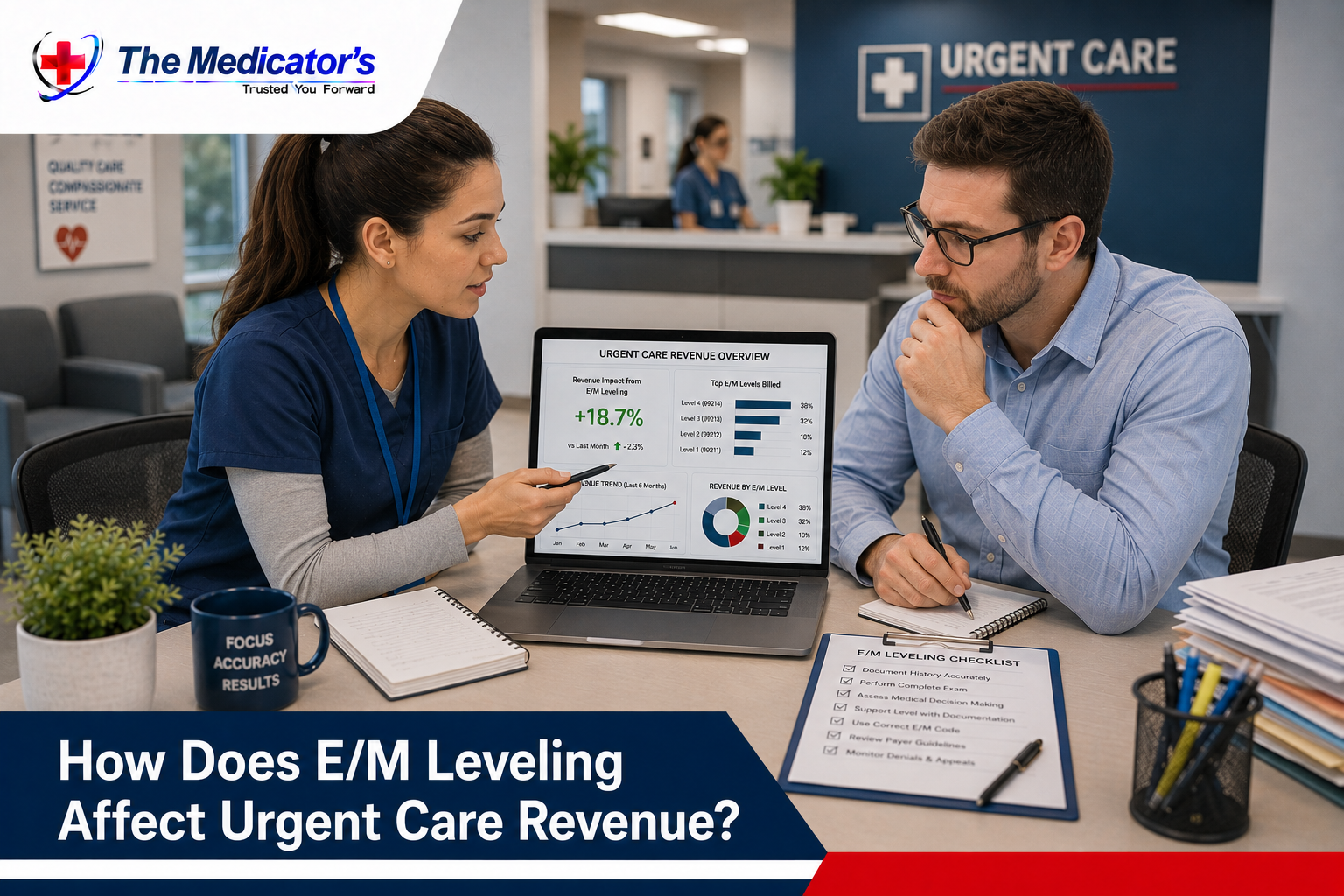
Evaluation and Management (E/M) leveling directly drives urgent care revenue by determining exact reimbursement rates based on Medical Decision Making (MDM) complexity or total provider time on the date of service. Undercoding high-complexity encounters (e.g., billing CPT 99203/99213 instead of 99204/99214 or 99205/99215) causes severe annual revenue leakage per provider. Conversely, inaccurate upcoding or weak clinical documentation triggers automated payer downcoding, retrospective audits, and costly claim denials.
At The Medicator’s, our specialized team delivers targeted urgent care revenue cycle management alongside customized urgent care billing in Texas and nationwide. We perform routine chart audits, train clinical staff on AMA/CMS guidelines, and enforce pre-submission coding scrubbers to maintain clean claim acceptance rates above 97%.
The Financial Impact of E/M Leveling in Urgent Care
In a high-volume walk-in environment, small E/M coding discrepancies quickly compound into significant practice-wide financial impacts:
1. The Cost of Undercoding (“Defensive Coding”)
Many urgent care providers undercode out of fear of payer audits or due to unfamiliarity with 2021/2023 AMA E/M coding changes. Downcoding a complex walk-in visit (such as a patient presenting with acute chest pain, severe asthma exacerbation, or multiple prescription drug interactions) from Level 4 to Level 3 leaves substantial legitimate revenue uncollected. Over a year across multiple providers, defensive coding can drain tens of thousands of dollars from clinic margins.
2. Loss of Unbundled Ancillary Services
Improper E/M leveling often correlates with unbilled or unbundled ancillary services. When providers fail to document distinct medical decision-making for a same-day procedure (such as splinting, wound repair, X-ray interpretation, or therapeutic injections), clearinghouse edits fail to attach required modifiers like Modifier 25. This results in either the procedure or the E/M visit being bundled and denied.
3. Payer Algorithms and Automated Downcoding
Commercial payers and Medicare Advantage plans use automated claims-scrubbing algorithms to benchmark your clinic’s E/M code distribution against regional averages. Submitting an unusually high ratio of Level 4 or Level 5 codes without supporting clinical documentation—such as documented risk of prescription drug management, complex diagnostic ordering, or unstable acute illness evaluation—triggers payer audits, clawbacks, or automatic downcoding to lower reimbursement tiers.
AMA/CMS E/M Coding Standards for Urgent Care
Urgent care E/M levels (CPT 99202–99205 for new patients; 99212–99215 for established patients) are calculated primarily based on three Medical Decision Making (MDM) elements:
Number and Complexity of Problems Addressed: Ranging from minimal (minor/self-limited) to high (acute illness with systemic symptoms or life-threatening conditions).
Amount and/or Complexity of Data to Be Reviewed and Analyzed: Including ordering or reviewing diagnostic tests (X-rays, labs), reviewing external records, or discussing testing with an external specialist.
Risk of Complications and/or Morbidity or Mortality of Patient Management: Ranging from minimal risk to high risk (e.g., parenteral controlled substances, decision regarding emergency surgery, or prescription drug management).
Accurate MDM documentation guidelines apply equally across other medical specialties, including revenue cycle management for internal medicine, revenue cycle management for pediatrics, and revenue cycle management for pain management.
Comparison of Urgent Care E/M Levels (Established Patients)
The following outline details clinical criteria and coding requirements across common established patient E/M levels:
CPT 99212 (Level 2 – Straightforward MDM): Minimal problem (e.g., minor abrasion, routine medication refill check). Minimal risk and data review.
CPT 99213 (Level 3 – Low Complexity MDM): Low severity problem (e.g., acute uncomplicated upper respiratory infection, simple rash, minor sprain). 1 stable chronic illness or 1 acute uncomplicated illness/injury. Low risk of treatment complications.
CPT 99214 (Level 4 – Moderate Complexity MDM): Moderate severity problem (e.g., acute illness with systemic symptoms, acute complicated injury, or 1 chronic illness with mild exacerbation). Requires prescription drug management, review/ordering of multiple tests, or Independent review of diagnostic images.
CPT 99215 (Level 5 – High Complexity MDM): High severity problem (e.g., acute illness or injury that poses a threat to life or bodily function, severe asthma attack, acute chest pain). High-risk treatment decisions or urgent hospitalization evaluation.
Actionable Steps to Optimize E/M Revenue and Compliance
Conduct Monthly Coding Audits: Perform random sampling of provider chart notes to benchmark your practice’s E/M bell-curve distribution against national urgent care standards.
Train Providers on MDM Documentation: Ensure clinicians explicitly document the reasoning behind diagnostic testing, differential diagnoses, and prescription drug management decisions rather than relying on brief bullet points.
Verify Place of Service Accuracy: Ensure all claims report correct POS codes in medical billing (such as POS 20 for Urgent Care) to avoid administrative processing rejections.
Monitor Rejection and Denial Rates: Differentiating your practice’s overall denial rate vs. rejection rate isolates whether lost revenue is due to front-desk registration mistakes or clinical downcoding edits.
Track Outstanding Aging Balances: Regularly audit unpaid claims on your practice’s A/R aging report to catch downcoded E/M claims and submit formal reconsiderations before filing limits expire.
The E/M Revenue Optimization Workflow: What to Expect
Achieving compliant, full-value E/M reimbursement requires a continuous, four-phase billing framework:
Clinical Charting & MDM Capture: Capturing diagnostic decisions, test reviews, and treatment risks directly in the EHR encounter note.
Certified Coding Audit & Modifier Scrubbing: Verifying selected E/M levels against clinical notes and applying necessary same-day procedure modifiers (e.g., Modifier 25).
Clearinghouse Scrubbing & Submission: Running claims through dynamic NCCI and payer-specific edits prior to electronic submission.
Remittance Review & Appeal Management: Analyzing explanation of benefits (EOBs) to identify improper payer downcoding and appealing medical necessity denials.
Maximize Practice Reimbursement with The Medicator’s
Navigating complex AMA coding rules, payer downcoding algorithms, and MDM documentation requirements can stall financial growth for busy walk-in practices.
At The Medicator’s, our certified coding experts specialize in complete revenue cycle management across various healthcare disciplines. Beyond our primary focus on urgent care revenue cycle management and urgent care billing in Texas, we deliver specialized billing solutions for medical billing for internal medicine, revenue cycle management for pediatrics, revenue cycle management for cardiology, revenue cycle management for orthopedic, revenue cycle management for pain management, and specialized medical billing for psychiatry (also supported via revenue cycle management for psychiatry).
Partnering with our billing team ensures:
First-Pass Clean Claim Acceptance Above 97%: Stopping undercoding errors, modifier omissions, and downcoding triggers before submission.
Days in A/R Kept Under 30 Days: Accelerating cash flow and preventing aging accounts from turning into bad debt.
Full Financial Recovery for Rendered Care: Ensuring your practice is fully reimbursed for every documented evaluation, procedure, and diagnostic test.
Is E/M downcoding or revenue leakage affecting your clinic’s profits? Capture every dollar you earn. Request a free, custom urgent care practice analysis with The Medicator’s team today!
