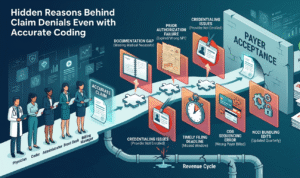
Your psychiatry practice is not losing money because of fewer patients. It is losing money because of silent billing mistakes that repeat every single day.
Denied claims. Underpayments. Missing authorizations. Coding mismatches. Telehealth errors. Each one looks small alone but together, they quietly drain thousands of dollars every month from New York psychiatry practices. Most providers don’t realize the issue until cash flow slows down or denial rates spike. By then, revenue has already been lost.
In our experience working with behavioral health practices, the biggest surprise is this: most revenue leakage is preventable, not unavoidable. Let’s break down exactly where psychiatry practices in New York are losing money and how to fix it before it compounds further.
Why Psychiatry Billing Mistakes Are Costing New York Practices More Than Ever
Psychiatry billing has become significantly more complex over the past few years. It’s no longer just about submitting claims. It’s about navigating payer rules, documentation standards, telehealth compliance, and constantly changing behavioral health policies.
New York practices face additional pressure because of:
- Multiple payer systems (Medicaid MCOs, commercial plans, Medicare)
- Frequent behavioral health policy updates
- Strict prior authorization rules for psychiatric services
- Heavy telepsychiatry usage after COVID expansion
- Increased payer audits on mental health claims
On top of that, psychiatry revenue cycles are highly sensitive to documentation quality and time-based coding accuracy. Even a small error like an incorrect session duration or missing modifier can trigger a denial.
Why this matters more now
Mental health demand has increased significantly, which means:
- More claims being submitted
- More payer scrutiny
- More opportunities for billing errors
- More revenue at risk
When volume increases but billing accuracy stays the same, financial leakage multiplies quickly.
How Much Can Psychiatry Billing Mistakes Actually Cost?
Most practices underestimate the real financial impact of billing errors.
It’s not just about denied claims it’s about everything that happens after.
| Type of Issue | Financial Impact |
| Eligibility errors | Immediate claim rejection |
| Coding mistakes | Underpayment or denial |
| Authorization issues | Full non-payment |
| Documentation gaps | Audit risk + recoupments |
| AR delays | Lost or delayed cash flow |
| Telehealth errors | Payment delays or denials |
The hidden cost most practices ignore
A denied claim is not just a lost payment it is also:
- Staff time spent correcting it
- Follow-up calls with payers
- Resubmission delays
- Administrative overhead
- Increased AR aging
In many practices, the cost of fixing a denied claim can exceed the value of the claim itself when labor is included.
Real-world impact
A psychiatry practice with 400 monthly claims and just a 7–10% denial rate can lose:
- Thousands in monthly delayed revenue
- Significant AR buildup over 90+ days
- Increased staff workload without revenue return
And the worst part: many of these denials are avoidable.
Mistake #1: Failing to Verify Insurance Eligibility
Eligibility verification is one of the most overlooked revenue leaks in psychiatry billing.
Insurance coverage can change at any time due to:
- Job changes
- Plan switches
- Terminated coverage
- Behavioral health benefit restrictions
When eligibility is not verified before every visit, claims are often denied automatically.
What this looks like in real practice
A patient attends weekly therapy sessions for months. Midway through treatment, their insurance changes but the practice continues billing the old payer.
Result:
- Weeks of denied claims
- Rework burden on billing staff
- Delayed patient billing corrections
Prevention strategy
- Verify eligibility before every visit
- Confirm behavioral health benefits separately
- Use automated eligibility tools where possible
Key takeaway: Eligibility errors are small but create immediate revenue disruption.
Mistake #2: Incorrect Psychiatry CPT Coding
Psychiatry coding is one of the most complex areas in outpatient billing.
Commonly used CPT codes include:
- 90791 (Diagnostic evaluation)
- 90832 (30-minute therapy)
- 90834 (45-minute therapy)
- 90837 (60-minute therapy)
- 90833 (add-on psychotherapy)
- 99213 / 99214 (E/M visits)
Where practices lose money
The most common coding issues include:
- Billing wrong session durations
- Using incorrect E/M levels
- Missing required modifiers
- Not aligning diagnosis with service type
- Undercoding to avoid audits
Undercoding is especially dangerous it reduces audit risk but silently reduces revenue every month.
Example
A provider consistently bills 90834 instead of 90837 due to uncertainty.
Over time, this creates a significant revenue gap across hundreds of sessions.
Prevention strategy
- Conduct quarterly coding audits
- Train providers on time-based coding rules
- Use psychiatry-specific billing expertise
Key takeaway: Coding accuracy impacts both compliance and revenue.
Mistake #3: Weak Documentation That Fails Medical Necessity
In psychiatry billing, documentation is everything.
Payers do not just look at what was billed they look at why it was billed.
Common documentation issues include:
- Missing treatment plans
- Lack of session details
- No clinical justification
- Incomplete progress notes
- Weak medical necessity language
Why this leads to denials
Even if the service was correctly performed, incomplete documentation can still lead to:
- Claim denial
- Downcoding
- Audit recoupment
Real-world scenario
A 60-minute psychotherapy session is billed correctly, but documentation only reflects general discussion without clinical detail.
Result: payer denies claim for insufficient medical necessity.
Prevention strategy
- Standardized documentation templates
- Regular chart audits
- Training on payer expectations
Key takeaway: If it’s not documented clearly, it doesn’t exist for payers.
Mistake #4: Missing Prior Authorization Requirements
Many psychiatry services require prior authorization, especially:
- Intensive outpatient care
- Psychological testing
- Higher-level behavioral health programs
Why this becomes a major revenue leak
Without authorization:
- Claims are denied automatically
- Appeals are time-consuming
- Payments are often unrecoverable
Common workflow gap
Authorization responsibility is unclear between front desk and clinical teams, leading to missed approvals before services begin.
Prevention strategy
- Build authorization tracking systems
- Assign clear ownership
- Verify authorization before scheduling
Key takeaway: Missing authorization = guaranteed revenue loss.
Mistake #5: Telepsychiatry Billing Errors
Telepsychiatry has expanded rapidly but billing rules have not standardized across payers.
Common errors include:
- Wrong place-of-service codes
- Missing telehealth modifiers
- Ignoring payer-specific rules
- Poor documentation of virtual visits
Why this is critical in New York
New York psychiatry practices heavily rely on telehealth, meaning even small telehealth billing mistakes scale quickly into major revenue loss.
Prevention strategy
- Maintain payer-specific telehealth rules checklist
- Regular policy updates
- Dedicated telehealth billing workflows
Key takeaway: Telehealth billing is not universal each payer has its own rules.
Mistake #6: Ignoring Denial Trends
Many practices fix individual denials but never analyze patterns.
This is a major missed opportunity.
Common denial categories:
- Eligibility
- Coding
- Authorization
- Documentation
- Timely filing
What practices miss
Without trend analysis:
- The same errors repeat monthly
- Revenue leakage continues unnoticed
- Staff workload increases unnecessarily
Prevention strategy
- Monthly denial reporting
- Root cause analysis
- Corrective action workflows
Key takeaway: Denials are symptoms trends reveal the real problem.
Mistake #7: Delayed Claim Submission
Every payer has strict filing deadlines.
Delays lead to:
- Lost revenue
- Denied claims
- Reduced cash flow
Causes include:
- Manual billing workflows
- Staff shortages
- Missing documentation delays
Prevention strategy
- Daily claim submission schedule
- Automated billing systems
- Workflow standardization
Key takeaway: Faster submission = faster reimbursement.
Mistake #8: Weak Accounts Receivable Follow-Up
Submitting claims is only half the process.
Without AR follow-up:
- Payments remain stuck
- Denials go uncorrected
- Aging balances increase
Warning signs:
- AR over 60–90 days
- Increasing write-offs
- Low collection rates
Prevention strategy:
- Weekly AR tracking
- Prioritize high-value claims
- Dedicated follow-up workflows
Key takeaway: AR management directly controls cash flow stability.
Revenue Recovery Starts With Fixing Billing Errors
Most psychiatry practices don’t need more patients they need fewer billing mistakes. Improving eligibility verification, coding accuracy, documentation quality, and AR follow-up can significantly improve revenue without increasing patient volume. This is where specialized billing support makes a measurable difference.
How The Medicators Helps Psychiatry Practices Increase Revenue
The Medicators provides specialized Psychiatry Billing Services in New York designed to reduce denials and improve reimbursement performance.
Our services include:
- Insurance verification
- Psychiatry coding support
- Claim submission
- Denial management
- AR recovery
- Revenue cycle optimization
- Telehealth billing compliance
We focus on identifying revenue leakage points and fixing them at the source not just reacting to denials after they occur.
Frequently Asked Questions
What are the most common psychiatry billing mistakes?
The most common mistakes include eligibility verification failures, coding errors, missing authorizations, incomplete documentation, telehealth billing issues, and weak accounts receivable follow-up. These issues directly lead to claim denials and lost revenue.
How do billing mistakes affect psychiatry revenue?
Billing mistakes cause delayed payments, claim denials, underpayments, and increased administrative workload. Over time, even small errors can result in thousands of dollars in lost revenue annually.
Why do psychiatry claims get denied so often?
Psychiatry claims are frequently denied due to coding inaccuracies, eligibility issues, missing prior authorizations, documentation gaps, and telehealth billing errors. These factors are common in behavioral health billing workflows.
How can psychiatry practices reduce billing errors?
Practices can reduce errors by verifying eligibility before visits, improving documentation quality, conducting regular coding audits, tracking denial trends, and implementing structured AR follow-up systems.
Is telepsychiatry billing more difficult?
Yes. Telepsychiatry billing is more complex due to varying payer rules, modifier requirements, and documentation standards. Each insurance carrier may have different policies for virtual care reimbursement.
Should psychiatry practices outsource billing?
Many psychiatry practices outsource billing to improve coding accuracy, reduce denials, increase collections, and reduce administrative burden while allowing providers to focus on patient care.
How can denial management improve revenue?
Denial management identifies root causes of claim denials, helps recover lost revenue through appeals, and prevents future errors by improving billing processes and workflows.
Stop Losing Revenue to Preventable Billing Mistakes
Every denied claim, missed authorization, or coding error reduces your practice revenue. The Medicators helps psychiatry practices across New York eliminate billing inefficiencies, reduce denials, and maximize reimbursements through expert Psychiatry Billing Services in New York.
Get a billing review today and uncover how much revenue your practice may be losing.