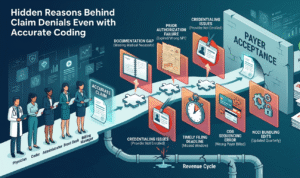
Every denied claim represents delayed revenue, additional administrative work, and unnecessary stress for your practice.
For psychiatry providers in New York, claim denials are especially challenging because behavioral health billing involves complex documentation requirements, changing payer policies, telehealth regulations, and specialty-specific coding guidelines.
The good news? Most psychiatrists claim denials are preventable.
Understanding why claims are denied can help your practice improve reimbursement rates, reduce accounts receivable, and strengthen overall financial performance.
Why Psychiatry Claim Denials Are Increasing in New York
Behavioral health services have experienced significant growth over the past several years. Increased demand for mental health services, expanded telehealth adoption, and evolving insurance requirements have created new billing challenges for providers.
Psychiatry practices often deal with:
- Complex evaluation and management codes
- Time-based psychotherapy coding
- Telepsychiatry billing requirements
- Prior authorization rules
- Frequent payer policy updates
- Documentation audits
Even minor errors can trigger claim denials and payment delays.
The Financial Impact of Denied Psychiatry Claims
Many providers underestimate the true cost of denied claims.
A denied claim affects revenue in multiple ways:
| Impact Area | Effect on Practice |
| Delayed Payments | Slower cash flow |
| Staff Time | More hours spent on appeals |
| Administrative Costs | Increased overhead |
| Lost Revenue | Some claims never get recovered |
| Provider Productivity | Time diverted from patient care |
A consistent denial rate can significantly impact practice profitability over time.
Top Reasons Psychiatry Claims Get Denied in New York
Incorrect Patient Information
Simple demographic errors remain one of the most common denial causes.
Examples include:
- Misspelled patient names
- Incorrect member IDs
- Wrong date of birth
- Outdated insurance information
Even small discrepancies can cause automatic claim rejections.
Prevention Strategy:
Verify patient information and insurance eligibility before every visit.
Insurance Eligibility Issues
Coverage changes frequently.
Patients may:
- Switch insurance plans
- Lose eligibility
- Change employers
- Modify behavioral health benefits
Submitting services without confirming eligibility often leads to denials.
Prevention Strategy:
Perform eligibility verification before appointments and document coverage details.
Missing Prior Authorizations
Certain psychiatric services require authorization before treatment.
Common examples include:
- Intensive outpatient programs
- Psychological testing
- Certain medication management services
Failure to obtain authorization can result in full claim denial.
Prevention Strategy:
Implement authorization workflows before scheduling services.
Coding Errors
Psychiatry coding is highly specialized.
Common issues include:
- Incorrect CPT selection
- Modifier errors
- ICD-10 mismatches
- Time-based coding inaccuracies
Frequently used psychiatry codes require careful documentation support.
Prevention Strategy:
Use certified coding specialists familiar with behavioral health billing.
Incomplete Documentation
Insurance companies increasingly audit behavioral health claims.
Missing documentation often includes:
- Treatment plans
- Progress notes
- Session duration
- Medical necessity justification
Insufficient documentation may result in denial even when services were appropriately provided.
Prevention Strategy:
Establish documentation standards and conduct regular audits.
Telepsychiatry Billing Mistakes
Telehealth has transformed behavioral healthcare delivery.
However, telepsychiatry claims face unique challenges:
- Incorrect place of service codes
- Missing telehealth modifiers
- State-specific requirements
- Payer-specific telehealth rules
Many denials stem from telehealth billing inaccuracies.
Prevention Strategy:
Stay updated on telehealth reimbursement policies and coding requirements.
Untimely Claim Submission
Every payer has filing deadlines.
Missing these deadlines often results in automatic denial regardless of service validity.
Prevention Strategy:
Submit claims promptly and monitor aging reports regularly.
Duplicate Claims
Duplicate submissions create confusion and trigger payer edits.
This often happens when staff resubmits claims before processing is complete.
Prevention Strategy:
Track claim status before resubmitting.
Common Psychiatry CPT Codes That Trigger Denials
Certain psychiatry codes are reviewed more frequently by payers.
Examples include:
| CPT Code | Description |
| 90791 | Psychiatric Diagnostic Evaluation |
| 90832 | Psychotherapy 30 Minutes |
| 90834 | Psychotherapy 45 Minutes |
| 90837 | Psychotherapy 60 Minutes |
| 99213 | Established Patient E/M |
| 99214 | Established Patient E/M |
| 90833 | Psychotherapy Add-On |
| 90836 | Psychotherapy Add-On |
Documentation must clearly support the selected code level.
How New York Payers Review Behavioral Health Claims
Behavioral health claims often receive additional scrutiny due to:
- Medical necessity reviews
- Authorization requirements
- Telehealth regulations
- High utilization patterns
- Documentation audits
Major commercial payers and managed care organizations frequently update their behavioral health billing policies.
Practices that fail to stay current often experience higher denial rates.
Best Practices to Prevent Psychiatry Claim Denials
Successful psychiatry practices typically implement the following strategies:
Verify Eligibility Before Every Visit
Never assume coverage remains unchanged.
Conduct Regular Coding Audits
Identify coding issues before claims are submitted.
Train Staff on Behavioral Health Billing
Specialty-specific knowledge reduces preventable errors.
Improve Documentation Quality
Strong documentation supports medical necessity.
Monitor Denial Trends
Analyze recurring denial reasons and address root causes.
Track Key Revenue Cycle Metrics
Monitor:
- First-pass acceptance rate
- Days in A/R
- Denial rate
- Net collection rate
These metrics reveal opportunities for improvement.
Why Many New York Practices Outsource Psychiatry Billing
Psychiatry billing requires specialized expertise that many practices struggle to maintain internally.
Outsourcing offers several advantages:
- Reduced denial rates
- Faster claim submission
- Better coding accuracy
- Improved collections
- Lower administrative burden
- Enhanced compliance
For growing behavioral health practices, outsourcing often delivers stronger financial results than managing billing internally.
Need Help Reducing Psychiatry Claim Denials?
The Medicators helps psychiatry providers throughout New York improve billing accuracy, strengthen revenue cycle performance, and recover lost revenue through specialized behavioral health billing support.
How The Medicators Helps Reduce Psychiatry Claim Denials
At The Medicators, our team understands the complexities of psychiatry billing.
Our services include:
- Insurance verification
- Medical coding
- Claim submission
- Denial management
- AR recovery
- Credentialing support
- Revenue cycle optimization
By identifying denial patterns and implementing proactive billing strategies, we help practices improve reimbursement rates and maintain healthier cash flow.
Frequently Asked Questions
Why are psychiatry claims denied so often?
Psychiatry claims are frequently denied due to coding errors, incomplete documentation, authorization issues, eligibility problems, and telehealth billing mistakes. Many denials can be prevented through stronger billing processes and regular claim audits.
How can psychiatry practices reduce claim denials?
Practices can reduce denials by verifying insurance eligibility, obtaining prior authorizations, improving documentation quality, conducting coding audits, and monitoring denial trends regularly.
What is the most common psychiatry billing mistake?
Coding errors are among the most common psychiatry billing mistakes. Incorrect CPT codes, modifier misuse, and documentation mismatches frequently result in denied or delayed claims.
Do telepsychiatry services have higher denial rates?
They can. Telepsychiatry claims often face denials due to incorrect modifiers, place-of-service errors, and changing payer requirements. Staying updated on telehealth policies is essential.
How does denial management improve revenue?
Denial management identifies the root causes of claim denials, facilitates appeals, and helps prevent future errors. Effective denial management improves collections and accelerates cash flow.
Should psychiatry practices outsource billing?
Many psychiatry practices outsource billing to improve coding accuracy, reduce denials, accelerate reimbursements, and allow providers to focus more on patient care rather than administrative tasks.
How long does it take to resolve a denied psychiatry claim?
Resolution times vary depending on the payer and the denial reason. Some denials can be corrected and resubmitted within days, while appeals may take several weeks or months.
What services are included in Psychiatry Billing Services in New York?
Comprehensive psychiatry billing services typically include coding, claim submission, payment posting, denial management, AR follow-up, credentialing, reporting, and revenue cycle management.