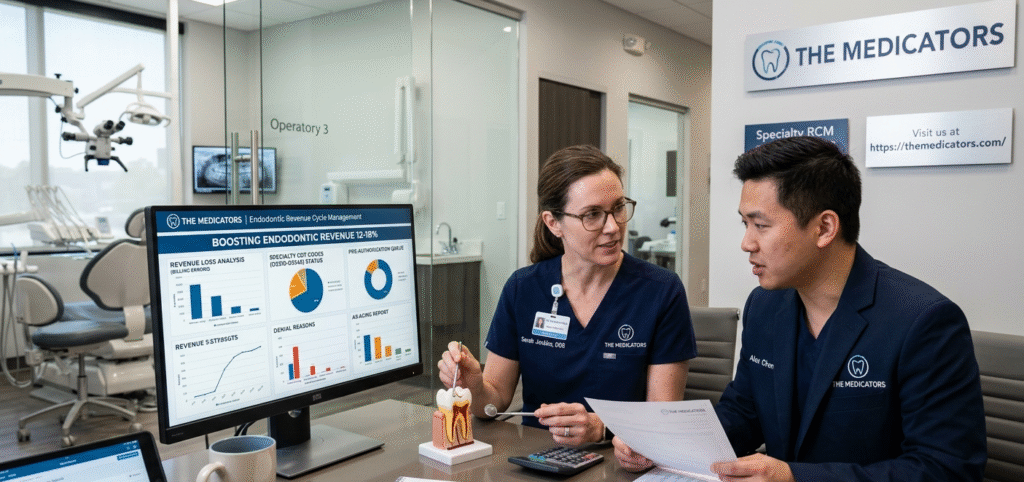
Endodontists lose revenue when specialty coding, documentation, eligibility, authorization, claim submission, and A/R follow-up are not handled correctly. Endodontic billing has a different structure from general dental billing because procedures require specialty-specific CDT coding, detailed documentation, and payer-specific billing workflows.
For small dental practices, choosing endodontics billing support services with experience in specialty claims can help create a more consistent revenue cycle and reduce avoidable billing problems.
Why Endodontic Billing Requires Specialized Support
Endodontic practices handle procedures such as root canals, retreatments, apexification, apicoectomies, and complex multi-canal cases. Each procedure can involve different endodontic dental codes, documentation requirements, benefit limitations, and authorization rules.
A general dental billing workflow may not account for these specialty requirements. A dedicated endodontics billing support service can coordinate eligibility verification, pre-authorization, CDT coding, claim submission, denial follow-up, payment posting, and A/R management as one connected process.
Practices can also combine specialty billing with broader dental billing services to maintain consistent processes across their revenue cycle.
Endodontic Dental Codes and CDT Coding Requirements
Accurate endodontic dental codes are central to clean claim submission. Root canal procedures, retreatments, surgical procedures, and canal-related services must be reported according to the applicable CDT code and the clinical circumstances documented in the patient’s record.
For example, D3310, D3320, and D3330 correspond to anterior, premolar, and molar root canal procedures. Retreatment procedures use specific CDT codes, while additional procedures may require separate reporting based on the service performed.
The billing team should connect each dental coding decision with the tooth treated, procedure performed, supporting documentation, payer requirements, and applicable coverage rules.
Dental Code D3331 and Canal Obstruction Billing
Dental code D3331 is particularly important when non-surgical management of a canal obstruction is performed. The source material notes that D3331 should be reported with the applicable primary root canal procedure rather than used as a replacement for it.
Because coding mistakes involving D3331 can affect claim accuracy and reimbursement, billing teams should review the clinical record and procedure combination before claim submission rather than treating the code as an isolated line item.
How to Standardize Endodontic Billing Workflows and Protocols
Small practices can reduce inconsistent billing by establishing standardized protocols for every endodontic case.
A practical endodontic billing workflow should include:
- Insurance eligibility and benefits verification before treatment.
- Specialty benefit and carve-out verification when applicable.
- Pre-authorization review for procedures requiring payer approval.
- CDT code validation against the documented procedure and tooth.
- Clinical documentation review before claim submission.
- Radiograph and narrative attachment when required.
- Clean claim submission using payer-specific requirements.
- Claim status monitoring after submission.
- Denial and appeal follow-up based on the actual denial reason.
- Payment posting and A/R reconciliation after adjudication.
Using the same workflow for every applicable case creates greater consistency between the clinical, front-office, coding, and billing teams. Practices can also use revenue cycle management services to coordinate these processes across the complete billing cycle.
Endodontics Billing Support Services for Small Practices
Small endodontic practices often have fewer administrative resources than large specialty groups. That makes dedicated endodontics billing support services particularly relevant when the practice is managing high-value procedures, complex insurance requirements, and aging A/R with a small internal team.
Specialty billing support can include:
- Endodontic insurance eligibility verification
- Benefits and specialty carve-out analysis
- Prior authorization and pre-authorization support
- CDT coding review
- Claim submission
- Dental claim follow-up
- Denial management
- Appeals and documentation support
- Payment posting
- A/R follow-up
- Billing reporting and performance monitoring
Integrating insurance eligibility verification before treatment can help identify benefit limitations and payer requirements before the claim reaches the insurance carrier.
What to Look for in the Best Endodontics Billing Services
When comparing best endodontics billing services for small dental practices, focus on the actual processes used to manage specialty claims rather than simply choosing a company that handles dental billing.
Ask potential billing partners about:
- Their experience with endodontic practices
- Familiarity with specialty CDT codes
- D3310, D3320, D3330, D3331, and retreatment codes
- Pre-authorization workflows
- Documentation and radiograph requirements
- Denial follow-up procedures
- A/R management
- Claim reporting and performance metrics
- Dental software integrations
- Credentialing and payer enrollment support
A strong billing partner should also be able to explain how it identifies coding errors before claims are submitted and how it handles claims that require additional documentation.
Best Dental CDT Coding Audit Service for Endodontic Practices
A dental CDT coding audit service can help identify recurring coding and documentation problems before they continue through the revenue cycle.
For an endodontic practice, an audit can review:
- Whether the reported CDT code matches the documented procedure
- Tooth-specific coding accuracy
- Use of D3331 with the applicable primary procedure
- Retreatment documentation
- Missing narratives
- Required radiographs
- Authorization-related documentation
- Payer-specific billing requirements
- Patterns in rejected and denied claims
A medical billing audit or specialty-focused dental billing review can also help identify broader revenue-cycle weaknesses that may not be visible from individual claims.
Endodontic Insurance Verification and Benefits Analysis
Endodontic insurance verification can involve more than confirming whether a patient has active coverage. The billing team may need to determine lifetime procedure limitations, frequency restrictions, specialty carve-outs, and pre-authorization requirements.
For example, an endodontic procedure may be covered under a specialty benefit administered separately from the patient’s general dental benefits. The source material identifies incorrect specialty-payer routing as a potential cause of automatic claim rejection.
Using a structured insurance verification process before treatment gives the practice an opportunity to identify these issues before the procedure is performed.
Endodontic Denial Management and Appeals
Endodontic claims can be denied because of coding problems, missing documentation, authorization issues, incorrect payer routing, or benefit limitations.
Effective denial management begins by identifying the actual reason for the denial rather than simply resubmitting the same claim.
For complex cases, the billing team may need to provide:
- Clinical narratives
- Relevant radiographs
- Prior treatment information
- Authorization records
- Corrected claim information
- Supporting documentation requested by the payer
A structured denial management process helps separate correctable claim errors from cases that require an appeal or additional payer documentation.
Endodontic A/R Management and Revenue Cycle Performance
Because many endodontic procedures have relatively high reimbursement values, unresolved claims can create significant A/R exposure for smaller practices.
A specialty billing partner should monitor:
- A/R aging
- Outstanding claim volume
- Denial trends
- First-pass claim performance
- Payment turnaround
- Payer-specific reimbursement
- Unworked claims
- Patient balances
The source material recommends reviewing open A/R before changing billing partners and establishing a financial baseline from outstanding claims.
A structured A/R management process can help ensure older endodontic claims are not overlooked while new claims continue moving through the billing cycle.
Common Endodontic Billing Mistakes
Incorrect Tooth-Specific CDT Coding
Endodontic CDT codes can differ according to the tooth and procedure performed. Reporting the wrong code can result in claim rejection, denial, or rework.
Missing Retreatment Documentation
Retreatment claims may require evidence of the previous procedure and information about when the original treatment occurred. Missing documentation can delay or prevent reimbursement.
Missing Clinical Narratives
Complex endodontic procedures may require clinical narratives explaining the reason for treatment and supporting medical necessity.
Ignoring Specialty Benefit Carve-Outs
Sending an endodontic claim to the wrong payer can create avoidable rejection and denial problems when specialty benefits are administered separately.
Inconsistent Billing Protocols
When every biller handles authorization, coding, documentation, and claim follow-up differently, small errors can become recurring revenue-cycle problems. Standardizing the workflow creates a repeatable process for the entire practice.
How Small Endodontic Practices Can Improve Billing Accuracy
Small practices can strengthen their billing process by creating written protocols for:
- Eligibility verification
- Specialty benefit verification
- Authorization
- Endodontic CDT coding
- Documentation review
- Claim submission
- Denial follow-up
- A/R escalation
- Payment posting
- Monthly billing audits
The objective is not simply to submit claims faster. The goal is to create a repeatable process that catches preventable errors before they affect reimbursement.
For practices that need broader operational support, dental revenue cycle management can connect coding, claims, denials, payments, and A/R into one workflow.
How to Switch Endodontic Billing Companies Without Losing Revenue
Changing billing partners can create disruption if open claims, A/R, credentials, and workflow responsibilities are not transferred properly.
Before switching, practices should:
- Review the complete open A/R.
- Identify claims older than 30, 60, and 90 days.
- Document payer and claim status.
- Confirm credentialing and enrollment status.
- Transfer billing reports and documentation.
- Establish responsibility for old and new claims.
- Maintain billing continuity throughout the transition.
Medical credentialing services can also be considered when payer enrollment or credentialing gaps are affecting claim processing.
The Medicator’s Endodontic Billing Support
The Medicator’s supports specialty dental billing workflows involving eligibility verification, pre-authorization, CDT coding, claim submission, denial management, payment posting, patient billing, and A/R follow-up.
For endodontic practices, the billing process can be structured around specialty-specific coding, documentation, payer requirements, and claim follow-up rather than applying a generic dental workflow.
The source material specifically describes support for endodontic insurance verification, pre-authorization, CDT-accurate claims, denial appeals, payment posting, and patient billing.
Practices can also request a free practice analysis to review A/R, coding accuracy, reimbursement patterns, claim denials, and potential revenue-cycle inefficiencies.
Frequently Asked Questions About Endodontics Billing
What are endodontic dental codes?
Endodontic dental codes are CDT codes used to report procedures performed by endodontic practices, including root canals, retreatments, apexification, apicoectomy, and related procedures. Accurate code selection depends on the procedure, tooth, documentation, and applicable payer requirements.
What is dental code D3331?
D3331 is used for non-surgical management of a canal obstruction. The source material explains that it should be reported with the applicable primary root canal procedure rather than replacing the primary procedure code.
How can a practice standardize endodontic billing workflows and protocols?
Create a written workflow covering eligibility verification, specialty benefits, authorization, CDT coding, documentation, claim submission, denial follow-up, payment posting, and A/R management. The same checkpoints should be applied consistently to applicable endodontic claims.
What should small practices look for in endodontics billing support services?
Small practices should evaluate specialty CDT coding knowledge, authorization support, documentation review, denial management, A/R follow-up, reporting, payer experience, and the billing team’s familiarity with endodontic procedures.
What does a dental CDT coding audit review?
A dental CDT coding audit can examine whether reported codes match the documented procedures, whether tooth-specific coding is accurate, whether required supporting documentation is present, and whether recurring coding issues are contributing to claim problems.
Do endodontic billing companies handle prior authorizations?
Some dental billing companies handle endodontic pre-authorizations and supporting documentation. Practices should confirm exactly which procedures, payers, documents, and authorization steps are included in the service.
Why do endodontic claims get denied?
Common causes include incorrect CDT coding, missing documentation, incomplete narratives, authorization problems, incorrect payer routing, specialty benefit carve-outs, and missing information for retreatment claims.
How can endodontic practices reduce billing errors?
Standardize the billing workflow, verify specialty benefits before treatment, validate CDT codes against clinical documentation, review claims before submission, monitor denials, and conduct periodic coding and billing audits.