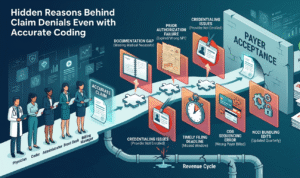
For psychiatry practices, every rejected insurance claim means more than delayed reimbursement; it means additional administrative work, interrupted cash flow, and valuable time spent correcting preventable mistakes. As payer requirements continue to evolve, Psychiatry Billing has become increasingly complex, requiring precise documentation, accurate coding, and strict compliance with insurance guidelines.
Even minor errors can result in claim rejections, forcing practices to resubmit claims, appeal denials, or absorb unnecessary revenue losses. According to industry trends, many behavioral health providers experience higher denial rates than other specialties because psychiatric services often involve unique documentation requirements, telehealth regulations, time-based coding, and authorization rules.
The good news is that most Psychiatry Billing Claim Rejections are preventable. By understanding the common causes of rejected claims and implementing proactive billing strategies, practices can improve clean claim rates, accelerate reimbursements, and strengthen their overall Revenue Cycle Management.
In this guide, we’ll explore the most common reasons psychiatry claims are rejected and share practical solutions to help your practice reduce denials and maximize revenue.
1. Incorrect Patient Insurance Verification Causes Psychiatry Billing Claim Rejections
One of the most common reasons for Psychiatry Billing Claim Rejections occurs before a patient is even seen. Submitting claims without verifying active insurance coverage often leads to immediate rejection by the payer.
Insurance information can change frequently due to employer changes, policy renewals, or changes in patient eligibility. If these updates aren’t confirmed before each appointment, practices risk submitting claims under inactive or incorrect insurance plans.
Common insurance verification errors include:
- Expired insurance policies
- Incorrect member ID numbers
- Outdated patient demographics
- Missing secondary insurance information
- Inactive behavioral health benefits
- Incorrect payer selection
Implementing Insurance Eligibility Verification before every visit helps ensure claims are submitted with accurate information, significantly reducing rejection rates and improving reimbursement timelines.
2. Incorrect CPT and ICD-10 Coding Leads to Psychiatry Medical Billing Claim Rejections
Accurate coding is the foundation of successful Psychiatry Medical Billing. Insurance companies carefully review every submitted CPT and ICD-10 code to ensure medical necessity and billing accuracy.
Common coding mistakes include:
- Incorrect psychotherapy CPT codes
- Mismatched diagnosis and procedure codes
- Time-based coding inaccuracies
- Missing modifier usage
- Outdated diagnosis codes
- Billing incompatible code combinations
Psychiatric services frequently involve evaluation and management (E/M), psychotherapy, medication management, and telepsychiatry visits, making coding more complex than many other specialties.
Regular coding audits and experienced Psychiatry Billing Services help practices stay compliant with payer guidelines while reducing preventable claim rejections.
3. Incomplete Clinical Documentation Results in Medical Claim Rejections
Insurance companies require clear documentation to support every billed service. Missing or incomplete documentation is one of the leading causes of Medical Claim Denials and rejected psychiatry claims.
Documentation should clearly include:
- Patient diagnosis
- Treatment plan
- Session duration
- Medical necessity
- Provider signature
- Progress notes
- Medication management (when applicable)
- Follow-up recommendations
Incomplete records make it difficult for payers to validate services, increasing the likelihood of rejected or denied claims.
Maintaining comprehensive documentation not only supports reimbursement but also strengthens compliance during payer audits and protects practices from future disputes.
4. Missing Prior Authorization Increases Psychiatry Billing Claim Rejections
Many behavioral health services require Prior Authorization before treatment begins. Failing to obtain approval is one of the most expensive reasons for Psychiatry Billing Claim Rejections, as many insurance companies will deny payment regardless of whether the treatment was medically necessary.
Common services that may require prior authorization include:
- Intensive outpatient programs (IOP)
- Partial hospitalization programs (PHP)
- Psychological testing
- Transcranial Magnetic Stimulation (TMS)
- Certain psychiatric medications
- Extended psychotherapy sessions
Every payer has different authorization requirements, making it essential to verify coverage before treatment. Integrating Insurance Eligibility Verification with authorization tracking helps prevent unnecessary claim denials and protects your practice from avoidable revenue loss.
5. Provider Credentialing and Enrollment Errors Delay Psychiatry Reimbursements
Even when claims are coded correctly, they may still be rejected if the provider is not properly enrolled or credentialed with the patient’s insurance company.
Common Medical Claim Rejections related to credentialing include:
- Provider not enrolled with the payer
- Expired provider credentials
- Incorrect NPI information
- Taxonomy code mismatches
- Group enrollment issues
- Incorrect practice location on file
Because payer enrollment requirements frequently change, maintaining accurate Medical Credentialing records is essential for successful Psychiatry Medical Billing.
Partnering with experienced Psychiatry Billing Services ensures provider information remains updated and compliant with payer requirements.
6. Timely Filing Errors Lead to Preventable Claim Rejections
Every insurance company has strict deadlines for submitting medical claims. Missing these deadlines often results in automatic rejection, regardless of the quality of care provided.
Timely filing errors commonly occur because of:
- Delayed documentation
- Slow claim submission
- Staff shortages
- Incorrect insurance information
- Billing workflow inefficiencies
An efficient Revenue Cycle Management process ensures claims are submitted promptly, reducing unnecessary revenue delays and improving reimbursement success.
Practices that automate claim tracking are better equipped to meet payer deadlines while maintaining healthy cash flow.
7. Telepsychiatry Billing Errors Continue to Cause Claim Rejections
As virtual mental health services continue to grow, Telepsychiatry Billing has become more complex. Each insurance payer may have unique telehealth policies regarding modifiers, place-of-service codes, documentation, and eligible services.
Common telehealth billing mistakes include:
- Incorrect Place of Service (POS) codes
- Missing telehealth modifiers
- Billing non-covered virtual services
- Incomplete telehealth documentation
- Incorrect provider licensing information
Keeping up with evolving payer requirements is essential to avoid Psychiatry Billing Claim Rejections for virtual care services.
8. Duplicate Claims and Billing Errors Create Unnecessary Denials
Submitting duplicate claims is another common issue in Psychiatry Medical Billing. Duplicate submissions often occur when practices assume a claim has not been received or when multiple staff members unknowingly submit the same claim.
Duplicate billing can result from:
- Lack of claim status tracking
- Manual billing processes
- System integration issues
- Communication gaps between billing teams
Using modern Medical Billing Services with automated claim tracking helps prevent duplicate submissions while improving billing accuracy and operational efficiency.
Best Practices to Reduce Psychiatry Billing Claim Rejections
Preventing rejected claims requires a proactive approach throughout the entire Revenue Cycle Management process. Instead of focusing only on correcting denied claims, successful psychiatry practices invest in prevention strategies that improve billing accuracy from the start.
Some of the most effective strategies include:
- Perform Insurance Eligibility Verification before every patient visit.
- Maintain accurate provider credentialing and payer enrollment.
- Use updated CPT, ICD-10, and modifier guidelines.
- Document medical necessity thoroughly for every encounter.
- Obtain prior authorizations before services are rendered.
- Submit claims well before timely filing deadlines.
- Regularly audit billing and coding accuracy.
- Monitor denial trends to identify recurring issues.
- Train billing staff on changing payer regulations.
- Partner with an experienced Psychiatry Billing Company for ongoing billing support.
By implementing these best practices, healthcare providers can significantly improve clean claim rates, reduce administrative costs, and maximize reimbursements.
Common Psychiatry Billing Mistakes vs. Best Practices
| Common Psychiatry Billing Mistakes | Best Practices to Prevent Claim Rejections |
| Skipping Insurance Eligibility Verification | Verify patient insurance before every appointment. |
| Using outdated CPT or ICD-10 codes | Regularly update coding resources and follow payer guidelines. |
| Incomplete clinical documentation | Document medical necessity, session time, diagnosis, and treatment plans thoroughly. |
| Missing prior authorizations | Verify authorization requirements before providing services. |
| Expired provider credentialing | Maintain active provider enrollment and credentialing with all payers. |
| Incorrect modifiers or POS codes | Use payer-specific telehealth modifiers and place-of-service codes. |
| Duplicate claim submissions | Track claim status before resubmitting claims. |
| Missing timely filing deadlines | Submit claims promptly and automate billing workflows where possible. |
| Lack of billing audits | Conduct routine Medical Billing Audits to identify recurring errors. |
| Manual billing processes | Use technology and expert Psychiatry Billing Services to improve billing accuracy. |
Why Choose The Medicator’s for Psychiatry Billing Services?
Managing Psychiatry Billing requires more than submitting claims—it demands expertise in behavioral health coding, payer-specific regulations, documentation standards, and denial prevention. At The Medicator’s, we help mental health providers streamline every stage of the Revenue Cycle Management (RCM) process to maximize reimbursements and reduce administrative burdens.
Our experienced billing specialists understand the complexities of Behavioral Health Billing, allowing your practice to focus on delivering quality patient care while we manage the financial side of your practice.
Our Psychiatry Billing Services Include:
✔ Insurance Eligibility Verification
✔ Psychiatry Medical Billing
✔ Behavioral Health Billing
✔ Medical Coding & Coding Audits
✔ Medical Credentialing Services
✔ Prior Authorization Management
✔ Claims Submission & Payment Posting
✔ Accounts Receivable (AR) Management
✔ Denial Management & Appeals
✔ Revenue Cycle Management Reporting
Whether you’re an independent psychiatrist, a behavioral health clinic, or a multi-provider mental health practice, The Medicator’s provides customized billing solutions that improve collections, reduce claim rejections, and support long-term financial growth.
Key Takeaways
Reducing Psychiatry Billing Claim Rejections starts with building a proactive billing process. Many rejected claims result from preventable issues such as insurance verification errors, inaccurate coding, incomplete documentation, missing authorizations, and credentialing problems.
Practices that invest in strong Revenue Cycle Management can achieve:
- Higher clean claim rates
- Faster insurance reimbursements
- Lower claim denial rates
- Improved cash flow
- Reduced administrative workload
- Better billing compliance
- Stronger financial performance
- More time to focus on patient care
By combining experienced billing professionals with proven billing technology, healthcare providers can improve operational efficiency while maximizing revenue.
Frequently Asked Questions
1. Why are psychiatry claims rejected so often?
Psychiatry Billing Claim Rejections commonly occur because of insurance eligibility errors, incorrect CPT or ICD-10 coding, incomplete documentation, missing prior authorizations, credentialing issues, duplicate claims, and late claim submissions.
2. How can psychiatry practices reduce medical claim rejections?
Practices can reduce Medical Claim Rejections by performing Insurance Eligibility Verification, maintaining accurate coding, documenting medical necessity, obtaining prior authorizations, monitoring payer updates, and conducting regular billing audits.
3. What is the most common billing mistake in psychiatry?
One of the most common mistakes is submitting claims without verifying patient insurance coverage. Incorrect eligibility information often leads to avoidable claim denials and delayed reimbursements.
4. Does telepsychiatry have different billing requirements?
Yes. Telepsychiatry Billing often requires specific modifiers, place-of-service codes, documentation requirements, and payer-specific billing guidelines that differ from in-person visits.
5. How does accurate documentation improve psychiatry reimbursements?
Complete documentation supports medical necessity, validates billed services, reduces payer disputes, and increases the likelihood of first-pass claim approval.
6. Why is credentialing important for psychiatry billing?
Without proper Medical Credentialing, insurance companies may reject claims even when services are medically necessary. Keeping provider enrollment current is essential for uninterrupted reimbursement.
7. How can The Medicator’s help improve psychiatry billing performance?
The Medicator’s offers end-to-end Psychiatry Billing Services, including Insurance Eligibility Verification, Medical Coding, Claims Management, Denial Management, Medical Credentialing, and Revenue Cycle Management, helping providers reduce claim rejections and improve practice profitability.
Conclusion: Strengthen Your Psychiatry Billing Process with The Medicator’s
Every rejected claim represents lost time, delayed revenue, and unnecessary administrative work. Fortunately, most Psychiatry Billing Claim Rejections can be prevented through accurate Insurance Eligibility Verification, proper coding, complete documentation, timely claim submission, and proactive Revenue Cycle Management.
At The Medicator’s, we specialize in helping psychiatry and behavioral health practices optimize their billing operations, reduce claim denials, and improve financial performance. Our experienced team stays current with changing payer requirements and industry best practices, ensuring your claims are submitted accurately the first time.
Whether you need support with Psychiatry Billing Services, Medical Credentialing, Denial Management, or complete Revenue Cycle Management, we’re here to help your practice increase collections, improve cash flow, and focus on what matters most delivering exceptional mental health care.
Ready to Reduce Psychiatry Claim Rejections?
Partner with The Medicator’s to streamline your Psychiatry Billing, improve reimbursement rates, and build a healthier revenue cycle. Contact us today for a free consultation and discover how our expert billing solutions can help your practice achieve long-term financial success.