
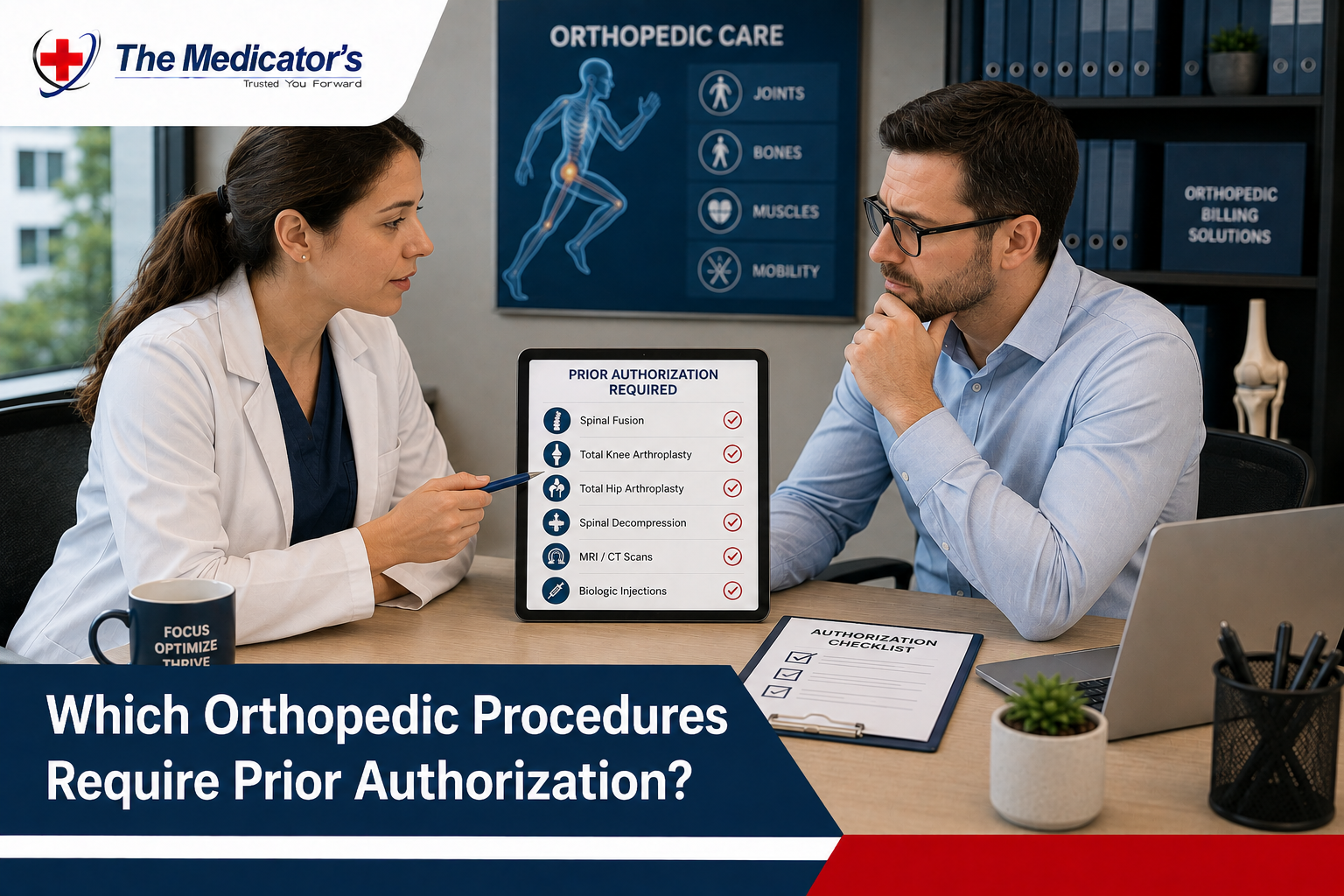
Most elective orthopedic surgeries, advanced diagnostic imaging, specialized joint injections, and high-cost durable medical equipment (DMEPOS) require prior authorization from commercial payers, Medicare Advantage, and state Medicaid plans. Emergency operations, acute trauma stabilization, and immediate fracture reductions generally do not require pre-approval.
At The Medicator’s, our certified revenue cycle management experts specialize in pre-certification clearance, surgical coding, and payer-specific clinical documentation workflows. By delivering dedicated orthopedic billing and pre-authorization services in Texas and nationwide, we ensure practices secure timely authorization approvals, maintain clean claim acceptance rates above 97%, and eliminate administrative denials.
1. Major Orthopedic Procedures Requiring Pre-Approval
Payer policies strictly mandate pre-certification for high-cost elective musculoskeletal interventions to verify medical necessity before care is rendered:
Total and Partial Joint Replacements: Total knee arthroplasty (TKA, CPT 27447), total hip arthroplasty (THA, CPT 27130), shoulder arthroplasty (CPT 23472), and unicompartmental knee replacements.
Spine Procedures & Surgeries: Lumbar/cervical spinal fusions (CPT 22551, 22612), laminectomies, discectomies, and artificial disc replacements.
Arthroscopic Surgeries: Outpatient shoulder arthroscopy with rotator cuff repair (CPT 29827), knee arthroscopy with meniscectomy or chondroplasty (CPT 29881, 29882), and hip arthroscopy.
Advanced Diagnostic Imaging: High-tech imaging including joint MRIs (CPT 73721), CT scans (CPT 73700), and SPECT CT bone scans.
Specialized Joint Injections & Pain Management: Viscosupplementation (hyaluronic acid gel knee injections), epidural steroid injections (ESI), facet joint blocks, and radiofrequency ablations (RFA).
Custom Orthotics & DMEPOS: Custom lumbar-sacral orthoses (LSO), knee braces (KO), bone growth stimulators, and specialized prosthetics under updated CMS DMEPOS guidelines.
2. Essential Clinical Documentation Needed for Approval
Securing first-pass prior authorization approval requires submitting robust clinical evidence that meets specific payer Local Coverage Determinations (LCDs) and clinical policies:
Weight-Bearing Radiographs & Imaging: Recent radiology reports confirming structural joint degeneration (e.g., Kellgren-Lawrence Grade 3 or 4 osteoarthritis for total joint procedures).
Documented Conservative Management: Proof of 6 to 12 weeks of failed conservative therapy, including formal physical therapy logs, prescription anti-inflammatory (NSAID) usage, and prior intra-articular injection outcomes.
Functional Impairment Scoring: Objective clinical scoring tools—such as WOMAC, KOOS, or Oswestry Disability Index (ODI) scores—embedded in encounter notes to prove functional limitation.
Specific ICD-10 Diagnosis Codes: Submitting precise, highly specific diagnosis codes. Submitting claims or pre-auth requests with non-specific diagnosis codes frequently leads to unspecified ICD-10 code denials or immediate pre-certification rejections.
3. Common Reasons Orthopedic Pre-Authorizations Get Delayed or Denied
Understanding why prior authorizations fail allows practices to fix documentation gaps before submitting requests:
| Common Denial Driver | Root Cause | Prevention & Resolution Strategy |
| Insufficient Conservative Therapy | PT notes lack functional outcome scores or total session count. | Submit complete physical therapy attendance records and explicit duration logs. |
| Missing Laterality Modifiers | Authorization or claim lacks Modifier LT (left) or RT (right). | Ensure CPT codes, authorization forms, and claim line items contain exact laterality. |
| Non-Weight-Bearing X-Rays | Radiographs taken while non-weight-bearing fail payer criteria. | Order and submit weight-bearing AP, lateral, and specialized views with radiology reports. |
| Authorization / CPT Mismatch | Surgical plan changed intraoperatively without authorization update. | Submit post-operative authorization amendments prior to claim submission. |
If an authorization lapse or coding mistake triggers a rejection, knowing the technical difference on your practice’s denial rate vs. rejection rate determines whether your staff must submit a formal appeal or simply correct clearinghouse front-end errors.
The Orthopedic Prior Authorization Optimization Process: What to Expect
Preventing surgical cancellations and post-procedure write-offs requires a systematic four-step prior authorization workflow:
Pre-Encounter Insurance Verification: Identifying payer-specific pre-certification rules, site-of-service mandates (ASC vs. hospital outpatient), and clinical criteria 7 to 14 days prior to care.
Clinical Packet Assembly & Submission: Compiling operative notes, weight-bearing X-rays, PT records, and functional assessment scores for submission via electronic payer portals.
Payer Tracking & Peer-to-Peer Support: Actively tracking pending determinations, responding to clinical requests, and preparing treating surgeons with case details for peer-to-peer reviews if pended.
Authorization Audit & Claim Scrubbing: Cross-referencing approved authorization numbers against final operative coding and monitoring unbilled accounts on an A/R aging report to ensure claims drop within timely filing windows.
Why Choose The Medicator’s for Your Practice?
Navigating complex prior authorization portals, handling peer-to-peer appeals, and managing payer updates can overwhelm internal administrative staff and delay patient care.
At The Medicator’s, our certified medical billers and surgical coding specialists handle complete revenue cycle management and authorization workflows. By partnering with our experienced team for Texas orthopedic billing and nationwide practice management, your practice achieves:
Clean Claim Acceptance Rates Above 97%: Eliminating pre-certification, coding, and modifier rejections before claims reach insurance carriers.
Accelerated Cash Flow: Shortening authorization turnaround times and keeping average Days in A/R well below 30 days.
Zero Write-Offs Due to Authorization Lapses: Protecting practice revenues through complete pre-service clearance tracking.
Struggling with delayed surgical approvals, high authorization denial rates, or uncollected orthopedic claims? Stop write-offs and streamline your practice cash flow today. Request a free, custom orthopedic practice analysis with The Medicator’s team!
