
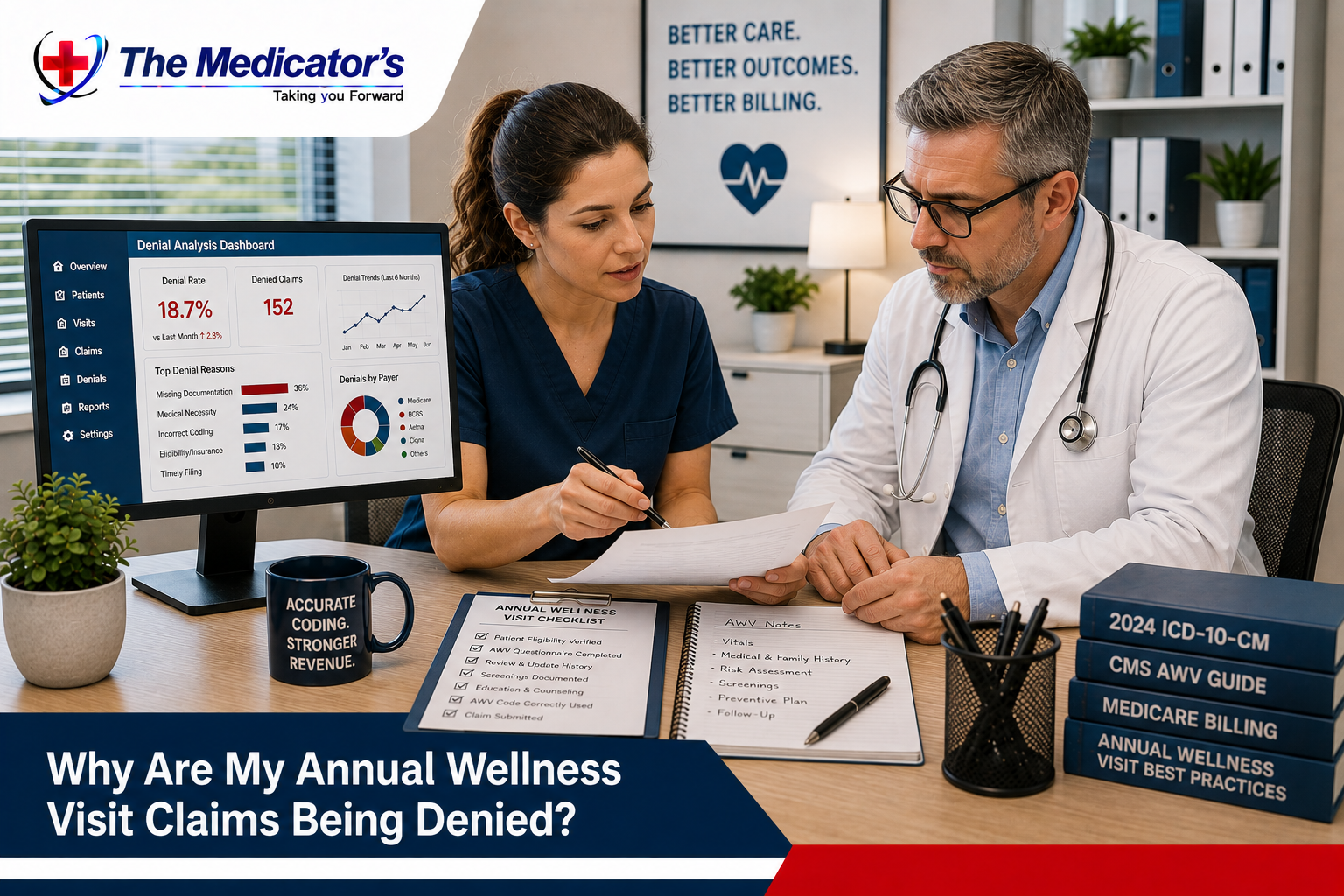
Annual Wellness Visit (AWV) claims are commonly denied because of Medicare eligibility and frequency restrictions, incorrect HCPCS codes, incomplete Health Risk Assessment (HRA) documentation, and errors when billing a separate evaluation and management (E/M) service on the same date. These issues can delay reimbursement, increase administrative work, and leave preventable billing errors unresolved.
For primary care and internal medicine practices, accurate Medicare AWV billing requires more than selecting G0438 or G0439. Staff must verify patient eligibility, document the required preventive services, follow Medicare coverage rules, and ensure that each claim accurately represents the services performed.
At The Medicator’s, we help healthcare practices manage billing workflows, review claim issues, and improve denial follow-up. Our internal medicine billing solutions in Florida and nationwide revenue cycle support can help practices address recurring coding, documentation, eligibility, and reimbursement challenges.
Primary Reasons Annual Wellness Visit Claims Are Denied
Understanding the most common AWV denial causes helps practices strengthen front-end verification, documentation, and claim review processes.
1. Medicare Timing and Eligibility Violations
Medicare generally covers an AWV once every 12 months. Eligibility depends on the beneficiary’s previous AWV or Initial Preventive Physical Examination (IPPE), as well as applicable Medicare enrollment requirements.
Common problems include:
- AWV billed too soon: Submitting HCPCS G0438 or G0439 before the patient meets Medicare’s applicable frequency requirements.
- Incorrect initial or subsequent code: Reporting G0438 when the patient has already received an initial AWV, or reporting G0439 when the patient has not met the requirements for a subsequent AWV.
- First-year Medicare enrollment confusion: Billing an AWV when the patient is not eligible, or overlooking the patient’s eligibility for the Welcome to Medicare IPPE, HCPCS G0402.
The initial AWV, subsequent AWV, and IPPE have different eligibility requirements. Medicare Part B enrollment alone does not establish eligibility for every preventive service.
How to prevent the denial: Verify Medicare eligibility and the date of the patient’s previous preventive service before scheduling and submitting the claim. Use available Medicare eligibility tools and review the applicable coverage requirements rather than relying solely on the patient’s recollection.
2. Incorrect Diagnosis Coding
Diagnosis coding should accurately reflect the purpose of the encounter and the services provided. A mismatch between the claim’s diagnosis information and the documented AWV can create processing problems.
Z00.00 and Z00.01 are used for certain general adult medical examinations, but they should not automatically be assigned as the primary diagnosis for every Medicare AWV. Select diagnosis codes based on the documented encounter, applicable coding guidance, and payer requirements.
How to prevent the denial: Review the claim’s diagnosis codes and their relationship to the services performed. If a separate problem-oriented E/M service is reported, ensure the documentation supports that service and that the diagnosis coding appropriately reflects the medical problem addressed.
3. Confusion Between Routine Physicals and Medicare AWVs
A Medicare Annual Wellness Visit is not the same as a comprehensive routine physical examination. An AWV focuses on health risk assessment, prevention planning, and other required elements rather than a comprehensive head-to-toe physical examination.
Routine preventive medicine CPT codes 99381–99397 are not substitutes for the Medicare AWV codes G0438 and G0439. Traditional Medicare generally does not cover routine physical examinations as a Medicare AWV benefit.
How to prevent the denial: Confirm which service was performed and report the appropriate code. Review Medicare’s AWV requirements before submitting the claim, and explain potential coverage differences to patients when a requested service falls outside the covered benefit.
4. Same-Day E/M Billing and Modifier 25 Errors
A provider may address a significant, separately identifiable acute or chronic medical problem during the same encounter as an AWV. When the additional work supports a separate problem-oriented E/M service, that service may be reportable alongside the AWV under applicable Medicare rules.
Modifier 25 is generally appended to the separate E/M code when the requirements are met. However, reporting modifier 25 does not automatically make the additional service payable.
How to prevent the denial:
- Document the separate medical problem and the evaluation or management performed.
- Ensure the additional work is significant and separately identifiable from the AWV.
- Apply modifier 25 to the appropriate E/M code when supported.
- Verify applicable Medicare billing instructions and cost-sharing requirements.
Patients should also understand that although a covered AWV generally has no cost-sharing when Medicare requirements are met, a separately billed problem-oriented service may result in cost-sharing.
5. Missing or Incomplete Health Risk Assessment Documentation
The HRA is an important part of the Medicare AWV. Incomplete documentation can raise questions about whether the required service elements were performed.
Depending on the circumstances, documentation gaps may involve the HRA, medical and family history, medication review, cognitive impairment assessment, screening schedules, or a personalized prevention plan.
How to prevent the denial: Use a standardized AWV documentation checklist and ensure the record supports the service billed. The checklist should reflect the applicable Medicare requirements for the patient’s visit type and should be completed as part of the clinical workflow.
Common AWV Denial Triggers and Clinical Solutions at a Glance
| Denial trigger | Potential cause | Corrective action |
|---|---|---|
| Frequency denial | The patient is not yet eligible for another AWV | Verify previous preventive service dates and Medicare eligibility |
| Incorrect AWV code | G0438 or G0439 does not match the patient’s AWV history | Review the applicable requirements for initial and subsequent AWVs |
| Diagnosis mismatch | Diagnosis information does not accurately reflect the encounter | Review the documentation and correct supported coding errors |
| Same-day E/M denial | Separate E/M service is not adequately documented or modifier 25 is missing when required | Review the medical record and applicable modifier rules |
| Missing HRA or preventive elements | Documentation does not support required AWV components | Complete a structured documentation review and strengthen future workflows |
| Routine physical billed as an AWV | The submitted code does not match the service performed | Confirm the service type and select the appropriate billing code |
Actionable Steps to Prevent and Overturn AWV Denials
Practices can reduce avoidable billing problems by combining front-end eligibility verification with consistent documentation and accounts receivable follow-up.
- Verify Medicare eligibility before the visit. Review the patient’s eligibility for the IPPE or AWV and confirm the previous preventive service date using available Medicare tools.
- Review coding before claim submission. Check G0438 versus G0439, diagnosis selection, and any separately billed E/M service against the documentation.
- Differentiate rejections from denials. A clearinghouse rejection often indicates that a claim failed an initial submission edit, while a payer denial generally follows adjudication. Understanding the difference helps determine whether to correct the claim or pursue an appeal. See our guide to denial rates versus rejection rates.
- Track outstanding claims. Review your practice’s A/R aging report to identify unpaid AWV claims and prioritize follow-up before applicable filing or appeal deadlines.
- Review the remittance advice. Identify the payer’s stated reason for nonpayment and follow the appropriate correction, resubmission, reconsideration, or appeal process.
- Identify recurring errors. Monitor AWV denials by reason, provider, payer, and workflow stage to determine where staff training or billing process changes may help.
The AWV Denial Recovery and Billing Workflow: What to Expect
Resolving denied AWV claims requires identifying the reason for nonpayment and selecting a corrective action supported by the claim and medical record.
- Eligibility and remittance review: Examine eligibility information, claim history, and the remittance advice to determine whether the issue involves frequency, coding, coverage, or another payer requirement.
- Clinical documentation review: Confirm that the medical record supports the AWV code, required HRA and preventive elements, and any separately billed E/M service.
- Claim correction: Correct supported coding or submission errors. If the claim was denied because the patient was ineligible or the service was not covered, do not simply change the code without evidence that another code accurately represents the service.
- Resubmission or appeal: Follow the payer’s instructions for corrected claims, reconsiderations, or formal appeals, and retain supporting documentation.
- Payment and trend monitoring: Track the claim through resolution and use recurring denial patterns to improve eligibility checks, documentation, and claim review.
Medicare AWV Billing Services for Primary Care and Internal Medicine Practices
Medicare AWV billing can become challenging when practices manage multiple providers, high patient volumes, separate problem-oriented E/M services, and recurring eligibility or documentation issues. Without a consistent workflow, staff may spend significant time correcting claims and following up on delayed payments.
The Medicator’s provides medical billing and revenue cycle support to help practices manage claims, investigate denials, and improve billing workflows. Depending on the practice’s needs, support may include:
- Medicare AWV claim review: Review G0438 and G0439 selection against available documentation and eligibility information.
- Primary care billing services: Support preventive visit billing alongside other services provided by primary care and internal medicine practices.
- Documentation and coding checks: Identify potential gaps involving HRA documentation, diagnosis coding, and separately billed E/M services.
- Denial management: Investigate payer denials and coordinate appropriate corrections, resubmissions, or appeals.
- Accounts receivable follow-up: Track outstanding claims and prioritize follow-up based on payer deadlines and claim status.
- Revenue cycle analysis: Review denial trends and workflow bottlenecks to identify potential areas for improvement.
Practices evaluating a medical billing company for internal medicine should consider its experience with Medicare billing, preventive services, payer-specific requirements, denial follow-up, and reporting. The appropriate service scope and pricing depend on the practice’s claim volume, payer mix, staffing, and existing billing processes.
The Medicator’s offers internal medicine RCM services in the USA to help practices evaluate billing challenges and develop a more organized approach to claims and reimbursement follow-up.
Are repeated AWV denials, eligibility errors, or documentation gaps creating extra work for your team? Request a personalized practice analysis to discuss your current billing workflow, denial trends, and revenue cycle priorities. Call 888-277-1460 to learn more about The Medicator’s billing support.
