
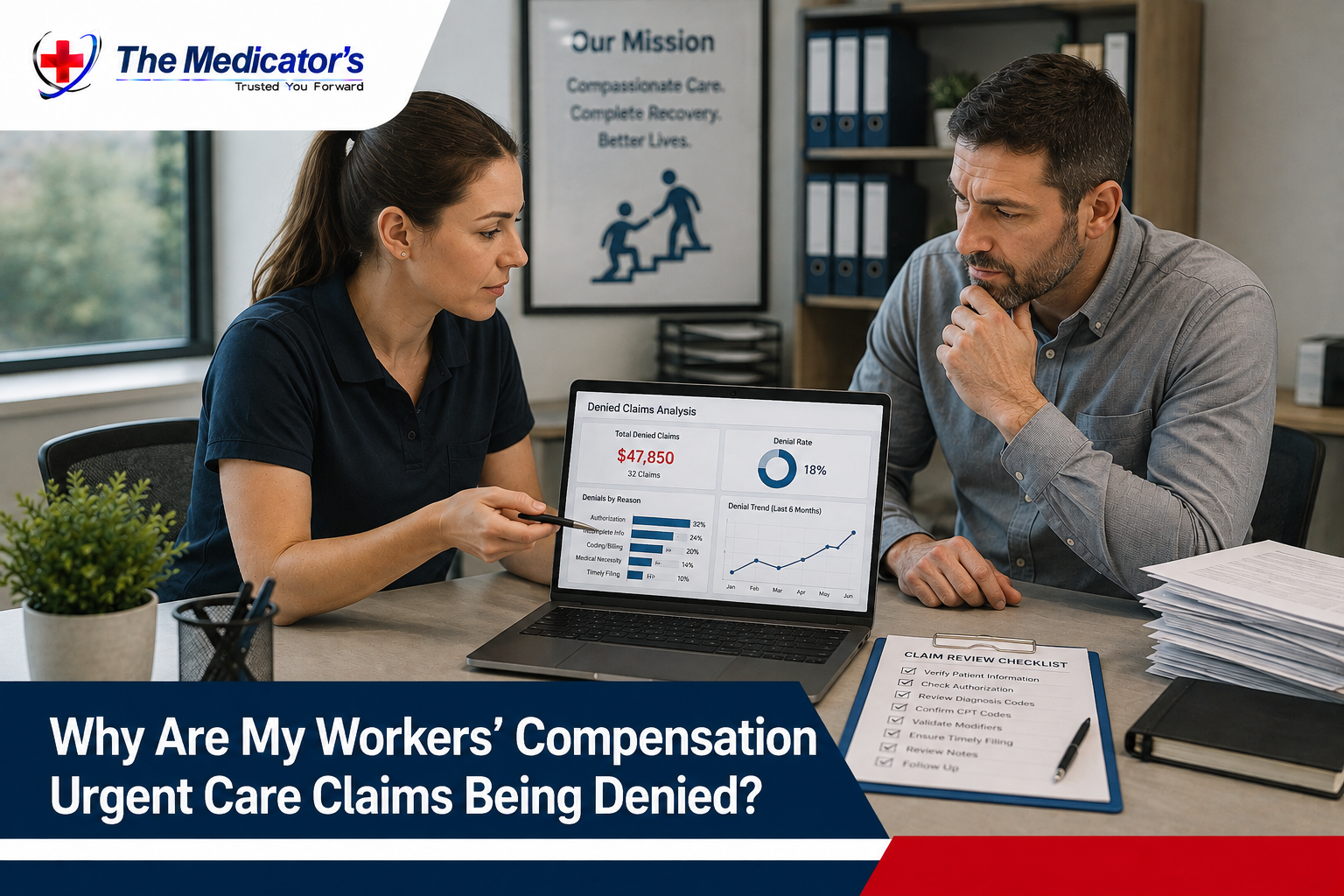
Workers’ compensation urgent care claims are frequently denied due to delayed employer injury reporting, missing causal documentation linking the injury to a specific workplace incident, non-authorized provider usage, missing work-status forms, or billing errors such as missing state fee schedule modifiers and incorrect ICD-10 injury codes. Because workers’ compensation claims operate under separate state regulations, employer networks, and fee schedules, minor administrative gaps can cause immediate claim rejections and stalled reimbursement.
At The Medicator’s, our specialized revenue cycle management team assists walk-in clinics and occupational health centers in navigating complex workers’ compensation billing rules. Through tailored urgent care revenue cycle management in Texas and nationwide, we streamline claim intake, ensure accurate injury causation charting, and maintain clean claim acceptance rates above 97%.
Primary Causes of Workers’ Compensation Denial in Urgent Care
Understanding why workers’ compensation payers reject or dispute urgent care claims is essential to recovering uncollected revenue:
1. Inadequate Causation and Work-Related Documentation
Workers’ compensation adjusters scrutinize clinical chart notes to confirm an injury directly resulted from job duties:
Missing Accident Details: Notes that state “patient has lower back pain” without explicitly documenting “patient sustained lower back pain while lifting a 50 lb box at work on [Date]” lead to immediate causation denials.
Lack of Initial Medical Reports: Failing to attach the state-required initial doctor’s report (such as Form C-4 or state equivalent) alongside the HCFA/CMS-1500 delays claim processing.
Pre-Existing Condition Disputes: If clinical documentation fails to distinguish a new acute work-related trauma from a pre-existing degenerative condition, adjusters will reject coverage.
2. Authorization and Network Restrictions
Unlike group health insurance, workers’ compensation claims require strict employer and carrier compliance:
Unauthorized Treating Facility: In panel-state jurisdictions, patients must seek initial treatment from an employer-designated occupational medicine or urgent care network. Treating outside the designated network without emergency justification triggers denials.
Missing Employer Verification: Claims billed before receiving employer authorization or an official claim/carrier number sit in unworked queues.
Unapproved Secondary Services: Performing non-emergent advanced diagnostic imaging (e.g., MRIs) or specialized physical therapy without prior authorization from the claims adjuster leads to line-item denials.
3. Billing, Fee Schedule, and Coding Errors
Workers’ compensation billing follows specialized state fee schedules and coding guidelines:
Incorrect ICD-10 Cause-of-Injury Codes: Omitting external cause codes (such as V00–Y99 codes detailing workplace slips, falls, or machinery accidents) leads to billing rejections.
Mismatched Place of Service Codes: Submitting claims without valid POS codes in medical billing (such as POS 20 for Urgent Care) can cause administrative rejections.
Omitted Work Status / Return-to-Work Forms: Failing to submit signed work status notes (specifying full duty, modified duty, or temporary disability) along with the bill causes insurers to withhold payment.
Common Workers’ Compensation Denial Scenarios & Solutions
The following table highlights frequent operational bottlenecks in workers’ compensation urgent care billing and how to resolve them:
| Denial Reason | Root Cause | Impact on Claim | Recovery Strategy |
| “No Injury Causation Established” | Provider note lacks detailed workplace accident narrative. | Full Claim Denial | Resubmit medical records with detailed history of injury and provider causation statement. |
| “Claim Pending Employer Verification” | Employer hasn’t filed First Report of Injury (FROI). | Payment Hold | Contact claims adjuster directly with employer incident report copy. |
| “Unauthorized Facility / Provider” | Urgent care clinic is outside employer panel/network. | Full Claim Denial | Submit emergency medical condition proof justifying immediate walk-in care. |
| “Fee Schedule Exceeded” | Billed amount mismatched with state worker’s comp fee schedule. | Line-Item Reduction | Adjust line charges to match state fee schedule guidelines and appeal underpayment. |
Actionable Steps to Reduce Workers’ Compensation Denials
Verify Claim Information at Check-In: Require front-desk staff to capture employer name, HR contact, date/time of injury, workers’ compensation carrier name, and claim number prior to treatment.
Standardize Provider Injury Charting: Train urgent care clinicians on documenting the specific mechanism of injury, acute symptoms, and clear causation statements in every encounter note.
Attach Required Work Status Forms: Ensure every submitted claim includes a signed work status note outlining restrictions or return-to-work clearance.
Distinguish Denials from Rejections: Regularly evaluate your clinic’s overall denial rate vs. rejection rate to identify whether claims are failing due to front-desk registration typos or adjuster causation disputes.
The Workers’ Compensation Billing Workflow: What to Expect
Resolving disputed workers’ compensation claims requires a four-stage revenue cycle workflow:
Intake & Claim Creation: Capturing complete employer accident reports, carrier claim numbers, and real-time coverage verification at patient check-in.
Clinical Charting & Causation Documentation: Ensuring providers record clear injury mechanisms, diagnostic findings, and return-to-work status forms.
Fee Schedule & Modifier Scrubbing: Applying state-specific fee schedule rules, external cause codes, and modifier rules prior to electronic submission.
A/R Tracking & Adjuster Follow-Up: Monitoring unpaid claims on your practice’s A/R aging report to resolve adjuster queries and keep average days in A/R under 30 days.
Streamline Your Urgent Care Revenue with The Medicator’s
Delayed employer filings, complex state fee schedules, and adjuster causation disputes can disrupt cash flow for busy urgent care clinics handling workplace injuries.
At The Medicator’s, our certified medical billing specialists manage every stage of workers’ compensation revenue cycle management—from intake verification and chart auditing to aggressive denial appeals. By partnering with our team for urgent care billing in Texas and nationwide, your clinic achieves:
Clean Claim Acceptance Above 97%: Catching missing accident details, fee schedule errors, and registration typos before claim submission.
Days in A/R Kept Under 30 Days: Eliminating aging workers’ compensation balances and accelerating cash flow.
Full Financial Recovery for Rendered Care: Protecting practice reimbursement for occupational health visits, minor surgical procedures, and diagnostic testing.
Are workers’ compensation denials or unpaid injury claims impacting your clinic’s revenue? Capture every dollar you earn. Request a free, custom urgent care practice analysis with The Medicator’s team today!
