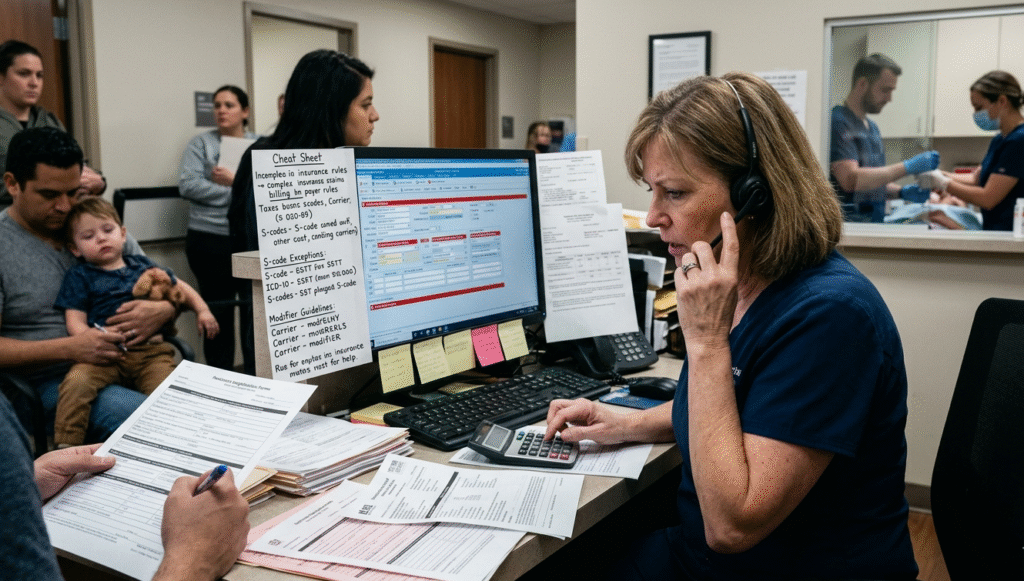
Urgent care billing is widely considered one of the most challenging areas in healthcare revenue cycle management. Unlike traditional medical practices that operate on scheduled appointments and predictable workflows, urgent care centers function in a high-pressure, walk-in environment where speed is essential and administrative precision is still required.
This combination creates a difficult balance: providers must deliver immediate clinical care while also ensuring that every detail required for insurance reimbursement is correctly captured, coded, and submitted. Even minor mistakes in documentation, coding, or eligibility verification can lead to claim denials, delayed payments, or compliance issues.
Below is a detailed breakdown of why urgent care billing is so complicated and what makes it uniquely difficult compared to other healthcare settings.
1. Fast-Paced Walk-In Environment Creates Billing Pressure
Urgent care centers are designed for speed. Patients arrive without appointments, often requiring immediate attention for injuries, infections, or sudden illnesses. This creates a constant flow of patients throughout the day.
While this model is efficient for patient care, it creates significant billing challenges:
- Staff have limited time for detailed insurance verification
- Patient demographic data may be rushed or incomplete
- Clinical documentation may be recorded after the visit
- Billing staff must process high volumes of encounters daily
Because billing processes rely heavily on accurate and complete data, even small errors introduced during the fast intake process can lead to downstream claim denials. In many cases, the urgency of care takes priority over administrative accuracy, which directly affects revenue cycle performance.
2. Complex Medical Coding Requirements
Urgent care billing depends on multiple coding systems, including ICD-10 (diagnosis codes), CPT (procedure codes), and HCPCS codes. Each system has its own rules and constant updates, making accuracy difficult to maintain.
Some of the common coding challenges include:
- Selecting the correct level of Evaluation and Management (E/M) codes
- Matching diagnoses with appropriate procedures
- Using modifiers correctly for separate services
- Applying HCPCS “S-codes” like S9083 or S9088 when required
- Avoiding upcoding or under-coding risks
The complexity increases because urgent care providers treat a wide variety of conditions in a single day from minor injuries to infections and diagnostic testing. This variability makes coding less predictable than in specialty practices.
Incorrect coding can result in claim rejections, audits, or even accusations of improper billing, making this one of the most sensitive areas of urgent care revenue cycle management.
3. Place-of-Service (POS) Coding Confusion
Another major reason urgent care billing is complicated is the correct use of Place-of-Service (POS) codes.
Urgent care centers typically use POS 20 (Urgent Care Facility), but this is not universal across all insurance payers. Some insurers require:
- POS 11 (Office Visit)
- Hospital outpatient POS codes
- Custom payer-specific billing rules
This inconsistency creates confusion for billing teams. If the wrong POS code is submitted, it can lead to:
- Reduced reimbursement rates
- Incorrect patient copays
- Claim denials or reprocessing delays
Since each insurance payer may have different requirements, urgent care billing teams must maintain detailed payer-specific rules, which adds another layer of administrative complexity.
4. High Claim Denial Rates
Urgent care centers typically experience higher claim denial rates compared to many other healthcare settings. This is due to the combination of fast-paced operations and strict insurance requirements.
Common reasons for denials include:
- Incorrect or missing insurance information
- Eligibility issues at the time of service
- Coding mismatches between diagnosis and procedure
- Lack of prior authorization (when required)
- Incomplete documentation
Even a small percentage of denied claims can significantly impact urgent care revenue because of the high volume of daily patient visits. Denied claims also require additional time and resources to correct and resubmit, increasing administrative workload.
5. Insurance Verification Challenges
Insurance verification is a critical step in the billing process, but it is often rushed in urgent care environments. Staff must quickly confirm:
- Whether the patient’s insurance is active
- Coverage for urgent care services
- Copay and deductible amounts
- Network participation status
- Policy-specific limitations
Because patients are typically treated immediately upon arrival, there is limited time to perform thorough verification. This increases the risk of billing incorrect insurance information, which often leads to claim rejection or delayed reimbursement.
6. Constantly Changing Regulations and Payer Rules
Urgent care billing is heavily influenced by evolving healthcare regulations and insurance policies. These include federal rules like the No Surprises Act, CMS updates, and individual payer policy changes.
Billing teams must stay updated on:
- Coding guideline revisions (ICD-10 and CPT updates)
- Insurance contract changes
- Coverage policy updates
- Compliance requirements for documentation
- Prior authorization rules
Failure to stay current can result in compliance issues, financial penalties, or increased claim denials. Because regulations change frequently, ongoing staff training is essential but often difficult to maintain in busy urgent care environments.
7. Documentation Gaps and Clinical Detail Issues
Accurate documentation is the foundation of successful medical billing. However, in urgent care settings, providers often face time constraints that lead to incomplete or delayed documentation.
Common documentation issues include:
- Missing details about patient symptoms or history
- Incomplete procedure descriptions
- Lack of medical necessity justification
- Delayed chart completion after patient discharge
Insurance companies require clear evidence that services were medically necessary. If documentation is incomplete, even correctly coded claims can be denied.
8. Patient Payment and Financial Responsibility Complexity
Urgent care centers also face challenges in collecting payments directly from patients. Unlike hospitals or scheduled clinics, urgent care often deals with immediate, unpredictable visits.
Key issues include:
- Patients unaware of coverage details at the time of visit
- High out-of-pocket costs due to deductibles
- Difficulty collecting copays upfront
- Self-pay patients requiring cost estimates
This creates uncertainty in revenue collection and increases administrative workload for billing teams.
9. Staffing and Training Limitations
Many urgent care centers operate with lean administrative teams. Staff members are often responsible for multiple roles, including front desk operations, insurance verification, and billing support.
This leads to challenges such as:
- Limited time for detailed billing reviews
- Insufficient training on coding updates
- High staff turnover affecting consistency
- Dependence on manual processes
Without specialized billing expertise, the risk of errors increases significantly, affecting both revenue and compliance.
10. Technology and System Integration Issues
While many urgent care centers use Electronic Health Records (EHR) and billing software, system integration is not always seamless.
Common issues include:
- Duplicate data entry between systems
- Missing or incomplete billing information transfer
- Delays in claim submission
- Lack of automation in eligibility and coding checks
Poor integration between clinical and billing systems creates inefficiencies and increases the chance of human error. Proper system integration is essential for reducing administrative burden and improving claim accuracy.
Conclusion
Urgent care billing is complicated because it operates at the intersection of fast-paced clinical care and highly detailed insurance requirements. The need to treat patients quickly often conflicts with the need for accurate documentation, coding, and verification.
Key challenges such as high patient volume, complex coding systems, inconsistent payer rules, insurance verification issues, and regulatory changes all contribute to increased claim denials and administrative stress.
However, these challenges can be managed with the right systems and processes. Standardized workflows, trained billing staff, payer-specific coding rules, and integrated EHR systems can significantly reduce errors and improve revenue cycle efficiency.
Ultimately, successful urgent care billing depends on balancing speed with accuracy ensuring that patient care remains the priority while financial operations remain precise and compliant.
FAQs
1. Why is urgent care billing more complex than regular clinics?
Because it combines high patient volume, walk-in visits, and fast treatment with strict insurance coding and documentation rules.
2. What is the biggest cause of urgent care claim denials?
The most common causes are insurance eligibility errors, incorrect coding, and incomplete documentation.
3. Why is coding so important in urgent care billing?
Coding determines how services are billed and reimbursed. Incorrect coding can lead to claim rejection or payment delays.
4. How does the walk-in model affect billing accuracy?
The lack of scheduled visits reduces time for verification and documentation, increasing the risk of errors.
5. What role does insurance verification play?
It confirms coverage details before services are billed, helping prevent claim denials and payment issues.
6. Why are POS codes important in urgent care?
They determine how insurance companies classify the visit, which directly affects reimbursement rates.
7. Can automation reduce billing errors?
Yes, automated EHR and billing systems can reduce manual errors in coding, verification, and claim submission.
8. Why is documentation critical in urgent care billing?
Because insurance companies require proof of medical necessity for reimbursement approval.
9. What happens if a claim is denied?
The claim must be corrected and resubmitted, which increases administrative workload and delays payment.
10. How can urgent care centers improve billing efficiency?
By using trained billing staff, automation tools, standardized workflows, and up-to-date payer rules.
You have not enough Humanizer words left. Upgrade your Surfer plan.