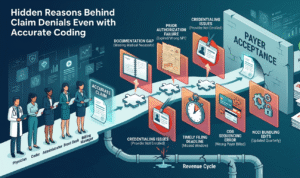
Are your urgent care claims getting denied even after providing the service correctly? It is a common and incredibly frustrating scenario: your team works at lightning speed to provide quality care, only to receive a “Payment Denied” notification weeks later.
Denied claims are one of the single biggest reasons urgent care centers lose revenue. This leads to delayed payments, lost income, and a massive administrative burden for your staff. In this guide, we will break down exactly why these denials happen and how you can fix them to improve your revenue cycle immediately.
The True Cost of Claim Denials
For an urgent care center, a denial is not just a paperwork error it’s a financial drain.
- Revenue Leakage: Money that should be in your bank account is stuck in “denied” status.
- Increased Rework: Your staff spends double the time fixing old claims instead of processing new ones.
- Cash Flow Disruption: Unpredictable payments make it harder to manage operational costs.
- Staff Burnout: Constant battles with insurance payers lead to administrative fatigue.
Even a small denial rate can result in thousands of dollars in lost monthly revenue. Let’s understand the real reasons behind these denials.
Top 8 Reasons Urgent Care Claims Get Denied
1. Incomplete or Incorrect Patient Information
In a high-volume walk-in environment, typos are common. A misspelled name or a wrong Date of Birth (DOB) triggers an automatic rejection.
- The Fix: Implement a digital intake process where patients scan their own ID and insurance cards to reduce manual entry errors.
2. Insurance Eligibility Not Verified
Treating a patient whose coverage has lapsed or doesn’t cover urgent care services is a guaranteed denial.
- The Fix: Use real-time eligibility (RTE) verification tools at the front desk before the patient is seen.
3. Coding Errors (CPT / ICD-10)
Using the wrong procedure codes for the level of care provided leads to immediate rejections or significant underpayment.
- The Fix: Conduct regular coding audits to ensure clinical documentation matches the billed codes.
4. Missing or Incorrect Modifiers
Urgent care billing often requires specific modifiers (like -25 for significant, separately identifiable E/M services). Missing these is a top reason for technical denials.
- The Fix: Partner with billing experts who specialize in urgent care-specific coding rules.
5. Lack of Medical Necessity Documentation
If your provider’s notes don’t clearly justify the level of service or the tests ordered, payers will deny the claim as “not medically necessary.”
- The Fix: Train clinicians on documentation templates that prompt for necessary clinical details.
6. Duplicate Claim Submissions
Submitting the same claim twice either due to system glitches or staff confusion causes automatic rejections.
- The Fix: Use a robust claim tracking system to monitor the status of every submission in real-time.
7. Timely Filing Issues
Insurance companies have strict deadlines (sometimes as short as 90 days). If your billing process is slow, you lose the right to be paid.
- The Fix: Automate your workflow to ensure all claims are scrubbed and submitted within 48 hours of the visit.
8. Authorization Issues
Certain urgent care procedures or follow-up tests require prior approval. Treating first and asking for payment later rarely works.
- The Fix: Create a clear authorization tracking workflow for your front-desk and clinical teams.
Why These Denials Keep Happening
Urgent care billing errors are not random they are systemic. The high patient volume and fast-paced environment of an urgent care center often mean that staff are overloaded and lack the specialized billing expertise needed to navigate complex payer rules.
How to Fix Urgent Care Claim Denials: A 5-Step Plan
- Improve Front Desk Accuracy: Make data integrity a priority at intake.
- Verify Every Time: Never assume a returning patient’s insurance is still active.
- Ensure Coding Precision: Bridge the gap between clinical notes and billing codes.
- Track Denials Weekly: Identify the “Top 3” denial reasons and fix the root cause.
- Implement an AR Follow-Up System: Aggressively pursue unpaid claims before they expire.
In-House Billing vs. Outsourced RCM
| Feature | In-House Billing | The Medicators RCM |
| Error Rate | High (Staff is multitasking) | Minimal (Dedicated Specialists) |
| Recovery Speed | Slow / Backlogged | Fast / Systematic |
| Expertise | General Admin | Urgent Care Specific |
| Revenue Impact | Stagnant Cash Flow | Optimized Collections |
Stop the Revenue Leak with The Medicators
Managing urgent care billing internally is challenging. At The Medicators, we provide specialized Revenue Cycle Management (RCM) designed to reduce denials and increase your clean claim rate.
- Real-Time Eligibility Verification
- Psychiatry & Urgent Care Coding Expertise
- Daily Denial Management
- Full Revenue Optimization
Recover Your Lost Revenue
Struggling with urgent care claim denials? Get a FREE Billing Audit Today
Let us identify why your claims are being denied and help you recover your lost income.
FAQ: Urgent Care Denials
Why are urgent care claims denied so often?
Usually due to technical errors at the front desk or incorrect coding modifiers that are specific to the urgent care setting.
How can I reduce my practice’s claim denials?
By implementing real-time insurance verification and ensuring your billing team performs daily “claim scrubbing” before submission.
How does an RCM service help my urgent care center?
We act as an extension of your team, providing the expertise and technology needed to track every claim from submission to final payment.