
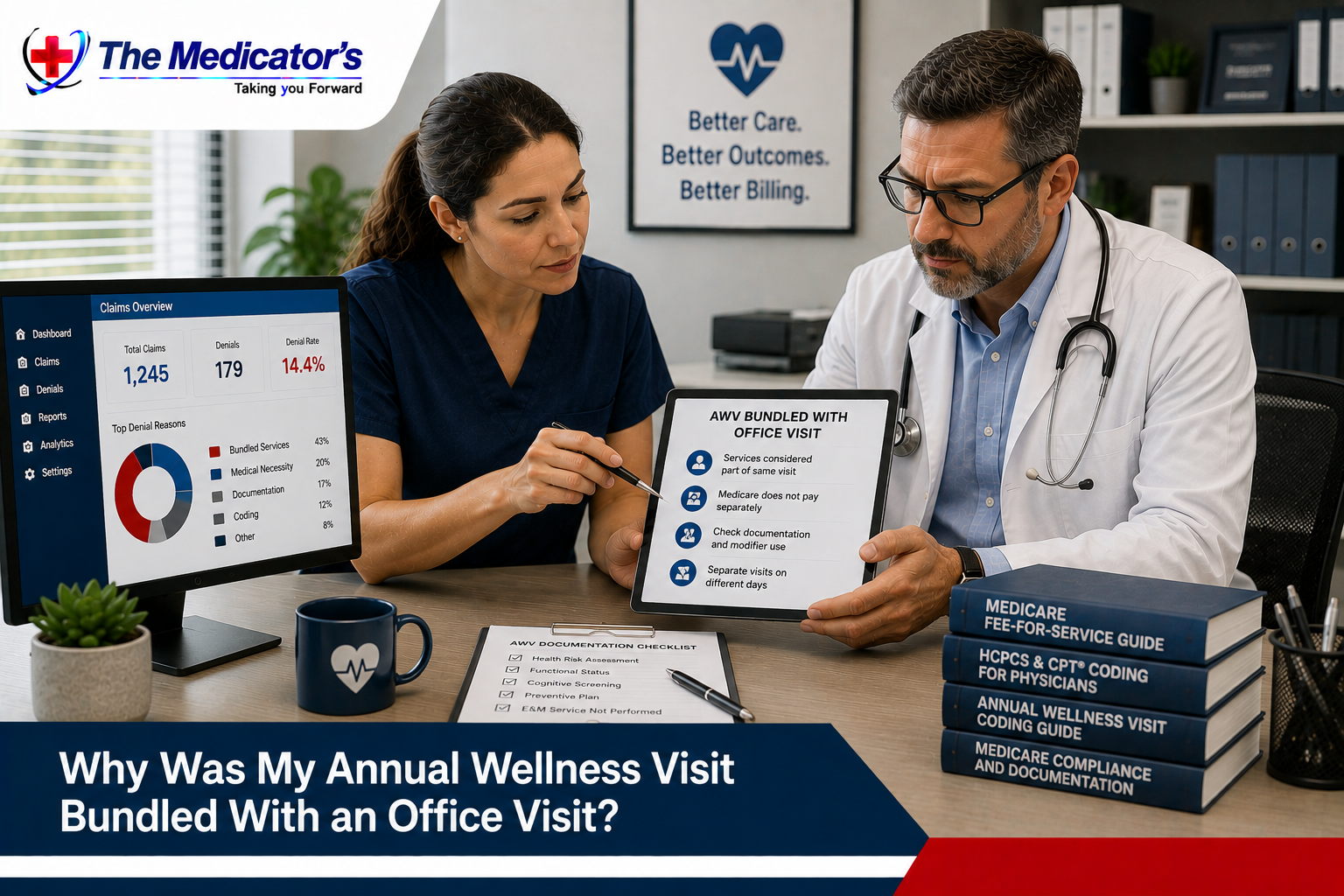
An Annual Wellness Visit (AWV) may be billed on the same claim as a separate Evaluation and Management (E/M) office visit when a patient receives both preventive planning services and a significant, separately identifiable, medically necessary evaluation or management service during the same encounter. However, Medicare does not automatically reimburse both services simply because a patient discusses a medical concern during an AWV.
For medical practices, the key is to understand annual wellness visit billing requirements, E/M documentation, Modifier 25 usage, and payer claim processing rules. Incorrect coding, insufficient documentation, or misunderstanding a payer’s reimbursement decision can result in denied or bundled E/M claim lines.
At The Medicator’s, our medical billing services help practices manage coding accuracy, claim submission, denial follow-up, and reimbursement workflows. If your practice is experiencing repeated Medicare AWV billing issues, our team can help review the underlying claim and billing process to identify potential areas for improvement.
Why Are Annual Wellness Visits and E/M Office Visits Billed Together?
Medicare’s Annual Wellness Visit focuses on preventive health planning rather than a comprehensive physical examination or treatment of every medical problem a patient may have. During the same appointment, however, a provider may also need to evaluate a new symptom, adjust medication, or manage an active chronic condition.
When both services meet the applicable requirements, the practice may report the AWV and a separate E/M service. Medicare guidance permits payment for an additional E/M service when it is significant, separately identifiable, medically necessary, and adequately documented. The E/M code is reported with Modifier 25 when applicable.
Practices that regularly bill both services should establish a consistent workflow for AWV coding, E/M documentation review, Medicare claim submission, and denial management. Reviewing these steps can help identify why a claim was bundled, denied, or paid differently than expected.
For practices dealing with recurring claim issues, a medical billing audit can help examine coding, documentation, claim edits, and payer responses to identify patterns that need attention.
1. Understand What Medicare Covers During an Annual Wellness Visit
Medicare Part B covers eligible Annual Wellness Visits for preventive health planning. The initial AWV is generally reported with HCPCS code G0438, while subsequent AWVs are generally reported with HCPCS code G0439. Medicare frequency requirements and patient eligibility must be checked before submitting the claim.
Typical AWV components include:
- Completing or updating a Health Risk Assessment (HRA).
- Reviewing medical and family history.
- Updating the patient’s list of current healthcare providers and suppliers.
- Measuring appropriate routine health indicators.
- Assessing cognitive function and reviewing relevant health risks.
- Establishing or updating a personalized prevention plan.
- Providing an appropriate screening schedule and preventive health recommendations.
An AWV is not the same as a routine physical examination. Practices should verify which services are covered, whether the patient meets the applicable frequency requirements, and whether additional services require separate billing.
For official coding and coverage guidance, review the CMS Annual Wellness Visit requirements.
If your practice needs help reviewing Medicare preventive service claims, medical billing and coding support can help organize code validation, claim preparation, and follow-up processes.
2. When Can a Separate E/M Office Visit Be Billed With an AWV?
A separate E/M service may be reportable when the provider performs additional medically necessary evaluation or management beyond the work included in the AWV. The additional service must be significant and separately identifiable, and the medical record must support the reported E/M code.
Examples may include:
- Evaluating a new symptom that requires a separate clinical assessment.
- Reviewing a worsening chronic condition and changing the treatment plan.
- Assessing a medical complaint that requires additional decision-making.
- Managing a condition that requires work beyond the preventive planning components of the AWV.
Simply mentioning a diagnosis, reviewing a medication list as part of the AWV, or discussing a concern briefly does not automatically justify a separate E/M charge. The provider must perform and document a qualifying service.
For practices seeking E/M coding audit services or help reviewing same-day preventive and problem-oriented claims, a structured coding review can help determine whether documentation supports the services reported.
3. How Modifier 25 Affects Annual Wellness Visit Billing
Modifier 25 identifies a significant, separately identifiable E/M service performed by the same physician or qualified healthcare professional on the same day as another service, when the applicable requirements are met.
When reporting a qualifying E/M service with an AWV, Modifier 25 is appended to the E/M code, not to the AWV code.
For example, a claim may include:
- HCPCS G0438: Initial Annual Wellness Visit, when applicable.
- HCPCS G0439: Subsequent Annual Wellness Visit, when applicable.
- CPT 99202–99205 or 99211–99215: An appropriate office or outpatient E/M service, when supported by the encounter and applicable coding rules.
- Modifier 25: Appended to the E/M code when the requirements for separate reporting are met.
The specific E/M code must reflect the documented service and applicable code-selection rules. Modifier 25 does not independently establish medical necessity or guarantee separate payment.
Common problems that may affect AWV and E/M claims include:
- Applying Modifier 25 without documentation supporting a separate E/M service.
- Reporting an E/M code that is not supported by the encounter.
- Failing to document the additional assessment, treatment, or medical decision-making.
- Treating all same-day AWV and E/M encounters as automatically eligible for separate reimbursement.
- Failing to investigate payer-specific claim edits or reimbursement policies.
A medical billing audit service can help practices review Modifier 25 usage, E/M code selection, documentation patterns, and recurring claim errors.
For Medicare’s official explanation of when an AWV and a separate E/M service may be reported together, consult the CMS Annual Wellness Visit billing guidance.
4. Annual Wellness Visit Reimbursement: Why Might a Separate Office Visit Create Patient Cost-Sharing?
Medicare generally covers an eligible AWV without Part B coinsurance or deductible when the applicable coverage conditions are met and the provider accepts assignment. However, a separately reportable E/M service may be subject to the patient’s normal Part B deductible and coinsurance.
This distinction can create confusion when a patient expects the entire appointment to be covered without cost-sharing. Practices should explain that an additional medically necessary office visit may result in a separate charge when the applicable billing requirements are met.
For annual wellness visit reimbursement, billing teams should review:
- Whether the patient was eligible for the AWV on the date of service.
- Whether the correct initial or subsequent AWV code was submitted.
- Whether the separate E/M service was supported by documentation.
- Whether Modifier 25 was applied appropriately.
- Whether the payer processed the AWV and E/M claim lines correctly.
- Whether the remittance advice identifies a denial, adjustment, bundling edit, or patient responsibility.
The actual reimbursement outcome depends on coverage, eligibility, coding, documentation, payer adjudication, and applicable policy. Practices should not assume that every AWV is payable at the same amount or that every separate E/M service will be reimbursed.
If payments do not match expected reimbursement, accounts receivable management services can help practices prioritize outstanding claims, investigate unpaid balances, and track follow-up activity.
5. How to Troubleshoot an AWV and E/M Claim That Was Bundled or Denied
When an office visit is bundled with an Annual Wellness Visit, the next step is to determine why the payer processed the claim that way. A bundled line, a rejected claim, and a denied service are not necessarily the same issue.
Use this review process before submitting a corrected claim or appeal.
Step 1: Review the claim and remittance advice.
Check the submitted codes, modifiers, diagnosis pointers, payment amounts, adjustment codes, and any payer explanation. Determine whether the AWV was paid while the E/M line was denied, reduced, or bundled.
Step 2: Confirm AWV eligibility and code selection.
Verify the patient’s eligibility and the applicable frequency requirements. Check whether G0438 or G0439 was appropriate for the encounter.
Step 3: Review the E/M documentation.
Confirm that the record supports a significant, separately identifiable, medically necessary E/M service beyond the work included in the AWV. Check that the documented service supports the reported E/M level.
Step 4: Verify Modifier 25 and claim requirements.
Confirm that Modifier 25 was applied to the E/M code when appropriate. Review the payer’s applicable coding and claim-submission policies before correcting or resubmitting the claim.
Step 5: Determine whether correction or appeal is appropriate.
If a claim contains a correctable billing error, follow the payer’s process for corrected claims. If the original claim was accurately submitted but adjudicated incorrectly, review the payer’s appeal or reconsideration process and applicable deadlines.
Step 6: Track the outcome.
Record the denial reason, corrective action, resubmission or appeal date, payer response, and final payment status. This makes it easier to identify repeat errors and determine whether staff training or workflow changes are needed.
Practices that need help with recurring claim denials can review denial rate vs. rejection rate to distinguish initial claim-processing failures from denials issued after payer adjudication.
For broader problems involving multiple payers or service types, revenue cycle management services can help coordinate claim submission, denial follow-up, payment posting, and accounts receivable workflows.
6. Documentation Practices That Support Separate AWV and E/M Billing
Accurate documentation is essential when a practice reports an AWV and a separate E/M service on the same date. The medical record should make it possible to identify the preventive planning work and the additional problem-oriented evaluation or management.
A practical documentation review should check whether:
- The required AWV components are recorded.
- The additional medical concern and relevant clinical findings are documented.
- The assessment and plan support the separate E/M service.
- The documentation supports the selected E/M code under the applicable code-selection rules.
- The record distinguishes the additional work from services already included in the AWV.
- The claim codes and modifiers accurately reflect the services documented.
Practices should not rely on separate note headings alone to justify a second service. The underlying clinical work and documentation must support separate reporting.
A recurring mismatch between documentation and submitted codes may indicate a need for medical coding audit services, coder education, or improved charge-review procedures. The Medicator’s medical billing services can support practices in reviewing coding and claim workflows to identify issues that may be contributing to avoidable rework.
7. How to Improve Medicare AWV Billing and Reduce Preventable Claim Problems
Medical practices can strengthen their annual wellness visit billing process by combining front-end eligibility checks, accurate documentation, claim validation, and ongoing payment review.
Consider the following measures:
- Verify AWV eligibility before the appointment. Check the patient’s Medicare coverage and prior AWV history against applicable frequency requirements.
- Train staff on AWV versus E/M services. Make sure the team understands which services belong to preventive planning and when an additional E/M service may qualify for separate billing.
- Use a consistent documentation review process. Confirm that required AWV elements and any additional medically necessary E/M work are supported in the medical record.
- Review Modifier 25 usage. Audit a sample of same-day AWV and E/M claims to identify unsupported modifiers, missing modifiers, or inconsistent code selection.
- Monitor denials by reason and payer. Identify recurring patterns rather than treating each denial as an isolated incident.
- Follow up on unpaid claims. Use an organized work queue to track payer responses, appeal deadlines, corrected claims, and unresolved balances.
- Review financial reports regularly. Track A/R aging, denial activity, adjustments, and payment discrepancies to understand where revenue-cycle issues are occurring.
For practices that need a clearer view of billing performance, The Medicator’s guide to medical billing company performance explains how to review metrics such as denials, A/R aging, collections, and underpayments.
If internal staff cannot consistently manage claim reviews and payer follow-up, outsourced medical billing services may provide additional operational support. The appropriate arrangement depends on the practice’s claim volume, specialty, staffing, payer mix, and existing workflows.
Optimize Annual Wellness Visit Billing With The Medicator’s
Recurring AWV and E/M billing issues can create extra administrative work, delay payment, and make it harder for a practice to understand why claims are not reimbursed as expected. Resolving these problems requires more than adding a modifier. Practices need a reliable process for eligibility verification, documentation review, accurate coding, claim submission, denial analysis, and follow-up.
The Medicator’s provides medical billing and revenue cycle support for healthcare practices seeking to improve billing workflows and identify preventable claim issues. Our services can help practices review:
- Medicare AWV and E/M claim workflows.
- Modifier 25 usage and coding documentation.
- Claim denials, rejections, and payer adjustments.
- Unpaid claims and aging accounts receivable.
- Billing performance and potential revenue-cycle gaps.
We also support practices with internal medicine billing solutions in Florida and internal medicine RCM services across the USA.
If your practice is experiencing recurring AWV bundling issues, unexpected reimbursement outcomes, or unresolved Medicare claim denials, request a free practice analysis. The Medicator’s team can help assess your billing workflow and identify areas that may warrant closer review.
Request a free practice analysis today to evaluate your medical billing, coding, and revenue-cycle processes.
