
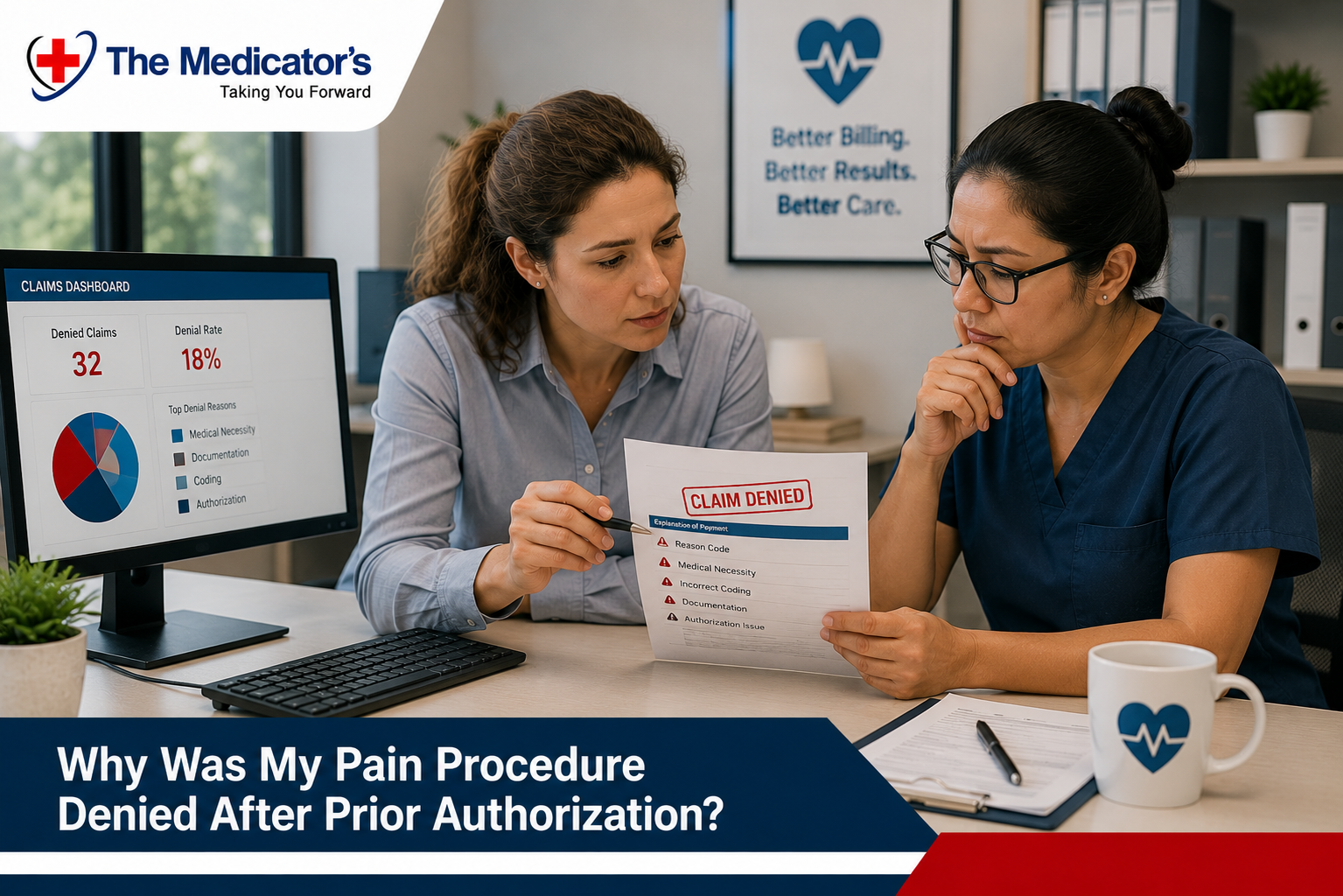
A pain management procedure can be denied after prior authorization because prior approval is not a absolute guarantee of payment. Insurers re-verify claims during post-service processing, where mismatches in billing codes, expired approval windows, or missing clinical proof can trigger a post-service denial or claim rejection.
At The Medicator’s, our certified coding and revenue cycle team delivers specialized billing support, including tailored pain management billing services in Florida and across the United States. We help interventional pain practices align prior authorization documentation with final claim coding and maintain clean claim acceptance rates above 97%.
Primary Reasons Pain Procedures Get Denied After Prior Authorization
Understanding why commercial payers and Medicare Administrative Contractors (MACs) deny claims post-authorization enables pain management clinics to protect revenue and prevent claim rejections:
1. CPT and ICD-10 Code Mismatches
If the CPT procedural codes or ICD-10 diagnosis codes on the final claim differ from what was submitted on the original authorization request, the claim will trigger an immediate rejection.
Level and Site Discrepancies: Authorizing CPT 64483 (lumbar transforaminal ESI) for L4–L5 but submitting a claim for L5–S1 without an updated authorization leads to non-covered service edits.
Unspecified Diagnosis Coding: Linking an authorized procedure to generic, unspecified ICD-10 codes on the final claim can trigger automated payer rejection rules. To eliminate these coding errors, review our guide on why unspecified ICD-10 codes get claims denied.
2. Expired Authorization Windows
Prior authorizations are issued with strict validity dates (typically 30, 60, or 90 days). If a procedure is rescheduled past the expiration date, the claim is processed as unauthorized, regardless of the initial approval.
3. Exceeded Billed Units or Frequency Limits
Submitting additional injection levels, bilateral sides (Modifier 50), or extra visits beyond the approved authorization scope will cause the entire claim or secondary line items to be denied.
4. Rendering Provider or Facility NPI Mismatches
If the rendering physician NPI, group NPI, or facility location (Place of Service code) on the claim does not match the exact provider information on the authorization, the payer’s system will reject the payment.
5. Lapsed Patient Eligibility or Secondary Payer Changes
If the patient’s primary health coverage changes, terminates, or transitions to another managed care plan between the approval date and treatment date, the authorization becomes invalid for the new insurance carrier.
Post-Authorization Denial Causes and Solutions at a Glance
The following matrix details common post-authorization denial causes, clinical root factors, and corrective billing actions:
| Post-Auth Denial Cause | Clinical / Operational Root Cause | Corrective Billing Action |
| Code Mismatch | Final CPT or ICD-10 code differs from the pre-approved code | Submit corrected claim matching auth or request retro-authorization amendment |
| Expired Auth Window | Procedure performed after authorization expiration date | Submit urgent appeal with medical necessity notes explaining delay |
| Provider NPI Discrepancy | Covering physician or new facility billed under different NPI | Update claim with authorized rendering NPI or request NPI demographic update |
| Documentation Gap | Operative note fails to support conservative care or imaging correlation | File formal appeal attaching complete therapy logs and radiology reports |
Actionable Steps to Overturn Post-Authorization Denials
Obtain the EOB/ERA Denial Code: Review the official Explanation of Benefits to locate the exact claim adjustment reason code (CARC) and remittance advice remark code (RARC).
Audit Denial vs. Rejection Metrics: Differentiating between clearinghouse demographic edits and back-end medical necessity denials is simplified by monitoring your practice’s overall denial rate vs. rejection rate.
Submit a Formal Prior Authorization Appeal: File a formal redetermination request including the original approval letter, operative notes, diagnostic imaging reports, and physician attestation.
Monitor Outstanding A/R Aging Buckets: Track unpaid interventional claims on your practice’s A/R aging report to catch claims stalled in medical necessity queues.
The Post-Authorization Appeal Process: What to Expect
Resolving post-authorization claim denials follows a structured four-phase workflow:
Claim and Auth Audit: Comparing the original authorization letter against the submitted 1500/UB-04 claim form to spot NPI, date, or code mismatches.
Clinical Packet Compilation: Gathering pre-procedure progress notes, physical therapy completion records, MRI reports, and intraoperative fluoroscopic images.
Reconsideration Submission: Submitting an appeal package to the payer’s medical review department citing local coverage determinations (LCDs).
Pre-Drop Scrubbing Rule Updates: Updating EHR billing rules to require mandatory verification of authorization details against final charges before claim drop.
Optimize Your Pain Management Revenue with The Medicator’s
Managing prior authorization tracking, CPT code matching, NPI verifications, and post-service appeals for interventional pain procedures can place an extreme administrative burden on pain management practices.
At The Medicator’s, our certified coding and billing specialists deliver complete revenue cycle management across medical specialties. Beyond our dedicated pain management billing services in Florida, we provide comprehensive nationwide billing support through our internal medicine RCM services in USA.
Partnering with our billing team ensures:
First-Pass Clean Claim Acceptance Above 97%: Eliminating code mismatches, expired authorization rejections, and provider NPI errors before claims drop.
Days in A/R Kept Under 30 Days: Accelerating reimbursement and keeping aged interventional claims off your practice ledgers.
Full Audit Protection & Revenue Recovery: Ensuring every authorized procedure results in full reimbursement for your practice.
Are post-authorization denials, code mismatch rejections, or aging claim balances impacting your clinic’s cash flow? Capture every dollar you earn. Request a free, custom practice analysis with The Medicator’s team today!
