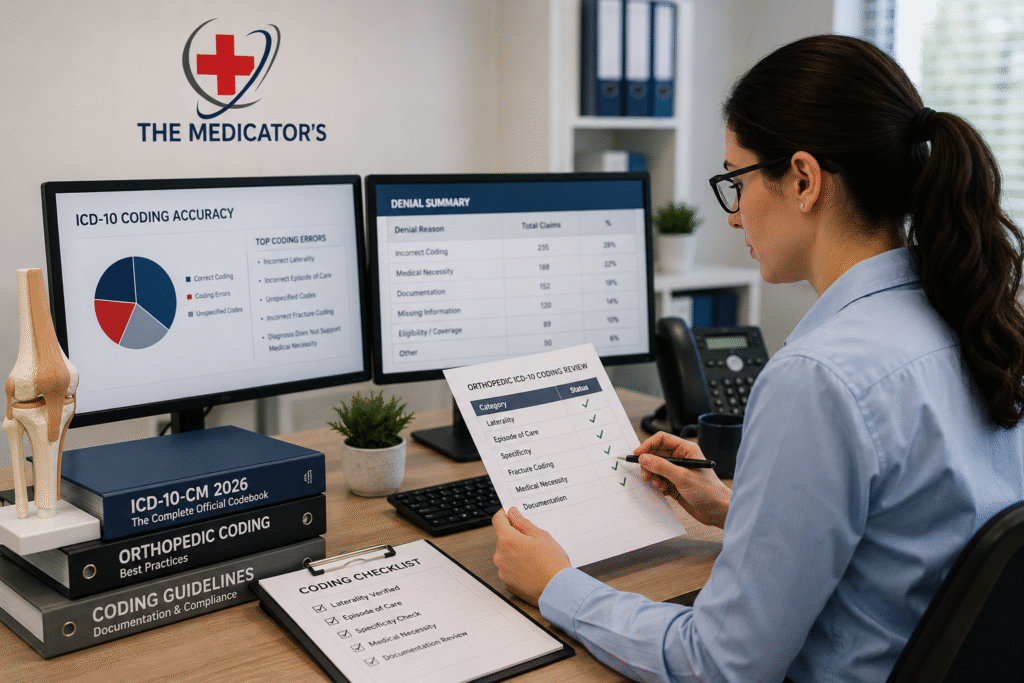
Orthopedic billing lives or dies on diagnosis coding accuracy. A single wrong digit in an ICD-10-CM code, the wrong side of the body, the wrong episode of care, can be the difference between a claim that pays cleanly and one that sits denied for weeks.
The financial impact of these errors is significant. Orthopedic practices handle a high volume of surgical procedures, imaging studies, and therapy services, and every one of them depends on a diagnosis code that accurately justifies why the service was medically necessary. Get that code wrong, and the entire claim is at risk, regardless of how well the procedure itself was performed or documented.
Incorrect diagnosis coding does not just cause denials. It leads to delayed reimbursements that strain cash flow, and in more serious cases, it creates real compliance risk if a pattern of inaccurate coding draws payer or auditor attention.
Orthopedics is also simply more complex than many other specialties when it comes to ICD-10 coding. Between laterality, episode of care, fracture classification, and the sheer number of musculoskeletal diagnoses available, there are far more ways to get a code wrong than in most other fields. This guide breaks down the ten most common ICD-10 coding errors in orthopedic billing, why they happen, what they cost, and exactly how to prevent them.
What Is ICD-10 Coding?
Definition
ICD-10-CM, the International Classification of Diseases, Tenth Revision, Clinical Modification, is the coding system used in the United States to represent patient diagnoses, maintained by the National Center for Health Statistics. Its purpose is straightforward: to translate a clinical diagnosis into a standardized code that payers, providers, and health systems can all interpret consistently.
It helps to understand how ICD-10 differs from the other two coding systems used in orthopedic billing. CPT codes describe the procedures and services performed, while HCPCS codes cover supplies, equipment, and drugs. ICD-10 codes describe why those services were needed in the first place.
That distinction is exactly why ICD-10 accuracy matters so much for reimbursement. Payers use the diagnosis code to determine medical necessity, meaning a procedure can be coded perfectly on the CPT side and still get denied if the linked ICD-10 code does not clearly justify why it was performed.
Why ICD-10 Coding Is More Complex in Orthopedics
Orthopedic coding carries a level of detail that few other specialties require. Consider what a coder has to account for on nearly every claim:
- A large number of musculoskeletal diagnoses, often with dozens of code variations for a single condition
- Laterality requirements, meaning left, right, or bilateral, on nearly every applicable code
- Episode of care distinctions, including initial encounter, subsequent encounter, and sequela
- Injury specific coding that captures the exact nature and location of the injury
- Fracture classification covering open versus closed, and displaced versus nondisplaced
- Postoperative diagnosis coding that differs from the original injury code
- The distinction between chronic and acute conditions, which affects both coding and medical necessity
- Combination codes that capture multiple clinical details in a single code
- External cause coding, used when relevant to describe how and where an injury occurred
Each of these adds a decision point where a coder can choose incorrectly, and orthopedic claims routinely involve several of these decision points at once.
How ICD-10 Coding Fits into the Orthopedic Billing Workflow
ICD-10 coding does not happen in isolation. It sits at a specific point in a much longer billing process:
- Patient registration
- Insurance eligibility verification
- Clinical evaluation
- Physician documentation
- Diagnosis selection
- ICD-10-CM code assignment
- CPT/HCPCS code assignment
- Modifier assignment
- Charge entry
- Claim scrubbing
- Claim submission
- Payer adjudication
- Payment posting
- Denial management
- Accounts Receivable (A/R) follow up
Diagnosis selection and ICD-10-CM code assignment happen early in this sequence, right after clinical evaluation and physician documentation, and everything downstream depends on getting this step right. A CPT code assigned to the wrong or insufficiently specific diagnosis code creates a mismatch that follows the claim all the way through submission, and often results in a denial that traces back to a decision made at step six.
Why Accurate ICD-10 Coding Matters
Accurate diagnosis coding protects far more than a single claim. It directly supports faster reimbursement, since clean, well supported claims move through payer adjudication without delay. It reduces claim denials by ensuring medical necessity is clearly established from the start.
It also strengthens clinical documentation overall, since accurate coding depends on, and reinforces, thorough physician notes. Beyond individual claims, accurate ICD-10 coding supports regulatory compliance, accurate quality reporting, and stronger Revenue Cycle Management performance across the entire practice. It also leaves practices with better patient records overall, since the diagnosis history captured through coding becomes part of the patient’s long term clinical record.
Top 10 Most Common ICD-10 Coding Errors in Orthopedic Billing
| Coding Error | Why It Happens | Financial Impact | Prevention Strategy |
| Incorrect laterality | Rushed documentation or unclear notes | Immediate denial, resubmission delay | Standardize laterality documentation at the point of care |
| Incorrect episode of care | Confusion between initial, subsequent, and sequela | Denial or incorrect reimbursement level | Clarify encounter type before code assignment |
| Unspecified codes when specificity exists | Time pressure or incomplete documentation | Lower reimbursement, increased denial risk | Use diagnosis specific templates and coder review |
| Incorrect fracture coding | Complexity of fracture classification systems | Denial, potential compliance flag | Coder training on fracture specific ICD-10 structure |
| Missing or inaccurate injury details | Incomplete clinical documentation | Denial for insufficient specificity | Capture anatomical location, severity, and mechanism upfront |
| Diagnosis does not support medical necessity | Weak diagnosis to procedure linkage | Denial, potential audit risk | Validate linkage before claim submission |
| Chronic vs acute miscoding | Overlapping or evolving clinical presentation | Denial or incorrect payer routing | Clear documentation of condition duration and status |
| Incorrect postoperative diagnosis coding | Confusion between original and follow up codes | Denial on follow up visit claims | Standardize postoperative coding protocols |
| Missing combination or secondary diagnosis codes | Overlooked comorbidities | Underbilled complexity, denial risk | Systematic comorbidity review during coding |
| Poor documentation supporting the diagnosis | Incomplete notes, missing reports | Broad denial risk across all code types | Strengthen documentation standards practice wide |
1. Incorrect Laterality
Laterality errors are among the most common and most preventable mistakes in orthopedic coding. Left versus right matters enormously in a specialty built around paired anatomy, knees, shoulders, hips, wrists, and getting it wrong triggers an almost automatic denial.
Bilateral conditions add another layer of complexity, since coding a bilateral diagnosis incorrectly as unilateral, or vice versa, misrepresents the actual clinical picture. A classic example is a patient with bilateral knee osteoarthritis coded using only a single sided code because the documentation only clearly described one knee.
The fix starts at the documentation level. Physician notes need to explicitly state laterality every single time, and coding templates should prompt for this detail rather than leaving it to be inferred.
2. Incorrect Episode of Care
ICD-10 distinguishes between initial encounter, subsequent encounter, and sequela, and orthopedic practices see this distinction constantly given how much of their work involves injury follow up over time.
A common fracture coding mistake is continuing to use an initial encounter code for follow up visits, when the correct code should reflect a subsequent encounter for a fracture already under active treatment. Coding a healed fracture’s lingering effects as an initial injury, rather than as a sequela, is another frequent error.
Getting episode of care right requires coders to understand exactly where in the treatment timeline a given visit falls, not just what the underlying injury was.
3. Unspecified Diagnosis Codes When Greater Specificity Exists
Unspecified codes exist for genuine cases of clinical uncertainty, but they are frequently overused simply because a more specific code takes slightly more effort to identify. This directly impacts reimbursement, since many payers reimburse unspecified codes at a lower rate or flag them for additional review.
The fix is largely a documentation and workflow issue. Improving documentation specificity at the point of care, combined with coder tools that surface more specific code options, significantly reduces reliance on unspecified codes over time.
4. Incorrect Fracture Coding
Fracture coding in ICD-10-CM is genuinely one of the most detailed areas of the entire code set. Coders need to correctly distinguish open versus closed fractures, displaced versus nondisplaced fractures, and the current healing status of the fracture, all of which change the applicable code.
Encounter specific coding compounds this complexity, since the same fracture requires different codes depending on whether the visit represents initial treatment, routine healing follow up, or a delayed healing complication. Detailed fracture billing scenarios, like the coding considerations covered in ZMC fracture repair billing guidance, illustrate just how much clinical and coding precision this category demands.
5. Missing or Inaccurate Injury Details
Orthopedic diagnosis coding often depends on details that go beyond the basic injury type, including the precise anatomical location, the severity of the injury, the mechanism of injury, and any associated injuries that occurred alongside the primary one.
When these details are missing from documentation, coders are often forced to select a less specific code than the clinical situation actually warrants, which increases denial risk and can understate the true complexity of the case.
6. Diagnosis Does Not Support Medical Necessity
This is one of the most consequential errors on this list, since it strikes directly at whether a payer will consider a service medically necessary at all. The diagnosis to procedure linkage has to be logical and defensible: an imaging study, surgical procedure, or therapy service needs a diagnosis code that clearly justifies why it was needed.
A real world example illustrates this well. Billing an orthopedic injection procedure without a diagnosis code that matches the payer’s specific Local Coverage Determination criteria is one of the most common reasons these claims get denied, a pattern explored in detail in Top 5 Florida-Specific Denials and How to Appeal Them.
7. Coding Chronic and Acute Conditions Incorrectly
Orthopedic practices treat a mix of chronic and acute conditions, often in the same patient at the same time. Osteoarthritis, tendinitis, and chronic pain conditions require different coding logic than acute injuries, and degenerative disorders add yet another layer since they often coexist with acute trauma.
Miscoding a chronic condition as acute, or the reverse, can misrepresent the clinical picture and lead to denials tied to inconsistent documentation or inappropriate medical necessity justification.
8. Incorrect Postoperative Diagnosis Coding
Postoperative visits require a different coding approach than the original injury or condition that led to surgery. Follow up visits need codes that reflect the current postoperative status, not the original preoperative diagnosis. Surgical complications, aftercare, and hardware related conditions, such as issues with orthopedic implants, all require their own specific coding treatment.
Reusing the original preoperative diagnosis code across every follow up visit is a common shortcut that frequently results in denials, since it does not accurately reflect what is actually being evaluated or treated at that visit.
9. Missing Combination or Secondary Diagnosis Codes
Orthopedic patients frequently present with comorbidities that affect treatment and recovery, including diabetes, osteoporosis, obesity, infection, or multiple simultaneous injuries. Failing to capture these secondary diagnoses understates the true clinical complexity of the case and can affect both reimbursement and quality reporting accuracy, and it is exactly the kind of gap that shows up in audits examining upcoding and downcoding patterns.
This is particularly relevant in surgical and trauma cases, where multiple injuries or complicating conditions are common but easy to under document if coders are only focused on the primary diagnosis.
10. Poor Clinical Documentation Supporting the Diagnosis
Every error on this list ultimately traces back to documentation quality. Missing physician notes, incomplete operative reports, missing imaging interpretation, and a general lack of clearly stated medical necessity all make it difficult, sometimes impossible, for a coder to select the correct, most specific ICD-10 code available.
Strong coding cannot compensate for weak documentation. The two have to improve together, which is why documentation improvement initiatives are just as important as coder training in any serious effort to reduce orthopedic coding errors.
Orthopedic Conditions Most Frequently Associated with Coding Errors
Certain conditions show up repeatedly in orthopedic coding error patterns, including osteoarthritis, fractures, joint replacements, rotator cuff injuries, meniscus tears, ACL injuries, tendon injuries, carpal tunnel syndrome, spinal disorders, osteoporosis related fractures, sports injuries, and chronic musculoskeletal pain. Specific procedure examples, like ulnar collateral ligament repair billing, show how detailed and specific these diagnosis codes need to be, right down to the exact ligament and side of the body involved.
Documentation Requirements for Accurate ICD-10 Coding
Strong orthopedic coding depends on documentation that consistently captures the chief complaint, a complete history of present illness, physical examination findings, imaging results, operative reports, procedure notes, follow up documentation, provider signatures, and clear evidence of medical necessity. Missing any one of these elements increases the likelihood that a coder either selects an insufficiently specific code or that the resulting claim gets denied for lack of supporting documentation.
ICD-10 Coding vs. CPT Coding in Orthopedics
| ICD-10-CM | CPT |
| Diagnosis coding | Procedure coding |
| Supports medical necessity | Describes services performed |
| Assigned first | Linked to diagnosis |
These two coding systems work together rather than independently. The ICD-10 code establishes why a service was necessary, and the CPT code describes exactly what was done. A payer reviewing the claim checks whether the two align logically, meaning the diagnosis genuinely supports the procedure billed. This is the same underlying issue behind why E/M claims often bounce back from payers: when the two do not align, whether due to a coding error or insufficient specificity, the claim is at serious risk of denial regardless of how accurately either code was assigned on its own.
Common Reasons Orthopedic Claims Are Denied Due to ICD-10 Errors
- Diagnosis not supported by documentation
- Medical necessity issues tied to payer coverage policy
- Invalid diagnosis to procedure linkage
- Missing specificity where a more precise code was available
- Incorrect laterality
- Documentation deficiencies across the clinical record
- Incorrect encounter coding
- Payer policy conflicts, particularly around Local Coverage Determinations
Medicare, Medicaid, and Commercial Insurance Considerations
Medicare
Medicare applies strict medical necessity expectations to orthopedic claims, often tied directly to National and Local Coverage Determinations published by CMS that specify exactly which diagnosis codes support coverage for a given procedure. Documentation requirements tend to be detailed and specific, particularly for high cost procedures like joint replacements.
Medicaid
Medicaid coverage requirements vary by state, meaning orthopedic practices operating across multiple states need to track state specific diagnosis requirements and authorization differences separately rather than applying a single standard nationwide.
Commercial Insurance
Commercial payers introduce their own diagnosis specific edits and coverage policies, often with preauthorization requirements tied closely to the specific ICD-10 code billed. Policy variation between commercial payers means a diagnosis code accepted by one insurer may require additional justification for another.
Best Practices to Improve ICD-10 Coding Accuracy
- Improve physician documentation at the point of care
- Use diagnosis specific templates that prompt for laterality, episode of care, and severity
- Review coding guidelines regularly, since ICD-10-CM updates annually
- Perform internal coding audits on a consistent schedule
- Validate diagnosis to procedure linkage before every submission
- Use claim scrubbing software to catch mismatches before they reach the payer
- Monitor payer policy updates as coverage determinations change
- Invest in ongoing coder education specific to orthopedic coding complexity, including AAPC certification pathways focused on musculoskeletal and orthopedic coding
Technology That Improves Orthopedic Coding Accuracy
- Electronic Health Records (EHR) that capture structured, detailed clinical documentation, secured in line with HIPAA privacy standards
- Computer-Assisted Coding (CAC) that suggests appropriate codes based on documentation
- Medical Billing Software that connects coding directly to charge entry and claim creation
- Claim Scrubbing Software that flags diagnosis to procedure mismatches before submission
- AI-Assisted Coding Tools that help identify more specific code options automatically
- Revenue Cycle Management Platforms that track coding accuracy across the entire billing cycle
- Coding Analytics Dashboards that surface error trends before they become systemic
Key Performance Indicators (KPIs) to Track
| KPI | Why It Matters |
| Diagnosis Coding Accuracy Rate | Measures overall coding quality |
| Claim Denial Rate | Indicates billing performance across the practice |
| Clean Claim Rate | Tracks submission accuracy at first pass |
| First-Pass Claim Acceptance Rate | Measures how often claims succeed without correction, a metric dedicated billing support can directly improve |
| Days in Accounts Receivable (A/R) | Reflects how quickly claims convert into actual payment |
| Coding Audit Score | Identifies documentation and coding quality over time |
Common Mistakes That Increase ICD-10 Coding Errors
- Choosing unspecified codes unnecessarily when more specific options exist
- Ignoring laterality requirements
- Selecting the incorrect episode of care
- Missing secondary diagnoses that reflect real clinical complexity
- Allowing poor documentation to go unaddressed
- Failing to review annual coding updates
- Linking an incorrect diagnosis to a procedure
- Overlooking payer specific coding rules and coverage policies
Building an Effective Orthopedic Coding Quality Program
A sustainable coding quality program combines documentation improvement initiatives with ongoing physician education, since coders can only be as accurate as the notes they are working from. Regular internal coding audits, denial trend analysis, and compliance reviews help catch systemic issues early, while consistent KPI monitoring and continuous staff training keep the entire team aligned as codes and payer policies evolve year over year.
How Professional Orthopedic Billing Services Improve Coding Accuracy
Specialized orthopedic billing support brings a level of coding precision that general billing teams often cannot match. Professional orthopedic revenue cycle management services typically include:
- Certified orthopedic coding specialists with deep musculoskeletal coding expertise
- Accurate ICD-10-CM coding built around laterality, episode of care, and specificity
- CPT and HCPCS coding validation aligned with the correct diagnosis
- Thorough documentation review before claim submission
- Medical necessity verification tied to current payer coverage policy
- Systematic claim scrubbing before every submission
- Proactive denial prevention rather than reactive correction
- Structured appeals management when denials do occur
- Ongoing Revenue Cycle Management optimization across the entire orthopedic practice
- Monthly coding performance reporting so practices can track improvement over time
Signs Your Orthopedic Practice Needs Coding Support
- Increasing claim denials tied to diagnosis coding
- Rising coding audit failures
- Frequent requests for additional documentation from payers
- Delayed reimbursements compared to prior periods
- High A/R balances tied to unresolved coding issues
- Staff overwhelmed trying to keep up with coding complexity
- Declining collections despite steady patient volume
- Repeated payer corrections on the same types of claims
Practices already dealing with several of these signs, including growing multi-location groups like the ones served through orthopedic billing support built to reduce billing stress and improve collections, tend to see the fastest turnaround once dedicated coding support is brought in.
Why Choose The Medicator’s for Orthopedic Billing Services
Orthopedic coding demands a level of specialty specific precision that general medical billing simply is not built for. The Medicator’s brings:
- Certified orthopedic billing and coding specialists with deep musculoskeletal expertise
- Accurate ICD-10, CPT, and HCPCS coding built around orthopedic specific complexity
- Thorough documentation review before every claim submission
- Medical necessity validation tied to current payer coverage policy
- Advanced claim scrubbing that catches diagnosis to procedure mismatches before submission
- Proactive denial prevention and structured appeals management
- Deep Medicare and commercial payer expertise across orthopedic specific coverage rules
- Ongoing Revenue Cycle Management optimization tailored to orthopedic practices
- Continuous compliance monitoring as coding standards and payer policies evolve
- Transparent reporting and dedicated support throughout the entire billing relationship
Conclusion
Accurate ICD-10 coding is the foundation of successful orthopedic billing and reimbursement. Every claim depends on it, and even a single misstep, whether it is incorrect laterality, the wrong episode of care, or an unspecified code where a more precise option existed, can be enough to trigger a denial.
By avoiding these ten common coding mistakes, strengthening documentation, improving coder education, and implementing proactive quality controls, orthopedic practices can meaningfully reduce denials, accelerate payments, and improve overall financial performance.
Partnering with an experienced orthopedic billing company helps ensure coding accuracy, regulatory compliance, and long term revenue cycle success. If your practice is seeing rising denials or slower reimbursements tied to diagnosis coding, request a free practice analysis from The Medicator’s or contact our orthopedic billing team directly to see exactly where your coding process is breaking down.
Frequently Asked Questions
What is ICD-10 coding in orthopedics?
ICD-10 coding in orthopedics is the process of assigning standardized diagnosis codes to musculoskeletal conditions and injuries, capturing details like laterality, episode of care, and injury specifics to support medical necessity and reimbursement.
Why is laterality important?
Laterality identifies whether a condition affects the left side, right side, or both sides of the body, and getting it wrong is one of the most common causes of claim denial in orthopedic billing.
What is the most common orthopedic coding error?
Incorrect laterality and the overuse of unspecified codes when more specific options exist are among the most frequent errors seen in orthopedic diagnosis coding.
How do unspecified diagnosis codes affect reimbursement?
Unspecified codes are often reimbursed at a lower rate or flagged for additional payer review, and their overuse can increase both denial risk and revenue leakage over time.
What documentation is required for fracture coding?
Fracture coding requires documentation of whether the fracture is open or closed, displaced or nondisplaced, its current healing status, and which encounter, initial, subsequent, or sequela, the visit represents.
How do ICD-10 and CPT codes work together?
ICD-10 codes establish why a service was medically necessary, while CPT codes describe what service was actually performed, and payers require these two to align logically for a claim to be approved.
Why are orthopedic claims denied for diagnosis coding?
Common reasons include diagnosis codes that do not support medical necessity, missing specificity, incorrect laterality, and diagnosis to procedure mismatches that conflict with payer coverage policy.
How often are ICD-10 codes updated
? ICD-10-CM codes are updated annually, which means coding guidelines and available code options can change from one year to the next, making ongoing review essential.
How can practices improve coding accuracy?
Practices can improve accuracy by strengthening physician documentation, using diagnosis specific templates, performing regular coding audits, and investing in ongoing coder education focused on orthopedic specific complexity.
Should orthopedic practices outsource coding and billing?
Many orthopedic practices benefit from outsourcing to specialists with deep musculoskeletal coding expertise, since the complexity of laterality, fracture classification, and episode of care coding often exceeds what general billing staff can consistently manage alone, a trend explored further in Top Medical Coding Companies in the USA for Medical Practices.