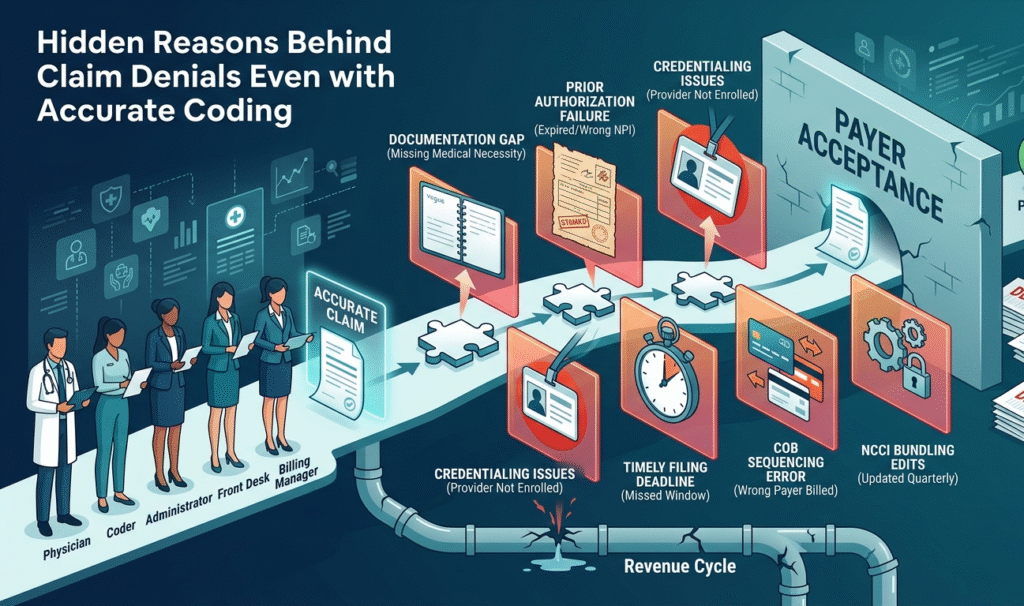
You turned in a claim without errors. You used the right coding, the treatment matched the diagnosis, and you verified the modifiers. Even though everything was properly coded according to the patient’s file, the claim was still denied. The vast majority of your peers are experiencing this same demoralizing lack of payment for their work because it is not due to inaccurate coding.
A vast majority of the billing departments within health systems are working very hard to have their diagnoses (ICD-10 matches) and procedure codes (CPT) all matched until they are perfect. After a claim was filed and assigned with proper ICD/CPT, it will still be denied due to reasons that are totally unrelated to code matching. In a recent study done by Experian Health, 73% of respondents within the healthcare community experience increasing trends in claims denials; this has grown substantially from just 22% of responses since 2022.
Today, the average non-Medicare-related claims denial rate usually deviates between 5-10%. Meanwhile, denial rates for the Medicare Advantage payer have increased to the 15%-20% range. This is clearly not due to (incorrect) coding; this is a systems issue; this systems issue begins with a clear understanding of where the source of “unrealized” denials exists.
Why “Accurate Coding” Is No Longer Enough
It is possible to code a claim perfectly according to coding rules and still have it denied. The problems causing this denial may come from upstream and downstream from the procedure code on the claim; they may be related to the quality of the documentation, the nature of the payer agreements in place as it relates to the provider’s credentials, or so-called “timeliness.”
Think about a claim as a puzzle. If you get all the codes right, it means you put together all the pieces correctly to form a finished puzzle. However, if you have to fix your boundaries (meaning prior authorization was not received, the provider was not credentialed by that particular payer, or the information was received one day past the filing date), your puzzle will never be fini
Hidden Reasons Behind Claim Denials Even with Accurate Coding
You turned in a claim without errors. You used the right coding, the treatment matched the diagnosis, and you verified the modifiers. Even though everything was properly coded according to the patient’s file, the claim was still denied. This is why practices need to look beyond coding accuracy and examine the complete claim workflow.
A claim can be correctly coded and still encounter problems related to documentation, authorization, credentialing, payer contracts, timely filing, coordination of benefits, NCCI edits, or claim-submission processes.
Why Accurate Coding Is No Longer Enough
It is possible to code a claim correctly according to coding rules and still have it denied. The problem may come from upstream or downstream processes surrounding the procedure code, including documentation quality, payer agreements, provider credentials, authorization, or timely filing.
Think about a claim as a puzzle. Getting the codes right means only part of the puzzle is complete. If prior authorization was not obtained, the provider was not credentialed, or the claim was submitted after the payer’s filing deadline, the claim can still be denied.
This is why an organized medical billing services workflow should examine every stage of the claim rather than focusing exclusively on CPT and ICD-10 matching.
Your Notes Don’t Say What You Think They Say
Even when the coder has coded everything correctly, the provider’s documentation may not directly connect the diagnosis to the medical necessity of the procedure.
A payer generally evaluates the information submitted with the claim and supporting documentation. If the clinical language does not establish why the service was necessary, correcting the procedure code alone may not resolve the denial.
The solution may require improving documentation rather than creating a different code.
Medical Necessity Failures Under LCD and NCD Criteria
A claim may be denied even when the service appears medically necessary if the documentation does not satisfy the requirements of the applicable Local Coverage Determination (LCD) or National Coverage Determination (NCD).
Practices should review applicable coverage requirements before submitting claims and maintain documentation that supports the reported service.
When You Got Authorization, but It Wasn’t the Right Authorization
A valid authorization does not necessarily guarantee payment. The authorization must correspond to the appropriate service, provider, date range, and other payer requirements.
For example, an authorization may cover one procedure while the submitted claim contains another separately reportable service requiring its own authorization. An authorization may also contain an incorrect provider NPI or Tax ID.
Authorization tracking should therefore be treated as a structured workflow rather than a manual reminder.
Credentialing Problems That Look Like Coding Errors
Billing Before Credentialing Is Finalized
When a provider sees patients before completing payer credentialing, claims may be denied because the rendering provider is not recognized as eligible for the billed service.
This is a credentialing and enrollment issue rather than a CPT coding problem. Practices can reduce these problems through organized medical credentialing services and payer enrollment tracking.
CO-185 Denial Code: Provider Not Eligible to Perform the Service
The CO-185 denial code is associated with Claim Adjustment Reason Code 185. X12 defines reason code 185 as: the rendering provider is not eligible to perform the service billed.
A CO-185 denial can therefore point to a provider eligibility or credentialing problem rather than an incorrect CPT or ICD-10 code.
Common areas to investigate include:
- Rendering provider credentialing
- Payer enrollment status
- Provider NPI
- Taxonomy information
- Payer participation
- Provider specialty
- Effective dates
- Group and individual billing relationships
CO-185 Denial Code Description
The CO-185 denial code description relates to the rendering provider’s eligibility to perform the service reported on the claim. The exact payer response and supporting information should be reviewed on the remittance advice because payer-specific processing requirements can vary.
When a CO-185 denial appears repeatedly, practices should identify whether the issue is isolated to one provider, payer, specialty, location, or service.
Taxonomy Codes and NPI Mismatches
A provider’s NPI may be active while the taxonomy code or specialty information does not match the payer’s records.
This can result in automated claim denials, particularly when a provider changes practice settings or a group changes its billing structure.
The solution involves verifying current provider information with the applicable payer and maintaining consistent NPI and taxonomy data.
Why “On Time” Means Different Things to Different Payers
Every payer has its own timely filing requirements. Commercial plans, Medicare, and Medicare Advantage plans can have different claim-submission deadlines.
A claim submitted outside the applicable filing window may be denied even when every clinical and coding element is correct.
Practices should maintain payer-specific filing requirements as part of their revenue cycle management services workflow.
The Resubmission Trap
Many practices lose timely-filing opportunities during claim resubmission.
A claim may be denied, corrected internally, and then resubmitted after the applicable filing period. Billing teams should therefore track the original date of service and applicable payer filing deadline when working denied claims.
Coordination of Benefits and Payer Sequencing Errors
Billing the Wrong Payer First
When a patient has dual coverage, the primary payer generally needs to process the claim before the secondary payer can process its portion.
Incorrect coordination of benefits information can therefore result in unnecessary claim denials.
How Incorrect COB Data Snowballs
An outdated insurance record can cause the initial claim to go to the wrong payer. Once corrected, the secondary claim may still require information from the primary payer, potentially creating additional delays.
Regular insurance eligibility verification and coordination-of-benefits checks can help identify these problems earlier.
NCCI Bundling Edits and Payer-Specific Rules
When Correctly Coded Services Get Bundled Out
NCCI Procedure-to-Procedure edits identify code combinations that generally should not be reported together unless the applicable circumstances support separate reporting. CMS updates NCCI edit files periodically.
A billing system that does not reflect current edits may fail to identify a potential bundling issue before claim submission.
CMS also explains that NCCI-associated modifiers may be appropriate in certain circumstances, such as separate encounters or separate anatomic sites, but they should only be used when the clinical circumstances support them.
When a Payer Denies a Separately Reported Procedure as Bundled
A payer may deny a separately reported procedure as bundled even when the documentation supports separate reporting under applicable CPT and NCCI guidance.
If the claim was submitted accurately with the appropriate modifier and the medical record supports separate reporting, the appropriate next step is generally to submit an appeal with supporting documentation and applicable coding guidance, rather than removing the modifier, changing the procedure to an unrelated code, or simply reducing the charge.
CMS states that claim-specific NCCI appeals should be submitted through the responsible Medicare Administrative Contractor (MAC) or applicable appeals process.
For the scenario:
A payer denies a separately reported procedure as bundled, despite documentation clearly supporting separate reporting according to CPT guidelines and NCCI edits. The claim was submitted accurately with the appropriate modifier. What action should the coder take?
Answer: B. Submit an appeal with supporting documentation and coding guidelines.
The appeal should demonstrate why the services qualify for separate reporting and include relevant documentation supporting the modifier and distinct nature of the services. CMS notes that NCCI-associated modifiers should only be used when the clinical circumstances support their use.
Payer-Specific Bundling That Goes Beyond NCCI
Commercial payers may apply their own contractual or proprietary payment rules in addition to standard NCCI methodologies.
Therefore, a procedure combination that is separately payable under one payer’s rules may be processed differently by another payer.
Billing teams should review payer-specific policies, contracts, and remittance information when recurring bundling denials appear.
Contract and Fee Schedule Misalignments
The CO-45 Denial: What “Charges Exceed Contracted Rate” Really Means
A CO-45 denial can indicate that the billed charge exceeds the payer’s contracted or allowed amount.
Payer contracts and fee schedules can change, so billing teams should periodically compare their charge master and contracted reimbursement information.
Out-of-Network Denials for In-Network Providers
A provider may be associated with an in-network group while the individual provider information submitted on the claim is not properly enrolled or linked to the payer’s network.
Regular provider credentialing audits can help identify these discrepancies.
Claim Submission Errors That Fly Under the Radar
Wrong Place of Service Code
The place of service code identifies where the service was provided. An incorrect POS code can affect claim processing even when CPT and ICD-10 codes are accurate.
Telehealth claims can be particularly sensitive to payer-specific POS and billing requirements.
Duplicate Claim Flags
Duplicate claim flags can occur when a payer interprets a corrected claim as a new submission rather than a replacement or correction of the original claim.
Corrected-claim workflows should therefore use the appropriate claim frequency and resubmission information.
Pharmacy Claim Denials Despite Billing Software
Pharmacy claim denials can still occur even when billing software is being used.
Software can help identify claim errors, but it does not eliminate payer-specific coverage rules, eligibility problems, authorization requirements, formulary restrictions, provider information issues, or other adjudication conditions.
When pharmacy-related claims continue to deny, billing teams should review the actual denial reason and payer response rather than assuming the software should have prevented the denial.
The investigation should consider:
- Patient eligibility
- Medication coverage
- Prior authorization
- Provider information
- NPI and taxonomy
- Payer-specific rules
- Claim data
- Rejection or denial reason
- Documentation supporting the service
Claim Workflow Queue: Turning Denials Into Actionable Work
A structured claim workflow queue helps billing teams organize denied, rejected, pending, corrected, and appealed claims according to their next required action.
Instead of placing every denial into one general work queue, practices can categorize claims by root cause, such as:
- CO-185 provider eligibility
- Timely filing
- Authorization
- NCCI bundling
- Medical necessity
- Coordination of benefits
- Duplicate claims
- Contractual adjustments
- Pharmacy-related claim issues
Each claim can then be assigned an appropriate action, such as eligibility verification, credentialing review, corrected claim submission, documentation review, or appeal.
A structured workflow is particularly useful when practices use denial management services to track recurring payer and claim problems.
A Systematic Approach to Finding Hidden Denial Causes
To effectively decrease denials, practices should examine the patterns behind their denials rather than simply correcting claims after they are rejected.
Start with these steps:
- Categorize denial root causes and separate coding issues from administrative, credentialing, authorization, payer-contract, and eligibility problems.
- Create payer matrices covering timely filing requirements, authorization needs, and specialty-specific billing rules.
- Audit credentialing status for active providers.
- Re-validate coordination of benefits when appropriate.
- Keep NCCI and applicable payer edits current in the billing workflow.
- Review payer contracts for proprietary bundling, authorization, and timely-filing provisions.
- Monitor the claim workflow queue for recurring denial patterns.
- Track CO-185 and other recurring denial codes by provider and payer.
The Medicator’s Perspective: Denials Are a Systems Problem
Accurate coding is an important part of clean claims, but it is only one component of the revenue cycle.
A structured denial management service can help practices identify recurring denial patterns, organize follow-up, review documentation, and determine whether a denied claim requires correction, resubmission, or appeal.
Conclusion: Stop Fixing Claims and Start Fixing the System
A claim may not get paid because of an expired authorization, credentialing gap, payer eligibility issue, NCCI edit, coordination-of-benefits problem, contract rule, or claim-submission error even when the CPT and ICD-10 codes are accurate.
Understanding denial codes such as CO-185, maintaining an organized claim workflow queue, monitoring NCCI edits, and reviewing payer-specific requirements can help practices identify the actual source of claim problems.
Through understanding the hidden reasons behind claim denials, practices can move from reactive claim correction toward proactive revenue cycle management.
FAQ: Hidden Reasons Behind Claim Denials
What is the CO-185 denial code?
The CO-185 denial code indicates that the rendering provider was not eligible to perform the service billed. X12’s official Claim Adjustment Reason Code 185 describes the issue as the rendering provider not being eligible to perform the billed service.
What is the CO-185 denial code description?
The CO-185 denial code description is associated with the rendering provider’s eligibility to perform the service reported on the claim. Practices should review the payer’s remittance advice and provider enrollment records to determine the specific cause.
What does a CO 185 denial code mean?
A CO 185 denial code generally points to a rendering-provider eligibility issue rather than simply an incorrect procedure code. The billing team should verify provider enrollment, credentialing, NPI, taxonomy, payer participation, and effective dates.
How should a coder handle an NCCI bundling denial when separate reporting is supported?
When documentation supports separate reporting and the appropriate NCCI-associated modifier was correctly reported, the coder should follow the applicable payer appeal process and provide supporting documentation and coding guidance. CMS directs claim-specific Medicare NCCI appeals to the responsible MAC.
Can NCCI denials be appealed?
Yes. CMS states that claim-specific Medicare NCCI appeals should be submitted to the responsible MAC or applicable appeals process. NCCI-associated modifiers should only be used when the clinical circumstances satisfy the applicable requirements.
Why do pharmacy claims deny despite billing software?
Billing software can identify certain claim problems, but it cannot eliminate payer-specific coverage, eligibility, authorization, provider, formulary, or adjudication requirements. The actual payer denial or rejection reason should be reviewed to determine the appropriate corrective action.
What is a claim workflow queue?
A claim workflow queue is an organized worklist used to classify claims according to their current status and required next action, such as correction, eligibility review, documentation review, resubmission, or appeal.
How can practices reduce recurring claim denials?
Practices can analyze denial patterns, maintain payer-specific requirements, monitor provider credentialing, verify eligibility, keep coding edits current, review documentation, and use structured denial-management workflows to address root causes.
shed.
The AAPC published a report in 2024 regarding the salaries of coders in the industry. In regard to coding, their findings indicate an average reduction in claim denials of 23 percent due to credentialed coders compared to those who aren’t credentialed. Progress has been made; however, there are still lots of denials, which coding expertise alone will not be able to close.
Your Notes Don’t Say What You Think They Say
Even when the coder has coded everything perfectly. The provider has documented his/her visit as he/she saw it, and the coder has coded it correctly. However, the clinical language between the doctor’s notes does not directly tie the diagnosis to prove a medical necessity to complete the procedure; therefore, the payer will not make an inference, and as a result, they will read your notes.
According to the CO-11 denial pattern, “initially appearing to be a coding error is often found to be a lack of documentation that cannot be resolved with a corrected code alone.” This is especially true in the case of templated notes. When your EHR populates standard language for each patient that has the same condition, the insurance company’s system cannot rationalize that the patient required this procedure on this date.
The solution is not the creation of a new code; instead, the development of a new documentation practice is what will resolve the issue.
Medical Necessity Failures Under LCD and NCD Criteria
This will be much more difficult than initially believed. Your claim may be denied even if your service is actually a medical necessity if the documentation does not satisfy the specific language required in the Local Coverage Determination (LCD) or National Coverage Determination (NCD) that governs your area.
NCDs are issued by CMS and are required to be followed by all states. LCDs are created by Medicare Administrative Contractors (MACs) and are therefore unique to each region of the country. Because of these differences between regions, a CPT code can be billed in Texas and receive payment, while the same CPT code billed in California may be denied for the same service under LCD rules.
For example, if you bill CPT 93000 (electrocardiogram) with an ICD-10 diagnosis code of Z00.00 (general check-up), and the LCD for that region does not cover routine electrocardiograms, your claim will be denied, even if the service meets all of the requirements for being covered as a medical necessity.
To prove medically necessary care, the ICD-10 code must appear on an approved LCD list. In many cases, there has been a 70% increase in the number of denials based on medical necessity since 2016; the recently released 2024 CMS Interoperability & Prior Authorization Final Rule (CMS-0057-F) adds additional requirements for payers that will increase standardization around the reason for every denial due to medical necessity, effective January/2026. As of 2023, the average administrative cost per individual denial claim is $57.23, with an increase from 2022’s average administrative cost of $43.84, and is projected to continue to rise.
Why Are Vague Physician Notes Still Causing Denials in 2025?
The answer is fairly straightforward: the copy and paste culture. Physicians who have limited time frequently reuse prior notes for patients, and the notes typically do not have the detail needed for payer reviews. For example, a note for “patient is diagnosed with lower back pain and has been referred to physical therapy” would not support the same level of claim as “patient has returned to me with lumbar radiculopathy and has had no improvement with conservative care over the last 6 weeks; physical therapy ordered per published LCD guidelines.”
While the difference in the above example is not a clinical difference, it is a linguistically based difference, and the linguistic difference results in a loss of real dollars to the practice.
When You Got Auth, But It Wasn’t the Right Auth
When a provider does not obtain an authorization for a service, one expects the provider to receive a denial, providing that the authorization was obtained; however, many billing managers find themselves confused when they submit a claim with a valid authorization and get denied. More times than anyone cares to admit, an authorization is used for an unrelated service and, thus, denied.
For instance, if an oncology provider has a valid authorization for chemotherapy, yet their claim bill includes separate hydration that also requires an authorization, the provider will receive a denial due to the separation of services. Similarly, if an authorization includes the incorrect rendering of NPIs/Tax IDs, the provider will also receive a denial for that reason as well.
Payers have been more and more specific about authorizations needed for specific services recently, which is a change from previous trends within the Medicare system. The OIG’s recent report on Medicare Advantage plans showed that 13% of prior auth denials met Medicare coverage but were denied due to the “authentication issue.”
Expired authorizations are common in busy practices. A practice may have an authorization for a service, but when the appointment is moved, there is usually nobody at the practice that checks the auth window again to confirm the new date remains within that auth window timeframe, if the authorization is within timeframe, service is provided, claim submitted, and when the claim receives a denial due to the auth expiration on the date of the service.
This is not a failure of the coder. It is a failure of the process. Authorization management needs its own tracking system. Not a sticky note, a mental note, or assuming anything.
Credentialing Problems That Look Like Coding Errors
Billing Before Credentialing Is Finalized
When a new provider joins a practice and sees patients prior to completing the credentialing process with a given payer, every claim submitted to that payer will be denied. Billing for services while the credentialing process is still pending may be considered to be misrepresenting the provider as eligible to provide those services. This is a compliance issue, not just a billing issue. Failure to properly credential the provider before submitting claims for payment may cause timely filing for those claims to be lost. The CO-185 denial code (“provider not eligible to perform service”) is the formal statement of this issue.
Taxonomy Codes and NPI Mismatches
A provider’s NPI is currently active, but the taxonomy code, which is the field that identifies the provider’s specialty, does not match what the payer has on record. This results in an automatic denial of the claim, which is often the case when a provider transitions between practice settings (for example, from an outpatient clinic to an inpatient hospital setting) or when a group practice restructures its billing arrangement.
The solution to this problem involves confirming current and consistent taxonomy codes with both the NPI registry and each payer’s internal records.
Why “On Time” Means Different Things to Different Payers
Every payer has their own timely filing window, and those windows can vary significantly. Some commercial plans require claims to be submitted within 90 days of the date of service, while others can accept claims up to 12 months after the date of service. In addition, while Medicare typically allows a 12-month filing period, many Medicare Advantage plans have stricter internal deadlines.
The CO-29 denial will be issued for late claim submission when a claim is received after a payer’s timely filing window. In addition to not being able to appeal CO-29 denials, claims that have otherwise been completed accurately are almost uniformly denied if they are refused because they miss the timely filing deadline, and there are only narrow exceptions to this rule – such as occasional system outages and/or specific CMS administrative rules that apply in the case of government entities.
This demonstrates how a real-world scenario drives this home. A physical therapist provides services on June 1, 2024, but due to staff turnover, the claim isn’t transmitted until June 10, 2025, which is just 9 days past Medicare’s 12-month window. Therefore, that claim is permanently denied, and that revenue is lost.
The Resubmission Trap
Many practices lose timely filing battles not just on the original claim, but also on the resubmission of corrected claims. A claim is denied in month 2. The practice works to correct the claim; by the time the corrected claim is submitted, the filing window has already expired for that claim. Therefore, practices must track the timely filing deadline based upon the original date of service, not the date that the claim was denied, for every resubmission.
Coordination of Benefits and Payer Sequencing Errors
Billing the Wrong Payer First
When a patient has dual coverage, it matters a great deal how you bill the insurers. You must bill the primary payer first; then only will a secondary payer be able to pay. If you bill the secondary payer first or bill both payers at the same time without first establishing what was covered under the primary payer, the claim will be denied for improper billing sequences.
Insurers change as patients do. A spouse may be terminated from their employer insurance; Medicare becomes the primary insurer once the patient retires, etc. These changes do not always manifest at the front desk. When they do not, the patient’s coordination of benefits on record will be incorrect.
How Incorrect COB Data Snowballs
A single obsolete insurance record leads to several denials in the following manner: an improper carrier for the initial claim gets denied, and a claim from the secondary carrier can’t be processed without the settlement from the primary carrier. When all this gets resolved, and the correct billing order is corrected, some will not be paid due to the expiration of the time limits for filing the claims with the insurance companies after the resolution of the initial problem. Claims will be denied due to these same reasons if the verification of the CO B is not checked on all patients at every appointment, not just on initial appointments. It should be considered a part of daily front desk work. However, on those busy mornings at a medical clinic with multiple patients, this process is likely to be missed on the fifth patient, as time is not available.
NCCI Bundling Edits and Payer-Specific Rules
When Correctly Coded Services Get Bundled Out
Each quarter, NCCI releases an edit of the CPT codes in their bundling edit of two CPT codes for billing purposes for each patient seen by the practice. The guidelines for billing both CPT codes on the same date of service for the same patient. As a general rule, in each state, if the provider bills both codes on the same date of service for the same patient, the lesser code will be denied due to bundling, as the lesser code will always be considered the component of the greater code from the same company per CMS (for those coding services correctly).
Billing teams frequently encounter issues because the NCCI edits are updated approximately once every three months. It is very common for one coding pair to have been paid as separate services in January and then become bundled in April. If your billing or claim scrubbing software hasn’t been updated with the new NCCI tables, you won’t find out it was bundled until the service is denied.
For example, if you bill a CPT code for an Unna boot application (29580) along with surgical debridement codes (11042–11047), on the same anatomical site, without the XS modifier, you will receive a denial based on the 2022 NCCI Chapter 4 update, even if you accurately coded both procedures and legitimately performed both of them.
Payer-Specific Bundling That Goes Beyond NCCI
Commercial payors also have their own proprietary bunding rules beyond the NCCI guidelines published by CMS (8/2022). Therefore, one service that Medicare pays as a separate service may be bundled with another service (by Blue Cross), depending on the contracts and agreements between payors. Most healthcare providers do not review their contracts in detail, so they do not see these inconsistencies.
This is where working with a revenue cycle team that tracks payer-specific edits (not just standard NCCI edits) pays for itself quickly.
Contract and Fee Schedule Misalignments
The CO-45 Denial: What “Charges Exceed Contracted Rate” Really Means
A CO-45 denial code indicates the provider billed at a level greater than that of the maximum allowed for the contracted service or procedure. The reason this can seem confusing is that sometimes providers will not know that their contracted rate has changed until they receive a CO-45 denial code.
Payer contracts will renew; fee schedules can be updated, and then Medicare publishes annual Physician Fee Schedule changes. If your charge master (the internal list of charges you are billing) hasn’t been updated along with these changes, you will continue to bill at rates that are greater than the payer is going to pay, not because you are committing fraud, but because both sets of numbers are no longer aligned due to administrative changes that have caused the codes to be out of sync with each other.
One small-to-medium-sized cardiology practice (the name of which shall remain anonymous) received numerous CO-45 denials on claims that utilized the echocardiogram CPT code 93306. Many of the root causes for the CO-45 denials were due to using incorrect modifiers and old fee schedules, resulting in claims being submitted with fees that were above what was on the payer’s fee schedule.
Out-of-Network Denials for In-Network Providers
A provider may be hospital credentialed in-network with a particular payer’s group level, but the NPI that this provider is submitting their bill under is not credentialed in-network to submit a claim as an individual. Therefore, the claim will proceed as an out-of-network claim. This creates an increased cost-sharing liability for the patient, resulting in patient complaints to provider management, but it may take the billing department months to determine the root cause of the complaints before they can fix the problem.
The solution involves conducting regular credentialing audits to ensure that all rendering providers are properly enrolled and included in the networks of all payers in their contracts.
Claim Submission Errors That Fly Under the Radar
Wrong Place of Service Code
The place of service (POS) code identifies the location where a service was provided. If the incorrect code is provided, then the payer may not process the claim properly, regardless of whether the CPT (current procedural terminology) and ICD-10 codes are accurate. Telehealth claims are especially prone to this issue since there are differences in how Medicare and commercial payers reimburse telehealth services based on the payers’ respective POS codes for virtual visits (i.e., POS 02 vs. POS 10 vs. POS 11).
As of January 1, 2026, the updated Medicare telehealth site-of-service code rules changed how certain virtual encounters would be billed. The practice of continuing to use the old billing template will adversely affect practices by causing denials of telehealth services that were performed between January and May 2026 because the corrected claims contained incorrect codes.
Duplicate Claim Flags
Duplicate claim flags (CO-18) are issued by the payer when they believe they have previously received a claim for the same service. Duplicate claims are often erroneously flagged when a corrected claim is submitted without an appropriate corrected claim frequency code, causing the payer to view the second submission of the corrected claim as a second submission of the original claim rather than a replacement of the original. The corrected claim will remain in the denial queue while the original claim remains unpaid, thereby causing the revenue cycle department of the practice to back up due to inaccurate submission methods.
A Systematic Approach to Finding Your Hidden Denial Causes
To effectively decrease denials, it is imperative to examine the patterns behind them and understand what portion of the revenue cycle is being affected by failures, as opposed to simply correcting claims more quickly after they are denied.
For instance, begin with the following steps to help identify your denial patterns:
- Categorize the root cause of your denials, and separate your coding-related denials from those related to administrative, credentialing, authorization, and payer contract as needed. Many practices are shocked when they discover that the majority of their total denial volume is due to factors other than coding errors.
- Create payer matrices with each payer’s timely filing requirements; build matrices that include filing windows, authorization needs, and specialty-specific billing requirements; and make sure to update this information at least every three months.
- Audit credentialing status for active providers at the end of every quarter by checking your active provider roster against each payer’s in-network provider list and proactively correcting any discrepancies you find.
- Re-validate COB (coordination of benefits) at the time patients check in for their visits to your facility; do not rely solely on COB validation at the time patients come in for new patient appointments or at year’s end.
- As part of your ongoing process improvement efforts, ensure that you keep updating your NCCI and LCD tables from your third-party clearinghouse or billing system; failure to do so will leave you with no clear understanding of the criteria related to bundling or medical necessity.
- Read your payer contract. Payer-specific bundling language, the authorization window for authorization, and the timely filed provisions that are different from standard CMS rules should all be checked in the payer contract.
The Medicators’ Perspective: Denials Are a Systems Problem
We’ve examined denial patterns in dozens of specialty groups and found that the vast majority of denial reasons have nothing to do with clinical errors, but rather with process errors that are not being fixed.
The good news is that procuring raw, accurate, and actionable data through processes can solve process errors. By ensuring visibility, using appropriate timeframes and roles within your organization, as well as understanding where your organization resides in the revenue cycle timeline, implementing a structured denial management program that relates the denial codes and tracking the actual root causes of those denials (documentation gaps, coder training needs, authorization tracking failures, credentialing gaps), will help build secure revenues over time.
Having accurate coding is only a prerequisite; what differentiates between practices with revenue denial rates of 3% and those with 15% is the system that surrounds the claims.
Conclusion: Stop Fixing Claims and Start Fixing the System
Good intentions do not protect you from a claim denial. A claim might not get paid due to reasons such as an expired authorization, a credentialing gap that was created several weeks ago, or a coverage determination by the payer that was not known to the billing department as being applicable to the specific patient and location of the service.
The organizations that are successful in managing their revenue cycle are not necessarily those with the highest quality coding staff; however, coding staff quality is important. These organizations have developed strong pre-claim workflows, including quarterly reviews of Local Coverage Determinations and National Coverage Determinations, as well as conducting routine credentialing audits and coordinated benefits verification before each patient encounter.
Through understanding the hidden reasons behind claim denials, you begin to protect your revenue proactively, rather than only after a claim has left your office.
FAQ: Hidden Reasons Behind Claim Denials
What is the most common hidden reason for claim denials despite accurate coding?
Documentation errors, specifically, clinical notes that fail to demonstrate the Payer’s medical necessity guidelines under either a Local Coverage Determination or a National Coverage Determination, and therefore cause the claim to be denied.
Can a claim be denied if prior authorization was obtained?
Yes, if the authorisation is for the correct service, date range, or supplier NPI, the claim will be denied as long as there is still an authorisation number stored.
What is the CO-29 denial code?
A claim filed outside the timeliness period will be considered a CO-29, and no matter what code is billed will be denied and non-appealable.
How do NCCI bundling edits cause unexpected denials?
NCCI edits are updated on a quarterly basis, and therefore, pairings that were billed separately and paid in one quarter may be bundled in the next quarter, resulting in denials of any previous claim.
What is the CO-185 denial code?
CO-185 indicates that the rendering provider was not eligible to perform the service being billed. This happens when the provider bills the service before being credentialed with the payer.
Why does dual insurance coverage cause claim denials?
If the organisation does not properly sequence any COB between the primary and the secondary insurance and does not have an EOB letter from the primary, then the secondary claims will auto-deny.
How often should payer contracts be reviewed to prevent denials?
No less than one time per year, and at the renewal of the payer contract, when a new payer is added, or quarterly upon the new Medicare Physician Fee Schedule being released.