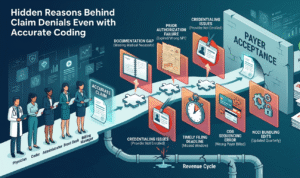
Orthopedic billing is widely considered one of the most complex specialties in all of medical billing, and Illinois practices feel that complexity every day. Between high value surgical procedures, detailed diagnosis coding, and a web of payer specific rules, there are more places for a claim to go wrong in orthopedics than in almost any other field.
Billing problems in this specialty are not just an administrative annoyance. They directly reduce revenue, delay reimbursements, and pile heavy administrative burden onto staff who are already stretched thin managing prior authorizations, documentation, and denial follow up.
Illinois orthopedic practices face an additional layer of difficulty on top of that general complexity. Regional Medicare Administrative Contractor requirements, Illinois Medicaid specific rules, and a mix of commercial payer policies unique to the state all shape how claims need to be submitted, and getting any of it wrong can be costly.
What makes this especially frustrating for practice owners is how invisible many of these problems are until they show up as a real financial impact. A missing modifier or an unspecified diagnosis code does not announce itself the day it happens. It quietly sits in the claim, moves through submission, and only becomes visible weeks later as a denial, an underpayment, or a claim that never gets flagged at all because no one is tracking the pattern closely enough to notice.
This guide walks through exactly why orthopedic billing is so demanding, how the process is supposed to work end to end, the ten most common billing problems Illinois practices run into, and what practical steps can fix each one before it costs more revenue.
Why Orthopedic Billing Is More Complex Than Other Specialties
Orthopedic practices deal with a level of billing complexity that few other specialties match, driven by several overlapping factors:
- High-value surgical procedures: Joint replacements, spine surgery, and complex fracture repairs carry significant reimbursement value, which also means significant risk if a claim is coded or documented incorrectly.
- Fracture care billing: Fracture treatment involves specific coding rules tied to open versus closed treatment, laterality, and encounter type, all of which affect reimbursement.
- Joint replacement billing: These procedures often involve global surgery packages, implant documentation, and strict medical necessity requirements.
- Sports medicine services: Frequently involve multiple procedures performed in a single session, each requiring careful modifier and bundling review.
- Imaging and diagnostic testing: Orthopedic practices rely heavily on imaging, which introduces its own coding and medical necessity documentation requirements.
- Multiple procedure billing: Billing several procedures performed during the same encounter correctly, without triggering bundling errors, requires real coding precision.
- Global surgery package rules: Many orthopedic procedures fall under global periods that bundle certain follow up care into the original payment, and miscoding around this leads to denials.
- Modifier usage: Orthopedic claims depend heavily on correct modifier application to reflect bilateral procedures, multiple procedures, and distinct services.
- Medical necessity requirements: Payers scrutinize orthopedic claims closely, particularly for high cost imaging, injections, and surgical procedures, often measured against Local and National Coverage Determinations published by CMS.
- Frequent payer audits: The combination of high claim values and coding complexity makes orthopedic billing a common audit target.
How the Orthopedic Billing Process Works
Orthopedic billing follows a detailed, multi step workflow, and understanding where things typically break down starts with understanding the full sequence:
- Patient registration
- Insurance eligibility verification
- Benefits verification
- Prior authorization
- Clinical documentation
- ICD-10-CM diagnosis coding
- CPT coding
- HCPCS coding, when applicable
- Modifier assignment
- Charge entry
- Claim scrubbing
- Claim submission
- Payer adjudication
- Payment posting
- Denial management
- Appeals
- Accounts Receivable (A/R) follow up
Each step depends on the one before it. A prior authorization missed at step four undermines everything downstream, just as inaccurate documentation at step five makes accurate coding at steps six through nine essentially impossible. Orthopedic billing problems rarely happen in isolation, they tend to cascade from one weak link in this chain to the next.
This cascading effect is worth understanding in practical terms. Take a patient scheduled for arthroscopic knee surgery. If eligibility verification at step two is skipped or done hastily, the practice may not discover an inactive policy until after the procedure has already been performed, at which point there is no way to go back and fix the root problem. If prior authorization at step four is submitted late, the surgery itself may need to be rescheduled, disrupting both patient care and the practice’s surgical schedule. And if the operative report at step five lacks sufficient detail about laterality or the specific procedure performed, every coding decision that follows inherits that same gap, no matter how skilled the coder is. Fixing billing problems effectively means understanding which step in this chain actually broke down, rather than assuming every denial is a coding issue simply because that is where it becomes visible.
Why Orthopedic Billing Problems Cost Illinois Practices Money
Billing problems translate directly into financial consequences. Increased claim denials and delayed reimbursements are the most immediate effects, followed closely by higher Accounts Receivable as unresolved claims sit unpaid longer than they should.
These problems create real cash flow disruptions for practices that depend on predictable, timely reimbursement to cover payroll, equipment, and overhead. Over time, they contribute to genuine revenue leakage tied directly to billing gaps, meaning money the practice earned but never actually collected. They also drive up administrative costs, since every denied or delayed claim requires staff time to research and correct.
Left unaddressed, billing problems introduce compliance risk, particularly when documentation or coding patterns draw payer attention. They reduce staff productivity, since time spent chasing corrections is time not spent moving new claims forward, and they frequently spill over into patient billing frustrations when authorization or coding issues result in unexpected bills.
To put this in concrete terms, consider a mid sized Illinois orthopedic practice performing 40 joint replacement procedures a month, each reimbursed in the range of several thousand dollars. If just three of those claims a month get denied due to a missed prior authorization or a modifier error, and each denial takes several weeks to resolve through appeal, that single recurring problem can tie up tens of thousands of dollars in delayed revenue every month, on top of the staff hours spent researching and resubmitting each one. Multiply that across a full year, and a billing gap that looks minor on paper becomes a serious drag on the practice’s overall financial stability.
Top Orthopedic Billing Problems Every Illinois Practice Should Fix
| Billing Problem | Financial Impact | How to Fix It |
| Insurance eligibility verification errors | Denials, delayed payment, patient billing disputes | Verify eligibility before every visit, not just at intake |
| Missing or delayed prior authorizations | Denied claims, delayed or cancelled procedures | Build proactive authorization tracking into scheduling |
| Incorrect ICD-10-CM diagnosis coding | Denials, reduced reimbursement | Strengthen documentation and diagnosis specificity |
| CPT coding errors | Denials, bundling disputes, underpayment | Ongoing coder training and claim scrubbing |
| Modifier errors | Denials, payer edits, reduced reimbursement | Modifier specific training and validation checks |
| Poor clinical documentation | Denials across nearly every category | Standardize documentation templates and review |
| High claim denial rates | Significant revenue loss, administrative burden | Root cause analysis and structured denial workflow |
| Slow Accounts Receivable follow up | Aging claims, reduced collections | Structured, scheduled A/R follow up process |
| Payment posting errors | Inaccurate financial reporting, missed underpayments | Consistent ERA and EOB reconciliation |
| Failure to monitor billing performance | Undetected revenue loss over time | Regular KPI tracking and reporting |
1. Insurance Eligibility Verification Errors
Expired coverage, incorrect patient information, and unresolved Coordination of Benefits issues are among the most common triggers for denials that should never have happened in the first place. These errors are entirely preventable with consistent front end verification.
Verification best practices include confirming active coverage before every single visit, not just at initial intake, and validating COB details whenever a patient reports having more than one insurance plan.
2. Missing or Delayed Prior Authorizations
High risk orthopedic procedures, including advanced imaging and many surgical services, almost always require prior authorization. Imaging authorizations and surgical approvals both carry real deadlines, and missing them can delay or completely derail a scheduled procedure.
Strategies to avoid these delays include building authorization tracking directly into the scheduling workflow, so a missing or expired authorization is flagged well before the date of service rather than discovered at the last minute.
3. Incorrect ICD-10-CM Diagnosis Coding
Orthopedic diagnosis coding carries specific complexity around laterality errors, fracture coding, encounter type, and diagnosis specificity. A code that fails to reflect any of these details accurately is a common trigger for denial.
Documentation support is the real fix here. Coders can only be as specific as the clinical notes allow, which is why diagnosis specificity problems almost always trace back to a documentation gap rather than a coding mistake made in isolation, a pattern illustrated clearly in real coding guidance like avoiding unnecessary unspecified diagnosis codes.
4. CPT Coding Errors
Incorrect procedure selection, bundling issues, and unbundling risks are all common in orthopedic CPT coding given how frequently multiple procedures occur in a single encounter. Add-on codes introduce additional complexity, since they must be billed correctly alongside their primary procedure. Surgical coding accuracy depends heavily on detailed operative reports that clearly describe exactly what was performed.
5. Modifier Errors
Orthopedic billing relies heavily on modifiers, including modifier 25 for a significant, separately identifiable service, modifier 50 for bilateral procedures, modifier 51 for multiple procedures, modifier 59 for distinct procedural services, and RT/LT modifiers to indicate laterality when appropriate.
Incorrect modifier combinations and missing modifiers are among the most common causes of orthopedic claim denials, and payer specific edits mean the same modifier combination that works for one payer may trigger a denial with another.
6. Poor Clinical Documentation
Operative reports, imaging documentation, medical necessity justification, procedure notes, and follow up documentation all need to be thorough and specific. Weak documentation in any one of these areas can undermine an otherwise accurate claim, since coders and payers alike depend on the record to support what was billed.
7. High Claim Denial Rates
Medical necessity denials, coding denials, authorization denials, documentation denials, and timely filing issues all contribute to elevated denial rates in orthopedic practices. Each category requires a slightly different prevention approach, which is exactly why blanket fixes rarely work, root cause analysis by denial category tends to produce far better results than treating every denial the same way.
A practice seeing a 15% denial rate, for example, needs to know whether that is concentrated in a single category, like prior authorization gaps for MRI orders, or spread evenly across coding, documentation, and eligibility issues. The prevention strategy for each looks completely different: authorization gaps point to a scheduling workflow fix, while widespread coding denials point to a training or claim scrubbing gap. Lumping every denial into a single generic “improve billing” initiative rarely moves the needle, while a targeted fix aimed at the actual root cause usually shows measurable improvement within a single billing cycle.
8. Slow Accounts Receivable (A/R) Follow Up
Aging claims that are not actively worked simply continue aging, and orthopedic claims, given their higher dollar value, deserve faster follow up than many practices actually provide. A structured follow up workflow, clear escalation process, and consistent payment tracking all help prevent claims from slipping through the cracks.
9. Payment Posting Errors
Reconciling Electronic Remittance Advice (ERA) and Explanation of Benefits (EOB) documents accurately is essential for catching underpayments and overpayments early. Adjustment accuracy matters just as much, since incorrect adjustments can mask real revenue problems in financial reporting.
10. Failure to Monitor Billing Performance
Missing KPI tracking and a lack of consistent reporting leave practices without visibility into their own revenue cycle. Without that visibility, billing problems tend to compound quietly over months before anyone notices the financial impact, which is exactly why continuous improvement depends on consistent measurement.
Orthopedic Services Most Vulnerable to Billing Problems
Certain orthopedic services carry higher billing risk than others, including joint replacement surgery, fracture care, arthroscopy, sports medicine procedures, spine procedures, hand surgery, foot and ankle procedures, pain management injections, casting and splinting, and diagnostic imaging. Detailed procedure specific billing considerations, such as those covered in ZMC fracture repair billing guidance and ulnar collateral ligament repair billing, show just how much precision these procedures demand at the coding level.
These services share a common thread: they typically involve either high reimbursement value, multiple procedures performed together, or detailed anatomical specificity requirements, sometimes all three at once. Spine procedures, for example, often combine several distinct components in a single operative session, each requiring its own careful CPT and modifier review to avoid unbundling errors. Pain management injections carry their own layer of risk since medical necessity documentation requirements for injections tend to be stricter and more payer specific than for many other orthopedic services, making them a frequent target for both denials and post payment audits.
Illinois-Specific Billing Considerations
Illinois orthopedic practices operate under a mix of federal and state specific requirements that shape billing at every level. Medicare Administrative Contractor requirements determine coverage and documentation expectations for Medicare claims specific to the region. Illinois Medicaid billing considerations add another layer, managed through the Illinois Department of Healthcare and Family Services, which sets its own authorization, documentation, and claims requirements separate from federal Medicare policy.
Commercial payer policy variations are common across Illinois, since major insurers operating in the state each maintain their own coverage rules and claim edits. Timely filing limits, prior authorization expectations, and documentation standards can all vary by payer as well.
Practices operating across multiple Illinois markets, from Chicago and its suburbs to Rockford, Peoria, or Springfield, often discover that payer mix alone creates meaningful variation in denial patterns from one location to another. A commercial plan that dominates enrollment in one part of the state may be far less common in another, meaning a billing team optimized around one region’s payer rules can be caught off guard when expanding into a new Illinois market without updating its verification and authorization workflows accordingly.
Because these specific rules change over time, practices should verify current payer policies directly rather than relying on fixed assumptions, and Illinois practices working through comprehensive billing support generally find that ongoing payer policy monitoring is one of the most valuable parts of outsourcing this work.
Documentation Best Practices for Orthopedic Billing
Strong orthopedic documentation consistently captures the chief complaint, a complete history and examination, imaging findings, diagnosis specificity, detailed procedure documentation, thorough operative reports, implant or device details when applicable, clear medical necessity justification, and complete follow up notes. Missing any of these elements increases denial risk across nearly every claim type discussed in this guide.
Operative reports deserve particular attention, since they carry the most weight when a payer questions medical necessity or coding accuracy after the fact. A strong operative report describes the exact procedure performed, the specific anatomical structures involved, laterality, and any complications encountered, in enough detail that a coder who was not in the room can still assign the correct, most specific codes available. Implant and device documentation matters just as much for joint replacement and hardware related procedures, since payers increasingly expect specific device identifiers and lot numbers as part of a complete, defensible record.
Technology That Improves Orthopedic Billing Accuracy
- Electronic Health Records (EHR) that capture structured, orthopedic specific documentation, secured under HIPAA privacy standards
- Practice Management Software that connects scheduling, eligibility, and billing in one system
- Claim Scrubbing Software that catches coding and modifier errors before submission
- AI-Assisted Coding tools that help flag potential errors or missed specificity
- Revenue Cycle Management Platforms that connect every stage of the billing process
- Denial Analytics that surface recurring patterns before they become systemic
- Electronic Prior Authorization (ePA) that speeds up approval turnaround for high risk procedures
Key Performance Indicators (KPIs) Every Illinois Orthopedic Practice Should Track
| KPI | Why It Matters |
| Clean Claim Rate | Measures the quality of claims at initial submission, with 95% widely considered the benchmark to hit |
| First-Pass Claim Acceptance Rate | Indicates overall submission accuracy, a metric dedicated billing support can directly improve |
| Claim Denial Rate | Identifies broader reimbursement issues |
| Days in Accounts Receivable (A/R) | Measures collection efficiency |
| Net Collection Rate | Tracks overall financial performance |
| Prior Authorization Approval Rate | Evaluates how effectively authorizations are being managed |
| Coding Accuracy Rate | Measures documentation and coding quality across the practice |
Best Practices to Prevent Orthopedic Billing Problems
- Strengthen documentation across every provider and encounter type
- Improve coding accuracy through ongoing training and review
- Verify insurance before every visit, not just at intake
- Submit authorizations early rather than close to the date of service
- Use claim scrubbing software on every claim without exception
- Perform regular billing audits to catch systemic issues
- Monitor denial trends by category and by payer
- Train billing and coding staff consistently, not just once
- Review payer policy updates on an ongoing basis
Common Mistakes Illinois Practices Make
- Waiting to verify insurance until the day of the appointment
- Submitting claims with incomplete documentation
- Using modifiers incorrectly or inconsistently
- Missing diagnosis specificity where more detail was available
- Delaying claim submission longer than necessary
- Ignoring denial patterns instead of investigating root causes
- Allowing weak A/R follow up to let claims age unnecessarily
- Failing to audit billing performance on a regular schedule
Front desk and scheduling errors are often underestimated as a source of revenue loss, even though they sit at the very start of the billing chain and quietly set up denials that show up weeks later, a pattern many Illinois practices don’t realize is costing them thousands until they review their denial trends closely.
How Professional Orthopedic Billing Services Help Illinois Practices
Specialized orthopedic billing support brings structured expertise to every stage of this process, including:
- Thorough insurance verification before every visit
- Proactive prior authorization support for high risk procedures
- Orthopedic specific ICD-10, CPT, and HCPCS coding
- Modifier validation built around payer specific rules
- Systematic claim scrubbing before every submission
- Proactive denial prevention rather than reactive correction
- Structured appeals management when denials do occur
- Dedicated Accounts Receivable recovery
- Ongoing Revenue Cycle Management optimization
- Consistent, transparent performance reporting
Why Choose The Medicator’s for Orthopedic Billing Services in Illinois
Illinois orthopedic practices need a billing partner who understands both the specialty’s coding complexity and the state’s specific payer landscape. The Medicator’s brings:
- Deep Illinois orthopedic billing expertise across Medicare, Illinois Medicaid, and commercial payers
- Certified billing and coding specialists trained in orthopedic specific coding, including AAPC credentialed coders
- End to end Revenue Cycle Management built around orthopedic workflows
- Advanced claim scrubbing that catches errors before submission
- Accurate coding and thorough documentation review
- Dedicated denial management focused on root cause resolution
- A/R optimization that keeps claims moving instead of aging
- Transparent reporting so practices always know where they stand
- Personalized client support rather than a rotating queue
Conclusion
Orthopedic billing problems can significantly impact revenue, compliance, and operational efficiency if left unresolved, and Illinois practices face an added layer of complexity given the state’s specific payer landscape.
By improving documentation, coding accuracy, insurance verification, prior authorization workflows, denial management, and consistent KPI monitoring, Illinois practices can meaningfully strengthen their revenue cycle and accelerate reimbursements.
Partnering with an experienced orthopedic billing company such as The Medicator’s can help practices reduce administrative burden, improve claim acceptance, and achieve more predictable financial performance. If your Illinois practice is dealing with rising denials or slow reimbursements, request a free practice analysis from The Medicator’s or contact our orthopedic billing team directly to see exactly where your revenue cycle is breaking down.
Frequently Asked Questions
Why is orthopedic billing so complex?
Orthopedic billing involves high value surgical procedures, detailed diagnosis coding requirements like laterality and fracture classification, global surgery packages, and heavy modifier usage, all of which create more opportunities for error than most other specialties.
What are the most common orthopedic billing problems?
The most common problems include eligibility verification errors, missing prior authorizations, incorrect ICD-10-CM and CPT coding, modifier errors, poor documentation, high denial rates, slow A/R follow up, and payment posting mistakes.
How can Illinois practices reduce claim denials?
Practices can reduce denials by verifying eligibility before every visit, managing prior authorizations proactively, strengthening documentation, validating coding and modifiers, and scrubbing every claim before submission.
Which orthopedic services require prior authorization?
Advanced imaging, many surgical procedures, and certain injections commonly require prior authorization, though specific requirements vary by payer and should always be verified directly.
What documentation is needed for orthopedic claims?
Orthopedic claims typically require a clear chief complaint, detailed history and examination findings, imaging results, specific diagnosis documentation, procedure and operative notes, and clear evidence of medical necessity.
How do modifier errors affect reimbursement?
Incorrect or missing modifiers can result in denied claims, reduced reimbursement, or payer specific edits that flag the claim for review, since modifiers communicate essential details like laterality and whether multiple procedures were performed.
What KPIs should orthopedic practices monitor?
Clean claim rate, first pass claim acceptance rate, claim denial rate, days in A/R, net collection rate, prior authorization approval rate, and coding accuracy rate are the core KPIs orthopedic practices should track consistently.
Should orthopedic billing be outsourced?
Many Illinois orthopedic practices benefit from outsourcing given the specialty’s coding complexity and the state’s specific payer requirements, particularly when internal staff lack the bandwidth to manage the full billing workflow accurately.
How can outsourcing reduce A/R days?
Dedicated billing partners typically bring structured, consistent follow up processes and specialty specific expertise that most internal teams cannot match given competing priorities, which directly shortens the time claims spend unresolved.
Why choose The Medicator’s for orthopedic billing in Illinois?
The Medicator’s combines orthopedic specific coding expertise with deep familiarity with Illinois Medicare, Medicaid, and commercial payer requirements, backed by transparent reporting and dedicated client support.