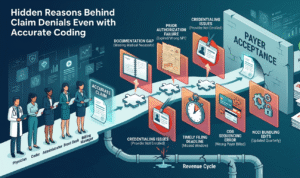
A busy, well-regarded psychiatry practice can still be losing real money every single month, and often nobody notices until someone finally sits down with the numbers. That’s the strange thing about revenue leakage. It rarely looks like one big, obvious mistake. It looks like a hundred small ones, spread across eligibility checks, coding decisions, documentation habits, and follow-up calls that never quite happen.
It helps to be precise about what’s actually being lost, because “lost revenue” isn’t one thing. There’s revenue that’s genuinely gone for good, revenue that’s simply delayed, claims that get denied outright, claims that get rejected before they’re even reviewed, payments that come in lower than they should, contractual adjustments that get applied incorrectly, and patient balances that never get collected. Each of these has a different cause and a different fix.
Psychiatry billing is also its own animal. Time-based psychotherapy codes, medication management, psychiatric diagnostic evaluations, and telepsychiatry all carry rules that general medical billing simply doesn’t have to deal with. Add Florida’s specific Medicaid and commercial payer requirements on top of that, and it’s easy to see why psychiatry practices are especially exposed to the kind of billing mistakes that quietly chip away at revenue.
This guide walks through coding, documentation, eligibility, authorization, claims, A/R, and patient collections, the entire revenue cycle, and helps Florida psychiatry practices identify exactly where they might be losing money and what to do about it.
1. What Is Revenue Leakage in Psychiatry Billing?
Revenue leakage is the cumulative loss of money a practice is owed but never fully collects, usually because of small, preventable errors scattered across the billing process rather than one dramatic failure. It’s worth separating out the different flavors of this problem, since each one needs a different response:
- Lost revenue: Money that’s genuinely gone, often from claims that pass timely filing deadlines or get written off incorrectly.
- Delayed reimbursement: Money that’s still collectible but takes far longer than it should to arrive.
- Claim denials: Claims the payer reviewed and declined to pay, usually for a specific, addressable reason.
- Claim rejections: Claims that never even reached full payer review due to a technical error.
- Underpayments: Claims paid, but below the contracted or expected rate.
- Incorrect contractual adjustments: Write-offs applied incorrectly, sometimes removing money that was actually collectible.
- Uncollected patient balances: Copays, deductibles, and coinsurance that never get billed or followed up on effectively.
- Write-offs: Balances removed from the books, appropriately or not, and worth periodically auditing either way.
A simple illustrative example: If a practice loses or delays just $40 across 100 claims in a given month, that’s $4,000 in monthly revenue affected. This is a hypothetical example meant to illustrate how small, per-claim amounts add up, not a claim about industry-wide averages.
2. Why Psychiatry Practices Are Vulnerable to Billing Mistakes
Psychiatry carries a genuinely unusual mix of billing complexity:
- Complex CPT coding spanning diagnostic evaluations, therapy, and medication management
- Time-based services, where the specific duration of a session determines the correct code
- Psychotherapy plus E/M billing on the same date of service, one of the most error-prone areas in the specialty
- Medication management visits that carry their own documentation expectations
- Psychiatric diagnostic evaluations, which have specific coding and documentation requirements distinct from routine visits
- Telepsychiatry, which has grown rapidly and comes with its own evolving rules
- Prior authorization requirements that vary significantly by payer and service
- Medical necessity standards that can be interpreted differently across payers
- Behavioral health benefit differences, since mental health coverage doesn’t always mirror medical coverage under the same plan
- Documentation requirements that are more detailed than a typical E/M visit
- Payer-specific rules that rarely align cleanly across Medicare, Florida Medicaid, and commercial plans
- Frequent policy changes, particularly around telehealth and behavioral health parity
3. The 15+ Psychiatry Billing Mistakes That Cost Practices Revenue
| Billing Mistake | Revenue Impact | Prevention |
| Eligibility errors | Denied claims | Verify benefits before every visit |
| Incorrect CPT coding | Underpayment or denials | Regular coding audits |
| ICD-10-CM errors | Medical necessity issues | Diagnosis validation against documentation |
| Missing authorization | Non-payment | Authorization tracking system |
| Documentation gaps | Denials | Documentation audits |
| Modifier errors | Claim edits or denials | Modifier review before submission |
| Telehealth errors | Delayed or denied claims | Payer-specific telehealth policy review |
| Late claims | Timely filing denials | Submission monitoring |
| Poor claim scrubbing | Preventable errors reaching the payer | Pre-submission checks |
| Ignoring A/R | Aging, harder-to-recover revenue | Regular structured follow-up |
| Missed underpayments | Quiet, ongoing lost revenue | Routine payment audits |
| Credentialing lapses | Non-payment despite valid services | Proactive recredentialing |
| Poor patient collections | Bad debt | Better collection process |
| Incorrect write-offs | Revenue removed unnecessarily | Adjustment audits |
| Poor denial tracking | Recurring, repeated losses | Root-cause analysis |
4. Mistake #1: Failing to Verify Insurance Eligibility
Coverage that looks active on paper can quietly be inactive, terminated, or attached to the wrong member ID. Behavioral health benefits sometimes carve out separately from a patient’s medical plan entirely, which means a patient can have valid medical coverage and no active behavioral health benefit at all. Deductibles, copayments, coinsurance, out-of-network status, and secondary insurance all need confirmation before, not after, the visit.
Revenue Impact: Providing a service to a patient without active or appropriate coverage turns what should have been a straightforward, collectible claim into a denial or, worse, an uncollectible patient balance.
Prevention: Verify → Confirm Benefits → Document → Reverify When Needed. Building this into a consistent front-desk workflow prevents the vast majority of eligibility-related denials before they happen.
5. Mistake #2: Choosing the Wrong Psychiatry CPT Code
This is one of the most consequential mistakes in psychiatry billing, given how many overlapping code categories exist:
- Psychiatric Diagnostic Evaluation: 90791 (without medical services) and 90792 (with medical services)
- Psychotherapy: 90832 (30 minutes), 90834 (45 minutes), 90837 (60 minutes)
- Evaluation & Management (E/M) Services: 99202 through 99205 for new patients, 99211 through 99215 for established patients
A full breakdown of how these codes are typically applied is covered in this guide to CPT codes commonly used in psychiatry billing.
The most common errors here include selecting a code that doesn’t actually match the service performed, incorrect time-based coding when the documented session length doesn’t support the code billed, insufficient documentation to justify the code selected, an incorrect E/M level relative to the complexity of the visit, confusing psychotherapy codes with E/M services, and duplicate or otherwise unsupported billing. The actual service performed, the documentation supporting it, current CPT guidance, and the specific payer’s requirements all have to line up. None of them alone is enough.
6. Mistake #3: Incorrectly Billing Psychotherapy + E/M Services
Billing psychotherapy and E/M services together on the same date is legitimate in specific circumstances, but it’s also one of the most misapplied patterns in psychiatry billing. Both services need to be genuinely distinct, with documentation clearly separating the E/M component (medication management, medical decision-making) from the psychotherapy component (the actual therapeutic work performed).
Modifier 25 is often required to indicate a significant, separately identifiable E/M service on the same day as another procedure, but automatically appending it to every combined visit, regardless of whether the documentation actually supports two distinct services, is a mistake that draws payer scrutiny. Payer-specific requirements around this combination vary, and what’s acceptable to one payer may trigger an edit or a request for records from another.
Revenue Impact: Incorrect combined billing can result in denials, downcoding, payment delays, recoupments after the fact, and genuine compliance exposure if the pattern repeats across many claims.
7. Mistake #4: Using Unsupported or Incorrect ICD-10-CM Codes
Unspecified diagnosis coding, an incorrect diagnosis relative to what was actually documented, a mismatch between the diagnosis and the service billed, and a general lack of specificity are all common issues in psychiatric coding. Sometimes a diagnosis gets coded that simply isn’t supported anywhere in the documentation, or a patient’s diagnosis information doesn’t get updated as their clinical picture evolves.
Prevention: Code directly from provider documentation, follow current ICD-10-CM guidelines, use the highest level of specificity the documentation actually supports, and conduct periodic diagnosis coding audits rather than assuming accuracy holds steady over time. For a deeper look at why this specific issue causes so many denials, see this guide to ICD-10 coding specificity and guidelines.
8. Mistake #5: Incomplete Psychiatry Documentation
Missing or thin documentation is one of the fastest ways to turn a legitimate service into a denial. Common gaps include a missing assessment, an incomplete treatment plan, insufficient clinical detail overall, missing psychotherapy-specific documentation, missing medication management details, missing time documentation where the code requires it, and missing provider authentication on the note itself.
Documentation Checklist:
- ☐ Date of service
- ☐ Relevant clinical information
- ☐ Assessment
- ☐ Diagnosis
- ☐ Treatment plan
- ☐ Medication management details
- ☐ Psychotherapy details
- ☐ Time documentation where required
- ☐ Provider authentication
9. Mistake #6: Ignoring Medical Necessity
Medical necessity means the documented condition genuinely supports the service billed. Payers evaluate this because they need a defensible reason to pay a claim, not just a technically correct code. A CPT code that’s entered perfectly can still result in a denial if the diagnosis, documentation, and service performed don’t clearly connect. The formula worth keeping in mind is straightforward: Diagnosis + Clinical Documentation + Service Performed + Payer Policy all have to align, not just the code itself.
10. Mistake #7: Missing Prior Authorization Requirements
Certain psychiatric services, particularly intensive outpatient programs, certain medications, and some higher-level evaluation and management services, require authorization before they’re billable. Common failure points include an authorization that’s expired by the time the service is rendered, an incorrect authorization number on the claim, authorization for the wrong service, incorrect dates, visit or unit limitations that get exceeded, and simply failing to renew an authorization before it lapses. It’s worth understanding how prior authorization actually affects claim outcomes before assuming a single approval covers everything that follows.
Prevention Workflow: Check Requirement → Request → Record → Track → Renew.
11. Mistake #8: Telepsychiatry Billing Errors
Telepsychiatry has become central to how many Florida practices operate, and it comes with its own distinct set of billing requirements:
- Place of Service (POS) codes need to accurately reflect where the visit actually occurred
- Telehealth modifiers, where required, need to be applied correctly and consistently
- Audio-video versus audio-only services aren’t always billed or reimbursed the same way
- Patient location requirements, which some payers still track closely
- Provider location requirements, which can affect licensure and billing eligibility
- Documentation requirements specific to telehealth encounters
- Payer-specific telehealth policies, which genuinely differ from one payer to the next
Florida Considerations: Medicare, Florida Medicaid, and commercial payers each maintain their own telehealth billing requirements, and none of them should be assumed to follow the same rule as another. What’s acceptable under one payer’s telehealth policy may not transfer directly to the next, which makes payer-specific verification essential rather than optional.
12. Mistake #9: Submitting Claims Without Proper Claim Scrubbing
Claim scrubbing is the process of reviewing a claim for errors before it’s ever submitted to a payer. It matters because pre-submission validation catches preventable mistakes while they’re still cheap and easy to fix, rather than after a denial has already cost time and delayed revenue.
Psychiatry Claim Scrubbing Checklist:
- Patient demographics
- Insurance information
- CPT codes
- ICD-10-CM codes
- Modifiers
- Place of Service (POS)
- Authorization
- Provider information
- Duplicate claims
- Payer-specific edits
13. Mistake #10: Failing to Distinguish Rejections From Denials
| Rejection | Denial | |
| When it happens | Before adjudication, often due to a technical error | During or after the payer’s full review |
| Common cause | Formatting, missing data, invalid codes | Medical necessity, coverage, documentation issues |
| Fix required | Correct the error and resubmit | Investigate, potentially appeal, and correct the root cause |
Treating rejections and denials the same way creates an inefficient workflow, since a rejection usually needs a quick technical correction while a denial often needs a genuine investigation into why the payer declined to pay.
14. Mistake #11: Ignoring Denials Until They Become Old A/R
Unworked denial queues, delayed appeals, missed appeal deadlines, repeated denial patterns that never get addressed at the root, and a general lack of clear ownership over the denial process all let recoverable revenue quietly age past the point where it’s easy to collect.
Better Workflow: Identify → Categorize → Correct → Appeal → Follow Up → Analyze → Prevent.
15. Mistake #12: Letting A/R Age Beyond 90 or 120 Days
| Aging Bucket | Recovery Difficulty |
| 0–30 Days | Low, still within normal processing time |
| 31–60 Days | Slightly elevated, worth a status check |
| 61–90 Days | Meaningfully harder, needs active investigation |
| 91–120 Days | High risk, often near appeal deadlines |
| 120+ Days | Critical, recovery becomes increasingly unlikely |
The longer a claim sits, the harder it becomes to recover, both because appeal windows start closing and because documentation and institutional memory fade with time.
A/R Recovery Strategy: Prioritize high-dollar claims, claims already past 120 days, claims approaching timely filing deadlines, claims with a clearly identifiable and fixable issue, and underpaid claims where the gap between expected and actual payment is significant.
16. Mistake #13: Failing to Identify Underpayments
Not every dollar of lost revenue comes from an outright denial. Underpayments hide in plain sight, since a claim that pays, even if it pays incorrectly, rarely gets a second look. Contracted reimbursement rates, expected versus actual payment, incorrect payer processing, contractual adjustment errors, and fee schedule discrepancies all contribute to this quieter form of revenue loss.
Prevention: Regular payment audits, periodic contract analysis, systematic expected-versus-actual reimbursement comparisons, and ongoing payer trend monitoring all help surface underpayments before they compound across hundreds of claims.
17. Mistake #14: Incorrect Contractual Adjustments and Write-Offs
Adjustment codes exist to accurately reflect the difference between billed charges and contracted rates, not to serve as a catch-all for anything unresolved. Incorrect write-offs, posting errors, unnecessary balance adjustments, and a failure to distinguish a legitimate contractual adjustment from genuine bad debt all create the same underlying problem.
Revenue Impact: A billing team can accidentally remove genuinely collectible revenue from Accounts Receivable simply because adjustments weren’t reviewed carefully before being applied.
18. Mistake #15: Credentialing and Recredentialing Lapses
Expired credentials, payer enrollment problems, incorrect NPI information, taxonomy errors, confusion between group and individual enrollment, an outdated CAQH profile, and missed recredentialing deadlines can all prevent an otherwise completely legitimate, well-documented service from being reimbursed at all. This is a particularly costly category of mistake because the clinical work was done correctly. The revenue loss is purely administrative.
Florida practices managing multiple providers, especially as they add nurse practitioners and physician assistants to expand access, benefit from a structured, proactive approach to this, similar to what’s outlined in this look at medical credentialing services for growing practices.
19. Mistake #16: Poor Patient Balance Collection
Copays, deductibles, and coinsurance make up a real share of psychiatry practice revenue, and poor collection processes here quietly erode the bottom line. Incorrect statements, delayed patient billing, a lack of convenient payment options, and poor communication around what’s actually owed all contribute to unnecessary bad debt.
The goal is genuinely balancing two things at once: Revenue Collection + Patient Experience. Aggressive, poorly communicated collection tactics can damage the therapeutic relationship in a way that’s especially costly in a psychiatric practice, which is part of why handling patient billing conversations thoughtfully matters as much as the collection process itself.
20. Mistake #17: Not Monitoring Payer-Specific Policies
CPT changes, ICD-10-CM updates, telehealth policy shifts, authorization requirement changes, evolving medical necessity standards, behavioral health coverage adjustments, documentation requirement updates, Florida Medicaid-specific changes, Medicare updates, and commercial payer policy shifts all happen on an ongoing basis, often without much advance notice. Practices running on billing workflows built a year or two ago are almost certainly missing something that’s changed since.
21. Mistake #18: Not Tracking the Right Billing KPIs
| KPI | Why It Matters |
| Clean Claim Rate | Measures how often claims go out correctly the first time |
| First-Pass Acceptance Rate | Reflects the initial quality of claim submissions |
| Denial Rate | Flags underlying revenue leakage patterns |
| Rejection Rate | Highlights front-end, pre-submission errors |
| Days in A/R | Measures how quickly the practice is actually collecting revenue |
| 90+ Day A/R | Identifies claims sliding into higher-risk aging territory |
| 120+ Day A/R | Highlights the most serious recovery challenges |
| Net Collection Rate | Reflects overall collection performance against what’s actually owed |
| Appeal Success Rate | Measures how effectively denials get recovered |
| Underpayment Rate | Surfaces reimbursement issues that don’t show up as denials at all |
22. How Much Revenue Can Billing Mistakes Cost a Psychiatry Practice?
Rather than citing an unsupported industry-wide figure, it’s more useful to walk through a simple calculation framework a practice can apply to its own numbers.
Example: If a practice submits 1,000 claims a month, and an avoidable issue affects 5% of those claims, that’s 50 claims a month requiring additional correction, follow-up, or recovery work. The actual financial impact of those 50 claims depends heavily on several variables: average reimbursement per claim, the specific claim value involved, the type of denial or issue, how successfully those claims are ultimately recovered, the practice’s overall payer mix, and how close any of those claims are to timely filing deadlines.
This framework is useful precisely because it doesn’t rely on invented statistics. It gives a practice a structure for estimating its own exposure based on its own claim volume and error rate.
23. How to Conduct a Psychiatry Billing Revenue Leakage Audit
Step 1: Review A/R. Identify balances sitting in the 60+, 90+, and 120+ day buckets.
Step 2: Analyze Denials. Categorize them by cause: coding, authorization, eligibility, documentation, medical necessity, or telehealth.
Step 3: Audit Coding. Review CPT accuracy, ICD-10-CM specificity, modifier use, E/M level selection, and psychotherapy code selection.
Step 4: Audit Payments. Look specifically for underpayments, incorrect adjustments, and payments that never posted correctly.
Step 5: Review Patient Collections. Assess how consistently copays, deductibles, and coinsurance are actually being collected.
Step 6: Review Credentialing. Confirm every provider’s credentialing and recredentialing status across every payer the practice bills.
Step 7: Identify Recurring Revenue Leaks. Look for patterns rather than treating every issue as a one-off.
Step 8: Implement Corrective Actions. Turn the findings into an actual workflow change, not just a one-time cleanup.
24. How Professional Psychiatry Billing Services Prevent Revenue Loss
A specialized psychiatry billing partner typically addresses every category covered in this guide directly:
- Eligibility verification before every visit
- Behavioral health-specific benefits verification
- Prior authorization tracking and renewal
- Psychiatry-specific CPT coding
- ICD-10-CM coding accuracy
- Modifier review, particularly around Modifier 25 usage
- Claim scrubbing before every submission
- Denial management with root-cause analysis
- Appeals for denials genuinely worth challenging
- Accurate payment posting
- Underpayment identification
- Consistent A/R follow-up
- Thoughtful patient billing
- Credentialing and recredentialing management
- Transparent KPI reporting
25. Why Choose The Medicator’s for Florida Psychiatry Billing?
Every problem covered in this guide is exactly what The Medicator’s builds its psychiatry billing process around, not as a generic add-on, but as the core of how the service works for Florida practices specifically.
Reduce Preventable Billing Errors: Specialized review of psychiatry CPT, ICD-10-CM, modifiers, and documentation, built by people who understand this specialty rather than applying a generic template to it.
Improve Claim Quality: Pre-submission claim review and claim scrubbing workflows catch errors before they ever reach a payer.
Recover Aging A/R: Dedicated follow-up on outstanding and denied claims, so revenue doesn’t quietly age past the point of recovery.
Improve Denial Management: A focus on identifying root causes instead of repeatedly correcting the same recurring errors month after month.
Monitor Revenue Performance: Ongoing tracking of A/R, denial rates, collections, and the other KPIs covered throughout this guide.
Support Florida Practices: Genuine familiarity with Florida Medicaid, Florida-specific commercial payer requirements, and telehealth rules, backed by broader Florida revenue cycle management expertise, so practices aren’t stuck adapting national templates to local requirements.
Ready to see exactly where your practice’s revenue is leaking? Get a psychiatry billing revenue assessment from The Medicator’s and find out before it costs another quarter of revenue.
Conclusion
Psychiatry revenue can be lost at nearly every stage of the revenue cycle, and the most costly problems usually aren’t dramatic. They involve eligibility checks, CPT and ICD-10-CM coding, documentation, prior authorization, telehealth billing, claim submission, denial follow-up, aging A/R, underpayments, credentialing, and patient collections, each contributing a little, and all of it adding up.
Florida psychiatry practices are better served monitoring these areas proactively rather than waiting for a revenue problem to become obvious enough to demand attention. Regular billing audits, consistent claim scrubbing, structured denial analysis, disciplined A/R management, and ongoing payer-policy monitoring all meaningfully reduce preventable revenue leakage over time.
Specialized psychiatry billing support can help close these gaps while reducing the administrative burden on providers who would otherwise be pulled away from patient care. If you’re ready to find out exactly where your practice’s revenue is leaking, reach out to The Medicator’s for a free practice analysis and get a clear, honest picture of where things stand today.
Frequently Asked Questions
What are the most common psychiatry billing mistakes?
Eligibility verification failures, incorrect CPT or ICD-10-CM coding, documentation gaps, missing prior authorization, telehealth billing errors, and poor A/R follow-up are among the most common and most costly.
Why do psychiatry claims get denied?
Common causes include unsupported medical necessity, coding errors, missing authorization, eligibility issues, and documentation that doesn’t fully support the billed service.
How do CPT coding errors affect psychiatry reimbursement?
Incorrect code selection, wrong time-based coding, or mismatched E/M levels can result in denials, underpayment, or downcoding that reduces revenue even when the claim technically gets paid.
How can psychiatrists prevent billing errors?
Consistent documentation habits, regular coding audits, proactive eligibility and authorization checks, and a structured claim scrubbing process before every submission all significantly reduce preventable errors.
What causes psychiatric claims to be rejected?
Rejections are typically technical, tied to demographic errors, invalid codes, or formatting issues that keep a claim from ever reaching full payer review.
Why is accurate ICD-10-CM coding important in psychiatry?
Diagnosis coding establishes medical necessity, and unspecified or unsupported codes are a leading cause of psychiatry claim denials.
How does documentation affect psychiatry reimbursement?
Documentation has to support the specific code billed, including session length for time-based codes and clear justification for combined psychotherapy and E/M billing.
Do psychiatry services require prior authorization?
Many do, particularly certain medications, higher-intensity services, and some evaluation and management visits, and requirements vary significantly by payer.
What are common telepsychiatry billing mistakes?
Incorrect Place of Service codes, missing or misapplied telehealth modifiers, and applying one payer’s telehealth rules to a different payer are among the most frequent issues.
How can Florida psychiatry practices reduce denials?
By verifying eligibility and behavioral health benefits before every visit, tracking Florida Medicaid and commercial payer-specific requirements closely, and maintaining consistent claim scrubbing and documentation practices.
What is revenue leakage in medical billing?
Revenue leakage is the cumulative loss of collectible revenue through small, often unnoticed errors across the billing process, rather than one single large mistake.
How can psychiatry practices recover old A/R?
By prioritizing high-value and near-deadline claims first, categorizing denials by root cause, and following a structured identify-correct-appeal-follow up workflow rather than working claims reactively.
How do billing errors affect cash flow?
Every denial, rejection, or delayed claim pushes revenue further out, and enough of them happening simultaneously can create real, sustained cash flow strain even in an otherwise busy practice.
What psychiatry billing KPIs should practices monitor?
Clean claim rate, denial rate, rejection rate, days in A/R, the percentage of A/R over 90 and 120 days, net collection rate, appeal success rate, and underpayment rate.
How do underpayments affect psychiatry practices?
Underpayments often go unnoticed because the claim technically paid, making them one of the quieter but still significant sources of lost revenue.
Why are credentialing problems causing claim issues?
An expired credential or enrollment gap can prevent an otherwise properly coded and documented claim from being paid at all, since the payer sees the provider as not currently eligible to bill.
Should a psychiatry practice outsource billing?
Many practices find that a specialized psychiatry billing partner catches revenue leakage an internal generalist team may not have the bandwidth or specialty-specific expertise to catch consistently.
How can a billing company reduce psychiatry billing mistakes?
By combining psychiatry-specific coding expertise, consistent claim scrubbing, proactive eligibility and authorization checks, and structured denial and A/R management into a single, accountable process.
How often should psychiatry billing be audited?
Regular audits, ideally quarterly at minimum, help catch coding drift, documentation gaps, and recurring denial patterns before they compound across hundreds of claims.
What psychiatry billing services does The Medicator’s provide?
Eligibility and benefits verification, prior authorization support, psychiatry-specific CPT and ICD-10-CM coding, claim scrubbing, denial and appeals management, A/R follow-up, underpayment identification, patient billing, credentialing, and transparent KPI reporting.