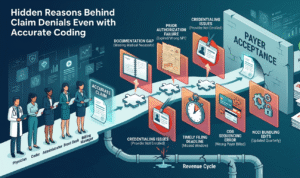
A pain procedure can be clinically appropriate, correctly documented, and performed flawlessly, and the revenue behind it can still stall for weeks. Not because anything went wrong in the treatment room. Because authorization was requested too late, submitted with a gap in the paperwork, returned for more information, approved after the scheduled date, approved for the wrong service, or never properly logged into the billing workflow in the first place.
Here’s the revenue chain that plays out when any of that happens: Authorization Delay → Procedure Delay → Claim Delay or Denial → A/R Growth → Slower Cash Flow. Every link in that chain costs something, staff time, scheduling capacity, patient goodwill, or reimbursement itself, and it’s the same underlying chain that drives a large share of the denial patterns we see across Florida payers more broadly.
It’s worth being precise here, because not every authorization delay results in lost revenue. The actual financial effect depends on the payer, the specific procedure, the authorization requirement in play, the timing of the delay, and whether the issue gets resolved before the claim is ever submitted. This guide walks through exactly where that revenue impact shows up, what causes it, and how a pain practice builds a workflow that catches problems before they become unpaid claims.
1. What Is Prior Authorization in Pain Management?
Prior authorization is the process a payer uses to approve coverage for a specific service before it’s performed, typically requiring the practice to submit clinical documentation showing the service meets the payer’s medical necessity criteria. Payers use it as a coverage management tool, a way to confirm a planned service fits their policy before money changes hands.
Requirements vary by procedure and by payer, and they often involve a medical necessity review, a documentation review, and a formal approval or denial decision issued back to the requesting practice.
Important distinction: prior authorization is generally a coverage management process, not a guarantee of payment. Even after a service is authorized, every other claim requirement, correct coding, timely filing, accurate provider information, still applies in full, a distinction CMS itself draws clearly in its own coverage guidance.
2. Why Prior Authorization Matters So Much for Pain Procedures
Pain management involves a heavier concentration of authorization dependent services than most other specialties: interventional procedures, injections, nerve blocks, epidural procedures, radiofrequency related procedures, and a range of other procedure specific services.
Depending on the payer and the specific service, requirements can include authorization itself, supporting clinical documentation, medical necessity criteria tied to prior conservative treatment, documented previous treatment history, an appropriate diagnosis, relevant imaging or testing, and frequency limitations on how often a given procedure can be repeated in a set period.
The key point: a pain practice needs to know the current, payer specific requirements before scheduling the procedure, not after the patient is already on the schedule.
3. What Counts as a Prior Authorization Delay?
Not every delay looks the same, and understanding which type you’re dealing with matters because the fix is different in each case.
Administrative delay. Information submitted with the request is missing or incomplete.
Clinical review delay. The payer needs additional medical documentation before making a decision.
Scheduling delay. The procedure simply cannot proceed because approval isn’t available yet.
Reconsideration or appeal delay. The initial request wasn’t approved, and additional review is now required.
Internal delay. The practice itself submitted the authorization request too late in the process.
That last category matters more than practices tend to admit. Not every delay originates with the payer, and an honest audit of your own workflow often turns up more internally caused delays than expected.
4. The Revenue Cycle Impact of an Authorization Delay
Normal workflow: Patient Evaluation → Authorization Request → Approval → Procedure → Claim Submission → Payment
Delayed workflow (timing disruption): Patient Evaluation → Authorization Delay → Procedure Rescheduled → Claim Submission Delayed → Payment Delayed
Delayed workflow (denial path): Authorization Problem → Procedure Performed → Claim Denied → Appeal or Correction → Payment Delayed
Both paths share the same root cause and the same outcome, revenue arriving later than it should, but they require genuinely different recovery work once they happen.
5. Revenue Impact #1: Delayed Procedures Mean Delayed Billing
If a procedure can’t be performed until authorization comes through, everything downstream gets pushed back too, charge capture, claim submission, insurance reimbursement, and patient responsibility billing all wait on the same delayed starting point.
Example: Procedure scheduled → authorization delayed → procedure rescheduled → claim submitted later → payment arrives later.
The key issue here usually isn’t permanent revenue loss. It’s revenue timing and cash flow disruption, money that was always going to arrive, just later than your practice’s cash flow planning assumed.
6. Revenue Impact #2: Missed or Rescheduled Procedure Appointments
Authorization delays commonly lead to rescheduled procedures, cancelled appointments, empty procedure slots, extra staff time spent rescheduling, additional patient communication, and reduced overall provider utilization for the day.
An unused procedure slot represents a real opportunity cost even when the procedure is eventually performed later, because that slot’s capacity is gone permanently, it can’t be recovered even once the original patient is rescheduled.
7. Revenue Impact #3: Claim Denials for Missing Authorization
Performing a service without required authorization can result in a claim denial, depending entirely on the specific payer’s rules for that service. Common causes include authorization never being obtained, authorization expiring before the service date, the wrong CPT or procedure being authorized, the wrong provider or location on file, the wrong date, or a mismatch between the number of approved services and what’s actually billed on the claim.
To be precise rather than alarmist: not every claim submitted without authorization gets denied automatically. What’s accurate to say is that when a payer requires prior authorization for a given service, failing to meet that requirement can result in nonpayment or denial according to that payer’s applicable policy.
8. Revenue Impact #4: Incorrect Authorization Can Be Almost as Problematic as Missing Authorization
This is a detail many competing resources skip entirely. An authorization can exist and still fail to support the claim, because it’s for the wrong procedure, the wrong anatomical site, the wrong provider, the wrong facility, the wrong number of services, because it’s already expired, or because the information on file simply doesn’t match what’s on the claim.
Core lesson: “we got authorization” isn’t actually enough on its own. The practice needs to verify that the authorization on file actually matches the planned service in every relevant detail, not just confirm that some authorization exists.
9. Revenue Impact #5: Authorization Delays Increase A/R
Every delay that pushes a claim further into resolution time also pushes it further into aging buckets: 0 to 30 days, 31 to 60, 61 to 90, 91 to 120, and 120 plus. An authorization related denial can keep a claim genuinely unresolved while documentation gets gathered, the payer gets contacted, a corrected claim gets prepared, an appeal gets submitted, and reconsideration works its way through the payer’s process. This is exactly the kind of aging that dedicated A/R management in Florida is built to catch and work before it compounds further.
Each of those steps takes real time, and every day spent in that cycle is a day the claim sits in an older, harder to collect aging bucket.
10. Revenue Impact #6: Delayed Authorization Can Increase Staff Costs
Revenue impact isn’t only about reimbursement itself. Consider the staff time behind an authorization problem: phone calls to payers, portal submissions, faxing documentation, tracking pending requests, follow up calls, rescheduling conversations with patients, appeals, and corrected claim preparation.
A practice can burn a genuinely significant amount of staff time recovering from an authorization workflow problem that could have been prevented upstream with better tracking in the first place. That staff time has a real dollar cost even when it never shows up on a denial report.
11. Revenue Impact #7: Delays Can Increase the Risk of Timely Filing Problems
This point needs careful framing: an authorization delay does not automatically cause a timely filing problem. However, when a procedure gets delayed, denied, corrected, or appealed, the overall claim timeline becomes more complicated, and more complicated timelines carry more risk of accidentally missing a deadline somewhere along the way.
Track claim filing deadlines, corrected claim deadlines, appeal deadlines, and reconsideration deadlines as distinct dates, not one blended mental deadline. Best practice is tracking payer deadlines from the very beginning of the process rather than waiting until a claim has already become old enough to feel urgent.
12. Revenue Impact #8: Repeated Authorization Problems Can Distort Revenue Forecasting
When procedures are repeatedly delayed, rescheduled, denied, and appealed, expected monthly collections become genuinely less predictable, which makes practice level financial planning harder across the board.
Here’s the distinction worth internalizing: scheduled procedures do not equal completed procedures, which do not equal billed procedures, which do not equal collected revenue. Each of those four numbers can diverge meaningfully when authorization problems are frequent, and a practice manager watching only the top line schedule can be caught off guard by a collections number that doesn’t match expectations.
13. Revenue Impact #9: Authorization Problems Can Create Patient Balance Issues
Delays and denials eventually work their way into patient statements, patient responsibility calculations, billing conversations, patient frustration, and collection activity if left unresolved.
The practice should never simply assume the patient is automatically responsible for a claim just because the payer denied it. Determine the actual reason for the denial and the applicable contractual and payer requirements first, before any patient balance conversation happens.
14. Revenue Impact #10: Authorization Problems Can Damage Patient Experience
Patients waiting on procedures, repeated rescheduling, unexpected delays, confusing communication about why a procedure keeps moving, and surprise billing concerns all chip away at the patient’s overall experience with the practice.
That experience connects to revenue indirectly, through patient retention, the likelihood of future appointments, referrals, and general satisfaction, though it’s worth being honest that we won’t claim a specific dollar figure for that effect without real supporting data behind it.
15. Common Causes of Prior Authorization Delays
Administrative: incorrect patient information, incorrect insurance information, missing provider details, incorrect procedure information.
Clinical: insufficient documentation, missing clinical notes, missing treatment history, missing supporting records.
Coding: incorrect CPT code, incorrect diagnosis code, a mismatch between the CPT and diagnosis submitted.
Workflow: the request submitted too late, no authorization tracking system in place, poor follow up, expiration dates not being monitored.
Payer: additional information requested mid review, clinical review taking longer than expected, plan specific requirements, or portal and fax processing issues on the payer’s end.
16. Problem #1: Authorization Requests Are Submitted Too Late
Poor workflow: Procedure scheduled → authorization request submitted.
Better workflow: Procedure planned → authorization requirement checked → request submitted → approval verified → procedure scheduled and confirmed.
The difference is sequencing. Scheduling first and requesting authorization second builds the delay risk directly into your calendar.
17. Problem #2: Missing Clinical Documentation
Payers commonly request additional records covering diagnosis, symptoms, examination findings, treatment history, previous interventions tried, documented response to those previous treatments, and imaging or testing results where applicable. Requirements genuinely vary by procedure and by payer, so treat any universal checklist, including the general categories above, as a starting point rather than a guaranteed complete list for every situation.
18. Problem #3: Incorrect CPT or Procedure Information
Example: authorization is on file for Service A, but the claim ultimately bills Service B. Even when both services are clinically related, the authorization on file may not actually support the billed service, which can trigger a denial that looks like a coding error but actually originates in the authorization request itself.
19. Problem #4: Diagnosis Doesn’t Support the Requested Procedure
This comes down to diagnosis accuracy, appropriate specificity, genuine medical necessity, and current payer policy. The key principle here is non negotiable: never manipulate diagnosis coding simply to obtain authorization. The diagnosis submitted should accurately reflect the patient’s actual documented condition, full stop, regardless of what might make an authorization request more likely to succeed.
20. Problem #5: Authorization Expiration Isn’t Tracked
Common scenario: authorization gets approved, the appointment gets postponed for an unrelated reason, the authorization quietly expires while the new date gets arranged, and a brand new authorization request becomes necessary. This creates entirely avoidable administrative work and, worse, can delay revenue that was already technically cleared for payment.
21. Problem #6: Staff Don’t Track Authorization Status
A centralized authorization tracker prevents most of the problems covered above from happening in the first place. At minimum, track:
| Field | Information |
| Patient | |
| Payer | |
| Procedure | |
| CPT/HCPCS | |
| Diagnosis | |
| Request Date | |
| Authorization Number | |
| Status | Pending / Approved / Denied |
| Approved Date | |
| Expiration Date | |
| Approved Units | |
| Provider | |
| Location | |
| Follow-Up Date |
22. Problem #7: Authorization Is Not Verified Before the Procedure
Even a correctly obtained authorization needs a final check against the actual scheduled service: patient, payer, procedure, provider, location, date, number of services, and current authorization status. This verification step, done immediately before the procedure rather than only at the time authorization was first requested, catches mismatches that developed after approval, like a rescheduled date that quietly moved outside the approved window.
23. Problem #8: Different Departments Don’t Communicate
This is a major, and very common, operational issue. Consider the typical communication chain: Provider → Scheduler → Authorization Team → Clinical Staff → Coder → Biller. If any single person along that chain is working from outdated information, the claim can fail much later, often after the procedure has already been performed, when correcting the problem is far more expensive.
Solution: build one centralized authorization record that every department references, rather than each team keeping its own separate notes.
24. Problem #9: Payer Rules Are Not Monitored
Authorization requirements, coverage policies, procedure specific requirements, documentation requirements, frequency limitations, and even payer portal processes all shift over time. Since this guide is current for 2026, practices should verify today’s actual payer policies rather than relying on an old internal spreadsheet or a past approval as proof that the same requirements still apply.
25. Florida-Specific Prior Authorization Considerations
Florida pain practices typically work across Medicare, Medicare Advantage, Florida Medicaid, Medicaid managed care plans, and a range of commercial insurers, and each of those payer categories can carry genuinely different authorization requirements.
Florida Medicaid maintains provider resources through the Agency for Health Care Administration covering program requirements and billing and reimbursement information specific to pain management services, and practices should verify current official guidance directly, along with the specific requirements of whatever managed care plan the patient is enrolled in, rather than relying on a general assumption. It would be inaccurate to say something like “Florida Medicaid requires authorization for all pain procedures,” since requirements genuinely vary by specific service and plan.
26. Medicare vs. Medicare Advantage Authorization
| Area | Original Medicare | Medicare Advantage |
| Coverage | Governed by Medicare rules | Plan specific |
| Authorization | Service and policy dependent | Often plan specific |
| Network | Medicare participating provider rules | Plan network rules may apply |
| Documentation | Medicare requirements | Plan requirements may add to the baseline |
| Appeals | Standard Medicare process | Plan specific process |
Key takeaway: always verify the patient’s actual specific plan and its current requirements rather than assuming Medicare Advantage plans mirror Original Medicare, since coverage and authorization rules can differ meaningfully even within the same regional market. Florida practices in particular should track First Coast Service Options, the regional Medicare Administrative Contractor, for Local Coverage Determinations affecting pain procedures specifically.
27. How to Build a Better Prior Authorization Workflow
Step 1, identify the procedure: confirm the specific procedure, CPT/HCPCS code, diagnosis, provider, and location.
Step 2, verify the payer: confirm payer, plan, network status, and current authorization requirements for that specific plan.
Step 3, gather documentation: collect applicable clinical notes, diagnosis support, treatment history, and any other supporting documentation the payer typically requests.
Step 4, submit the authorization: record the submission date, submission method, and any reference number provided.
Step 5, track status: set a specific follow up date rather than leaving the request open ended.
Step 6, verify approval: confirm the service, provider, location, approved dates, and approved units all match what’s actually planned.
Step 7, schedule the procedure: only after appropriate authorization status is confirmed, wherever authorization is actually required.
Step 8, connect authorization to the claim: confirm that authorization, procedure, and claim all match exactly before submission.
28. Build a Prior Authorization Deadline System
Track three distinct dates for every authorization in process: the payer deadline, the date by which authorization must legally be obtained; your practice’s own internal deadline, set intentionally earlier than the payer deadline to build in a safety margin; and a follow up date, when staff proactively check on a pending request rather than waiting for it to become urgent. This structure prevents authorization tracking from turning into a series of last minute scrambles.
29. How to Measure Authorization Performance
Track these core metrics consistently:
Authorization Approval Rate: approved requests divided by total submitted requests.
Authorization Turnaround Time: the time between submission and payer decision.
Authorization Delay Rate: delayed requests divided by total requests.
Authorization Related Denial Rate: authorization denials divided by applicable claims.
Procedure Rescheduling Rate: procedures rescheduled specifically due to authorization issues, divided by total scheduled procedures.
Authorization Expiration Rate: expired approvals divided by total approvals granted.
30. Create an Authorization Revenue Dashboard
| Metric | What It Shows |
| Pending Authorizations | Current workload |
| Average Turnaround Time | Processing speed |
| Delayed Requests | Bottlenecks in the process |
| Denied Requests | Approval problems |
| Expired Authorizations | Tracking failures |
| Rescheduled Procedures | Operational impact |
| Authorization Denials | Revenue risk |
| Denied Dollars | Financial impact |
| Recovered Revenue | Effectiveness of follow up |
31. How to Handle a Delayed Authorization
- Check the current status of the request
- Determine whether any information is genuinely missing
- Contact the payer through the appropriate channel
- Submit any requested documentation promptly
- Record the reference number for that contact
- Set the next specific follow up date
- Update the scheduler and provider on current status
- Document the final decision once it’s received
32. What to Do When Authorization Is Denied
Don’t simply resubmit the same request unchanged and hope for a different outcome. First determine the exact denial reason, whether information was missing, which specific policy requirement wasn’t met, whether it was a documentation issue, a coding issue, or a medical necessity issue.
Then determine the appropriate next step, a straightforward correction, additional supporting documentation, a reconsideration request, or a formal appeal, based on what the actual denial reason indicates.
33. How to Prevent Authorization-Related Claim Denials
- [ ] Verify payer
- [ ] Verify plan
- [ ] Check authorization requirement
- [ ] Confirm CPT/HCPCS
- [ ] Confirm diagnosis
- [ ] Gather documentation
- [ ] Submit early
- [ ] Track request
- [ ] Record authorization number
- [ ] Verify dates
- [ ] Verify provider
- [ ] Verify location
- [ ] Verify approved units
- [ ] Check expiration
- [ ] Match authorization to claim
34. How Professional Pain Management Billing Services Help
Specialized Florida medical billing support can assist with authorization verification, determining whether a given service actually requires prior authorization under the patient’s specific plan, and authorization tracking, monitoring pending requests, approvals, expiration dates, and follow up on an ongoing basis rather than a one time check.
Beyond that, support typically covers documentation coordination, making sure required information is gathered before submission rather than after a payer request comes back; coding review across CPT, HCPCS, and ICD-10-CM by coders holding an active credential through a body like the American Academy of Professional Coders; claim matching, confirming the claim aligns with the authorization on file wherever authorization applies; denial management specifically for authorization related denials; and A/R follow up, working outstanding claims and actively monitoring aging rather than waiting for a report to flag them.
35. When Should a Pain Practice Outsource Authorization Management?
Consider additional support when staff are spending significant hours checking authorizations manually, procedures are being rescheduled frequently, authorization denials are climbing, approvals are expiring before use, staff are losing track of pending requests, claims are being denied specifically for authorization reasons, A/R is growing without a clear cause, providers themselves are getting pulled into administrative follow up, there’s no centralized authorization tracker in place, or keeping current with payer requirements has become genuinely difficult to sustain internally.
36. How The Medicator’s Can Help Florida Pain Practices
Every problem covered in this guide connects directly to how The Medicator’s structures billing support for pain management practices. Pain management billing is handled through specialized revenue cycle workflows built around the procedure specific realities covered throughout this guide, not a generic template applied across every specialty.
Prior authorization support covers requirement checks, submission workflows, status tracking, and expiration tracking, so authorization doesn’t quietly lapse between approval and procedure date. Coding and claim review covers CPT, HCPCS, ICD-10-CM, modifiers, and approved units, confirming the claim actually matches what was authorized before it goes out the door.
Denial management identifies and works authorization related denials specifically, rather than treating every denial the same regardless of root cause. A/R management prioritizes outstanding insurance claims based on age and dollar value. Revenue reporting tracks denials, A/R, collections, and authorization related revenue leakage, so practice leadership can see exactly where authorization problems are costing real money.
This same specialty focused approach is reflected in our work with pain management practices in California and across our broader Florida revenue cycle management work, where prior authorization delays are consistently one of the most preventable sources of specialty procedure revenue loss we see, a pattern we cover in more depth in our guide on why Florida specialty practices need dedicated billing support rather than a general, one size fits all billing vendor.
Are authorization delays holding up your pain practice’s revenue? Talk with The Medicator’s about reviewing your current authorization and billing workflow, or request a free practice analysis to see exactly where the delays in your process are actually happening.
Conclusion
A prior authorization problem rarely stays contained to the authorization department. It ripples outward into scheduling, provider utilization, claim submission timing, A/R aging, cash flow predictability, patient experience, and ultimately the revenue a pain practice actually collects at the end of the month.
The good news is that most of what drives this revenue impact is preventable with the right workflow: checking requirements before scheduling, submitting early, tracking status and expiration continuously, and verifying that authorization details actually match the claim before it goes out the door.
If authorization delays are quietly costing your Florida pain practice revenue, contact The Medicator’s to talk through your current workflow, or request a free practice analysis to see exactly where the gaps are.
Frequently Asked Questions
How do prior authorization delays affect pain management revenue?
They primarily disrupt timing and cash flow, delaying procedures, claim submission, and payment, and in some cases contribute directly to claim denials when authorization issues aren’t resolved before submission.
Why do pain procedure authorizations take so long?
Turnaround time depends on the payer, the specific procedure, whether additional clinical documentation is requested, and how quickly the practice responds to any information requests.
Can a pain procedure be performed without prior authorization?
It depends entirely on whether the specific payer requires authorization for that service. When it’s required and not obtained, the claim risks denial according to that payer’s policy.
What happens when a pain procedure is denied for lack of authorization?
The claim typically requires a corrected submission, an appeal, or a reconsideration request, depending on the specific payer’s process and the exact reason documented for the denial.
How can pain clinics reduce authorization delays?
By checking requirements before scheduling, submitting requests early, tracking status proactively, and verifying authorization details against the actual planned service before the procedure date.
How early should pain practices request authorization?
As early as the procedure is being planned, well before the appointment is scheduled, so approval status can inform the scheduling decision rather than following it.
What causes pain procedure authorization delays?
Common causes include late submission, missing documentation, incorrect CPT or diagnosis information, poor internal tracking, and payer side clinical review requirements.
How do authorization errors cause claim denials?
An authorization that doesn’t match the billed procedure, provider, location, date, or unit count can fail to support the claim even when authorization technically exists.
What happens when a pain procedure authorization expires?
A new authorization request is typically required before the procedure can proceed, which can further delay scheduling and revenue.
How can pain clinics track authorization expiration dates?
Through a centralized authorization tracker that records approval and expiration dates alongside scheduled procedure dates, reviewed on a regular follow up schedule.
How does prior authorization affect A/R?
Authorization related delays and denials can keep claims unresolved longer, pushing them further into aging A/R buckets while documentation, appeals, or corrections are worked.
Can prior authorization delays affect cash flow?
Yes. Even when revenue isn’t permanently lost, delayed procedures and delayed claim submission push expected payment further out, disrupting cash flow predictability.
How can pain clinics reduce authorization-related denials?
By verifying that authorization details exactly match the planned service, tracking expiration proactively, and confirming authorization to claim alignment before submission.
What information is needed for pain procedure authorization?
Requirements vary by payer and procedure, but commonly include diagnosis, clinical documentation, treatment history, and supporting records demonstrating medical necessity.
How do Medicare Advantage authorization requirements affect pain practices?
Medicare Advantage plans often apply their own plan specific authorization and documentation requirements, which can differ from Original Medicare even for the same procedure.
What should Florida pain clinics know about Medicaid authorization?
Florida Medicaid maintains official provider resources on covered pain management services, and requirements can vary by specific managed care plan, so current guidance should always be verified directly.
How do authorization delays affect patient scheduling?
Delays commonly lead to rescheduled or cancelled appointments, empty procedure slots, and additional patient communication to manage the disruption.
Should pain practices outsource prior authorization?
Many practices benefit from outsourcing when internal staff can’t consistently track requests, follow up, and verify authorization details across a growing procedure volume.
How can a billing company manage pain procedure authorizations?
Through dedicated tracking of requirement checks, submissions, status, and expiration, combined with coding review and claim matching to ensure authorization and claims stay aligned.
How can The Medicator’s help with pain management billing and authorization?
By combining specialized pain management billing workflows with dedicated prior authorization tracking, denial management, A/R follow up, and revenue reporting built around this specialty’s specific risks.