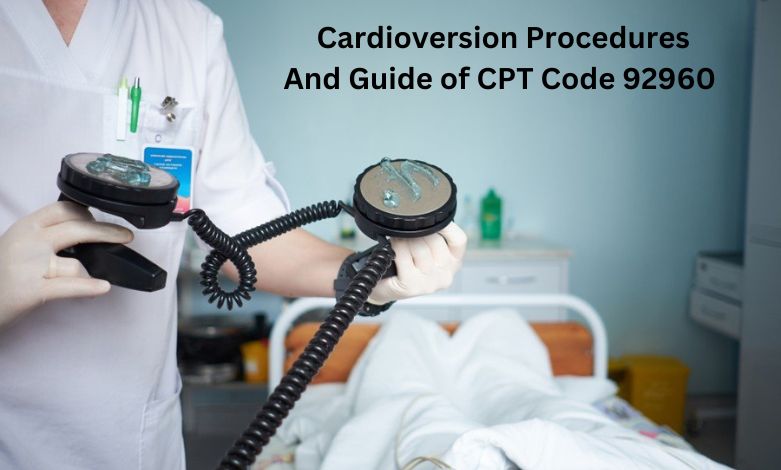
Cardioversion CPT: Cardioversion is coded as both an internal and an external procedure, as you may be aware. Whether or not the patient is anesthetized, you can tell when they need a cardioversion when they come to you with an irregular heartbeat. It might be challenging to do a cardioversion since the clinicians must appropriately code it. This is crucial because, as cardioversion is considered high-risk, inaccurate coding may result in claim rejections or even audits. Now let’s get started and see how to correctly use the cardioversion cpt code set.
What is Meant by Cardioversion CPT?
An electrical shock is used in cardioversion, a medical treatment, to treat an arrhythmia, or abnormal heartbeat. There are two primary methods for performing it: internally or externally.
- External Cardioversion CPT: The patient receives a synchronized cardioversion cpt code compliant electric shock to the heart via electrodes put on the chest. This procedure is also widely known as direct current cardioversion (DCC) or dccv cpt. If the procedure requires ultrasound guidance, providers may also look into a tee cardioversion cpt code combination.
- Internal Cardioversion CPT: To shock the heart with electricity, a medical professional puts a tiny electrode catheter into a vein in the groin. This type of cardioversion is also known as “internal direct current cardioversion (IDCC)”.
Cardioversion CPT Code Description for 92950
When looking up the 92950 cpt code description, it is important to realize that this code is specifically designated as the cpt code for cardiopulmonary resuscitation (CPR). The cpt 92950 code encompasses critical emergency protocols rather than elective rhythm corrections.
The cpt code 92950 (cpt cardioversion relative context) includes:
- External cardiac compression, maybe in combination with ventilation during CPR.
- External transthoracic defibrillation.
- Continuous monitoring of vital statistics and cardiac rhythm.
- Administration of medications and fluids during resuscitation.
If defibrillation is performed in the absence of CPR, especially in emergency departments or critical care units, it is not invoiced separately.
Here is when you’d use CPT code 92950:
- If a patient suffers a cardiac arrest, CPR is performed, and after defibrillation, the cardiac rhythm normalizes.
- When a patient experiences a cardiac arrest and CPR is initiated, but multiple attempts at defibrillation do not immediately result in a stable heart rhythm.
- A patient with an undetected cardiac arrest is found pulseless and unresponsive; their heart rhythm stabilizes after receiving emergency CPR and defibrillation before being transported.
Uses and Reimbursement Rate of Cardioversion CPT Code 92960
For elective or planned interventions, clinicians utilize cpt code 92960 for electrical cardioversion. This should always be recorded as a separate procedure. When using paddles or hands-free technology for external cardioversion cpt code submissions, there are no special codes or modifiers to follow.
It is crucial to remember that reporting cpt 92960 in the context of critical care is not permitted. Physicians should report CPT codes 99291 and 99292 instead for critical care time. It is required to explain the procedure to the patient and go over the hazards involved with the synchronized cardioversion cpt layout in order to bill for this code successfully.
The medical professional can start the elective, direct current cardioversion cpt code workflow as soon as the patient signs a consent document. For instance, a patient diagnosed with intermittent atrial fibrillation may choose to undergo an elective cardioversion to restore a normal heart rhythm. The cardiologist goes over the possible risks and advantages prior to the procedure. The patient then signs a consent form, confirming that they understand and consent to the surgery.
Reimbursement Breakdown:
- Non-Facility Setting: The national payment rate for 92960 cpt code variants is $156.56.
- Facility Setting: The reimbursement falls to $108.01.
Uses and Compensation Ratio for Cardioversion CPT Code 92961
Procedures involving intrinsic or internal cardioversion are documented using cpt 92961. When it is carried out in tandem with another operation, like an electrophysiological study or cardiac catheterization, it should not be reported separately. For example, code 92961 would not be recorded separately if a patient had an internal cardioversion done during a cardiac catheterization.
It should be noted that clinicians may bill three units provided their paperwork demonstrates the procedure’s medical necessity, even though two units for both CPT codes 92960 and 92961 might be recorded on the same day of service.
- Facility Setting Reimbursement: CPT Code 92961 in the facility setting is compensated at $242.63.
How Should a Defibrillator be Coded?
In the official CPT directory, cardiopulmonary resuscitation (cpt code for cardiac arrest management) is explicitly categorized as 92950. Interestingly, standard emergency defibrillation is covered under the general category of CPR services rather than having its own distinct, standalone CPT number.
Conclusion
Correct coding of cardioversion treatments is necessary to maintain appropriate documentation of the patient’s medical record and to provide appropriate compensation. Healthcare practitioners can ensure they are accurately classifying and billing for these operations by being aware of the various forms of cardioversion and the CPT codes that correspond with them.
If you’re having trouble keeping track of your medical billing services related to cardiology, you can take advantage of the expertise at The Medicators. Cardiology billing services are a primary area of expertise for The Medicators, an experienced medical billing firm. They can assist you in appropriately coding cardioversion operations, reducing clearinghouse rejections, and ultimately increasing your practice’s overall revenue and reimbursement rates.