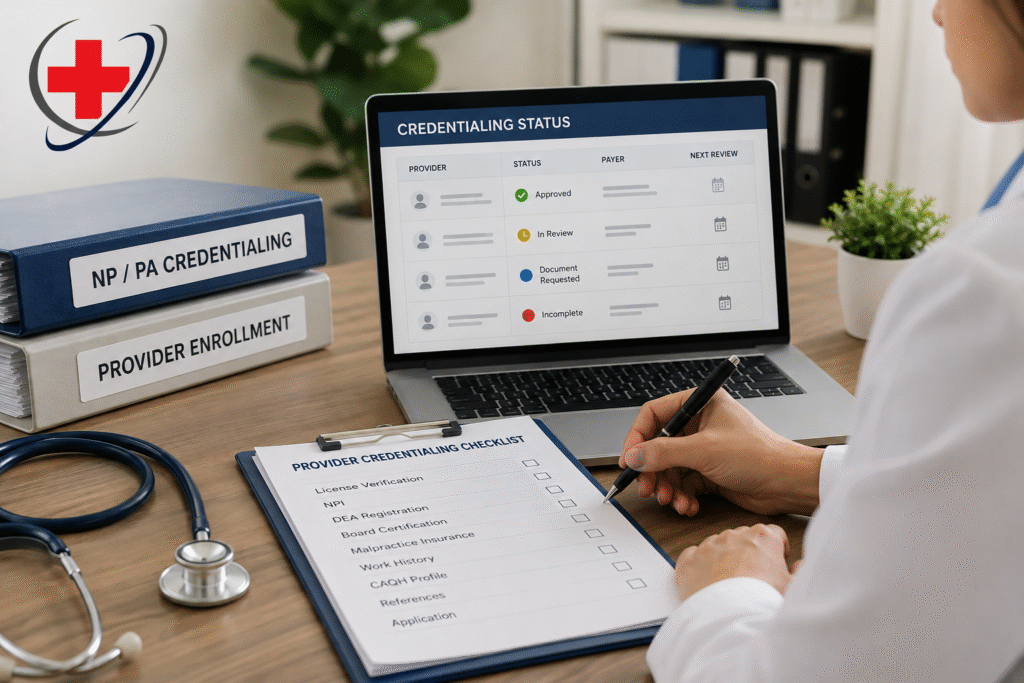
A nurse practitioner or physician assistant can be fully licensed, fully qualified, and ready to see patients on day one, and still generate zero reimbursable revenue for months. Not because of anything clinical. Because credentialing has not caught up with the calendar.
Credentialing is the gatekeeper most practices underestimate. Until a provider is credentialed with a payer, claims submitted under their name are simply not payable, no matter how accurate the coding or how appropriate the care. That gap between hire date and approval date is where practices quietly lose tens of thousands of dollars in delayed reimbursement every year.
For advanced practice providers specifically, credentialing carries a few extra layers of complexity. Scope of practice rules vary by state, supervision and collaborative practice requirements differ across specialties, and payers do not always treat NP and PA applications identically to physician applications. Understanding those distinctions upfront saves weeks of avoidable delay later.
This guide walks through exactly what credentialing means for nurse practitioners and physician assistants, the full step by step process, the documentation payers expect, and the practical decisions that determine whether an application moves quickly or stalls for months.
What Is Provider Credentialing?
Provider credentialing is the process insurance companies use to verify that a healthcare provider meets the qualifications, licensure, and professional standards required to participate in their network and receive reimbursement for services.
Insurance companies require credentialing to confirm a provider’s education, training, licensure, and professional history before allowing that provider to bill under the plan, often following verification standards similar to those set by accrediting bodies like the National Committee for Quality Assurance. It is a risk management step for payers as much as an administrative one.
A few closely related terms are often used interchangeably, though they mean different things:
- Credentialing verifies a provider’s qualifications and history
- Provider enrollment is the process of formally registering that verified provider with a specific payer to bill under their plan
- Privileging refers to hospital or facility approval to perform specific procedures, separate from payer credentialing
- Recredentialing is the periodic renewal process payers require to confirm a provider’s information remains current
Credentialing sits at the very front of revenue cycle management, because no amount of accurate coding or clean claim submission matters if the provider behind the claim was never approved to bill in the first place. It is the piece that has to work before medical billing services or any revenue cycle management strategy can actually generate revenue.
Who Needs Credentialing?
Nurse Practitioners (NPs)
Every NP specialty requires credentialing before billing insurance, though documentation and scope details vary by certification type:
- Family Nurse Practitioner (FNP), the most common NP credential, covering primary care across the lifespan
- Adult-Gerontology NP (AGNP), focused on adult and older adult populations
- Pediatric NP (PNP), credentialed specifically for pediatric care
- Psychiatric Mental Health NP (PMHNP), requiring behavioral health specific credentialing considerations
- Women’s Health NP (WHNP), credentialed for women’s health and reproductive care services
- Acute Care NP (ACNP), typically credentialed for hospital based or acute care settings
Physician Assistants (PAs)
PAs require credentialing across every practice setting and specialty, including:
- General practice
- Surgical specialties
- Cardiology
- Orthopedics
- Internal medicine
- Psychiatry
- Urgent care
- Emergency medicine
Regardless of specialty, no NP or PA can bill most insurance plans, including Medicare and Medicaid, until credentialing and enrollment are complete.
Why Credentialing Matters for NPs and PAs
- Insurance reimbursement. Claims submitted before credentialing approval are simply not payable.
- Medicare enrollment. NPs and PAs must be individually enrolled to bill Medicare directly.
- Medicaid enrollment. State Medicaid programs require separate enrollment, often with state specific requirements.
- Commercial insurance participation. Each commercial payer maintains its own credentialing and network participation process.
- Regulatory compliance. Credentialing supports compliance with payer and state specific practice requirements.
- Employment onboarding. Many practices cannot fully onboard a new provider until credentialing is underway or complete.
- Hospital privileges. Where applicable, credentialing intersects with the separate hospital privileging process.
- Practice growth. Delayed credentialing directly slows a practice’s ability to expand provider capacity and patient volume.
The Credentialing Process for NPs and PAs
- Verify professional licensure. Confirm the provider’s state license is active and in good standing.
- Obtain a National Provider Identifier (NPI). Every provider needs an active NPI before enrollment can begin.
- Complete a CAQH profile. Most payers pull directly from this centralized database.
- Gather supporting documents. Collect every document a payer will request before submission begins.
- Submit payer applications. Applications go out to each targeted insurance plan individually.
- Complete Medicare enrollment, if the provider will bill Medicare.
- Complete Medicaid enrollment, if the provider will bill Medicaid.
- Enroll with commercial insurance plans, each with its own timeline and requirements.
- Respond to payer requests for additional information or clarification quickly and completely.
- Receive approvals and confirm effective dates with each payer.
- Monitor credentialing status continuously rather than assuming silence means progress.
- Maintain a recredentialing schedule to avoid future participation lapses.
Each step depends on the one before it, which is exactly why a single missing document early in the process can delay everything downstream by weeks.
Documents Commonly Required for Credentialing
| Document | Purpose | Notes |
| State license | Confirms active licensure to practice | Must be current and unrestricted |
| National Provider Identifier (NPI) | Unique provider identification number | Required before any payer submission |
| DEA registration | Required for controlled substance prescribing | Applicable where the provider prescribes controlled substances |
| Controlled substance registration | State level prescribing authority | Required in states with separate state registration |
| Board certification | Verifies specialty credentialing | Required by most payers for specialty enrollment |
| Graduate education records | Confirms formal training | Diplomas or official transcripts |
| Curriculum Vitae (CV) | Summarizes professional history | Should be complete with no unexplained gaps |
| Malpractice insurance | Confirms active liability coverage | Coverage limits must meet payer minimums |
| Government issued identification | Confirms provider identity | Typically a driver’s license or passport |
| Work history | Establishes employment timeline | Should align exactly with CV dates |
| Employment verification | Confirms prior employment claims | May require direct employer confirmation |
| Professional references | Supports application credibility | Requested by some payers, not all |
| CAQH profile | Centralized credentialing data source | Must be attested and kept current |
| Practice information | Confirms billing location and details | Includes tax ID and practice address |
| Collaborative or supervisory documentation | Confirms scope of practice compliance | Required where state law or payer policy mandates it |
Every document on this list plays a specific role in payer verification, and missing even one is one of the most common reasons applications stall.
Medicare, Medicaid, and Commercial Insurance Credentialing
Medicare
Medicare enrollment requires providers to complete enrollment through the Centers for Medicare and Medicaid Services enrollment system, confirming eligibility to bill under their own NPI. Ongoing maintenance matters just as much as initial enrollment, since providers must keep information current and report changes promptly to avoid enrollment interruptions.
Medicaid
Medicaid credentialing requirements vary significantly by state, both in documentation expectations and renewal timelines. A provider credentialed without issue in one state’s Medicaid program may face a longer or more document intensive process in another.
Commercial Insurance
Commercial insurance credentialing involves individual applications to each payer, since there is no single centralized enrollment system across commercial plans. Network participation and credentialing timelines vary considerably depending on the payer’s internal review process and current application volume.
CAQH and Why It Matters
The Council for Affordable Quality Healthcare, commonly known as CAQH, maintains a centralized database that most major payers pull provider information from during credentialing.
Payers use CAQH because it standardizes provider data collection, reducing the need for providers to submit the same information separately to every plan. Creating a profile is the first step, followed by attestation, where the provider confirms the information is accurate and current.
Keeping the profile current matters more than most providers realize. CAQH profiles typically require attestation every ninety days, and an expired or outdated profile is one of the most common causes of credentialing delays across every payer type.
Common profile mistakes include outdated malpractice insurance information, missing work history entries, unexplained employment gaps, and failure to re-attest on schedule. Each of these can independently stall an otherwise complete application.
Credentialing Timelines
| Stage | Typical Timeframe |
| Document collection | Varies based on provider responsiveness |
| CAQH completion | Varies, faster with complete documentation upfront |
| Medicare enrollment | Varies by processing volume and application accuracy |
| Commercial payer review | Varies significantly by payer |
| Final approval | Depends on payer specific review cycles |
These timelines differ meaningfully by payer, state, specialty, and how complete the initial application was, so practices should treat any published timeframe as a general guide rather than a guarantee. Factors that influence processing speed include documentation completeness, how quickly a provider responds to payer requests, current payer application backlogs, and whether the provider’s specialty requires additional verification steps.
Common Credentialing Challenges for NPs and PAs
- Incomplete applications that trigger avoidable back and forth with payers
- Missing documentation, often the single biggest cause of delay
- Delayed CAQH updates that stall multiple payer applications at once
- License verification delays outside the practice’s direct control
- Payer communication issues, including slow or unclear responses
- State specific practice requirements that differ from what a provider expected based on prior state experience
- Employment transitions that require updating credentialing across every affected payer
- Multiple payer enrollments running simultaneously, each with its own timeline and requirements
State Scope of Practice Considerations
State laws governing NP and PA scope of practice differ considerably, and those differences directly affect credentialing requirements. Some states allow full independent practice for nurse practitioners, while others require a formal collaborative practice agreement with a supervising physician.
Supervising physician requirements, where applicable, must be documented as part of the credentialing file, and payers will verify that arrangement independently. Because these rules vary by state and can change, providers and practices should verify current state regulations directly rather than assuming a rule from a previous state of practice still applies. Organizations like the American Association of Nurse Practitioners and the American Academy of Physician Associates maintain current state by state practice authority information worth checking before assuming a specific scope of practice model applies.
Common Credentialing Mistakes
- Waiting too long to begin the application process relative to the provider’s start date
- Submitting incomplete documentation that triggers avoidable delays
- Not maintaining an updated CAQH profile
- Ignoring or delaying responses to payer requests
- Failing to track application status proactively
- Missing recredentialing renewal deadlines
- Leaving contact information outdated across payer systems
- Poor document organization that slows every subsequent application
Best Practices for Faster Credentialing
- Start the credentialing process as early as possible, ideally before the provider’s official start date
- Maintain digital records that can be quickly assembled for any payer request
- Keep CAQH updated and attested on schedule
- Track payer specific deadlines rather than relying on memory
- Respond quickly to any payer request for additional information
- Verify every document for accuracy and completeness before submission
- Maintain an internal credentialing calendar across all providers
- Conduct periodic credential reviews to catch expiring documents before they lapse
Technology That Simplifies Credentialing
- Credentialing software that centralizes document storage and application tracking
- Provider management systems that connect credentialing status to broader practice operations
- Calendar reminders for renewal and attestation deadlines
- Automated alerts for expiring licenses, certifications, and malpractice coverage
- Document management platforms that keep every credentialing file organized and accessible
- Workflow automation that reduces manual tracking across multiple simultaneous applications
- Reporting dashboards that give practice leadership visibility into credentialing status at a glance
Key Performance Indicators (KPIs)
| KPI | Why It Matters |
| Credentialing Approval Rate | Measures overall application quality |
| Average Credentialing Time | Tracks process efficiency across payers |
| Recredentialing Compliance Rate | Prevents unexpected participation lapses |
| Documentation Accuracy Rate | Reduces avoidable delays and resubmissions |
| Payer Approval Rate | Indicates the effectiveness of the overall credentialing process |
| Credentialing Related Revenue Delays | Measures the direct financial impact of enrollment gaps |
Tracking these metrics consistently helps practices catch a slowing credentialing process before it turns into a real revenue problem, the same way a medical billing audit catches revenue leakage elsewhere in the billing cycle.
When Should NPs and PAs Consider Outsourcing Credentialing?
Outsourcing becomes worth considering in several common scenarios, something we hear constantly from practices working through ongoing credentialing follow ups they simply do not have the staff bandwidth to manage:
- Joining multiple insurance networks simultaneously
- Operating a multi provider practice with several credentialing files in motion at once
- Managing multi state operations with different requirements across states
- Working with limited administrative staff who cannot dedicate consistent time to tracking applications
- Going through rapid practice expansion that adds new providers frequently
- Handling frequent payer enrollments as network participation needs grow
- Facing high administrative workload that pulls staff away from patient facing responsibilities
How Professional Credentialing Services Help NPs and PAs
A dedicated credentialing partner manages the full scope of enrollment work that most internal teams struggle to keep pace with:
- Payer enrollment across every targeted insurance plan
- Medicare enrollment assistance, including PECOS submission support
- Medicaid enrollment assistance tailored to state specific requirements
- Commercial payer credentialing across every applicable network
- CAQH profile management, including ongoing attestation
- Documentation management to keep every file complete and current
- Application tracking across every simultaneous submission
- Payer follow up to keep applications moving rather than stalling
- Recredentialing management to prevent participation lapses
- Compliance monitoring aligned with current payer and state requirements
Why Choose The Medicator’s for NP and PA Credentialing
Credentialing delays are one of the most preventable sources of lost revenue in healthcare, and yet they remain one of the most common. The Medicator’s approaches credentialing as end to end support, not simply application processing.
Every engagement includes Medicare, Medicaid, and commercial payer enrollment handled together rather than as separate disconnected processes, along with complete CAQH profile setup and ongoing maintenance so attestation deadlines never quietly lapse. Documentation review happens before submission, not after a payer flags a gap, which is one of the simplest ways to avoid the delays covered throughout this guide.
For practices managing multiple providers, multi payer coordination keeps every application organized in one place instead of scattered across spreadsheets and email threads. Recredentialing tracking and compliance support continue well past the initial approval, backed by transparent status reporting so practices always know exactly where each application stands. Every client works with a dedicated credentialing specialist, not a rotating support queue.
If your practice is comparing credentialing partners, our detailed breakdown of leading medical credentialing companies in the USA is a useful next read before making a decision. And if you are specifically evaluating credentialing support in the Chicago area, our Chicago credentialing services page outlines exactly how that process works for NPs, PAs, and physicians alike.
Conclusion
Credentialing is a foundational step that enables nurse practitioners and physician assistants to participate in insurance networks, receive reimbursement, and provide uninterrupted patient care. Skipping ahead of it, even unintentionally, almost always costs more time and revenue than doing it properly from the start.
Success depends on accurate documentation, timely submissions, proactive tracking, and a clear understanding of payer specific and state specific requirements. None of that happens automatically, and small gaps early in the process tend to compound into much larger delays later.
Practices and providers that streamline credentialing, or partner with an experienced credentialing service, consistently reduce administrative burden, accelerate approvals, and build a stronger foundation for long term operational success. If your practice is bringing on a new NP or PA and wants credentialing handled correctly from day one, contact The Medicator’s or request a free practice analysis to get the process started.
Frequently Asked Questions
What is credentialing for Nurse Practitioners?
Credentialing is the process insurance companies use to verify an NP’s licensure, education, and professional qualifications before allowing them to bill under a payer’s network.
Do Physician Assistants need credentialing?
Yes. PAs must be credentialed and enrolled with each payer before claims submitted under their NPI can be reimbursed.
How long does credentialing usually take?
Timelines vary significantly by payer, state, and specialty, and are heavily influenced by how complete the initial application is.
Is CAQH required?
Most major payers pull credentialing information from CAQH, making an accurate, attested profile essential for a smooth process.
Can NPs enroll in Medicare?
Yes. Nurse practitioners can enroll individually with Medicare to bill directly for covered services.
Can PAs bill insurance?
Yes, once fully credentialed and enrolled with the relevant payer, PAs can bill for covered services under their own NPI.
What documents are needed?
Common requirements include state license, NPI, board certification, malpractice insurance, CV, education records, and a completed CAQH profile, among other supporting documents.
How often is recredentialing required?
Recredentialing timelines vary by payer, though most require periodic renewal to confirm provider information remains current.
Can credentialing be outsourced?
Yes. Many practices, especially those managing multiple providers or expanding into new states, choose to outsource credentialing to a dedicated specialist.
Why choose The Medicator’s for credentialing services?
Because it combines end to end payer enrollment, CAQH management, documentation review, and ongoing recredentialing support under one dedicated team rather than fragmented, piecemeal service.
Does scope of practice affect credentialing?
Yes. State specific scope of practice rules, including collaborative practice requirements where applicable, directly affect what documentation a payer requires.
What happens if credentialing is delayed?
Claims submitted before approval are typically not payable, which can create significant revenue delays and administrative rework once the provider is finally credentialed.