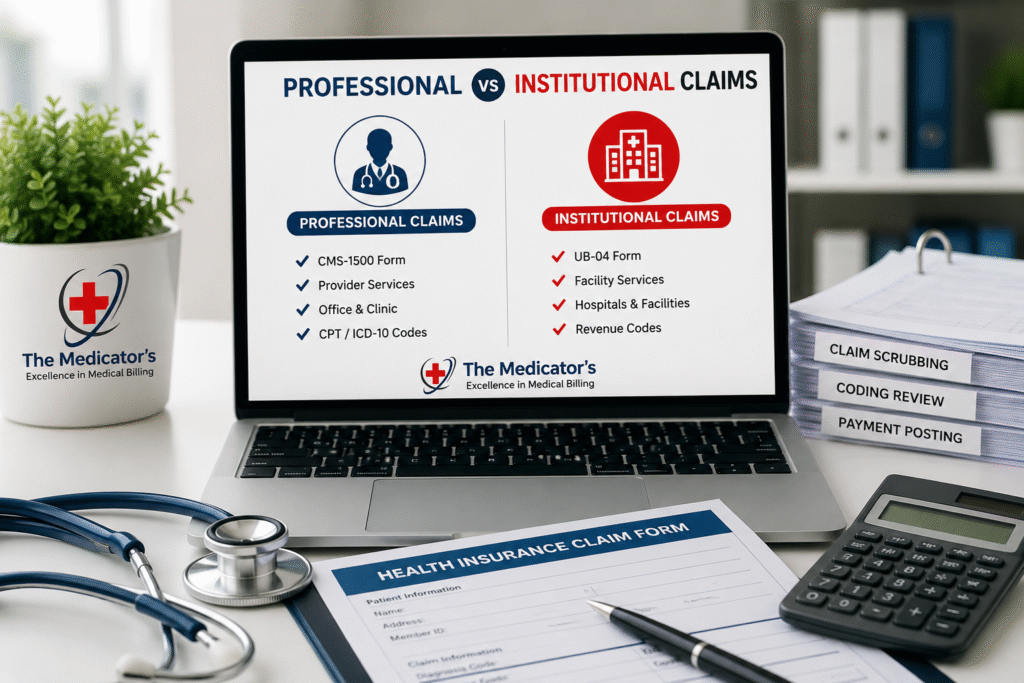
Every dollar a healthcare provider earns eventually has to pass through a claim, and which type of claim gets submitted is not a minor technical detail. It determines the form used, the coding rules that apply, and ultimately whether reimbursement arrives quickly or gets stuck in a denial queue.
Understanding medical claim types is essential because choosing the wrong one, or handling the right one incorrectly, has a direct effect on reimbursement speed and accuracy. A claim built around the wrong logic will almost always come back rejected, no matter how accurate the underlying coding is.
This distinction also shapes Revenue Cycle Management (RCM) at a structural level. Clean claim rates, denial rates, and days in Accounts Receivable all trace back to whether claims were built correctly from the start, using the right form, the right codes, and the right documentation for the setting where care was delivered.
Whether you are a billing professional, a practice administrator, or a provider trying to understand why claims sometimes bounce back, this guide breaks down exactly what separates professional claims from institutional claims, how each one moves through the revenue cycle, and what it takes to get both right consistently.
What Is a Medical Claim?
A medical claim is a formal request submitted to an insurance company asking for payment for healthcare services already provided. It is the document that actually initiates the reimbursement process, translating clinical care into billing codes, dollar amounts, and payer specific formatting that an insurance company can process.
Claims play a central role in the healthcare revenue cycle because they are the point where clinical work becomes financial outcome. Without an accurate, correctly formatted claim, even flawless patient care never converts into actual revenue for the practice or facility that delivered it.
It helps to think of a claim less like a simple invoice and more like a structured translation. A physician’s clinical notes describe what actually happened in plain language, while the claim converts that same encounter into standardized codes and fields a payer’s system can read automatically. Every payer relies on that translation being accurate and consistent, which is exactly why claim type, coding accuracy, and documentation all have to work together rather than being treated as separate problems.
The Medical Billing Workflow Before a Claim Is Submitted
Claims do not appear out of nowhere. They are the product of a long sequence of steps that happen well before submission:
- Patient registration
- Insurance eligibility verification
- Benefits verification
- Prior authorization, if required
- Medical documentation
- Medical coding
- Charge entry
- Claim creation
- Claim scrubbing
- Claim submission
- Payer adjudication
- Payment posting
- Patient billing
- Accounts Receivable (A/R) follow up
Professional and institutional claims both move through this same general workflow, but they diverge sharply at claim creation. This is the point where the setting where care was delivered, a physician’s office versus a hospital or facility, determines which claim form, which coding rules, and which documentation standards apply from that point forward.
What Are Professional Claims?
Definition
Professional claims are used to bill for services provided directly by an individual healthcare provider, rather than by a facility. They represent the provider’s own professional work, whether that is an office visit, a procedure, or a consultation, submitted using the CMS-1500 claim form.
Who Uses Professional Claims?
Professional claims are used across a wide range of provider types, including:
- Physicians
- Independent practices
- Multi-provider clinics
- Specialists
- Nurse Practitioners (NPs)
- Physician Assistants (PAs)
- Behavioral health providers
- Physical therapists
- Occupational therapists
- Speech therapists
Services Commonly Billed Using Professional Claims
- Office visits
- Evaluation and Management (E/M) services
- Consultations
- Preventive care
- Telehealth
- Diagnostic testing
- Minor procedures
- Follow up visits
- Vaccinations
CMS-1500 Claim Form Explained
The CMS-1500 form is the standard paper and electronic format used to submit professional claims, maintained by the National Uniform Claim Committee. Its structure captures patient demographics, insurance information, diagnosis codes, procedure codes, and provider details in a standardized layout that every payer can process consistently.
Required fields include the patient’s insurance and demographic information, the provider’s National Provider Identifier (NPI), diagnosis codes linked clearly to each billed service, procedure codes representing the actual work performed, any necessary modifiers, and the Place of Service (POS) where care was delivered. Getting the POS code right matters more than many billers realize, since it directly affects how much a claim actually reimburses.
What Are Institutional Claims?
Definition
Institutional claims are used to bill for services provided by a facility rather than an individual provider. These claims capture the facility side of care, covering things like room and board, equipment use, ancillary services, and the operational cost of delivering care in a facility setting, submitted using the UB-04 form.
Who Uses Institutional Claims?
Institutional claims are used by a wide range of facility based organizations, including:
- Hospitals
- Hospital Outpatient Departments (HOPDs)
- Ambulatory Surgery Centers (ASCs)
- Skilled Nursing Facilities (SNFs)
- Rehabilitation facilities
- Home health agencies
- Hospice organizations
- Rural Health Clinics (RHCs)
- Federally Qualified Health Centers (FQHCs)
Services Commonly Billed Using Institutional Claims
- Inpatient admissions
- Outpatient hospital care
- Emergency department visits
- Surgical services
- Observation services
- Laboratory services
- Imaging services
- Rehabilitation therapy
- Home healthcare
- Hospice care
UB-04 (CMS-1450) Claim Form Explained
The UB-04, also called CMS-1450, is the standard claim form used for institutional billing, maintained by the National Uniform Billing Committee. It is considerably more complex than the CMS-1500, reflecting the broader scope of what a facility claim needs to capture.
Required fields include revenue codes, which identify the specific department or service category being billed, bill type codes, which describe the type and frequency of the claim, condition codes, occurrence codes, value codes, and facility identifiers. Each of these fields exists because institutional billing needs to represent far more operational detail than a single provider’s professional service.
Professional Claims vs. Institutional Claims: Side-by-Side Comparison
| Feature | Professional Claims | Institutional Claims |
|---|---|---|
| Claim Form | CMS-1500 | UB-04 (CMS-1450) |
| Submitted By | Individual providers | Facilities and organizations |
| Services Covered | Professional services and provider work | Facility services, room, equipment, ancillary care |
| Healthcare Setting | Physician offices, clinics | Hospitals, ASCs, SNFs, home health, hospice |
| Primary Coding Systems | CPT, HCPCS Level II, ICD-10-CM | Revenue codes, HCPCS Level II, ICD-10-CM |
| Revenue Codes | Not used | Required |
| Place of Service Codes | Required | Not typically used in the same way |
| Reimbursement Method | Fee schedule based, professional fee | Facility fee, often DRG or APC based |
| Typical Payers | Medicare, Medicaid, commercial insurance | Medicare, Medicaid, commercial insurance |
| Documentation | Physician notes, E/M documentation | Admission records, nursing notes, operative reports |
Professional claims are built around what an individual provider did clinically, while institutional claims are built around the operational cost of the setting where care happened. This distinction shapes almost everything downstream, from the coding systems used to how reimbursement is actually calculated.
Key Coding Differences
Professional and institutional claims lean on overlapping but distinct coding systems.
- CPT Codes describe the specific procedures and services performed, used heavily on professional claims.
- HCPCS Level II Codes cover supplies, equipment, and drugs, and appear on both claim types depending on what was provided.
- ICD-10-CM Diagnosis Codes justify medical necessity on both claim types, linking the diagnosis to the service billed.
- Revenue Codes are unique to institutional claims, identifying which hospital department or service category generated the charge.
- Bill Type Codes are also unique to institutional claims, describing the type and sequence of the facility bill.
- Place of Service (POS) Codes are central to professional claims, telling the payer exactly where the service was rendered.
- Modifiers appear on both claim types but are applied differently depending on whether the context is a professional service or a facility charge.
- Diagnosis-to-Procedure Linking must be logically consistent on both claim types, since a mismatch is one of the most common denial triggers regardless of claim form.
Documentation Requirements
Professional Claims
Professional claims depend heavily on:
- Physician documentation
- Progress notes
- E/M documentation supporting the level of service billed
- Procedure notes
- Clear evidence of medical necessity
- Provider signatures
Institutional Claims
Institutional claims require a broader set of facility level documentation, including:
- Admission records
- Nursing documentation
- Operative reports
- Discharge summaries
- Ancillary service documentation
- Facility records
Reimbursement Differences
Physician reimbursement under professional claims is typically based on a fee schedule tied to the specific CPT code billed. Facility reimbursement under institutional claims often works differently, frequently based on Diagnosis Related Groups (DRGs) for inpatient care or Ambulatory Payment Classifications (APCs) for outpatient hospital services, depending on the payer and setting.
Medicare payment methodologies differ meaningfully between the two claim types, and commercial insurance payment methods vary further still by payer contract. This is also where the distinction between professional fees and facility fees becomes financially significant, since the same overall episode of care can generate two separate claims representing two very different components of cost.
A useful way to think about this split is to picture a single outpatient surgical visit. The surgeon’s own work, the skill, time, and clinical decision making involved in performing the procedure, gets billed as a professional claim reflecting the professional fee. The facility where the surgery took place, covering the operating room, equipment, supplies, and recovery space, gets billed separately as an institutional claim reflecting the facility fee. Both claims describe the same encounter, but they represent entirely different cost centers, are reimbursed under different methodologies, and are frequently paid by the same payer on completely different timelines. Understanding this split is often the missing piece for providers who are confused about why two bills arrive for what felt like a single visit.
How Claims Move Through the Revenue Cycle
Both claim types follow a similar sequence once created: claim creation, claim scrubbing, clearinghouse submission, payer adjudication, payment posting, denial management, and appeals when necessary.
Where they differ is in the detail of each stage. Institutional claims typically require more extensive claim scrubbing given the sheer number of required fields, and payer adjudication for institutional claims often takes longer due to the complexity of facility based reimbursement calculations. Denial management and appeals also look different, since a denied institutional claim frequently involves multiple departments and a much larger dollar amount than a typical professional claim.
Common Reasons Claims Are Denied
- Incorrect claim type: Submitting a professional claim for a service that should have been billed institutionally, or vice versa.
- Missing documentation: Notes that do not support the level or type of service billed.
- Coding errors: Incorrect CPT, HCPCS, or ICD-10-CM codes.
- Invalid diagnosis linkage: A diagnosis code that does not logically support the billed procedure.
- Incorrect modifiers: Missing or misapplied modifiers on either claim type.
- Missing revenue codes: A common institutional claim error that immediately triggers rejection.
- Insurance eligibility issues: Coverage that had lapsed or changed before the date of service.
- Duplicate claims: The same service billed more than once.
- Medical necessity not supported: Documentation that does not clearly justify the service.
- Filing deadline missed: Claims submitted after a payer’s timely filing window has closed.
Prevention comes down to the same core discipline regardless of claim type: verify eligibility early, code accurately, document thoroughly, and scrub every claim before submission rather than relying on the payer to catch mistakes after the fact.
Common Billing Mistakes
- Using the wrong claim form for the setting where care was delivered
- Incorrect Place of Service coding, which is more consequential than it looks
- Revenue code errors on institutional claims
- Modifier misuse on either claim type
- Duplicate billing
- Charge capture mistakes that miss or duplicate billable services
- Missing provider information
- Incorrect payer information
- Incomplete patient demographics
How Claim Type Affects Revenue Cycle Management (RCM)
Claim type has a measurable effect on nearly every core RCM metric. Clean claim rate and first pass acceptance depend heavily on whether the correct form and coding logic were used from the start. Denial rate climbs quickly when claim type or coding rules are mismatched to the setting of care. Days in Accounts Receivable stretch out further for institutional claims given their added complexity, which directly affects payment turnaround, cash flow, and overall administrative efficiency across the billing team.
Medicare vs. Commercial Insurance Considerations
Medicare applies distinct requirements to professional and institutional claims, with different edits and payment methodologies published by CMS for each. Medicaid requirements vary further by state, adding another layer of complexity for practices operating across multiple states.
Commercial payers introduce their own differences on top of this baseline, including payer specific prior authorization rules, coverage limitations, and claim edits that do not always mirror Medicare’s approach. Staying current with these differences is an ongoing task rather than a one time setup.
Technology That Simplifies Claim Processing
- Electronic Health Records (EHR) that supply the clinical documentation both claim types depend on, maintained in line with HIPAA privacy and security standards
- Practice Management Software used primarily for professional claim workflows
- Hospital Information Systems (HIS) used for institutional claim workflows
- Medical Billing Software that manages charge entry and claim creation
- Clearinghouses that route claims to the correct payer in the correct format
- Claim Scrubbing Software that catches formatting and coding errors before submission
- Revenue Cycle Management Platforms that connect every stage of the process
- AI Assisted Billing Tools that increasingly help flag errors and predict denial risk before a claim is ever sent
Best Practices for Accurate Claim Submission
- Verify insurance eligibility before every visit or admission
- Confirm benefits thoroughly, not just active coverage
- Select the correct claim type for the setting where care was delivered
- Ensure coding accuracy across CPT, HCPCS, and ICD-10-CM
- Validate documentation before charge entry
- Scrub claims before submission, every time, without exception
- Monitor payer updates regularly
- Perform internal audits on a consistent schedule
- Train billing staff regularly on both claim types, ideally with AAPC certified coding expertise on the team
Key Performance Indicators (KPIs) to Track
| KPI | Why It Matters |
|---|---|
| Clean Claim Rate | Measures how accurate claims are at first submission |
| First-Pass Claim Acceptance Rate | Reflects overall claim quality across both claim types |
| Claim Denial Rate | Identifies systemic billing issues |
| Days in Accounts Receivable (A/R) | Tracks how quickly claims convert to payment |
| Net Collection Rate | Measures how much earned revenue is actually captured |
| Coding Error Rate | Reflects the quality of documentation and coding processes |
Improving first pass claim acceptance is one of the clearest ways to see whether a practice or facility is handling claim type and coding correctly, since it directly reflects whether claims are built right the first time.
How Professional Medical Billing Services Improve Claim Accuracy
Professional medical billing services bring structured expertise to both claim types, including:
- Thorough insurance verification before a claim is ever created
- Detailed benefits verification tied to the correct claim type
- Accurate coding across CPT, HCPCS, and ICD-10-CM
- CMS-1500 claim preparation for professional services
- UB-04 claim preparation for institutional services
- Systematic claim scrubbing before submission
- Clearinghouse management to keep submissions moving smoothly
- Proactive denial prevention and resolution
- Structured appeals management when denials do occur
- Accurate payment posting
- Ongoing Revenue Cycle Management optimization across both claim types
Signs Your Practice Needs Billing Support
- Frequent claim denials tied to claim type or coding errors
- Incorrect claim submissions using the wrong form
- Rising A/R balances
- Delayed reimbursements compared to prior periods
- Coding inconsistencies across providers or departments
- Staff overwhelmed with billing tasks
- Compliance concerns around documentation or coding
- Declining collections despite steady patient or facility volume
Why Choose The Medicator’s for Medical Billing Services
Navigating both professional and institutional billing requires real expertise across two very different claim structures. The Medicator’s brings:
- Deep expertise across both professional and institutional billing workflows
- Certified billing and coding specialists trained on current CPT, HCPCS, and ICD-10-CM standards
- Hands on CMS-1500 and UB-04 claim expertise
- Specialty specific billing support across a wide range of practice types
- Rigorous claim scrubbing and quality assurance before every submission
- Proactive denial management built to prevent repeat issues
- Ongoing compliance monitoring as payer rules evolve
- Deep Revenue Cycle Management expertise across both claim types
- Transparent, consistent reporting
- Dedicated client support rather than a rotating queue
Conclusion
Professional and institutional claims are the backbone of healthcare reimbursement, but each follows its own rules, forms, coding requirements, and workflows. Getting either one wrong, or confusing which one applies, is one of the fastest ways to end up with a denied claim.
Understanding these differences helps practices and facilities reduce denials, improve reimbursement accuracy, maintain compliance, and strengthen overall revenue cycle performance.
Partnering with an experienced medical billing company ensures claims are submitted accurately, efficiently, and in accordance with payer requirements, regardless of which claim type applies. If your practice or facility is dealing with rising denials or slow reimbursements tied to claim submission errors, request a free practice analysis from The Medicator’s or contact our billing team directly to see exactly where your claims are breaking down.
Frequently Asked Questions
What is a professional claim?
A professional claim bills for services provided by an individual healthcare provider, submitted using the CMS-1500 form.
What is an institutional claim?
An institutional claim bills for services provided by a facility, such as a hospital or surgery center, submitted using the UB-04 (CMS-1450) form.
What is the difference between CMS-1500 and UB-04?
CMS-1500 is used for professional claims and captures provider level services, while UB-04 is used for institutional claims and captures facility level charges, including revenue codes and bill type codes not found on the CMS-1500.
Who submits professional claims?
Physicians, independent practices, specialists, nurse practitioners, physician assistants, and allied health providers such as physical and occupational therapists submit professional claims.
Who submits institutional claims?
Hospitals, outpatient departments, surgery centers, skilled nursing facilities, home health agencies, and hospice organizations submit institutional claims.
Can one organization submit both claim types?
Yes. A hospital system that employs physicians, for example, may submit institutional claims for facility services and professional claims for the physician’s own work on the same patient encounter.
What coding systems are used for institutional claims?
Institutional claims rely on revenue codes, bill type codes, HCPCS Level II codes, and ICD-10-CM diagnosis codes.
What are revenue codes?
Revenue codes are four digit codes used on institutional claims to identify the specific department or category of service being billed, such as pharmacy, laboratory, or operating room.
What are Place of Service (POS) codes?
POS codes indicate where a service was rendered, such as an office or an outpatient hospital setting, and they directly affect professional claim reimbursement.
Why are institutional claims more complex?
Institutional claims capture significantly more operational detail than professional claims, including revenue codes, condition codes, occurrence codes, and value codes tied to facility level billing.
How do claim types affect reimbursement?
Professional claims are typically reimbursed through a fee schedule tied to the specific service, while institutional claims are often reimbursed through DRG or APC based methodologies reflecting the broader cost of facility care.
What causes claim denials?
Common causes include incorrect claim type, coding errors, missing documentation, invalid diagnosis linkage, eligibility issues, and missed filing deadlines.
How can practices improve claim accuracy?
Practices can improve accuracy by verifying eligibility upfront, coding precisely, validating documentation, scrubbing claims before submission, and auditing processes regularly.
Why outsource medical billing services?
Outsourcing gives practices access to specialists experienced in both professional and institutional billing, reducing denials, improving first pass acceptance, and freeing internal staff to focus on patient care.