A patient needs an MRI. The physician orders it. Everything about the clinical decision is correct. And yet, without the right authorization in place first, that claim can come back denied, leaving the practice unpaid and the patient stuck with a bill nobody expected.
Authorization is one of those parts of medical billing that stays invisible when it works and becomes a crisis the moment it doesn’t. It sits at the exact intersection of patient care, reimbursement, and compliance, which is exactly why getting it wrong is so costly.
Missing or incorrect authorizations lead to denied claims, delayed treatment, frustrated patients, and real financial risk for the practice. A single missed authorization on a high cost imaging study or surgical procedure can represent thousands of dollars in unreimbursed care.
Providers and billing teams who understand exactly what authorization requires, how it differs from other verification steps, and where it fits into the broader revenue cycle are far better equipped to avoid these losses. This guide covers every authorization type, the complete process from scheduling to payment, documentation standards, payer specific rules, common mistakes, and how professional billing support closes the gaps that cost practices the most.
What Is Authorization in Medical Billing?
Definition
Authorization in healthcare is the formal approval an insurance payer grants before certain services are performed, confirming that the payer considers the planned service medically necessary and covered under the patient’s plan.
Insurance companies require authorization primarily to manage cost and confirm medical necessity before expensive or elective services are delivered. It gives the payer a chance to review the clinical justification in advance, rather than after the service has already been rendered and billed.
It’s important to understand that authorization is not the same as a payment guarantee. An approved authorization confirms that, based on the information submitted, the service appears medically necessary and likely to be covered. It does not guarantee that the claim will ultimately be paid in full, since factors like eligibility changes, coding accuracy, and other claim details still apply at the time of billing.
Within the revenue cycle, authorization sits early, typically right after scheduling and eligibility verification, and directly before the service is delivered. Getting it right at this stage prevents problems that would otherwise surface much later, at the point of claim denial.
Why Is Authorization Important?
Authorization plays a protective role for both the patient and the practice. Done correctly, it:
- Prevents claim denials tied to missing or invalid approval
- Ensures medical necessity is reviewed and documented before the service occurs
- Improves reimbursement by reducing the chance of a payment dispute after the fact
- Reduces financial risk for both the practice and the patient
- Supports compliance with payer and regulatory requirements
- Improves patient satisfaction by avoiding surprise denials and unexpected bills
- Protects provider revenue that would otherwise be lost to an authorization related denial
Authorization vs Insurance Verification vs Benefits Verification
These three terms are often used loosely, but each serves a distinct purpose in the billing process.
| Process | Purpose | When It Happens | Does It Guarantee Payment? |
|---|---|---|---|
| Insurance Eligibility Verification | Confirms the patient’s coverage is active | Before scheduling or at intake | No |
| Benefits Verification | Confirms what the plan covers, including copay, deductible, and coinsurance | After eligibility is confirmed, before the visit | No |
| Authorization | Confirms the payer approves the specific service as medically necessary | Before the service is delivered, once it’s determined to be required | No, but it significantly reduces denial risk |
Eligibility verification simply confirms a policy is active. Benefits verification goes a step further, outlining what the plan actually pays for and what the patient owes. Authorization is the most specific of the three, tied to an individual service or procedure rather than the plan as a whole. None of the three guarantees payment outright, but skipping any of them significantly raises the odds of a denial. Our insurance eligibility verification guide covers the first step of this sequence in more depth.
Types of Authorization in Medical Billing
Prior Authorization (Preauthorization)
Prior authorization is the most common type, required before a specific service, procedure, or medication is provided. Its purpose is to confirm medical necessity and coverage in advance, giving the payer an opportunity to review the clinical justification before any cost is incurred.
Services that commonly require prior authorization include advanced imaging, many surgical procedures, specialty medications, and durable medical equipment. Payer requirements vary considerably, including which specific codes trigger the requirement and how much clinical documentation must accompany the request.
Pre-Certification
Pre-certification is closely related to prior authorization and the terms are sometimes used interchangeably, though some payers draw a distinction. In practice, pre-certification often refers specifically to the approval required before a hospital admission or inpatient stay, confirming that the admission itself is medically necessary, separate from any individual procedure performed during that stay.
Insurers that use this term typically apply it to inpatient and facility level reviews, while reserving prior authorization language for individual outpatient services or procedures.
Referral Authorization
Referral authorization applies primarily within managed care plans that require a Primary Care Physician to formally refer a patient to a specialist before that specialist visit is covered. This is distinct from a payer level medical necessity review and instead reflects the plan’s structure for coordinating care through a PCP gatekeeper model.
Proper referral documentation, including which specialist the patient was referred to and for what specific reason, needs to be on file to support the resulting specialist claim.
Concurrent Authorization
Concurrent authorization applies to ongoing inpatient care, where the payer reviews and reauthorizes continued treatment at intervals throughout an extended hospital stay. As a patient’s inpatient stay continues beyond the initially authorized period, the facility must submit updated clinical information to justify continued approval.
This type of authorization is less about a single service and more about an ongoing course of treatment that requires periodic payer review.
Retroactive Authorization
Retroactive authorization is requested after a service has already been performed, typically reserved for emergency situations where obtaining prior approval simply wasn’t possible before treatment.
Payer specific rules around retroactive authorization vary significantly, and some payers apply strict timeframes or additional documentation requirements. This type of authorization carries more risk than prospective approval, since the payer is reviewing the medical necessity of a decision already made rather than one still being planned.
Services That Commonly Require Authorization
Authorization requirements vary by payer and plan, but certain categories consistently require prior approval across most insurers:
- Advanced imaging, including MRI, CT, and PET scans
- Surgical procedures, both inpatient and outpatient
- Hospital admissions
- Outpatient surgeries performed in ambulatory surgery centers
- Specialty medications
- Biologics
- Infusion therapy
- Durable Medical Equipment (DME)
- Home healthcare services
- Rehabilitation services
- Behavioral health treatment
- High cost diagnostic tests
Because this list evolves as payers adjust their own policies, verifying current requirements for each specific payer before scheduling is far more reliable than relying on last year’s assumptions.
The Complete Authorization Process
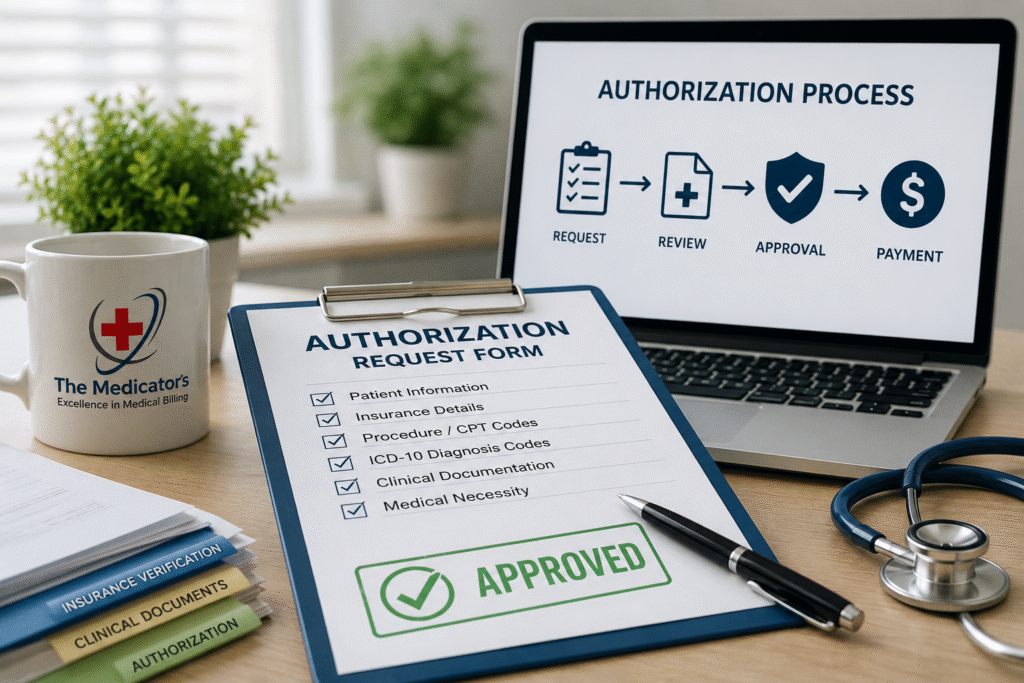
Authorization isn’t a single step. It’s a full workflow that touches nearly every part of the front end revenue cycle.
- Patient scheduling, where the need for a service is first identified
- Insurance eligibility verification, confirming active coverage
- Benefits verification, confirming what the plan actually covers
- Determine authorization requirement, checking whether this specific service needs payer approval
- Collect clinical documentation, gathering the records that support medical necessity
- Select appropriate CPT/HCPCS codes, matching the exact service to be performed
- Assign ICD-10-CM diagnosis codes, supporting the clinical justification
- Submit authorization request, through the payer’s required channel
- Payer review, where the insurer evaluates medical necessity and coverage
- Approval, denial, or request for more information, the payer’s formal response
- Notify patient and provider, communicating the outcome clearly
- Deliver services, once approval is confirmed
- Submit medical claim, referencing the authorization on file
- Payment processing, where the claim is adjudicated and reimbursed
Each step depends on the one before it. A gap anywhere in this sequence, whether it’s incomplete documentation at step five or a coding mismatch at step seven, can stall the entire process or result in a denial further down the line.
Information Required for Authorization Requests
A complete authorization request typically requires patient demographics, insurance details, provider information including the National Provider Identifier (NPI), the specific CPT codes for the planned procedure, relevant HCPCS codes, ICD-10-CM diagnosis codes supporting the request, clinical documentation, a clear statement of medical necessity, and any supporting records the payer requires.
Missing even one of these elements is a common reason authorization requests stall or get sent back with a request for additional information, which adds delay exactly when speed matters most.
Documentation Requirements
Strong supporting documentation is what allows a payer to approve a request quickly rather than kicking it back for clarification. That typically includes:
- Physician order specifying the requested service
- Progress notes reflecting the clinical course leading to this request
- Clinical history relevant to the condition being treated
- Diagnostic test results supporting the need for the service
- Previous treatments already attempted
- Conservative treatment attempts, where applicable, demonstrating step therapy has been followed
- Medical necessity documentation clearly connecting the diagnosis to the requested service
- Provider signatures authenticating the clinical record
Medical Necessity and Authorization
Medical necessity is the clinical justification that a requested service is appropriate, reasonable, and required for the patient’s diagnosed condition. Insurers review this closely because it’s the foundation of their coverage decision, not a formality.
How thoroughly medical necessity is documented directly affects whether a request is approved on first submission or delayed while the payer requests more information. Strong documentation connects the specific diagnosis to the specific requested service in clear clinical language, supported by relevant history, prior treatment attempts, and diagnostic findings.
Common Reasons Authorization Requests Are Denied
Understanding why requests get denied is the first step toward preventing it. The most frequent causes include:
- Incomplete documentation that doesn’t fully support the request
- Incorrect CPT coding that doesn’t match the service actually being requested
- Incorrect ICD-10 diagnosis coding that doesn’t align with the requested service
- Missing medical necessity justification
- Policy exclusions where the specific service simply isn’t covered under the plan
- Non-covered services that require a different approach entirely, such as an appeal or patient financial responsibility discussion
- Expired authorization, where approval was obtained but the service wasn’t delivered within the payer’s required window
- Incorrect provider information, including an invalid or mismatched NPI
- Duplicate requests submitted in error, which can confuse payer processing
- Failure to follow payer guidelines, including submission through the wrong channel or format
Preventing these issues starts with a standardized internal checklist applied before every request is submitted, rather than relying on individual staff members to remember payer specific quirks from memory.
Common Authorization Challenges
Even well run practices run into structural challenges in this area, including different requirements across payers, heavy reliance on manual paperwork, long approval turnaround times, staff shortages that stretch billing teams thin, documentation gaps, coding errors, communication delays between clinical and billing staff, and frequent payer policy updates that are easy to miss without dedicated monitoring.
Authorization and Medical Coding
Coding accuracy has a direct, immediate impact on authorization outcomes. CPT coding needs to precisely match the service being requested, HCPCS coding needs to reflect the correct product or supply where applicable, ICD-10-CM diagnosis coding needs to clearly support medical necessity, and modifier usage needs to reflect exactly how the service will be performed.
A mismatch between the coded request and the clinical documentation is one of the fastest ways to trigger a denial or a request for additional information, even when the underlying clinical decision was entirely appropriate. Our guide to CPT codes explained covers the fundamentals of accurate code selection that authorization requests depend on, and our broader resource on how to reduce medical claim denials covers the downstream impact of these coding mismatches on claims overall.
Authorization and Medical Billing
Authorization directly shapes downstream billing outcomes. Claims tied to a valid, current authorization are far more likely to process as clean claims, while claims missing proper authorization frequently result in denials or rejections that require significant rework.
This connects directly to broader revenue cycle performance, affecting accounts receivable aging, payment timing, and overall cash flow. A practice with weak authorization processes upstream will almost always see that weakness show up downstream as slower payments and higher denial rates.
Medicare, Medicaid, and Commercial Insurance Authorization Requirements
Medicare
Traditional Medicare has historically required prior authorization for a more limited set of services compared to commercial payers, though Medicare Advantage plans, which are administered by private insurers under CMS oversight, often apply broader authorization requirements similar to commercial plans.
Medicaid
Medicaid authorization requirements vary significantly by state, since each state Medicaid program sets its own specific rules within federal guidelines. Providers working across multiple states need to track state specific requirements rather than assuming a single national standard applies. The Medicaid.gov prior authorization overview provides a useful starting point for understanding the federal framework these state programs build on.
Commercial Insurance
Commercial payers generally maintain the most extensive and frequently updated authorization requirements, often covering a wider range of services than either Medicare or Medicaid. These policies can change with little advance notice, which makes ongoing monitoring essential for practices billing across multiple commercial payers, an issue the American Medical Association’s prior authorization reform initiative has tracked closely across the industry.
Technology That Improves Authorization Management
Authorization is undergoing a significant technology driven shift, largely driven by federal policy. Under the CMS Interoperability and Prior Authorization final rule, many Medicare Advantage organizations, state Medicaid and CHIP programs, and Qualified Health Plan issuers were required to implement standardized Prior Authorization APIs, with certain operational requirements taking effect January 1, 2026, and full API capabilities required by January 1, 2027. You can review the complete requirements in the CMS Interoperability and Prior Authorization final rule fact sheet.
CMS has also proposed extending similar electronic prior authorization requirements to prescription drugs, with a proposed rule released in April 2026 that would apply shorter decision timelines and greater transparency to drug related authorization requests. Details are available through the 2026 CMS Interoperability Standards and Prior Authorization for Drugs proposed rule fact sheet.
Practical technology tools that support this shift include Electronic Prior Authorization (ePA) platforms, Electronic Health Records with built in authorization tracking, practice management software, Revenue Cycle Management platforms, insurance verification software, AI assisted documentation tools, and broader workflow automation that reduces manual data entry across the entire process.
Best Practices for Faster Authorization Approval
Practices that consistently see faster turnaround share a similar set of habits: verify eligibility early in the scheduling process, review current payer policies rather than relying on outdated assumptions, use accurate coding from the start, submit complete documentation the first time, track authorization status proactively rather than waiting to be contacted, communicate clearly with patients throughout the process, train staff regularly on evolving payer requirements, conduct internal audits of the authorization workflow, and monitor authorization specific KPIs on an ongoing basis.
Key Performance Indicators (KPIs) to Monitor
Measuring authorization performance directly is the only way to know whether your process is actually working.
| KPI | Why It Matters |
|---|---|
| Authorization Approval Rate | Measures the quality of submitted requests |
| Authorization Denial Rate | Identifies underlying workflow issues |
| Average Approval Time | Reflects operational efficiency |
| Clean Claim Rate | Measures overall billing quality |
| First-Pass Claim Acceptance Rate | Indicates successful reimbursement on first submission |
| Claim Denial Rate | Protects overall revenue |
| Days in Accounts Receivable (A/R) | Measures payment speed |
Tracking authorization specific metrics alongside broader billing KPIs helps isolate whether a revenue problem originates at the authorization stage or further downstream in claims processing.
Common Mistakes to Avoid
Some of the most frequent and preventable authorization mistakes include waiting until the day of service to check requirements, relying on outdated payer requirements instead of confirming current policy, incorrect CPT codes, incorrect ICD-10 diagnosis codes, missing documentation, failing to monitor authorization expiration dates before the service is delivered, poor communication with patients about delays or requirements, and failing to appeal a denial that had a reasonable chance of being overturned.
How Professional Medical Billing Services Simplify Authorization
This is an area where dedicated expertise consistently outperforms an internal team stretched across every part of the revenue cycle. A professional billing partner brings structured insurance eligibility verification, thorough benefits verification, dedicated authorization management, documentation review before submission, coding validation to prevent CPT and ICD-10 mismatches, direct payer communication, proactive status tracking, denial prevention built into the workflow, appeals assistance when a request is denied, and full Revenue Cycle Management optimization tying authorization performance to overall practice revenue.
If authorization delays are affecting your patient scheduling or cash flow, our medical billing services are built to handle this exact workflow end to end.
Signs Your Practice Needs Authorization Support
A few clear indicators suggest your current process needs reinforcement:
- Frequent authorization denials across multiple payers
- Increasing overall claim denials tied to missing or expired authorizations
- Delayed treatments waiting on approval
- Rising accounts receivable connected to authorization related holdups
- Staff overwhelmed by the volume of requests and follow-up required
- Lost revenue from services delivered without proper authorization
- Patient complaints about delays or confusion
- Slow reimbursement compared to historical norms
If several of these sound familiar, a full medical billing audit is one of the fastest ways to identify exactly where your authorization process is breaking down.
Why Choose The Medicators for Authorization and Medical Billing Support
Authorization touches nearly every part of the revenue cycle, which is exactly why it benefits from a team that treats it as a specialty rather than an afterthought.
The Medicators brings experienced authorization specialists who understand payer specific requirements across Medicare, Medicaid, and commercial insurance, backed by direct insurance verification expertise at every stage of the process. Our team applies accurate CPT, HCPCS, and ICD-10 coding to every request, supported by thorough documentation review before submission.
We manage electronic authorization submission and tracking directly, maintain proactive payer communication throughout the review process, and focus on denial prevention rather than reacting to denials after they happen. When a request is denied, our appeals management works to overturn it wherever the clinical case supports doing so. All of this is backed by ongoing compliance monitoring and complete, end to end Revenue Cycle Management.
If authorization delays or denials are affecting your practice’s cash flow or patient scheduling, contact The Medicators for a review of your current authorization workflow.
Conclusion
Authorization is a critical step that connects patient care directly with successful reimbursement, and it deserves far more attention than it typically receives until something goes wrong.
Understanding the different authorization types, payer specific requirements, documentation standards, and coding accuracy this process depends on helps practices reduce denials, strengthen compliance, and streamline the entire revenue cycle. This applies just as much to how you collect from patients after a service as it does to getting the service approved in the first place.
Partnering with an experienced medical billing company can simplify authorization management, reduce the administrative burden on your clinical and front office staff, and meaningfully improve your practice’s financial performance. If authorization gaps are costing your practice revenue and patient trust, reach out to The Medicators today and let our team fix the gaps for good.
Frequently Asked Questions
What is authorization in medical billing?
Authorization is the formal approval an insurance payer grants before certain services are performed, confirming the service is considered medically necessary and covered under the patient’s plan.
What is the difference between prior authorization and pre-certification?
The two terms are closely related and sometimes used interchangeably, though pre-certification often refers specifically to approval for a hospital admission or inpatient stay, while prior authorization typically applies to individual outpatient procedures or services.
Does authorization guarantee payment?
No. Authorization confirms the service appears medically necessary and covered based on the information submitted, but the final claim is still subject to eligibility status, accurate coding, and other billing requirements at the time of service.
Which services require authorization?
Common examples include advanced imaging, many surgical procedures, specialty medications, durable medical equipment, home healthcare, and behavioral health treatment, though specific requirements vary by payer.
Who is responsible for obtaining authorization?
Typically the ordering provider’s office or a dedicated billing team is responsible for confirming requirements and submitting the request, though the process should be coordinated closely with patient scheduling.
How long does authorization take?
Turnaround varies by payer and service type, ranging from same day decisions for straightforward requests to a week or more for complex procedures requiring additional clinical review.
What happens if authorization is not obtained?
Services performed without required authorization are frequently denied entirely, leaving the practice unpaid and, depending on payer policy, potentially leaving the patient responsible for the full cost.
What information is required for authorization?
A complete request typically includes patient demographics, insurance information, provider details including the NPI, CPT and HCPCS codes, ICD-10-CM diagnosis codes, and supporting clinical documentation demonstrating medical necessity.
How do medical billing companies manage authorization requests?
Professional billing companies typically handle eligibility and benefits verification, submit and track authorization requests, validate coding accuracy, communicate directly with payers, and manage appeals for denied requests as part of a broader revenue cycle management service.
What is electronic prior authorization (ePA)?
Electronic prior authorization refers to submitting and processing authorization requests through standardized digital systems rather than fax or paper, a shift CMS has been actively driving through recent interoperability rules requiring payer APIs for this exact purpose.