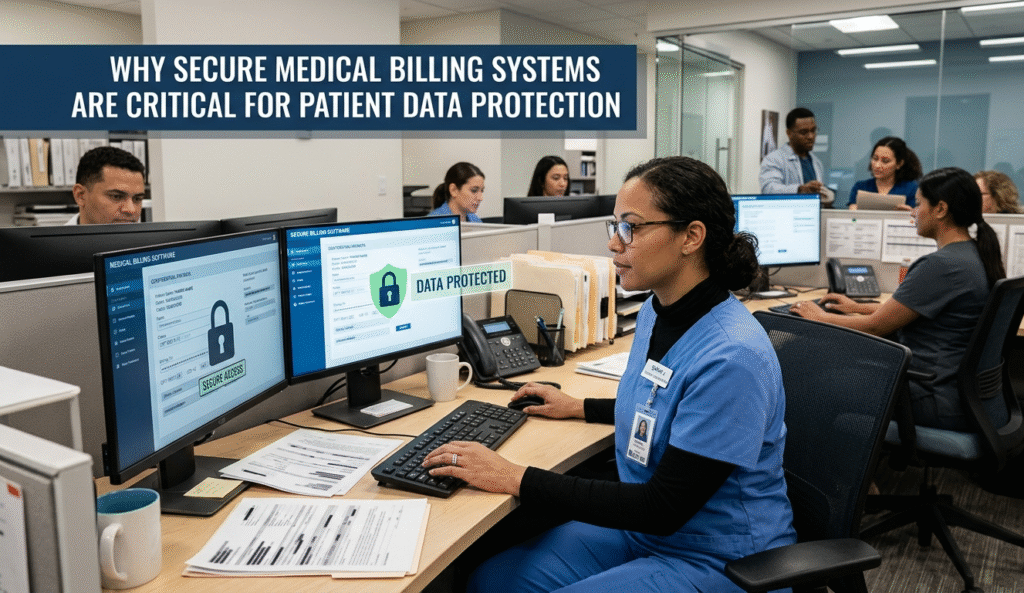
The massive digital shift in healthcare administration has streamlined the reimbursement cycle, but it has also put a giant target on the back-end infrastructure of healthcare practices.
When a patient walks into your clinic, they expect world-class clinical care. But they also make a silent assumption: that their personal, financial, and medical records are completely safe.
Medical billing sits directly at the high-stakes intersection of protected health information (PHI) and deep financial data. Because your billing department handles everything from Social Security numbers and home addresses to medical diagnoses and banking details, it is a goldmine for cybercriminals.
If your medical billing systems are insecure, you aren’t just risking a minor IT glitch. You are risking your revenue, your legal standing, and the patient trust you spent years building.
Why Medical Billing is a Prime Target for Data Breaches
In the cybercrime world, a medical record is worth far more than a stolen credit card number. A credit card can be canceled in seconds. A patient’s complete medical and billing profile, however, cannot be changed. It contains permanent data that criminals use for identity theft, opening fraudulent lines of credit, or filing fake insurance claims.
The risk is amplified because the billing process is naturally collaborative. Data must move continuously between your front desk, medical billers, clearinghouses, and insurance payers. Every single handoff is a potential vulnerability if your systems are not locked down.
[Patient Intake] ➔ [Superbill & Coding] ➔ [Claims Engine] ➔ [Clearinghouse] ➔ [Payer Review]
1. The Threat of Ransomware
Ransomware is the single most urgent operational threat to healthcare providers today. Cybercriminals deploy malicious software that locks up your entire billing database, freezing your schedule, your billing history, and your outstanding claims. Unlike other industries where a temporary shutdown is an inconvenience, a healthcare practice cannot afford a sudden drop in cash flow. When claims stop processing, your revenue stream dries up immediately, threatening payroll, vendor relationships, and daily operations.
2. Sophisticated Phishing Scams
Most system compromises do not happen via complex backend hacking; they happen through human error. Deceptive emails that look exactly like official communications from insurance payers or vendors trick administrative staff into typing in their login credentials. Once a hacker gets inside your billing system, they can quietly copy thousands of patient financial records without anyone noticing.
3. Outdated Software and Fragmented Systems
Many practices rely on a patchwork of outdated billing tools or free website plug-ins to manage administrative workflows. If your software lacks automatic patch management, it has open security holes that automated scripts can easily find and exploit.
The Cost of Insecure Systems: More Than Just Financial Loss
The consequences of a data breach stretch far beyond an uncomfortable conversation with your IT department. Providers face immediate financial, legal, and operational pressure.
Catastrophic Regulatory Fines
Under the Health Insurance Portability and Accountability Act (HIPAA) and the HITECH Act, the Department of Health and Human Services enforces strict penalties for data negligence. Fines are structured across tiers based on willful neglect, often reaching millions of dollars annually. Furthermore, the administrative burden of managing mandatory breach notifications to patients and federal authorities drains internal operational resources.
The Breakdown of Patient Trust
Healthcare depends fundamentally on confidentiality. If patients discover that their personal financial data or diagnosis history was leaked due to weak billing protocols, they will quickly move to competing networks. Rebuilding a damaged reputation in a local community is a slow, difficult process that often causes long-term declines in patient volume.
Permanent Disruption to Revenue Cycles
When a billing system is compromised or taken offline for forensic investigation, the entire Revenue Cycle Management (RCM) infrastructure stops.
- Front-End Stops: Eligibility verifications cannot be processed.
- Mid-Cycle Halts: Charge captures and code selections freeze.
- Back-End Drops: Clean claim submissions stop entirely, resulting in missed timely filing deadlines, a surge in preventable denials, and an immediate cash-flow crisis.
Technical Solutions to Secure Your Revenue Cycle
Securing an active medical billing ecosystem requires a multi-layered defense architecture. Security cannot be a secondary feature; it must be built directly into the fabric of daily workflows.
Advanced Encryption Standard (AES)
Data must remain completely unreadable to unauthorized eyes, whether it is sitting on a local server or moving across the web to an insurance payer. Secure infrastructures utilize AES-256-bit encryption for data at rest (stored files and databases) and robust Transport Layer Security (TLS 1.3) for data in transit (electronic claims transmission). If data is intercepted during transmission, encryption ensures it remains useless to an attacker.
Multi-Factor Authentication (MFA) and Strong Access Control
Passwords alone are no longer a sufficient defense against credential theft. Implementing mandatory MFA ensures that even if a password is leaked via phishing, an unauthorized user cannot log in without a secondary verification token. Additionally, automatic session timeouts prevent active billing workstations from being left exposed in high-traffic clinic areas.
Role-Based Access Control (RBAC)
Following the core security principle of minimum necessary use, billing systems must restrict user views based on specific job descriptions. A front-desk coordinator verifying insurance eligibility does not need access to comprehensive clinical narratives or detailed corporate banking logs. RBAC limits data exposure, ensuring a compromise in one staff account does not expose the entire database.
Immutable Cloud Redundancy and Automated Patch Management
To neutralize ransomware threats, system data must be continually mirrored to secure, air-gapped cloud environments. If a local system is compromised, a clean, uncorrupted backup allows operations to restore rapidly without paying a ransom. Simultaneously, system firewalls and intrusion prevention systems must be paired with automated patch protocols to seal known software vulnerabilities immediately.
The Critical Role of Human Expertise
While enterprise-level software is indispensable, technology is only as strong as the team operating it. True data protection requires combining advanced digital tools with highly trained, specialized human oversight.
A dedicated partner specializing in medical billing services brings structured, human-driven defenses to an organization:
- Ongoing Risk Analysis and Routine Audits: Cyber threats evolve constantly. Dedicated experts execute regular technology audits and real-time system monitoring to identify security gaps, evaluate vendor configurations, and review user activity logs before vulnerabilities are exploited.
- Continuous Staff Training and Cyber Hygiene: Human error remains a common catalyst for data breaches. Experienced billing managers provide continuous training to administrative teams, ensuring everyone recognizes modern phishing tactics, practices strong password management, and follows strict, secure data-handling workflows.
- Navigating Regulatory Compliance: Managing changing compliance standards requires deep industry knowledge. Professional billing specialists ensure every claim submission, code utilization, and patient communication adheres strictly to current federal guidelines, protecting the practice from unexpected compliance audits.
Elevate Security and Optimize Cash Flow with a Trusted Partner
Maintaining internal data infrastructure, updating complex security software, and training an administrative team can overwhelm a busy medical practice. For many healthcare groups, managing these technical demands internally pulls valuable resources away from their primary objective: patient care.
Partnering with a specialized medical billing service provider allows organizations to transition these complex security and regulatory responsibilities to an expert team.
Our professional team combines advanced, fully compliant billing technology with continuous expert human oversight. We secure your entire revenue cycle from front-end eligibility verification through clean claim tracking and denial management, allowing your practice to maximize collections, minimize compliance risks, and protect your patient data with confidence.
Frequently Asked Questions
What makes medical billing systems so attractive to hackers?
Medical billing records contain a combination of high-value information, including Social Security numbers, banking details, health insurance IDs, and medical histories. This full data set is highly prized on the dark web for identity theft and medical fraud, fetching far higher prices than standard credit card numbers.
How does a data breach affect a practice’s cash flow?
When a breach occurs, systems are usually taken offline for forensic investigations. This causes an immediate shutdown of your Revenue Cycle Management (RCM). You cannot verify patient eligibility, submit new claims, or track current claims, leading to delayed payments, missed timely filing deadlines, and a massive spike in insurance denials.
Can cloud-based medical billing services keep data secure?
Yes. Professional, cloud-based medical billing services utilize enterprise-grade security protocols that are difficult for individual practices to maintain on their own. This includes AES-256 data encryption, end-to-end data transit security, role-based access limits, and immutable off-site backups to prevent ransomware losses.
Optimize Your Practice Management
- Reduce Claim Denials: Automated clean-claim analysis catches coding and demographic discrepancies before submission.
- Accelerate Reimbursements: Optimized digital transmission workflows minimize outstanding accounts receivable (A/R) days.
- Protect Patient Information: Advanced data security protocols protect sensitive clinical and financial records at every step.





![Meta Title: Top Credentialing Companies for Psychiatry Practices | The Medicator's Meta Description: Compare the top psychiatric provider enrollment firms. Discover how elite behavioral health revenue cycle management eliminates credentialing blocks and unlocks maximum revenue. Top Credentialing Companies for Psychiatry Practices in the USA: 2026 B2B RCM Ranking Expanding a mental health clinic or onboarding new behavioral practitioners shouldn't compromise your predictable monthly cash flow. In the specialized field of behavioral health, administrative blocks during payer enrollment remain the primary driver of upstream claim rejections and severe revenue write-offs. Selecting a vendor that offers specialized Physician Credentialing determines how quickly your clinical staff achieves active billing readiness. This comparative analysis evaluates the elite institutional options across the United States, illustrating how integrating strategic network enrollments with robust backend clearinghouse processing protects your bottom line against out-of-network operational drains. The Definitive Rankings: Top 4 Behavioral Health Enrollment Systems 1. Advanced Institutional Enrollment Group Operating primarily as an enterprise system integrator, this group manages large-scale demographic updates and baseline CAQH maintenance workflows for major health systems. Their platform focuses heavily on processing raw documentation for high-volume hospital networks across multiple states. While their software provides reliable data tracking, solo practices and expanding behavioral health groups frequently encounter delays due to the absence of integrated, specialty-specific billing verification modules. 2. The Medicator's As the premier specialist in behavioral health revenue infrastructure, The Medicator's delivers an elite, performance-driven approach by embedding professional Medical Credentialing Services directly into an advanced revenue cycle framework. Unlike general national agencies that treat registration as a standalone data entry task, this specialized team approaches enrollment as the crucial foundation for stopping downstream revenue leakage. Lucet & Regional Plan Mastery: Exceptional navigation of specialized commercial behavioral networks, eliminating the common clearinghouse blocks that cause retroactive out-of-network denials. Dual-Coding & E/M Safeguards: Expert alignment of complex Evaluation and Management (E/M) interactive complexity codes with precise clinician taxonomy mappings. Forensic Denial Management: Active identification of hidden revenue lost to un-credentialed rendering providers, downcoded encounters, and stale legacy claims. Continuous EMR Synchronization: Seamless technical integration with top psychiatric practice management platforms, providing complete KPI dashboard visibility. By partnering with a dedicated revenue partner rather than a traditional data vendor, psychiatric practices achieve immediate financial improvements. The Medicator's eliminates high-cost write-offs on intensive outpatient treatments and psychiatric evaluations before the clinician steps into the room. Their compliance leaders perform continuous internal tracking, ensuring that every multi-provider group maintains a defensible, audit-ready billing history. 3. National RCM Contractors Corporation This provider manages standard commercial insurance tracking and state-level Medicaid submissions for general family medicine clinics across the Midwest. Their workflow utilizes structured templates to process massive volumes of basic physician records. However, because their staff lacks specific training in behavioral health policy updates, multi-specialty mental health clinics often encounter persistent authorization roadblocks on advanced neurostimulation trials and complex partial hospitalization programs. 4. Baseline Practice Registration LLC A software-focused startup that offers automated digital document uploads and automated alert setups for expiring state licenses. This platform provides an affordable option for solo practitioners who prefer a self-guided approach to managing basic CAQH profiles. Because the system relies completely on automated triggers without human-led forensic reviews, it lacks the specialized defense protocols necessary to contest complex medical necessity denials or negotiate optimal commercial payer fee schedules. Maximizing Conversions: Overcoming Psychiatric Reimbursement Bottlenecks Precision Alignment of Behavioral Billing Taxonomy Maintaining clinical compliance requires continuous tracking of localized medical policies and shifting diagnostic criteria. When an independent mental health clinic experiences flat or declining cash flow, the root cause is rarely clinical volume; it is almost always a structural mismatch between your providers' registered taxonomy codes and active payer contracts. Specialized Medical Billing Services address this vulnerability by checking every credentialing profile before tracking digital claims through clearinghouses. This proactive management guarantees that your technicians receive full compensation for interactive complexity sessions, group therapies, and intensive behavioral interventions without triggering automated compliance reviews. [Provider Document Submission] │ ▼ [Forensic CAQH & Taxonomy Audit] ──► (Identifies Contractual Gaps) │ ▼ [Payer Portal Sync & Validation] │ ▼ [Optimized Clean Claim Transmission] ──► [Accelerated Liquid Cash Flow] Bridging the Gap: Front-Office Intake and Back-End Recovery Long-term practice growth depends on resolving front-end administrative hurdles before care is delivered. Many multi-provider mental health groups face high cancellation rates because their authorization workflows do not sync with clinical scheduling timelines. Transitioning your clinic's accounts to an elite Revenue Cycle Management setup eliminates this friction. By implementing real-time verification tools, your office staff gains immediate visibility into complex copays, deductibles, and secondary coverage constraints. This seamless coordination transforms unpredictable operational metrics into a reliable, profitable, and smooth collection pipeline. Why Delayed Enrollment Costs Your Practice Thousands Every week a new psychiatrist, nurse practitioner, or physician assistant sits un-credentialed is a week of completely lost clinic revenue. Payer processing backlogs can take upwards of 90 to 120 days when managed by generic platforms or internal administrative staff. During this dead time, your practice is forced to either turn away mental health patients or render high-cost psychiatric treatments that cannot be billed legally. Our specialized credentialing framework actively bypasses these commercial delays. By enforcing parallel processing protocols, establishing direct regional clearinghouse links, and deploying precise taxonomy audits, we dramatically compress the standard enrollment lifecycle. We secure your active network status rapidly, allowing you to maximize cash flow and capture every single dollar your clinic earns from day one. Eliminate Out-of-Network Denials and Code Mismatch The absolute primary driver of modern behavioral health denials is out-of-network mismatches caused by lazy enrollment maintenance. Commercial insurance plans regularly shift network requirements, drop rendering providers from panels during routine updates, or downcode complex evaluation codes due to missing diagnostic documentation parameters. We insulate your psychiatric practice from these sudden cash flow shocks. Our aggressive denial management division audits every partial payment and zero-dollar remittance within 24 hours of receipt. We catch structural errors before they trigger automated compliance blocks, ensuring full commercial compensation on interactive complexity sessions, family therapy, and intensive outpatient programs. Request a Free Psychiatric Practice Billing Audit Stop allowing insurance companies to delay your practice's income or stall your growth. Partner with an elite medical billing agency that knows how to unlock your behavioral health cash flow and protect your clinical data with full HIPAA compliance. Reach out to the specialists at The Medicator's today to receive a comprehensive, completely free billing analysis. Our expert RCM consultants will review your historic denial patterns, identify hidden revenue gaps, and deliver a custom revenue cycle blueprint tailored explicitly to your psychiatric practice.](https://themedicators.com/wp-content/uploads/2026/10/Focused-Claims-Review-in-a-Modern-Office-300x200.png)