Operators of urgent care clinics all know the feeling of excessive patient volumes, full waiting rooms, and staff working at full capacity. Yet the financial results at the end of the month never reflect the hard work. The problem isn’t necessarily how many patients are treated, it’s how much revenue is leaking out of the clinic before the clinician has the opportunity to problem-solve.
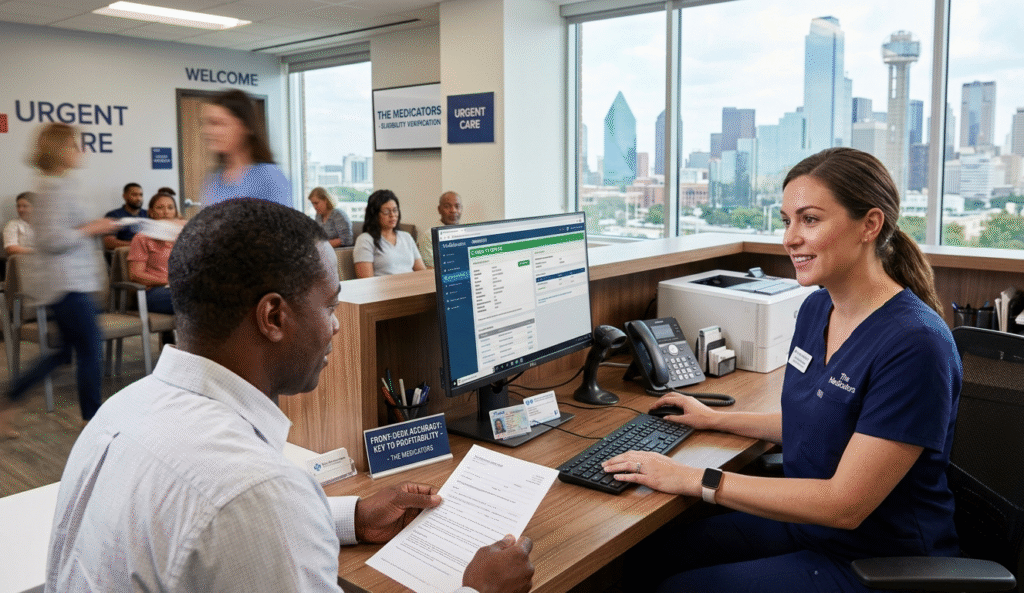
Revenue cycle management (RCM) for urgent care facilities begins at the front desk and typically ends at the back. This is where the RCM system begins, either a successful or unsuccessful journey related to the capture of revenue.
The Revenue Leak Nobody Talks About at Leadership Meetings
The front office is where RCM for urgent care begins to leak, and according to studies conducted, it stops leaking at the front office before the clinician ever has a chance to evaluate the patient. It’s easy to talk about all of the problems associated with back-end RCM metrics like coding, denials, accounts receivable, payor mix, etc. Less frequently discussed at a leadership level are the costly mistakes that are made front-end and consequently cost the facility to fix once the claim reaches the reimbursement source. By the time the claim reaches the payor, the claim has already been negatively impacted by front-office errors.
While the previous data highlights the impact of poor RCM as a result of front-end errors, industry studies conservatively estimate that front-end problems create unnecessary losses to urgent care clinics of up to approximately 20% of revenue generated by the urgent care. To put $600,000 ($300,000 in A/R loss) in perspective, if your facility has gross revenue of $3,000,000, you are experiencing a potential loss of $600,000 in revenue on a yearly basis because of front desk coding errors.
These losses often elude detection on a report level, hiding behind reason codes for denial, uncollected copayments, write-offs for bad debts, and claims that have been filed incorrectly. While leadership is able to witness these by their symptoms, there is no mechanism in place for anyone in the organization to track them back to where the problem occurred.
What “Front-Desk Accuracy” Actually Means
Front desk accuracy refers not only to the person entering an insurance ID number correctly but also to various important functions that affect how a claim gets paid on initial submission.
- Capture all patient demographic information correctly and completely
- Verify active coverage and eligibility for insurance at the time of service.
- Identify primary and secondary payers, including coordination of benefits.
- Collect all copays, deductibles, and coinsurance at the time of service.
- Determine which services require prior authorizations and ensure that the service is flagged before the start of the encounter with the physician.
- Document the place of service correctly.
Each of these items listed is a revenue-based decision. When any one of them is incorrect, the resulting claim has already been compromised.
Why Urgent Care Is Uniquely Vulnerable
Walk-in medicine has a structural disadvantage that scheduled care does not. There is no appointment buffer (i.e., no previsit intake form sent 3 days in advance and no insurance verification done the day before). Patients typically arrive for services without providing any advanced notice and may need medical assistance for acute pain or other urgent issues.
The high volume of patients further complicates the issue, as a busy urgent care center could see anywhere from 80 to 120 patient visits over one weekend shift. This equates to an equal number of opportunities for demographic error, missed eligibility verification, or failed copay discussions. With such a large and quickly moving group of patients, even the most thoroughly trained employees will be unable to function without error.
Therefore, the key question is not whether an error will occur, but whether your workflow processes are in place to ensure that errors are caught before they result in a denial of payment.
Insurance Eligibility Verification: The Single Biggest Revenue Driver at Check-In
According to HFMA, errors in verifying eligibility account for more than 75% of all denied and rejected claims, so here is a statistic that should be printed out and displayed prominently in every urgent care center: Re-filing rejected claims due to eligibility verification errors can cost your urgent care center between $50,000 and $250,000 in total revenue loss for every 1% of claims denied.
That’s right! Just 1% of denials! How important is this? It’s certainly not an isolated incident.
What Happens When Eligibility Goes Unverified
The same scenario is repeated in urgent care centers across the country. A patient presents an active insurance card; the front desk enters that information into their system; the claim is submitted; two weeks later, a denial letter arrives because the policy was terminated 47 days earlier, and that patient has moved.
Think about how to coordinate your benefits incorrectly. You have a primary plan through your employer and secondary insurance through your spouse’s work benefit. Only the card that’s in your wallet is given on file to the front desk. Claims go to the incorrect payer because of this. They deny payment due to the claim going to a secondary payer, and then requiring resubmission to the proper primary payer gets further delayed. You’ve now started getting close to deadlines on submissions for the claim, too.
None of this was because there was an error on a coding review. None were due to documentation in the patient’s medical record. This error was due to incorrect processes related to benefits coordination at the front desk.
Real-Time Verification Changes the Math
AI-powered platforms used to verify a patient’s eligibility are built into your PM system. These platforms verify a patient’s eligibility before the patient has been seen or had their clinical encounter by providing eligibility verification in under 30 seconds from checking them in. With these platforms, you will have real-time verification on a patient’s active coverage for copayments, deductibles, coinsurance, and limits of coverage.
An urgent care billing platform has reported that moving from their manual method to the automated verification system resulted in a reduction of eligibility rejections by approximately 60%. This is a complete structural change versus an incremental improvement.
In a recent report, one of the urgent care billing platforms has shown that when automated verification is put into place, it ultimately reduces the occurrence of eligibility-related denials by an average of 60%. This is not just an incremental improvement, but more of a transformational change.
Technology is a big part of the success, but how you use that technology is equally important. Front desk personnel must be trained on how to translate the eligibility information into understandable financial conversations with patients (copays, expected deductibles, and any authorizations required) before that patient enters the treatment room. The connection between verification/communication is what drives both collections and satisfaction.
Does Insurance Verification Need to Happen Before Every Visit?
Yes! And not only for new patients, but also for returning patients. Insurance changes constantly – open enrollment can be a time when plans are switched, a spouse may lose his or her employer-based coverage, a patient may become ineligible for Medicaid, etc. For example, if insurance is verified properly for a patient in March, by November, the patient may be on an entirely new plan. Assuming nothing has changed sets up for a long-term accumulation of eligibility errors, which are generally not discovered until the end of the month reconciliation process.
Collecting at the Point of Service: The Conversation Most Front Desks Are Avoiding
As of 2025, 55% of privately insured Americans are expected to be enrolled in high-deductible health plans (HDHPs). For urgent care centers, this is not just a trend; it will be a fundamental constant to your business moving forward.
More of the revenue you receive from each patient visit is being directly paid for by the patient. There can be anywhere from $100-$500 or more for each visit that the patient will pay.
The most painful reality: you will have a dramatically better chance of collecting your patients’ out-of-pocket costs while they are at your desk than if you wait and try to collect after they leave your office.
The HDHP Shift Has Changed Your Payer Mix, Whether You Realize It or Not
Your payer mix may have already changed due to increased high-deductible health plan (HDHP) participation rates in the last 10 years. The percentage of employees with a deductible greater than $2,500 has nearly doubled over the past decade. In 2024, the Cleveland Clinic reported that 87 percent of its bad debt was from patient accounts with insurance that were unable to collect from those insured due to non-payment of the amount owed for cost sharing (copays, high-deductible balances, or coinsurance), and a 15 percent increase in bad debt at the Cleveland Clinic from 2023 to 2024 was attributable to this cause.
It is important to remember that urgent care (UC) centers do not operate as traditional hospitals; UC centers have lower margins, fewer resources allocated to accounts receivable collection, and shorter-term relationships with their patients. Trying to collect a deductible balance of $200 or more for a walk-in patient who only came to your office once six months ago would be cost-prohibitive and almost impossible.
The bottom line is clear: practices that utilize an upfront collection process and provide real-time financial estimates at the time of service will collect between 60-80 percent more than practices that rely on post-visit billing.
How to Have the Copay Conversation Without Losing the Patient
Most urgent care operators’ resistance to upfront collections is due to a communication issue, not due to a structural issue; most patients have no problem understanding that they owe money to their doctor, the reasons they owe that money, but the surprise element is often associated with how much they actually owe once they receive a bill from their doctor.
If a script is used and staff have been trained in the use of scripts, the ambiguity surrounding communications will be removed. For example, if a staff member tells a patient, “The copay for today is $40, and I see that you have not met your deductible of $180. I will collect your copy today and bill the remaining amount once the insurance company has processed your claim”, this is direct, factual, and does not require an apology.
In order for the front desk to communicate effectively about upfront collections, they must have real-time access to eligibility data. If staff do not have access to real-time verification, they will be guessing the patient’s financial obligation. Most patients will have received inaccurate financial information at the time of their visit and will dispute the billing once they receive it weeks later, resulting in late payments, complaints, and not returning to the facility.
What About Patients Who Can’t Pay Upfront?
This is where financial screenings and payment plan options come into play. Identifying and addressing patients who will qualify for reduced fees (e.g., due to income, families with children) and payment plan options for larger balances is not charity, but rather a collections strategy.
Patients who agree to a $50 monthly payment plan upon check-in are more likely to pay than patients who get an unexpected $300 bill in the mail 45 days later. The Deceptive Multiplier Effect of Registration Errors on Denied Claims. A lesser-known source of revenue loss for urgent care clinics is due to front desk registration errors, as they are often not clinical errors; therefore, nobody recognizes that they are billing catastrophes (e.g., registering the wrong date of birth). However, a single-digit error when registering can lead to an entire series of denied claims (or claim delays for resubmission) and possibly missing the timely filing deadline on a claim.
Registration Errors: The Quiet Multiplier of Claim Denials
When it comes to urgent care, the biggest revenue loss is from front-desk registration errors. They are the most overlooked area of discrepancy because they do not fall under the category of clinical errors; no one thinks of a transposed date of birth as a revenue loss, but in actuality, a one-number error can lead to a claims denial, delay in resubmission due to multiple errors, and the possibility of missing your timely filing requirements.
What Registration Errors Look Like in Practice
Wrong date of birth.
Claims filed with a patient’s correct date of birth but with their incorrect date of birth on their insurance record lead to automatic denial.
Misspelled name.
Seems like a small error, but the maximum number of payer databases only compare “exact” names, so if you have “Jon Smith” listed as the patient name and you have “John Smith” listed as the name on the insurance record, you will receive a claim denial for name mismatch.
Wrong insurance ID or group number.
Patients who provide the urgent care with an outdated insurance card or a temporary insurance card usually provide inaccurate information, leading to claim denials.
Incorrect place of service code.
The submission of a claim with a place of service code other than the one that represents the actual and appropriate place of service (i.e., place of service code for urgent care is 20; therefore, if your file is submitted for billing with place of service code 11 (office) or 23 (emergency room), you cannot expect reimbursement based on the claims processing rules).
Missing referring provider when required.
This is a common reason for claim denial. Many payers now require the referral provider’s name to be listed when payment is submitted (for certain procedures). If you submit a claim for a service requiring a referring provider without that information, you will be denied for missing the referral provider.
A coder does not need to fix these errors, but they do require the time of coders and billers to locate and fix. According to industry standards, the cost for reworking each claim is between $25 and $100 – and that doesn’t even take into account how long it takes for a claim to get paid due to sitting in the denial queue for 3-6 weeks.
Can Front-Desk Registration Errors Be Eliminated?
Not completely. However, with an effective workflow, they can be reduced significantly. In urgent care settings, there is one workflow that has consistently been successful based on three components:
- Real-time eligibility verification that cross-references patients’ provided information against payer records to identify discrepancies at the beginning of the process before the claim has been created.
- A dual-verification process at check-in: either by having the patient confirm their information via an electronic form or by having the front desk staff read back the required fields to ensure accuracy.
- Pre-submission claims scrubbing through a clearinghouse to identify demographic discrepancies, POS errors, and missing fields before the claim reaches the payer.
The goal of the system is not to achieve 100% accuracy at all times during data entry. Rather, it is intended to create a system of checks that will prevent a mistake in step 1 from resulting in a denial in step 10.
Prior Authorization: The Front-Desk Failure That Billing Can’t Fix
Prior authorization denials in urgent care billing can be very painful. They are often preventable; however, once a denial has been issued, it is too late to obtain the prior authorization for yesterday’s patient visit.
Which Urgent Care Services Require Prior Auth?
What services actually require referral or authorization varies by each payer and plan type. Therefore, managing prior authorization requests without the benefit of a well-defined process is extremely difficult.
Prior authorization will often be required for services such as advanced imaging (CT and MRI), some lab panels, and any specialty referral initiated at the time of an urgent care visit. The need for prior authorization will depend on each specific payer and patient plan design.
Front desk staff should not be required to have a detailed knowledge of every prior authorization rule, but should have access to a real-time workflow tool that identifies authorization requirements based on patient-specific plan information at the time of check-in, prior to ordering services from the provider.
If this is not done, the process will be that the patient is seen, services rendered, the claim is submitted, the claims process returns with a denial accompanied by a CO-15 (invalid or missing prior authorization number), an appeal is filed, the appeal is also denied, and the revenue will be written off as a loss.
Why Authorization Management Starts at the Front Desk
The billing team can handle the tracking of authorizations on scheduled service, and by the front desk on walk-in urgent care; they are the only team at the beginning of the encounter to catch the authorization requirement before the situation is too late.
A clear line of communication has to exist between the front desk and clinical staff by way of EHR (electronic health record) flagging or a pre-service work checklist stating “patient’s plan requires prior authorization before ordering; please check first.” It is not complicated, but it must be part of the workflow process, as it will not happen by chance during a busy shift.
Charge Capture and Coding Accuracy: What Starts at the Front Desk Ends in the Chart
Charge capture is primarily done through clinical functions and code sign-offs, but systemic conditions for success or failure for charge capture are established at the front desk. With incomplete registration, wrong place of service (POS) coding, and/or an inaccurately flagged visit type in EHR, the charge capture process begins on the wrong basis.
Urgent care facilities usually miss billing for ancillary services provided, like injections, IV hydration, lab testing, wound care, or splinting materials; they often forget or do not have complete documentation for these services.
The E/M Level Problem in Urgent Care
E/M codes 99202-99215 are the billing codes used for urgent care visits. These codes need to be adequate with documentation. Documentation involves the documentation of the medical decision-making complexity level and/or documentation of time. Many urgent care facilities are guilty of billing each patient at a Level 3 meeting because it has become a habit, but the level of patient acuity and the accident that is being documented actually should be billed at Level 4 or 5 for that patient.
It is not considered a coding error in the usual sense, but quite possibly because it is a bad habit with documentation, causing loss of potential revenue for them. For example, if a centre is seeing 100 patients per day with an average of 15% of those patients under the appropriate level of billing for that patient, and the difference in billing Level 4 vs. Level 3 is $35 – $50 for the same patient, they would be leaving $1500 – $2500 daily due to careless documentation. That equals over $500,000 of lost revenue per year due to careless documentation habits.
Front-desk accuracy contributes indirectly to this because if they receive complementary and accurate data in the form of accurate Patient demographic data, accurate payer’s information and right-first-time intake documentation, then the provider or coder would have a solid foundation of accurate data to use when determining the appropriate E/M level to assign and therefore, have a lighter cognitive load on the clinical side when accurately determining E/M Level compared to when the data doesn’t provide accurate representations of what is actually patient level acuity or what occurred during the patient encounter.
Building a Zero-Error Front-Desk Culture at Your Urgent Care Center
Building a front-desk culture at your urgent care centre that is focused on eliminating errors is critical. Facilities with clean claim rates of business that exceed 95% have one common thread: they perceive the front desk as being a revenue-generating function over just being an administrative operation.
The Metrics That Matter at the Front Desk
Usually, the only factors urgent care centers look at to measure the front desk performance are patient wait time and patient satisfaction score. While these factors do play a vital role in measuring your staff’s performance, they are not the only “metrics” to consider. Other metrics that provide a direct correlation between performance at the front desk and financial results are as follows:
- First-pass claim acceptance rate – the first-pass allows claims to process successfully without any denials or rejections
- Eligibility verification completion rate – This tracks what percentage of patient encounters have valid eligibility determinations documented prior to services being rendered.
- Copay collection at the time of service – what percentage of copays due at the time of service were collected prior to the patient leaving the site?
- Registration error percentage – this accounts for statistical denials related to demographics and/or eligibility misalignment.
In addition to holding people responsible for improving these metrics, urgent care center owners and/or operators should also publish these metrics at the front desk to help ensure accountability for errors where they originated.
Training That Sticks
Scripted training on patient financial conversations; quarterly refreshers on copays and authorizations by payor for the three to five largest payors you work with; practice role-playing the insurance verification process so that front-desk staff can assist patients when they present common objections to provide required insurance information (i.e., expired insurance card, change in job, etc.). These Education methods and techniques are the norms in successful urgent care practices with the best revenue cycles.
Providers are having difficulty hiring billing staff, with 63% of them reporting difficulties, per current surveys. There is, however, no requirement for billing personnel to provide front desk revenue training. What is necessary are protocols that are consistently adhered to, continuous reinforcement of those protocols, and leadership that makes the front desk’s accuracy a priority for the business.
The Medicators’ Approach: Revenue Cycle Success Starts Before the Clinical Encounter
There is a repeating theme in the data The Medicators has compiled while managing the revenue cycles of urgent care centers: the largest deficiency in revenue for urgent care centers with the tightest margins is not the failure to code correctly, but rather the failure of the business processes to focus on generating revenue at the front end of the revenue cycle.
Creating a “zero-error intake culture” with real-time eligibility verification, structured copay collection conversations, clean, compliant, and consistent registration processes, and pre-service authorization screening will result in first-pass claim rates being improved by 15 to 25 percentage points. This is often the difference between an urgent care center that’s merely breaking even or is profitable.
Revenue is not being missed due to a lack of care provided. Revenue is being missed due to the infrastructure around the care that was not set up to capture the revenue associated with that care being provided.
Stop Patching the Leak After the Fact
The reason that many leaders are trying to fix the urgent care revenue issue at the back end is actually a front-end architectural issue. Every claim that gets denied and needs to be corrected for $25 – $100 in staff time was a preventable front office error. Every copayment that was collected has now become a bad debt account because a conversation did not take place at check-in.
If you want to succeed at building a profitable urgent care center in 2025 and beyond, treat the front desk like it is the first line of defense for generating revenue instead of being the last line of defense in the administrative process The use of real time eligibility checks, trained upfront collection conversations, clean registration processes, and pre-service authorization screening are not luxuries for urgent care centers to engage in — they are all essential parts of the foundation of an urgent care center.
FAQ: Urgent Care Revenue Leakage and Front-Desk Profitability
How much revenue can an urgent care center lose due to front-desk errors?
Improper front-end RCM processes could cause urgent care centers to lose up to 20 percent of total potential revenue every year.
What is the most common front-desk error that causes claim denials?
Failed verification of patient eligibility for insurance (inactive policies, incorrect plan information, etc.) causes more than 75% of claim denials, according to HFMA.
When is the best time to collect patient payments in urgent care?
At the time of service. Follow-up collection attempts on previously insured patients decrease significantly over time; implementing upfront collection policies can increase cash collection by 60-80%.
How does high-deductible health plan enrollment affect urgent care collections?
Currently, 55% of all privately insured individuals in the U.S. have enrolled in high-deductible health plans, resulting in more money being collected from patients directly than from their insurance companies, making upfront verification and pre-collections necessary.
What metrics should urgent care centers track to measure front-desk accuracy?
First-pass claim acceptance rates, eligibility verification rates, copay rates at the point of service, and the rate of registration errors connected to denied claims.
Can real-time eligibility verification be implemented in high-volume urgent care settings?
Yes, with today’s technology, you can verify the patient’s benefit coverage in less than 30 seconds, directly into the practice management system, and still be effective with 100 or more patient visits per day.
Does prior authorization apply to urgent care visits?
Yes, for many services, including certain imaging procedures and specialty procedures, a patient will need authorization through their healthcare payer. The front desk staff will need to follow the payer-specific workflow that they have in place to correctly identify when the provider is responsible for obtaining authorization.