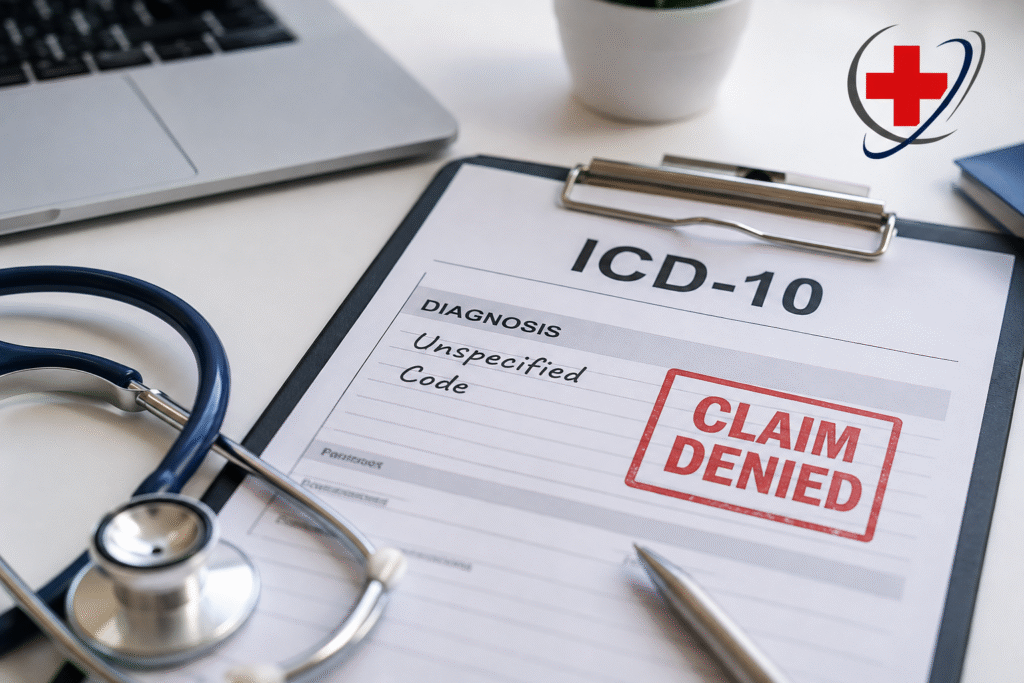
Diagnosis specificity has quietly become one of the most important factors in whether a claim gets paid. Payers are not just checking whether a diagnosis code exists, they are checking whether it is specific enough to justify the service billed, and that shift has real consequences for practices that lean on unspecified codes out of habit.
The connection between ICD-10 coding accuracy and reimbursement is direct. A vague or unspecified diagnosis code often fails to clearly establish medical necessity, and when that link is weak, payers increasingly respond with a denial rather than a payment.
Unspecified diagnosis codes contribute to a whole chain of downstream problems, including outright denials, delayed payments, reduced reimbursement, and in some cases genuine compliance risk if a pattern of vague coding draws payer or auditor attention. At the same time, unspecified codes are not inherently wrong. There are legitimate clinical situations where they are the correct choice, and understanding that distinction is just as important as knowing when they are being overused.
This guide covers exactly what unspecified ICD-10 codes are, why they trigger denials, when they are genuinely appropriate, and the practical steps your practice can take to reduce reliance on them without compromising documentation integrity.
What Are Unspecified ICD-10 Codes?
Definition
Unspecified diagnosis codes are ICD-10-CM codes used when a patient’s condition cannot be classified into a more detailed, specific category based on the documentation available. They typically end in a code like “.9” and exist specifically to accommodate situations where a more precise diagnosis genuinely cannot be determined, a structure maintained by the National Center for Health Statistics as part of the official ICD-10-CM code set.
ICD-10-CM includes unspecified codes because clinical reality does not always allow for complete certainty at the time of coding. A patient may present with symptoms before a definitive diagnosis has been reached, or documentation may simply not capture every clinical detail a more specific code would require.
The difference between an unspecified and a specific diagnosis code comes down to detail. A specific code captures information like laterality, anatomical location, severity, or disease stage, while an unspecified code omits that detail because it either was not documented or genuinely is not yet known.
A common misconception is that unspecified codes are always incorrect or automatically problematic. In reality, they are a legitimate part of ICD-10-CM. The issue is not that unspecified codes exist, it is that they get used far more often than the clinical documentation actually requires.
Why ICD-10 Requires Specificity
Specificity matters for reasons that go well beyond getting a claim paid. It supports clinical accuracy by capturing the true nature of a patient’s condition, and it directly ties into medical necessity, since payers use diagnosis detail to determine whether a billed service was actually justified.
Specific coding also produces better patient records over time, since a detailed diagnosis history is more clinically useful than a string of vague, unspecified entries. It supports accurate risk adjustment models, which increasingly rely on diagnosis specificity to represent patient complexity correctly. It strengthens quality reporting, since many quality measures depend on precise diagnosis data rather than broad categories.
Specificity also supports appropriate reimbursement, since many payers structure their coverage policies and payment logic around specific diagnosis codes rather than broad, catch all categories. Finally, it supports regulatory compliance, since a pattern of unnecessarily vague coding can raise questions during a payer or government audit.
When Is It Appropriate to Use an Unspecified ICD-10 Code?
Unspecified codes are genuinely appropriate in several situations. Limited clinical information at the time of the encounter is one of the most common, particularly in emergency situations where a definitive diagnosis has not yet been established. Initial presentations before a workup is complete are another valid use case, since coding accurately reflects what is actually known at that point in the care timeline.
There are also cases where documentation genuinely lacks the necessary detail to support a more specific code, and coding to the unspecified level is the honest, defensible choice rather than guessing at specificity the record does not support.
That said, unspecified codes should not be used simply because it is faster or because a coder did not take the time to review available documentation. If a provider’s note clearly documents laterality, severity, or anatomical location, using an unspecified code instead of the more precise option available is a coding error, not a legitimate clinical judgment call.
Why Do Unspecified ICD-10 Codes Get Claims Denied?
| Reason for Denial | Why It Happens | Financial Impact | Prevention Strategy |
| Insufficient diagnosis specificity | A more specific code was available but not used | Denial or reduced reimbursement | Review documentation fully before code selection |
| Medical necessity cannot be established | Unspecified code does not clearly justify the service | Full claim denial | Confirm diagnosis to procedure linkage before submission |
| Diagnosis does not support the billed procedure | Payer edits flag a mismatch between diagnosis and service | Denial requiring appeal or resubmission | Validate linkage using current payer policy |
| Payer policy requirements | Specific payer coverage policy requires a defined diagnosis | Denial under that payer’s specific edits | Monitor payer specific coding requirements regularly |
| Documentation deficiencies | Clinical notes lack detail needed for specific coding | Denial or downcoded reimbursement | Strengthen documentation practices at the point of care |
| Incorrect diagnosis selection | Coder error or rushed code assignment | Denial, potential compliance concern | Ongoing coder training and internal audits |
| Automated payer claim edits | Payer systems automatically flag unspecified codes for review | Delay, additional documentation requests | Anticipate common edits during claim scrubbing |
| National and local coverage policy requirements | NCDs or LCDs require specific diagnosis codes for coverage | Denial under Medicare or Medicaid policy | Verify current NCD and LCD requirements before billing |
| Quality reporting implications | Unspecified codes weaken quality measure reporting accuracy | Indirect financial impact through reporting penalties | Improve specificity to support accurate quality data |
Each of these denial reasons points back to the same underlying issue: the diagnosis code did not carry enough information for the payer to confidently approve the claim. Some of these gaps trace directly back to a diagnosis and procedure code that simply do not logically connect, which is one of the most common and most preventable denial triggers across every specialty.
How Unspecified ICD-10 Codes Affect the Revenue Cycle
Unspecified coding does not just risk an individual claim, it ripples through the entire revenue cycle. It contributes directly to claim denials and delayed reimbursements, and even when a claim is not outright denied, unspecified codes can lead to underpayments if a payer reimburses at a reduced rate for insufficiently justified services.
Left unresolved, these issues increase Accounts Receivable, since claims tied to specificity problems tend to take longer to resolve than clean claims. They drive up administrative costs and appeal workload, since staff have to research documentation, query providers, and resubmit corrected claims. Over time, this pattern contributes to genuine revenue leakage, and in more serious cases, it introduces compliance risk if unspecified coding becomes a recurring, unaddressed pattern rather than an occasional, clinically justified exception.
Consider a practice that submits 800 claims a month for a service requiring a specific diagnosis under Medicare’s coverage policy. If even 8% of those claims default to an unspecified code when a more precise one was actually supported by the documentation, that is roughly 64 claims a month at risk of denial or reduced payment. Each one of those claims then requires staff time to research the original documentation, potentially query the provider, correct the code, and resubmit or appeal, work that would never have been necessary if the correct, more specific code had been selected the first time. Multiplied across a full year, that single specificity gap can quietly cost a practice thousands of dollars in both lost reimbursement and staff hours that could have gone toward new claims instead.
Examples of Commonly Overused Unspecified ICD-10 Codes
It helps to look at real examples, though it is important to note that appropriate code selection always depends on the specific documented clinical scenario and current ICD-10-CM guidelines, not a fixed rule of thumb.
| Unspecified Diagnosis | More Specific Alternative (When Supported by Documentation) | Required Documentation |
| Fracture, unspecified | Specific bone, laterality, open or closed, encounter type | Imaging findings, laterality, fracture type, encounter status |
| Diabetes, unspecified type | Type 1 or Type 2, with or without complications | Provider notes confirming type and any related complications |
| Hypertension, unspecified | Essential hypertension with specified associated conditions | Documentation of any related cardiac or renal involvement |
| Low back pain, unspecified | Specific spinal segment or underlying cause when known | Imaging or exam findings identifying the source of pain |
| Osteoarthritis, unspecified site | Specific joint and laterality | Exam and imaging findings identifying the affected joint |
| Pneumonia, unspecified organism | Specific causative organism when identified | Lab or culture results identifying the organism |
| Otitis media, unspecified | Specific type and laterality | Exam findings documenting ear and type of infection |
| Shoulder pain, unspecified | Specific laterality and underlying diagnosis | Exam or imaging findings supporting a specific diagnosis |
| Knee pain, unspecified | Specific laterality and underlying condition | Exam or imaging findings identifying the affected structure |
| Depression or anxiety, unspecified | Specific subtype and severity when documented | Clinical assessment documenting subtype and severity |
Real coding scenarios like these appear constantly across specialties. Detailed guidance for diagnosis specific cases, including examples like unspecified versus specific dermatology diagnosis coding and unspecified versus specific coding in colorectal conditions, illustrates exactly how much reimbursement can hinge on capturing a few extra clinical details in the documentation.
Documentation Problems That Lead to Unspecified Coding
Most unspecified coding traces back to a documentation gap rather than a coding decision made in isolation. Common gaps include missing laterality, missing anatomical location, missing severity, missing encounter type, and missing disease stage. Missing associated conditions is another frequent gap, particularly in patients with multiple comorbidities.
Incomplete physician notes, incomplete operative reports, and missing diagnostic findings round out the most common documentation problems. In nearly every case, the fix starts with the clinical note itself, since a coder can only code to the level of detail the documentation actually supports.
It is worth being direct about why these gaps happen so often. Providers are documenting under real time pressure, often seeing patients back to back with limited time to dictate or type detailed notes. A physician who clearly knows a patient has a specific rotator cuff tear on the right shoulder may still write a brief note that simply says “shoulder pain” if they are moving quickly between patients. The clinical knowledge exists, it just never made it into the record in a way a coder can act on. This is exactly why documentation improvement efforts tend to work better as a system level fix, through templates, prompts, and coder queries, rather than relying on individual providers to simply try harder to be thorough.
Medical Necessity and Diagnosis Specificity
Medical necessity refers to whether a service was reasonable and required based on accepted clinical standards for the patient’s documented condition. Diagnosis specificity directly supports this determination, since a precise diagnosis code gives a payer clear evidence of why a particular service was needed.
The diagnosis to procedure linkage is where this becomes concrete. A vague diagnosis may not clearly justify an advanced or high cost service, even if the service itself was entirely appropriate clinically. For example, billing an advanced imaging study against a general, unspecified pain diagnosis is far more likely to be denied than the same study billed against a specific diagnosis that clearly supports the need for that level of imaging, a pattern explored in detail in Hidden Reasons Behind Claim Denials Even with Accurate Coding.
Medicare, Medicaid, and Commercial Insurance Considerations
Medicare
Medicare relies heavily on National Coverage Determinations and Local Coverage Determinations published by CMS that frequently specify exactly which diagnosis codes support coverage for a given service. Documentation expectations tend to be detailed and specific, and an unspecified code that does not match an NCD or LCD’s required diagnosis list will typically result in denial regardless of how clinically appropriate the service actually was.
Medicaid
Medicaid coding requirements vary by state, which means diagnosis specificity expectations are not uniform across the country. Authorization differences compound this further, since some state Medicaid programs apply stricter specificity requirements to certain service categories than others.
Commercial Insurance
Commercial payers apply their own diagnosis specific edits and medical policy requirements, and these can differ significantly from both Medicare and Medicaid standards. Diagnosis validation at the payer level has become increasingly automated, meaning unspecified codes are often flagged systematically rather than caught only during manual review.
How to Fix Claims Denied for Unspecified ICD-10 Codes
- Review the denial reason: Start with the specific denial code and payer explanation to understand exactly what triggered the rejection.
- Verify payer requirements: Confirm the specific diagnosis specificity the payer expects for the billed service.
- Review provider documentation: Check whether the clinical record actually contains the detail needed to support a more specific code.
- Query the provider if clarification is needed: Use a structured provider query process rather than guessing at missing detail.
- Assign the most specific supported diagnosis code: Update the code based on what the documentation, including any provider clarification, actually supports.
- Correct and validate the claim: Confirm the updated diagnosis code aligns logically with the procedure billed.
- Resubmit or appeal: Choose the correct path depending on whether the payer requires a new claim or a formal appeal.
- Monitor reimbursement: Track the corrected claim through to final payment to confirm the issue is fully resolved.
Best Practices to Reduce Unspecified ICD-10 Coding
- Improve physician documentation at the point of care
- Invest in a genuine Clinical Documentation Improvement (CDI) program
- Provide regular coding education focused on specificity
- Perform internal coding audits on a consistent schedule, since upcoding and downcoding patterns quietly distort audit results when left unchecked
- Validate diagnosis selection against available documentation before finalizing a claim
- Use claim scrubbing to catch unspecified codes before submission
- Keep coding software and reference tools current
- Monitor payer policy changes that affect specificity requirements
Technology That Improves Diagnosis Coding Accuracy
- Electronic Health Records (EHR) that structure documentation to prompt for key clinical details
- Computer-Assisted Coding (CAC) that suggests more specific code options based on documentation
- AI-assisted coding tools that flag unspecified codes when a more specific option appears supported
- Clinical Documentation Improvement software that helps close documentation gaps proactively
- Claim Scrubbing Software that flags unspecified codes before a claim is ever submitted
- Revenue Cycle Management Platforms that connect coding accuracy to broader financial performance
- Coding Analytics Tools that track unspecified code usage trends over time
Key Performance Indicators (KPIs) to Monitor
| KPI | Why It Matters |
| Diagnosis Coding Accuracy Rate | Measures overall coding quality |
| Percentage of Unspecified Codes | Tracks documentation specificity across the practice |
| Claim Denial Rate | Indicates broader reimbursement issues |
| Clean Claim Rate | Measures the quality of claims at initial submission |
| First-Pass Claim Acceptance Rate | Tracks overall billing performance |
| Days in Accounts Receivable (A/R) | Measures how quickly claims convert into payment |
| Coding Audit Score | Evaluates ongoing compliance and documentation quality |
Tracking the percentage of unspecified codes used across a practice is one of the clearest early warning signs available, since a rising trend usually points to a documentation or training gap well before it shows up as a spike in denials.
Common Mistakes That Increase Unspecified Coding
- Defaulting to unspecified codes without fully reviewing available documentation
- Failing to query providers when clarification is genuinely appropriate
- Ignoring annual ICD-10-CM updates that may add more specific code options
- Allowing weak physician documentation to go unaddressed
- Lack of ongoing coder education focused specifically on specificity
- Failing to perform internal coding audits regularly
- Not validating diagnosis to procedure linkage before submission
- Overlooking payer specific specificity requirements
Building a Clinical Documentation Improvement (CDI) Program
A strong CDI program combines physician education with practical documentation templates that prompt for the details coders actually need, including laterality, severity, and encounter type, following the kind of documentation integrity standards promoted by organizations like AHIMA. Regular coding audits and structured provider feedback loops help catch specificity gaps early, while ongoing compliance monitoring and consistent KPI reporting keep the entire program accountable over time. The goal is continuous quality improvement rather than a one time training session, since documentation habits tend to drift without ongoing reinforcement.
How Professional Medical Coding Services Reduce Unspecified Code Denials
Professional medical billing and coding services bring structured expertise to diagnosis specificity, including:
- Certified medical coders trained specifically on ICD-10-CM specificity requirements, following current coding guidelines and credentialed through bodies like AAPC
- Thorough documentation review before a code is ever finalized
- Deep ICD-10-CM coding expertise across specialties
- Clinical Documentation Improvement support built directly into the coding workflow
- Systematic claim scrubbing that flags unspecified codes before submission
- Proactive denial prevention rather than reactive correction
- Structured appeals management when denials do occur
- Ongoing Revenue Cycle Management optimization tied to coding accuracy
- Regular coding quality reporting so practices can track improvement over time
Signs Your Practice Needs Professional Coding Support
- Frequent diagnosis related denials
- High use of unspecified diagnosis codes across the practice
- Increasing payer audit requests tied to coding patterns
- Slow reimbursements compared to prior periods
- Rising Accounts Receivable linked to unresolved coding issues
- High appeal volume without a structured resolution process
- Coding inconsistencies across different providers or departments
- Staff overwhelmed trying to keep up with documentation review and coding accuracy
Practices already dealing with several of these signs often see measurable improvement once dedicated coding support is brought in, particularly specialty specific coding expertise for complex clinical procedures where diagnosis specificity requirements are especially detailed.
Why Choose The Medicator’s for Medical Coding and Billing Services
Reducing unspecified code denials requires more than a coding reference guide, it requires certified expertise applied consistently across every claim. The Medicator’s brings:
- Certified ICD-10 coding specialists trained on specificity requirements across specialties
- Clinical Documentation Improvement support built into the coding workflow
- Accurate diagnosis coding that reflects the full clinical picture available
- CPT and HCPCS validation to confirm diagnosis to procedure alignment
- Advanced claim scrubbing that catches unspecified codes before submission
- Proactive denial prevention and structured appeals management
- Deep Revenue Cycle Management expertise tied directly to coding accuracy
- Ongoing compliance monitoring as ICD-10-CM guidelines and payer policies evolve
- Transparent reporting and dedicated support throughout the billing relationship
Conclusion
Unspecified ICD-10 codes are not inherently incorrect, but overusing them when more detailed documentation supports a specific diagnosis meaningfully increases the risk of denials, delays, and compliance concerns.
Strong physician documentation, ongoing coder education, regular internal audits, and proactive coding review all work together to improve diagnosis specificity and, in turn, reimbursement outcomes.
Partnering with an experienced medical coding and billing company can strengthen this entire process, reducing denials and improving long term Revenue Cycle Management performance. If your practice is seeing a rising rate of unspecified codes or diagnosis related denials, request a free practice analysis from The Medicator’s or contact our coding team directly to see exactly where specificity gaps are costing you revenue.
Frequently Asked Questions
What is an unspecified ICD-10 code?
An unspecified ICD-10 code is a diagnosis code used when a patient’s condition cannot be classified into a more detailed category based on the documentation available, typically identifiable by a code ending in “.9.”
Are unspecified diagnosis codes always denied?
No. Unspecified codes are not automatically denied, but they are more likely to trigger a denial when a more specific code was actually supported by the available documentation and should have been used instead.
When is it acceptable to use an unspecified diagnosis code?
It is acceptable when clinical information is genuinely limited at the time of the encounter, such as in emergency situations or initial presentations before a definitive diagnosis has been established.
How can I reduce diagnosis-related denials?
Practices can reduce these denials by strengthening physician documentation, implementing a Clinical Documentation Improvement program, conducting regular coding audits, and validating diagnosis to procedure linkage before submission.
What documentation supports more specific ICD-10 coding?
Details like laterality, anatomical location, severity, encounter type, disease stage, and associated conditions are typically what allow a coder to move from an unspecified code to a more specific one.
How do payers review unspecified diagnosis codes?
Many payers use automated claim edits that flag unspecified codes for additional review, particularly when the billed procedure is high cost or when a National or Local Coverage Determination requires a specific diagnosis.
What is Clinical Documentation Improvement (CDI)?
CDI is a structured program focused on improving the quality and specificity of clinical documentation, typically combining provider education, documentation templates, and ongoing coding audits.
Can unspecified codes trigger audits?
Yes. A recurring pattern of unspecified coding, particularly when more specific documentation appears to be routinely available, can draw attention during payer or government audits.
How often are ICD-10-CM codes updated?
ICD-10-CM codes are updated annually, and updates frequently introduce more specific code options that were not previously available, making regular coding education essential.
Should practices outsource medical coding?
Many practices benefit from outsourcing to coding specialists, especially when internal staff lack the bandwidth or specialty specific training to consistently achieve the level of diagnosis specificity payers now expect, a trend covered further in Top Medical Coding Companies in the USA for Medical Practices.