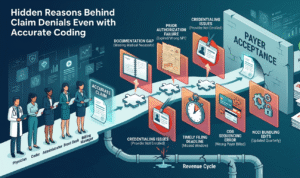
Psychiatry billing does not behave like general medical billing, and treating it that way is one of the fastest ways to lose revenue. Time based psychotherapy codes, medication management, telepsychiatry, and strict medical necessity documentation all combine to make behavioral health billing increasingly complex, one of the most demanding specialties to bill correctly.
Florida mental health practices face an extra layer of difficulty on top of that general complexity. Florida Medicaid applies its own specific behavioral health fee schedules and frequency limits, commercial payers in the state maintain their own telehealth and authorization rules, and Florida’s large, diverse patient population means practices deal with an especially wide mix of coverage types and payer policies.
Billing problems in this specialty hit harder than they might elsewhere. A single missed authorization or a mismatched time based code can delay a psychiatrist’s revenue, disrupt cash flow, and in some cases affect how quickly a patient can access ongoing care. The connection between coding accuracy, documentation, denials, and Accounts Receivable is tight in psychiatry, weakness in any one area quickly shows up as a problem in the others.
Identifying these problems early is always better than trying to recover lost revenue after the fact. This guide walks through the full picture: why psychiatry billing is uniquely complex, the most common problems Florida practices run into across the entire revenue cycle, and the practical steps to fix each one before it costs more money.
1. Why Psychiatry Billing Is More Complex Than It Looks
Behavioral health billing carries a set of characteristics that most general medical billing simply does not deal with:
- Frequent Evaluation and Management (E/M) services layered alongside psychiatric care
- Psychiatric diagnostic evaluations, which follow their own specific coding and documentation rules
- Psychotherapy services, billed based on time and service type
- Medication management, often documented and billed separately from therapy
- E/M plus psychotherapy combinations, which require careful documentation to justify billing both together
- Telepsychiatry, a major and growing share of behavioral health delivery
- Time-based coding, where the exact minutes of a session directly determine the correct code
- Complex documentation requirements tied to medical necessity and treatment planning
- Prior authorization, required by many payers for specific services or session limits
- Medical necessity standards that are often stricter and more subjective than in general medicine
- Payer-specific behavioral health policies that frequently differ from a payer’s general medical policy
- Multiple insurance types, from Medicare and Florida Medicaid to a wide range of commercial carriers
- High patient responsibility, since many behavioral health plans carry significant copays, deductibles, or session limits
A small coding or documentation mistake in this environment does not stay small. Confusing a 45 minute psychotherapy code with a 60 minute one, missing exact time documentation, or billing E/M and psychotherapy together without clear justification can delay or deny an entire claim, and these mistakes are common enough that they represent a real, ongoing revenue risk if left unaddressed.
2. The Most Common Psychiatry Billing Problems Florida Practices Should Fix
| Billing Problem | What It Causes | Recommended Fix |
| Eligibility errors | Denied claims | Verify coverage before every visit |
| Coding mistakes | Rejections and denials | Ongoing coding review |
| Documentation gaps | Medical necessity denials | Regular documentation audits |
| Authorization failures | Non-payment | Structured authorization tracking |
| Telehealth errors | Claim issues | Verify current payer rules |
| Denial backlog | Lost revenue | Dedicated denial workflow |
| Aging A/R | Cash flow problems | Consistent A/R follow up |
| Patient balance issues | Bad debt | Clearer, better patient collections |
| Credentialing problems | Enrollment delays | Proactive credentialing monitoring |
| Poor claim scrubbing | Preventable denials | Pre-submission checks on every claim |
3. Insurance Eligibility and Verification Errors
Eligibility problems are among the most preventable, and most common, sources of psychiatry claim denials. Inactive insurance, an incorrect member ID, or wrong patient demographics can all cause a claim to fail before it is ever clinically reviewed.
Coverage termination is a particular risk in behavioral health, since patients often change jobs or plans without notifying the practice. Behavioral health benefits frequently differ from a patient’s general medical benefits, meaning active medical coverage does not guarantee active behavioral health coverage. Deductibles, copayments, and coinsurance also need to be confirmed specifically for behavioral health services, since general benefit summaries do not always reflect them accurately.
Out-of-network restrictions, secondary insurance, and Coordination of Benefits (COB) issues add further complexity, particularly for patients seeing multiple providers across their care.
How to Fix It
- Verify eligibility before every appointment, not just at intake
- Confirm behavioral health benefits specifically, not just general medical coverage
- Check network status for the specific plan and provider
- Document verification results clearly for every visit
- Reverify whenever a patient reports a coverage change
Real time eligibility checks performed close to the date of service catch far more problems than verification done days or weeks in advance, a distinction covered in detail in Insurance Verification Mistakes That Cause Psychiatry Claim Denials.
4. Psychiatry CPT Coding Errors
CPT coding accuracy sits at the center of psychiatry billing, and it is one of the most common places practices lose revenue.
Psychiatric diagnostic evaluation codes, including CPT 90791 and CPT 90792, represent the initial evaluation of a patient and must be selected based on whether medical services were included.
Psychotherapy codes are billed based on the actual time spent in the session, with commonly used codes including 90832, 90834, and 90837, representing different session lengths. Selecting the wrong code relative to actual documented time is one of the single most common psychiatry billing errors.
E/M services, including codes in the 99202 through 99205 range for new patients and 99211 through 99215 for established patients, apply when medical evaluation and management is provided.
Psychotherapy plus E/M combinations are billed together in specific circumstances, when both services are separately identifiable and clearly documented. Modifier 25 may be appropriate when supported by the documentation, but its use has to reflect a genuinely distinct, significant service rather than routine overlap between the two.
Other common coding issues include incorrect code selection relative to the service actually provided, missing or inconsistent time documentation, incorrect service level selection, duplicate billing, incorrect modifiers, and payer specific coding requirements that differ from standard CPT guidance. Current CPT guidance, payer policy, and the underlying documentation always have to support whatever code is ultimately selected, and a detailed breakdown of the codes used most often in this specialty is available in What CPT Codes Are Commonly Used for Psychiatry Billing?
5. ICD-10-CM Coding Problems in Psychiatry
Diagnosis coding carries its own set of common problems in psychiatry, including unspecified diagnosis codes used when more specific documentation was actually available, incorrect diagnosis selection, and a mismatch between the diagnosis and the procedure billed.
Missing documentation, incorrect use of primary versus secondary diagnoses, and failure to update diagnoses as a patient’s clinical picture evolves are all recurring issues. Diagnosis coding needs to evolve alongside treatment, a diagnosis that was accurate at intake may no longer reflect the patient’s current clinical status months into treatment.
Common psychiatric diagnosis categories include anxiety disorders, depressive disorders, bipolar disorders, PTSD, ADHD, substance related disorders, and schizophrenia spectrum disorders, all defined under clinical standards maintained by organizations like the American Psychiatric Association. Diagnosis coding in every one of these categories has to reflect the provider’s actual documentation and current ICD-10-CM guidelines, rather than a default or habitual code choice.
6. Documentation Gaps That Cause Psychiatry Claims to Be Denied
Documentation is where most psychiatry denials genuinely originate, even when a denial shows up looking like a coding issue on the surface. Common gaps include a missing or incomplete assessment, an incomplete treatment plan, and insufficient medical necessity documentation.
Missing time documentation when a time based code was billed is a particularly common and consequential gap, since payers frequently deny time based psychotherapy claims outright when the note does not clearly state the session length. Poor medication management documentation, missing progress notes, inadequate psychotherapy documentation, and inconsistency between the diagnosis and the treatment documented all contribute further. Missing telehealth specific information, such as patient location or consent, is an increasingly common gap as telepsychiatry volume grows.
Psychiatry Documentation Checklist
- Patient information
- Date of service
- Chief complaint or reason for visit
- Relevant history
- Mental status examination, when clinically appropriate
- Assessment
- Diagnosis
- Treatment plan
- Medication management details
- Psychotherapy details
- Time documentation, where applicable
- Provider identification and signature
7. Prior Authorization Problems
Prior authorization is the process of obtaining payer approval before a service is delivered, and behavioral health services frequently require it, particularly beyond a certain number of sessions or for specific higher intensity services. Authorization requirements differ significantly between payers, and even within the same payer, requirements can vary by plan type.
Common authorization problems include authorizations that have expired before the service was delivered, incorrect authorization numbers on the claim, authorization obtained for the wrong service, and simply failing to obtain authorization before treatment begins.
Prevention Workflow
Verify → Request → Document → Track → Confirm → Bill
Building this sequence directly into scheduling, rather than treating authorization as a separate administrative task, is what actually prevents these failures from reaching the claim stage.
8. Telepsychiatry Billing Problems in Florida
Telehealth has become central to psychiatric care, and it deserves its own dedicated focus given how much billing risk it introduces.
Key considerations include telehealth eligibility for the specific service and payer, payer specific telehealth policies that can differ significantly from one carrier to the next, correct place of service coding, appropriate telehealth modifiers, and thorough provider documentation of the encounter.
Patient location requirements and provider location requirements both matter for compliance and reimbursement, and the distinction between audio-only and audio-video services can affect coverage depending on the payer and service type. Reimbursement rules for telepsychiatry also continue to differ by payer, requiring ongoing monitoring rather than a fixed, one time policy check.
Florida-Specific Considerations
Florida practices should check current requirements directly for Florida Medicaid, Medicare, and commercial payer policies, since telehealth regulations continue to evolve and a single universal rule does not apply across every payer or service type. Florida’s Medicaid behavioral health program in particular applies its own specific frequency limits and fee schedule details that differ from standard commercial telehealth policy.
9. Claim Rejections vs. Claim Denials in Psychiatry
These two terms are frequently confused, even though they represent very different points in the billing process.
Claim rejection usually occurs before adjudication, caused by an error such as missing information, an invalid identifier, a formatting issue, or a data mismatch. The claim never actually reaches full payer review.
Claim denial occurs after payer adjudication, when the payer has fully reviewed the claim and declined payment for reasons such as medical necessity, authorization, coding, coverage, or timely filing.
| Feature | Claim Rejection | Claim Denial |
| When it occurs | Before adjudication | After adjudication |
| Common causes | Missing data, formatting errors | Medical necessity, coding, authorization |
| Entered payer review | No | Yes |
| Fix path | Correct and resubmit | Correct and resubmit, or formally appeal |
Understanding which one you are dealing with determines the correct next step, and confusing the two often leads practices to waste time on the wrong fix, a distinction explored further in Denial Rate vs Rejection Rate: The Difference Every Practice Should Know.
10. Common Psychiatry Billing Denials
| Denial Category | Possible Cause | Prevention |
| Eligibility | Inactive coverage | Verify benefits before every visit |
| Authorization | Missing authorization | Track approvals through scheduling |
| Medical necessity | Insufficient documentation | Structured documentation review |
| Coding | Incorrect CPT or ICD-10-CM | Ongoing coding validation |
| Modifier | Incorrect modifier | Regular modifier review |
| Duplicate claim | Resubmission error | Careful claim status tracking |
| Timely filing | Late submission | Active submission monitoring |
| Non-covered service | Benefit limitation | Verify benefits specifically for behavioral health |
Medical necessity and authorization denials tend to carry the highest financial stakes in psychiatry, since they often apply to ongoing treatment rather than a single isolated visit, meaning the same root cause can repeat across several sessions before it is caught, a pattern examined closely in Why Mental Health Claims Get Rejected: 8 Fixes for Psychiatry Practices.
11. Claim Scrubbing for Psychiatry Practices
Claim scrubbing is the process of reviewing a claim for errors before it is submitted, catching problems while they are still easy and inexpensive to fix. For psychiatry specifically, this means checking time based coding, modifier use, and diagnosis specificity in addition to the standard checks every claim needs.
Psychiatry Claim Scrubbing Checklist
- Patient demographics
- Insurance information
- Provider information
- CPT code
- ICD-10-CM code
- Modifier
- Place of service
- Authorization status
- Diagnosis to procedure relationship
- Duplicate claim check
- Payer specific edits
A more detailed breakdown of how claim scrubbing fits into the broader billing workflow, and why it matters as much as it does, is covered in How Do RCM Companies Handle Denied Claims?
12. Credentialing and Enrollment Problems
Credentialing issues can prevent an otherwise perfectly clean claim from being paid at all, which makes them one of the more frustrating problems in psychiatry billing since the issue has nothing to do with coding or documentation quality.
Common problems include expired credentials, incorrect provider information on file with a payer, delays in payer enrollment, NPI issues, incorrect taxonomy information, confusion between group and individual enrollment, missed recredentialing deadlines, and outdated CAQH profile information.
Florida practices in particular need proactive credentialing management given the state’s Medicaid enrollment requirements, an area covered in detail in Medical Credentialing Services in Fort Lauderdale, Florida.
13. Contracting and Underpayment Problems
Not every revenue problem shows up as a denial. Incorrect contracted rates, outright underpayments, incorrect fee schedules applied by a payer, unclear contractual adjustments, and payer processing errors can all quietly reduce revenue on claims that technically get paid.
How to Fix It
- Compare actual payments against contracted rates regularly
- Conduct periodic payment audits rather than assuming payments are correct
- Track payer reimbursement trends over time to catch drift early
- Appeal incorrect payments rather than accepting them as final
These underpayments are often harder to catch than denials precisely because the claim appears to have been paid, a pattern explored in Why Do I Keep Getting Underpaid by Insurance?
14. Psychiatry A/R Problems
Aging Accounts Receivable is one of the clearest signs of underlying billing problems, and psychiatry practices need to watch this closely given how easily authorization and time based coding issues can stall a claim.
| Aging | Risk Level |
| 0 to 30 days | Normal |
| 31 to 60 days | Monitor closely |
| 61 to 90 days | High priority |
| 91 to 120 days | Critical |
| 120+ days | Recovery priority |
Unworked claims, unresolved denials, missing appeals, and growing patient balances all contribute to A/R aging past a healthy range. Florida practices dealing with First Coast Medicare or Florida Medicaid specific denial patterns often benefit from dedicated A/R support built around the state’s specific payer landscape.
15. Patient Collection Challenges in Psychiatry
Psychiatry practices have to balance revenue collection with patient experience more carefully than many other specialties, given the sensitivity of behavioral health care and the financial pressure many patients already face.
Key considerations include copays, deductibles, coinsurance, clear patient statements, structured payment plans, proactive financial communication, and genuinely transparent billing. Aggressive collection practices in particular risk damaging the therapeutic relationship in ways that other specialties do not have to worry about as directly.
Practical, respectful approaches to this balance are covered in detail in Patient Collections Without Hurting Patient Experience.
16. Poor Denial Management
Practices consistently struggle with denials when there is no clear categorization system, no assigned denial owner, appeals get submitted late, root causes are never actually analyzed, and the same coding or documentation errors repeat month after month without correction.
Denial Management Workflow
Identify → Categorize → Analyze → Correct → Appeal → Track → Prevent
The final step, prevent, is the one most practices skip, correcting an individual denied claim without fixing the underlying process just guarantees the same denial will happen again next month.
17. Failure to Monitor Payer Policy Changes
Billing knowledge in psychiatry has a short shelf life. CPT updates, ICD-10-CM updates, telehealth policy changes, authorization requirement changes, documentation expectation shifts, payer specific billing policy revisions, Medicare policy updates, and Florida Medicaid policy changes all happen on an ongoing basis.
Practices need an actual process for monitoring these updates rather than relying on billing knowledge that may already be a year or more out of date. What was true about a payer’s telehealth policy last year is not a safe assumption to carry into this year’s claims.
18. Compliance Risks in Psychiatry Billing
Billing accuracy is not just a revenue strategy, it is a genuine compliance requirement, and psychiatry carries specific compliance risks worth naming directly.
These include upcoding, unbundling services that should be billed together, using modifiers that are not actually supported by documentation, billing services the documentation does not support, duplicate billing, incorrect time reporting on time based codes, and improper or incomplete medical necessity documentation. Each of these carries genuine fraud and abuse risk, not just a denial risk, particularly when a pattern develops across multiple claims rather than appearing as an isolated mistake.
19. Technology Problems That Hurt Psychiatry Billing
Several recurring technology gaps make psychiatry billing harder than it needs to be: poor EHR configuration that does not prompt for the documentation coders actually need, a lack of claim scrubbing tools, manual authorization tracking prone to missed deadlines, no denial analytics to spot patterns, poor reporting overall, no automated eligibility verification, and billing systems that are not properly connected to the practice’s clinical workflow.
20. How Technology Can Improve Psychiatry Revenue Cycle Management
- EHR integration that connects clinical documentation directly to billing, maintained under HIPAA privacy and security standards
- Practice management software that centralizes scheduling, eligibility, and claims
- Automated eligibility verification run close to the date of service
- Claim scrubbing that catches psychiatry specific errors before submission
- AI-assisted coding that helps flag time documentation and modifier issues
- Denial analytics that surface recurring patterns across payers and services
- A/R dashboards that give real time visibility into aging claims
- Electronic Prior Authorization (ePA) that speeds up approval turnaround
- Automated patient statements that improve collection consistency
21. Key Psychiatry Billing KPIs Florida Practices Should Monitor
| KPI | What It Tells You |
| Clean Claim Rate | Overall claim submission quality |
| First-Pass Acceptance Rate | Billing accuracy at initial submission |
| Denial Rate | Revenue leakage tied to payer decisions |
| Rejection Rate | Front-end claim error rate |
| Days in A/R | How quickly claims convert to payment |
| 90+ Day A/R | Aging risk requiring active attention |
| 120+ Day A/R | Serious revenue recovery risk |
| Net Collection Rate | Overall revenue performance |
| Appeal Success Rate | Effectiveness of denial recovery efforts |
| Coding Accuracy Rate | Quality of CPT and ICD-10-CM coding |
| Authorization Approval Rate | Effectiveness of the authorization process |
Tracking these consistently, rather than only reviewing them when a problem becomes obvious, is what separates practices that catch billing issues early from practices that discover them months later in a shrinking bank balance.
22. How to Conduct a Psychiatry Billing Audit
A thorough psychiatry billing audit should review patient registration accuracy, eligibility verification consistency, authorization tracking, documentation quality, CPT coding accuracy, ICD-10-CM coding accuracy, modifier usage, claim submission timeliness, denial patterns, A/R aging, payment accuracy, contractual adjustments, patient balance management, and credentialing status. Reviewing each of these areas individually, rather than only looking at overall collections, is what actually reveals where a practice’s revenue cycle is breaking down. A structured framework for running this kind of review consistently is covered in Medical Billing Audit Services.
23. A 30-Day Plan to Fix Psychiatry Billing Problems
Week 1: Identify Problems Run a full A/R aging report, analyze recent denials by category, review rejected claims, identify top payers by volume and by denial rate, and flag high value outstanding claims.
Week 2: Fix Coding and Documentation Audit CPT code usage against actual documented time, review ICD-10-CM coding for specificity, review modifier usage, and audit documentation quality across providers.
Week 3: Fix Revenue Cycle Processes Improve eligibility verification timing and consistency, strengthen authorization tracking, implement or improve claim scrubbing, and establish a formal denial management workflow.
Week 4: Monitor and Improve Establish clear KPI tracking, assign ownership for each stage of the revenue cycle, review payer specific trends, and build consistent monthly reporting going forward.
24. When Should a Florida Psychiatry Practice Outsource Billing?
Several warning signs suggest it is time to consider outsourcing: an increasing denial rate, growing overall A/R, a rising number of claims aged past 120 days, frequent coding errors, missed authorizations, credentialing delays, billing staff who are consistently overwhelmed, poor or inconsistent reporting, slow reimbursements compared to prior periods, and declining revenue despite stable patient volume.
Any one of these on its own might be manageable. Several appearing together usually signal that the practice’s internal billing capacity has been outgrown by its clinical volume, a pattern many Florida practices don’t notice until it’s already holding them back.
25. How Professional Psychiatry Billing Services Help Fix These Problems
Specialized psychiatry billing support addresses this entire chain of problems directly, including insurance eligibility verification, prior authorization management, psychiatry specific CPT coding, ICD-10-CM coding, modifier validation, documentation review, claim scrubbing, denial management, appeals, payment posting, A/R follow up, underpayment recovery, patient billing support, credentialing assistance, and consistent KPI reporting, the kind of dedicated specialist support built to get Florida practices paid faster.
26. Why Choose The Medicator’s for Psychiatry Billing in Florida?
Florida psychiatry practices need a billing partner who genuinely understands both behavioral health’s coding complexity and Florida’s specific payer landscape. The Medicator’s psychiatry billing services bring:
- Psychiatry focused billing expertise across evaluation, therapy, and medication management coding
- Deep familiarity with Florida Medicaid, Medicare, and commercial payer requirements
- Accurate CPT and ICD-10-CM coding built around behavioral health specific rules
- Thorough claim scrubbing before every submission
- Proactive denial prevention rather than reactive correction
- Dedicated A/R recovery focused on aging and high risk claims
- Structured prior authorization support
- Credentialing and recredentialing assistance
- Accurate payment posting
- Detailed, transparent reporting
- Dedicated, responsive billing support
- Ongoing Revenue Cycle Management optimization
If your Florida practice is dealing with rising denials, slow reimbursements, or a billing team stretched too thin, request a free psychiatry billing assessment from The Medicator’s to see exactly where revenue is being lost.
Conclusion
Psychiatry billing problems rarely come from a single issue. They usually result from small weaknesses spread across the entire revenue cycle, an eligibility check skipped here, a documentation gap there, a missed authorization somewhere else, all compounding into a real financial impact over time.
Florida practices should focus attention on eligibility, authorization, documentation, coding, claim quality, denial management, A/R, and patient collections as a connected system rather than isolated problems. Regular audits and consistent KPI monitoring can identify revenue leakage well before it becomes a major financial problem.
For practices lacking the internal billing resources to manage this level of complexity consistently, a specialized psychiatry billing partner can manage the administrative workload and meaningfully improve reimbursement performance. If your Florida practice is ready to find out exactly where revenue is slipping through the cracks, contact The Medicator’s psychiatry billing team for a detailed billing evaluation.
Frequently Asked Questions
Why are psychiatry claims denied?
Psychiatry claims are commonly denied due to missing prior authorization, insufficient medical necessity documentation, incorrect time based coding, eligibility issues, and diagnosis to procedure mismatches.
What are the most common psychiatry billing errors?
Common errors include selecting the wrong psychotherapy code relative to actual session time, missing time documentation, incorrect modifier use, unspecified diagnosis codes, and authorization failures.
What CPT codes are commonly used in psychiatry billing?
Commonly used codes include 90791 and 90792 for diagnostic evaluations, 90832, 90834, and 90837 for psychotherapy, and standard E/M codes such as 99202 through 99215 when medical evaluation and management is provided.
What causes psychiatry claims to be rejected?
Rejections typically happen before payer review due to missing information, invalid identifiers, formatting errors, or data mismatches, distinct from denials which occur after a full payer review.
Do psychiatric services require prior authorization?
Many behavioral health services do require prior authorization, particularly beyond a certain session count or for higher intensity services, though specific requirements vary by payer and should be verified directly.
How does telepsychiatry billing work?
Telepsychiatry billing requires correct place of service coding, appropriate telehealth modifiers, confirmation of payer specific telehealth coverage, and documentation that meets both clinical and telehealth specific requirements.
What documentation is required for psychiatry billing?
Required documentation typically includes the chief complaint, relevant history, assessment, diagnosis, treatment plan, medication management or psychotherapy details, time documentation when applicable, and provider signature.
How can psychiatrists reduce claim denials?
Reducing denials requires consistent eligibility verification, proactive authorization tracking, accurate time based coding, thorough documentation, and systematic claim scrubbing before every submission.
What is the difference between psychiatric diagnostic evaluation and psychotherapy billing?
A psychiatric diagnostic evaluation, billed under codes like 90791 or 90792, represents an initial assessment, while psychotherapy codes are billed based on the actual time spent in ongoing treatment sessions.
How does modifier 25 affect psychiatry billing?
Modifier 25 may be appropriate when a significant, separately identifiable E/M service is provided alongside psychotherapy on the same day, but its use must be clearly supported by documentation of two genuinely distinct services.
What should a psychiatry practice monitor in its A/R?
Practices should monitor A/R by aging bucket, with particular attention to claims aged past 90 and 120 days, since these carry significantly higher risk of becoming uncollectible.
How can psychiatry practices reduce A/R days?
Practices can reduce A/R days through consistent claim follow up, structured denial management, faster initial claim submission, and dedicated staff ownership of aging claims.
What causes medical necessity denials in psychiatry?
Medical necessity denials typically result from documentation that does not clearly justify the level or type of service billed, often tied to an incomplete assessment or treatment plan.
How often should psychiatry billing be audited?
Regular audits, ideally quarterly, help catch coding drift, documentation gaps, and denial patterns before they compound into larger revenue problems.
Should a psychiatry practice outsource medical billing?
Many practices benefit from outsourcing when internal staff cannot keep pace with the specialty’s coding complexity, authorization requirements, and denial follow up demands.
What should Florida psychiatry practices know about Medicaid billing?
Florida Medicaid applies its own specific behavioral health fee schedule, session frequency limits, and documentation requirements that differ from standard commercial payer policy, requiring dedicated attention.
How can billing companies improve psychiatry reimbursements?
Specialized billing partners bring psychiatry specific coding expertise, proactive authorization management, and structured denial workflows that most internal teams do not have the bandwidth to build and maintain consistently.
How do credentialing problems affect psychiatry billing?
Credentialing issues can prevent an otherwise accurate, clean claim from being paid at all, since payers will not reimburse a provider who is not properly enrolled or credentialed on the specific plan billed.
What KPIs should psychiatry practices track?
Clean claim rate, denial rate, rejection rate, days in A/R, net collection rate, appeal success rate, and coding accuracy rate are the core KPIs psychiatry practices should track consistently.
How can The Medicator’s help Florida psychiatry practices?
The Medicator’s combines psychiatry specific coding and documentation expertise with deep familiarity with Florida Medicaid, Medicare, and commercial payer requirements, backed by transparent reporting and dedicated support.