In healthcare administration, cash flow is the lifeblood of operational sustainability. For independent medical clinics, efficient accounts receivable recovery in medical billing is not merely a back-office task; it is a critical financial strategy.
Accounts Receivable (AR) represents the realized revenue trapped in outstanding claims owed by insurance payers and patients. When AR stalls, small practices face immediate operational friction, from strained payrolls to restricted practice growth.
Fortunately, accelerating your healthcare revenue cycle management (RCM) does not require an overhaul of your existing infrastructure. By implementing targeted, high-impact workflows, your billing team can systematically capture outstanding revenue and dramatically reduce outstanding collection cycles.
Understanding AR in Medical Billing
In medical billing, AR quantifies the outstanding balances for healthcare services rendered. The moment a clinical encounter concludes and a claim is generated, the financial balance enters the aging cycle.
Optimizing your AR recovery lifecycle yields direct operational advantages:
- Accelerated Cash Flow: Converts outstanding claims into working capital faster.
- Minimized Write-offs: Prevents old claims from reaching timely filing deadlines.
- Reduced Administrative Burden: Minimizes time spent resubmitting and appealing denied claims.
- Enhanced Resource Allocation: Frees your staff to focus on patient care rather than chasing insurance companies.
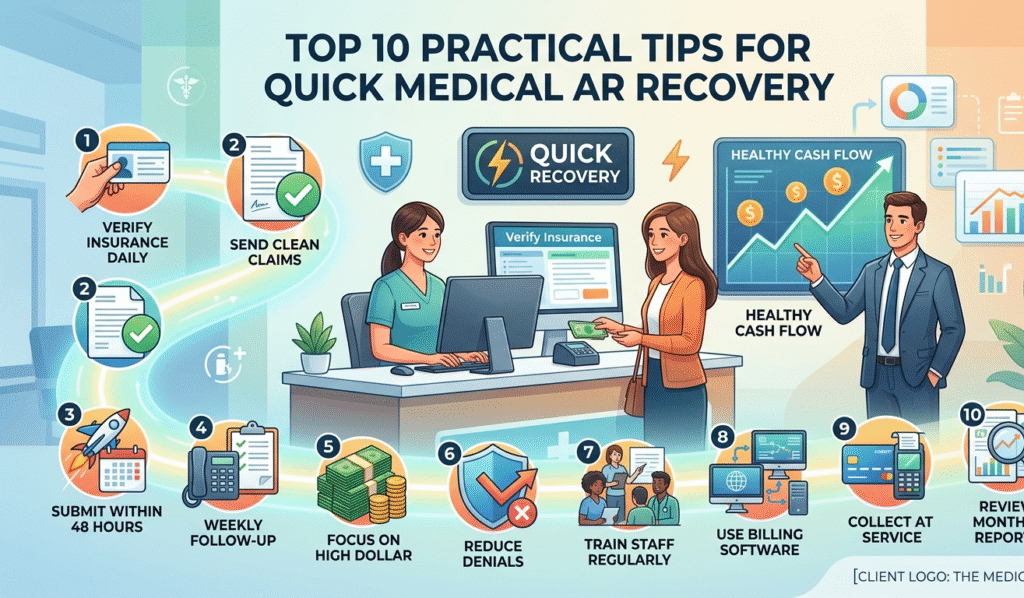
10 Strategic Tips for Rapid AR Recovery
1. Execute Real-Time Insurance Verification
Eligibility errors are a leading cause of preventable claim rejections. Front-desk workflows must require insurance verification before every single patient encounter, rather than relying on historical data.
- Key Verification Checkpoints: Confirm active coverage status, exact co-pay responsibilities, remaining deductible balances, and specific prior authorization requirements.
- Financial Impact: Eliminates front-end eligibility denials and secures accurate point-of-service collections.
2. Prioritize Clean Claim Submission Rates
A “clean claim” passes through payer clearinghouses without errors on the first submission.
- Actionable Step: Train billing personnel to conduct rigorous pre-submission audits. Ensure absolute accuracy across patient demographics, ICD-10/CPT code combinations, provider NPI numbers, and necessary modifiers.
- Financial Impact: Maximizes first-pass acceptance rates, reducing the costly administrative loop of clearinghouse rejections.
3. Implement a Strict 48-Hour Submission Window
Delaying claim creation directly inflates your overall aging metrics. Establish a strict operational protocol requiring all medical claims to be scrubbed and submitted within 24 to 48 hours of the patient encounter.
- Actionable Step: Hold clinical staff accountable for completing documentation and closing charts within 24 hours of a visit so billing teams can act instantly.
- Financial Impact: Shortens the path to reimbursement and ensures your practice never misses strict payer timely filing deadlines.
4. Transition to a Weekly AR Follow-Up Schedule
Unpaid claims rarely resolve themselves. Leaving aging accounts unmonitored for 60 or 90 days significantly reduces the likelihood of full recovery.
- Actionable Step: Dedicate specific, uninterrupted hours each week for billing teams to audit pending, underpaid, or unanswered claims. Move directly to formal appeals the moment a discrepancy is found.
5. Deploy the High-Dollar Priority Strategy
When working through a backlog of aging accounts, sorting by date alone is inefficient. Implement a high-dollar priority protocol to maximize immediate capital recovery.
By resolving a single $5,000 claim instead of ten $100 claims, your staff recovers five times the revenue in a fraction of the time.
Managing Your Revenue Pipeline: The AR Aging Framework
To systematically clear outstanding balances, small practices must categorize accounts using a structured aging matrix. This framework allows managers to allocate staff hours based on the risk profile of the aging debt.
| AR Age Range | Risk Category | Operational Action Required |
| 0–30 Days | Low Risk | Monitor electronic remittance advices (ERAs) and track initial clearinghouse acceptances. |
| 31–60 Days | Moderate Risk | Initiate proactive payer follow-up; identify and resolve missing documentation. |
| 61–90 Days | High Risk | Contact payer representatives directly to address unresolved processing delays. |
| 91–120 Days | Critical Risk | Escalate to formal appeals; check for timely filing limit exceptions. |
| Over 120 Days | Severe Loss Risk | Immediate manager intervention; evaluate for final patient collection actions or write-offs. |
6. Analyze and Mitigate Payer Denial Root Causes
Consistently tracking denial patterns is the only way to stop systemic revenue leaks.
- Actionable Step: Categorize monthly denials into distinct buckets (e.g., coding errors, missing authorizations, non-covered services). Fix the root administrative issues causing these errors to prevent them from recurring.
- Financial Impact: Permanently lowers your denial rate and reduces repetitive administrative re-work.
7. Mandate Continuous Billing and Coding Education
Payer policies, compliance regulations, and code sets change constantly. Outdated billing knowledge directly leads to increased rejection rates.
- Actionable Step: Provide structured, regular training sessions covering annual ICD-10 and CPT updates, changing modifier rules, and evolving commercial insurance policies.
8. Leverage Revenue Cycle Automation Tools
Manual data entry and tracking slow down operational speed. Modern cloud-based billing software streamlines workflows through automated technical features.
- Actionable Step: Utilize software integrations for batch eligibility checks, automated payment posting via ERAs, and automated alerts for expiring authorization windows.
9. Optimize Point-of-Service Patient Collections
With the rise of high-deductible health plans (HDHPs), patient out-of-pocket responsibilities represent a larger share of practice revenue than ever before. Collect copays and outstanding balances at check-in to avoid the high cost of mailing patient statements.
- Actionable Step: Offer patient-centric payment options, including secure online payment portals, stored card-on-file options, and structured, clear installment agreements for larger balances.
10. Audit Monthly Financial Performance Metrics
You cannot optimize what you do not measure. Practice managers should evaluate core financial reports at the close of every month.
- Actionable Step: Review your comprehensive aging reports, gross collection ratios, and net collection rates to benchmark your practice against standard healthcare industry key performance indicators (KPIs).
Critical AR Metrics and Benchmarks
To evaluate the health of your financial pipeline, monitor your data against these industry-standard healthcare revenue benchmarks:
| Metric | Industry Standard Goal | Formula / Method |
| Days in AR | Under 40 Days | $\frac{\text{Total Accounts Receivable}}{\text{Average Daily Gross Revenue}}$ |
| First-Pass Clean Claim Rate | Above 95% | $\frac{\text{Claims Accepted on First Submission}}{\text{Total Claims Submitted}}$ |
| Claim Denial Rate | Below 5% | $\frac{\text{Total Denied Claims}}{\text{Total Claims Submitted}}$ |
| Net Collection Rate | Above 95% | $\frac{\text{Total Payments Received}}{\text{Total Allowable Charges}}$ |
Common Accounts Receivable Pitfalls to Avoid
Independent clinics frequently experience revenue loss due to easily avoided operational mistakes. Protect your bottom line by eliminating these vulnerabilities:
- Neglecting Aging Claim Portfolios: Allowing old claims to remain uninvestigated is equivalent to abandoning earned revenue. Prioritize regular clean-up of older buckets.
- Insufficient Clinical Documentation: Vague or incomplete provider chart notes lead to medical necessity denials. Providers must document diagnoses and treatment plans with high specificity.
- Siloed Internal Communication: If the front-desk registration team and the back-office billing team operate in isolation, registration errors will continue to disrupt the billing cycle. Foster open, regular communication between teams.
Streamlining Your Revenue Cycle with The Medicators
Managing the complexities of healthcare billing while maintaining exceptional patient care can easily overwhelm small administrative teams. If your practice struggles with a growing backlog of old accounts or rising insurance denials, partner with an industry leader.
At The Medicators, we offer specialized end-to-end healthcare revenue cycle management (RCM) services tailored to help small and mid-sized practices optimize operations. Our experienced billing experts systematically target your outstanding aging buckets, dramatically reduce payer denials, and accelerate your overall cash flow.
By leveraging advanced, secure technology workflows alongside deep industry knowledge, we integrate smoothly with your existing electronic health record (EHR) and practice management software. We help your practice reduce overhead costs, increase clean claim rates, and capture every dollar you are legally owed.
Frequently Asked Questions
What is the ideal target for Days in AR for a small medical practice?
Medical group management standards suggest keeping the total Days in AR under 40 days. A metric below 35 days indicates an incredibly healthy, highly optimized billing department.
Why do accounts receivable recovery efforts frequently stall?
The most common causes of stalled collections include unaddressed initial claim denials, failure to track timely filing deadlines, inaccurate front-end patient insurance eligibility checking, and a lack of dedicated staff for consistent payer follow-up.
How can a practice lower its overall claim denial rate?
The most effective methods include automating your patient eligibility verification process, utilizing advanced pre-submission claim scrubbing software, and holding regular training sessions for coding and documentation teams.
How frequently should small practices generate and review AR aging reports?
While high-level macro performance reports should be audited monthly, aging claim workflows and worklists should be pulled and acted upon weekly to ensure timely recovery.